Hit Points
Vaardigheden
Wizard
| Niveau | Proficiency Bonus | Eigenschappen | Cantrips Known |
|---|---|---|---|
| 1 | + 2 | Arcane Recovery Spellcasting | 3 |
| 2 | + 2 | Arcane Recovery Spellcasting | 3 |
| 3 | + 2 | Arcane Recovery Spellcasting | 3 |
| 4 | + 2 | Arcane Recovery Spellcasting | 4 |
| 5 | + 3 | Arcane Recovery Spellcasting | 4 |
| 6 | + 3 | Arcane Recovery Spellcasting | 4 |
| 7 | + 3 | Arcane Recovery Spellcasting | 4 |
| 8 | + 3 | Arcane Recovery Spellcasting | 4 |
| 9 | + 4 | Arcane Recovery Spellcasting | 4 |
| 10 | + 4 | Arcane Recovery Spellcasting | 5 |
| 11 | + 4 | Arcane Recovery Spellcasting | 5 |
| 12 | + 4 | Arcane Recovery Spellcasting | 5 |
| 13 | + 5 | Arcane Recovery Spellcasting | 5 |
| 14 | + 5 | Arcane Recovery Spellcasting | 5 |
| 15 | + 5 | Arcane Recovery Spellcasting | 5 |
| 16 | + 5 | Arcane Recovery Spellcasting | 5 |
| 17 | + 6 | Arcane Recovery Spellcasting | 5 |
| 18 | + 6 | Arcane Recovery Spellcasting | 5 |
| 19 | + 6 | Arcane Recovery Spellcasting | 5 |
| 20 | + 6 | Arcane Recovery Spellcasting | 5 |
Spell Slots per Spell Level
| Niveau | Proficiency Bonus | Eigenschappen | 1st | 2nd | 3rd | 4th | 5th | 6th | 7th | 8th | 9th |
|---|---|---|---|---|---|---|---|---|---|---|---|
| 1 | + 2 | Arcane Recovery Spellcasting | 2 | 0 | 0 | 0 | 0 | 0 | 0 | 0 | 0 |
| 2 | + 2 | Arcane Recovery Spellcasting | 3 | 0 | 0 | 0 | 0 | 0 | 0 | 0 | 0 |
| 3 | + 2 | Arcane Recovery Spellcasting | 4 | 2 | 0 | 0 | 0 | 0 | 0 | 0 | 0 |
| 4 | + 2 | Arcane Recovery Spellcasting | 4 | 3 | 0 | 0 | 0 | 0 | 0 | 0 | 0 |
| 5 | + 3 | Arcane Recovery Spellcasting | 4 | 3 | 2 | 0 | 0 | 0 | 0 | 0 | 0 |
| 6 | + 3 | Arcane Recovery Spellcasting | 4 | 3 | 3 | 0 | 0 | 0 | 0 | 0 | 0 |
| 7 | + 3 | Arcane Recovery Spellcasting | 4 | 3 | 3 | 1 | 0 | 0 | 0 | 0 | 0 |
| 8 | + 3 | Arcane Recovery Spellcasting | 4 | 3 | 3 | 2 | 0 | 0 | 0 | 0 | 0 |
| 9 | + 4 | Arcane Recovery Spellcasting | 4 | 3 | 3 | 3 | 1 | 0 | 0 | 0 | 0 |
| 10 | + 4 | Arcane Recovery Spellcasting | 4 | 3 | 3 | 3 | 2 | 0 | 0 | 0 | 0 |
| 11 | + 4 | Arcane Recovery Spellcasting | 4 | 3 | 3 | 3 | 2 | 1 | 0 | 0 | 0 |
| 12 | + 4 | Arcane Recovery Spellcasting | 4 | 3 | 3 | 3 | 2 | 1 | 0 | 0 | 0 |
| 13 | + 5 | Arcane Recovery Spellcasting | 4 | 3 | 3 | 3 | 2 | 1 | 1 | 0 | 0 |
| 14 | + 5 | Arcane Recovery Spellcasting | 4 | 3 | 3 | 3 | 2 | 1 | 1 | 0 | 0 |
| 15 | + 5 | Arcane Recovery Spellcasting | 4 | 3 | 3 | 3 | 2 | 1 | 1 | 1 | 0 |
| 16 | + 5 | Arcane Recovery Spellcasting | 4 | 3 | 3 | 3 | 2 | 1 | 1 | 1 | 0 |
| 17 | + 6 | Arcane Recovery Spellcasting | 4 | 3 | 3 | 3 | 2 | 1 | 1 | 1 | 1 |
| 18 | + 6 | Arcane Recovery Spellcasting | 4 | 3 | 3 | 3 | 3 | 1 | 1 | 1 | 1 |
| 19 | + 6 | Arcane Recovery Spellcasting | 4 | 3 | 3 | 3 | 3 | 2 | 1 | 1 | 1 |
| 20 | + 6 | Arcane Recovery Spellcasting | 4 | 3 | 3 | 3 | 3 | 2 | 2 | 1 | 1 |
Klasse-eigenschappen
Niveau 1
Niveau 10
Niveau 12
Niveau 14
Niveau 16
Niveau 18
Niveau 19
Niveau 2
Niveau 20
Niveau 3
Niveau 4
Niveau 6
Niveau 8
Caster-voortgang
Cantrip-voortgang
| Niveau | 1 | 2 | 3 | 4 | 5 | 6 | 7 | 8 | 9 | 10 | 11 | 12 | 13 | 14 | 15 | 16 | 17 | 18 | 19 | 20 |
|---|---|---|---|---|---|---|---|---|---|---|---|---|---|---|---|---|---|---|---|---|
| Cantrips Bekend | 3 | 3 | 3 | 4 | 4 | 4 | 4 | 4 | 4 | 5 | 5 | 5 | 5 | 5 | 5 | 5 | 5 | 5 | 5 | 5 |
Startuitrusting
Klasse-eigenschappen
Arcane Recovery (Level 1)
You have learned to regain some of your magical energy by studying your spellbook. Once per day when you finish a short rest, you can choose expended spell slots to recover. The spell slots can have a combined level that is equal to or less than half your wizard level (rounded up), and none of the slots can be 6th level or higher.
For example, if you're a 4th-level wizard, you can recover up to two levels worth of spell slots. You can recover either a 2nd-level spell slot or two 1st-level spell slots.
Spellcasting (Level 1)
As a student of arcane magic, you have a spellbook containing spells that show the first glimmerings of your true power. See chapter 10 for the general rules of spellcasting and chapter 11 for the wizard spell list.
Cantrips
At 1st level, you know three cantrips of your choice from the wizard spell list. You learn additional wizard cantrips of your choice at higher levels, as shown in the Cantrips Known column of the Wizard table.
Spellbook
At 1st level, you have a spellbook containing six 1st-level wizard spells of your choice. Your spellbook is the repository of the wizard spells you know, except your cantrips, which are fixed in your mind.
Preparing and Casting Spells
The Wizard table shows how many spell slots you have to cast your wizard spells of 1st level and higher. To cast one of these spells, you must expend a slot of the spell's level or higher. You regain all expended spell slots when you finish a long rest.
You prepare the list of wizard spells that are available for you to cast. To do so, choose a number of wizard spells from your spellbook equal to your Intelligence modifier + your wizard level (minimum of one spell). The spells must be of a level for which you have spell slots.
For example, if you're a 3rd-level wizard, you have four 1st-level and two 2nd-level spell slots. With an Intelligence of 16, your list of prepared spells can include six spells of 1st or 2nd level, in any combination, chosen from your spellbook. If you prepare the 1st-level spell magic missile, you can cast it using a 1st-level or a 2nd-level slot. Casting the spell doesn't remove it from your list of prepared spells.
You can change your list of prepared spells when you finish a long rest. Preparing a new list of wizard spells requires time spent studying your spellbook and memorizing the incantations and gestures you must make to cast the spell: at least 1 minute per spell level for each spell on your list.
Spellcasting Ability
Intelligence is your spellcasting ability for your wizard spells, since you learn your wizard spells through dedicated study and memorization. You use your Intelligence whenever a spell refers to your spellcasting ability. In addition, you use your Intelligence modifier when setting the saving throw DC for a wizard spell you cast and when making an attack roll with one.
Spell
Spell
Ritual Casting
You can cast a wizard spell as a ritual if that spell has the ritual tag and you have the spell in your spellbook. You don't need to have the spell prepared.
Spellcasting Focus
You can use an arcane focus as a spellcasting focus for your wizard spells.
Learning Spells of 1st Level and Higher
Each time you gain a wizard level, you can add two wizard spells of your choice to your spellbook. Each of these spells must be of a level for which you have spell slots, as shown on the Wizard table. On your adventures, you might find other spells that you can add to your spellbook (see "Your Spellbook").
Your Spellbook
The spells that you add to your spellbook as you gain levels reflect the arcane research you conduct on your own, as well as intellectual breakthroughs you have had about the nature of the multiverse. You might find other spells during your adventures. You could discover a spell recorded on a scroll in an evil wizard's chest, for example, or in a dusty tome in an ancient library.
A spellbook doesn't contain cantrips.
Copying a Spell into the Book
When you find a wizard spell of 1st level or higher, you can add it to your spellbook if it is of a spell level you can prepare and if you can spare the time to decipher and copy it.
Copying a spell into your spellbook involves reproducing the basic form of the spell, then deciphering the unique system of notation used by the wizard who wrote it. You must practice the spell until you understand the sounds or gestures required, then transcribe it into your spellbook using your own notation.
For each level of the spell, the process takes 2 hours and costs 50 gp. The cost represents material components you expend as you experiment with the spell to master it, as well as the fine inks you need to record it. Once you have spent this time and money, you can prepare the spell just like your other spells.
Copying from a Spell Scroll
A wizard spell on a spell scroll can be copied just as spells in spellbooks can be copied. When you copy a spell from a spell scroll, you must succeed on an Intelligence (Arcana) check with a DC equal to 10 + the spell's level. If the check succeeds, the spell is successfully copied. Whether the check succeeds or fails, the spell scroll is destroyed.
Replacing the Book
You can copy a spell from your own spellbook into another book—for example, if you want to make a backup copy of your spellbook. This is just like copying a new spell into your spellbook, but faster and easier, since you understand your own notation and already know how to cast the spell. You need spend only 1 hour and 10 gp for each level of the copied spell.
If you lose your spellbook, you can use the same procedure to transcribe the spells that you have prepared into a new spellbook. Filling out the remainder of your spellbook requires you to find new spells to do so, as normal. For this reason, many wizards keep backup spellbooks in a safe place.
The Book's Appearance
Your spellbook is a unique compilation of spells, with its own decorative flourishes and margin notes. It might be a plain, functional leather volume that you received as a gift from your master, a finely bound gilt-edged tome you found in an ancient library, or even a loose collection of notes scrounged together after you lost your previous spellbook in a mishap.
Arcane Tradition (Level 2)
When you reach 2nd level, you choose an arcane tradition from the list of available traditions, shaping your practice of magic. Your choice grants you features at 2nd level and again at 6th, 10th, and 14th level.
Cantrip Formulas (Level 3)
3rd-level wizard optional feature
You have scribed a set of arcane formulas in your spellbook that you can use to formulate a cantrip in your mind. Whenever you finish a long rest and consult those formulas in your spellbook, you can replace one wizard cantrip you know with another cantrip from the wizard spell list.
Ability Score Improvement (Level 4)
When you reach 4th level, you can increase one ability score of your choice by 2, or you can increase two ability scores of your choice by 1. As normal, you can't increase an ability score above 20 using this feature.
If your DM allows the use of feats, you may instead take a feat.
Arcane Tradition feature (Level 6)
At 6th level, you gain a feature granted by your Arcane Tradition.
Ability Score Improvement (Level 8)
When you reach 8th level, you can increase one ability score of your choice by 2, or you can increase two ability scores of your choice by 1. As normal, you can't increase an ability score above 20 using this feature.
If your DM allows the use of feats, you may instead take a feat.
Arcane Tradition feature (Level 10)
At 10th level, you gain a feature granted by your Arcane Tradition.
Ability Score Improvement (Level 12)
When you reach 12th level, you can increase one ability score of your choice by 2, or you can increase two ability scores of your choice by 1. As normal, you can't increase an ability score above 20 using this feature.
If your DM allows the use of feats, you may instead take a feat.
Arcane Tradition feature (Level 14)
At 14th level, you gain a feature granted by your Arcane Tradition.
Ability Score Improvement (Level 16)
When you reach 16th level, you can increase one ability score of your choice by 2, or you can increase two ability scores of your choice by 1. As normal, you can't increase an ability score above 20 using this feature.
If your DM allows the use of feats, you may instead take a feat.
Spell Mastery (Level 18)
At 18th level, you have achieved such mastery over certain spells that you can cast them at will. Choose a 1st-level wizard spell and a 2nd-level wizard spell that are in your spellbook. You can cast those spells at their lowest level without expending a spell slot when you have them prepared. If you want to cast either spell at a higher level, you must expend a spell slot as normal.
By spending 8 hours in study, you can exchange one or both of the spells you chose for different spells of the same levels.
Ability Score Improvement (Level 19)
When you reach 19th level, you can increase one ability score of your choice by 2, or you can increase two ability scores of your choice by 1. As normal, you can't increase an ability score above 20 using this feature.
If your DM allows the use of feats, you may instead take a feat.
Signature Spells (Level 20)
When you reach 20th level, you gain mastery over two powerful spells and can cast them with little effort. Choose two 3rd-level wizard spells in your spellbook as your signature spells. You always have these spells prepared, they don't count against the number of spells you have prepared, and you can cast each of them once at 3rd level without expending a spell slot. When you do so, you can't do so again until you finish a short or long rest.
If you want to cast either spell at a higher level, you must expend a spell slot as normal.
Multiklassen
Multiklasse-vereisten
{"int":13}
Subklasses
Subklasse-eigenschappen
Academic Wizard
Academic Wizard Tradition (Level 2)
Academic wizards are highly trained in all forms of schools of magic and are specialized in the methodology and procedures of spellcasting itself. They analyze the structure of spell formulas in great detail to optimize them and to be able to handle them with greater ease than other mages. Their understanding of these basic concepts allows them to interchange spells in a versatile, almost effortless way. Academic wizards are only trained in the Arcane Tower in the kingdom of Aglarion, where they master their trade for long years before leaving the academy.
Efficient Spell Recovery
Starting at 2nd level, you have learned to recall spells more efficiently by remembering their key variables. You can recover an additional spell slot when using your arcane recovery class ability.
Simplified Spell Rituals
Starting at 2nd level, you have mastered conducting rituals by focusing on their most fundamental structures. Instead of the usual 10 minutes required to cast ritual spells, you can cast the ritual version of a spell in 1 minute.
Expedient Spell Preparation (Level 6)
Starting at 6th level, you can prepare spells faster than usual. Preparing a new spell takes 1 round per spell level for you instead of the usual 1 minute per spell level.
Elevated Spell Power (Level 10)
Starting at 10th level, you attain an optimized form of spellcasting methodology, which makes your spells more powerful. Spells you cast are considered to be one spell slot level higher than their actual spell slot level.
Combined Spell Effects (Level 14)
Starting at 14th level, you learn how to apply spells so that their effects are combined. You can apply and stack the same magical effect of a spell to a target one additional time. Once you use this feature, you can't use it until you finish a long rest.
Academy Philosopher
Academy Philosopher (Level 2)
Academy philosophers are great thinkers who do not specialize in any particular spell school, but rather spend their time analyzing the nature of reality and applying that learning to their magic. They usually spend many years studying at venerable schools where philosophers from many different disciplines gather. They enjoy participating in endless debates and dialogues, and they always seek to score points on those who champion rival schools of thought.
Philosophical School
Starting at 2nd level, you choose from one of several philosophical schools to specialize in at your academy. This school becomes deeply ingrained in your way of thinking about the world.
School: Cynicism
Cynics believe that one should reject material desires such as wealth and power. They advocate for an ascetic lifestyle, seeking to increase virtue by achieving harmony with nature. Starting when you choose this school at 2nd level, the gold and time you must spend to copy a spell into your spellbook is halved. Additionally, you may spend 10 minutes foraging to locate the material components for any spell, with a total value of 50 gp or less.
School: Eclecticism
Eclectics believe that no single set of doctrines can be all-encompassing. They adapt the ideas of multiple philosophical schools by choosing what they think is most reasonable.
Starting when you choose this school at 2nd level, you learn an additional language of your choice. Starting at 5th level, choose another philosophical school. You gain the abilities of that school.
School: Empiricism
Empiricists believe that the world must be observed to be understood, and that the goal of philosophy is to understand why things are as they are.
Starting when you choose this school at 2nd level, you become proficient in the Perception skill. Additionally, you may cast the identify or detect magic spell once with this trait (without using a spell slot), and you regain the ability to do so after completing a short or long rest.
School: Epicureanism
Epicureans believe that the world is ruled by chance and that appealing to the gods is useless vanity. They believe that happiness is achieved by minimizing pain and living simple lives.
Starting when you choose this school at 2nd level, when a creature you can see attacks you, you can use your reaction to impose disadvantage on the attack roll. You may use this ability a number of times equal to your Intelligence modifier, and it recharges when you complete a short or long rest.
School: Stoicism
Stoics believe that we must develop self-control and fortitude in order to overcome our own self-destructive emotions. They advocate for humility and faith as antidotes to suffering.
Starting when you choose this school at 2nd level, whenever you take damage that reduces you to 0 hit points or less, you may spend a spell slot of 1st level or higher to be reduced to 1 hit point instead. Once you have used this feature, you may not use it again until you complete a short or long rest.
School: Sophism
Sophists specialize in developing rhetorical and aesthetic powers, and they advocate for principles of excellence and virtue in all endeavors.
Starting when you choose this school at 2nd level, you become proficient in the Persuasion skill and double your proficiency bonus when using that skill. Additionally, you gain the friends cantrip.
School: Hedonism
Hedonists believe that pleasure is the supreme good, and that everyone should seek to achieve the immediate gratification of their desires.
Starting when you choose this school at 2nd level, when you regain hit points from a spell or ability, you may choose to add twice your wizard level to the number of hit points restored. Once you have used this feature, you may not use it again until you complete a short or long rest.
School: Skepticism
Skeptics believe that to truly possess knowledge of things is impossible. They believe that there are universal truths, but they cannot be understood well enough to shape dogmatic ideas about the world.
Starting when you choose this school at 2nd level, you have advantage on ability checks to detect visual illusions and on saving throws against effects imposed by them. You also have advantage on saving throws against spells and effects that would charm you.
Mathematical Principles (Level 6)
Starting at 6th level, you have spent years solving complex mathematical equations, allowing you to shape your spells with precision and create pockets of safety for allies. When you cast a spell that affects other creatures that you can see, you may choose a number of them equal to your Intelligence modifier. The chosen creatures automatically succeed on their saving throws against the spell, and they take no damage if they would normally take half damage on a successful save. Additionally, when you cast a spell that has an area of effect radius, you may choose to increase or decrease the radius by 5 feet.
Metaphysical Principles (Level 10)
Starting at 10th level, you gain new insights into the nature of causality. Whenever a creature casts a spell with a single target that you can see, you can use your reaction to choose a new target for the spell. The new target must be legal for that spell. Once you have used this feature, you may not use it again until you complete a short or long rest.
Magical Paradox (Level 14)
Starting at 14th level, you've spent years studying philosophical paradoxes, which allows you to work seemingly impossible feats with magic. Whenever you would lose concentration on a spell for any reason, you may choose to maintain concentration instead, as long as you are not incapacitated. You may use this feature a number of times equal to your Intelligence modifier, and you regain any expended uses after a long rest.
Academy Philosopher
Academy Philosopher (Level 2)
Academy philosophers are great thinkers who do not specialize in any particular spell school, but rather spend their time analyzing the nature of reality and applying that learning to their magic. They usually spend many years studying at venerable schools where philosophers from many different disciplines gather. They enjoy participating in endless debates and dialogues, and they always seek to score points on those who champion rival schools of thought.
Philosophical School
Starting at 2nd level, you choose from one of several philosophical schools to specialize in at your academy. This school becomes deeply ingrained in your way of thinking about the world.
School: Cynicism
Cynics believe that one should reject material desires such as wealth and power. They advocate for an ascetic lifestyle, seeking to increase virtue by achieving harmony with nature. Starting when you choose this school at 2nd level, the gold and time you must spend to copy a spell into your spellbook is halved. Additionally, you may spend 10 minutes foraging to locate the material components for any spell, with a total value of 50 gp or less.
School: Eclecticism
Eclectics believe that no single set of doctrines can be all-encompassing. They adapt the ideas of multiple philosophical schools by choosing what they think is most reasonable.
Starting when you choose this school at 2nd level, you learn an additional language of your choice. Starting at 5th level, choose another philosophical school. You gain the abilities of that school.
School: Empiricism
Empiricists believe that the world must be observed to be understood, and that the goal of philosophy is to understand why things are as they are.
Starting when you choose this school at 2nd level, you become proficient in the Perception skill. Additionally, you may cast the identify or detect magic spell once with this trait (without using a spell slot), and you regain the ability to do so after completing a short or long rest.
School: Epicureanism
Epicureans believe that the world is ruled by chance and that appealing to the gods is useless vanity. They believe that happiness is achieved by minimizing pain and living simple lives.
Starting when you choose this school at 2nd level, when a creature you can see attacks you, you can use your reaction to impose disadvantage on the attack roll. You may use this ability a number of times equal to your Intelligence modifier, and it recharges when you complete a short or long rest.
School: Stoicism
Stoics believe that we must develop self-control and fortitude in order to overcome our own self-destructive emotions. They advocate for humility and faith as antidotes to suffering.
Starting when you choose this school at 2nd level, whenever you take damage that reduces you to 0 hit points or less, you may spend a spell slot of 1st level or higher to be reduced to 1 hit point instead. Once you have used this feature, you may not use it again until you complete a short or long rest.
School: Sophism
Sophists specialize in developing rhetorical and aesthetic powers, and they advocate for principles of excellence and virtue in all endeavors.
Starting when you choose this school at 2nd level, you become proficient in the Persuasion skill and double your proficiency bonus when using that skill. Additionally, you gain the friends cantrip.
School: Hedonism
Hedonists believe that pleasure is the supreme good, and that everyone should seek to achieve the immediate gratification of their desires.
Starting when you choose this school at 2nd level, when you regain hit points from a spell or ability, you may choose to add twice your wizard level to the number of hit points restored. Once you have used this feature, you may not use it again until you complete a short or long rest.
School: Skepticism
Skeptics believe that to truly possess knowledge of things is impossible. They believe that there are universal truths, but they cannot be understood well enough to shape dogmatic ideas about the world.
Starting when you choose this school at 2nd level, you have advantage on ability checks to detect visual illusions and on saving throws against effects imposed by them. You also have advantage on saving throws against spells and effects that would charm you.
Mathematical Principles (Level 6)
Starting at 6th level, you have spent years solving complex mathematical equations, allowing you to shape your spells with precision and create pockets of safety for allies. When you cast a spell that affects other creatures that you can see, you may choose a number of them equal to your Intelligence modifier. The chosen creatures automatically succeed on their saving throws against the spell, and they take no damage if they would normally take half damage on a successful save. Additionally, when you cast a spell that has an area of effect radius, you may choose to increase or decrease the radius by 5 feet.
Metaphysical Principles (Level 10)
Starting at 10th level, you gain new insights into the nature of causality. Whenever a creature casts a spell with a single target that you can see, you can use your reaction to choose a new target for the spell. The new target must be legal for that spell. Once you have used this feature, you may not use it again until you complete a short or long rest.
Magical Paradox (Level 14)
Starting at 14th level, you've spent years studying philosophical paradoxes, which allows you to work seemingly impossible feats with magic. Whenever you would lose concentration on a spell for any reason, you may choose to maintain concentration instead, as long as you are not incapacitated. You may use this feature a number of times equal to your Intelligence modifier, and you regain any expended uses after a long rest.
Acoustics
Acoustics (Level 2)
You are a wizard who focuses on the study of sound, and tries to understand the nature of sound waves and vibrations that are present in all things. Followers of this tradition of Acoustics, often called Acousticians or Sound Sages, often prefer spells that can manipulate sound, and believe that all things have a 'perfect harmony' that they aim to tune themselves to, and that the incorrect vibrations within the heart or soul can lead to imbalance. Many of these wizards are musicians, avid linguists, or public speakers, but can also be found in unique roles within a military, or trying to mold the earth with the power of sound and vibrations.
Vocal Savant
Starting at 2nd level, you have became adept at manipulating sound. You learn the thaumaturgy cantrip.
Additionally, whenever you cast a spell of 1st level or higher, you can expend one additional 1st level spell slot to cast the spell without using verbal components.
Discombobulation
Starting at 2nd level, you have learned how to affect a creature's center of balance by manipulating sound. As an action, choose a number of creatures that you can see within 10 feet of you. If the target can hear you, it must succeed on a Constitution saving throw against your wizard spell save DC or be deafened until the end of your next turn, as you emit a noise that discombobulates it. Each deafened creature's speed drops to 0, and each creature drops any items or objects that it is carrying.
On subsequent turns, you can use your action to maintain this effect, extending its duration until the end of your next turn. However, the effect ends if you move more than 5 feet away from the creature, if the creature can neither see nor hear you, or if the creature takes damage.
Once the effect ends, or if the creature succeeds on its initial saving throw against this effect, you can't use this feature on that creature again until you finish a long rest.
Echolocation (Level 6)
At 6th level, you have learned how to locate creatures via sound. As a bonus action, you can gain blindsight up to 60 feet by attuning to sounds and vibrations. This effect lasts until the beginning of your next turn, and you cannot use this effect while deafened.
You can use this ability a number of times equal to your Intelligence modifier per long rest.
Fine Tuning (Level 10)
By 10th level, you have attuned to the might of sonic waves. You gain resistance to thunder damage, and you gain immunity to the deafened condition.
Additionally, you add the silence spell to your spellbook, if it is not there already. You can cast silence without expending a spell slot. When you do so, you cast the spell centered on you and it moves with you, though you can still cast spells with verbal components while this spell is active. Casting silence in this way shortens the duration of the spell to 1 minute while maintaining concentration.
Once you cast silence in this way, you can't do so again until you finish a short or long rest, though you can still cast it normally using an available spell slot.
Piano & Forte (Level 14)
At 14th level, you have mastered the art of sound manipulation. Whenever you cast a spell of 1st level or higher that deals damage, you can remove or amplify the sound the spell makes.
If you remove the sound, the spell is cast silently.
If you amplify the sound, creatures hit by the spell must make a Constitution saving throw. On a failed save, a creature takes thunder damage equal to your wizard level and is deafened until the end of their next turn, and takes half as much damage on a success. Creatures within 300 feet can hear the spell.
You can use both of these features once per short or long rest.
Alkemancer
Alkemancer (Level 2)
Wizards who combine traditional spellcasting with advanced alchemical practices and concoctions are called alkemancers. They are a mysterious breed sometimes confused with transmuters, with whom they share a complicated rivalry.
Wizard Specialty
Unlike many transmuters, who focus on the physical transformation of objects and creatures, alkemancers are concerned with the search for human perfection and immortality, and they use alchemy as a means in this pursuit. Still, there is much crossover between the two specialties. Alkemancers and transmuters can be found working toward the same goals, as both allies and rivals.
Alkemancy spells typically blend conjuration, necromancy, and transmutation effects. Few alkemancy spells belong to the schools of evocation or illusion, since spells of these schools summon energy out of nothingness or create things that are not real; both concepts are at odds with the precepts of alkemancy, which seeks to reduce energy and matter to its constituent parts and refine them to a more purified (or useful) state of existence.
Except as noted below, alkemancers function as wizards and use the wizard spell list.
Alchemical Savant
Beginning when you select this specialty at 2nd level, the gold and time you must spend to copy an alkemancy spell into your spellbook are halved.
When you gain a level, one of the two spells you learn for gaining a level can be an alkemancy spell even if you've never encountered the spell before. Similarly, when you learn a new cantrip, it can be an alkemancy cantrip even if you've never previously encountered it.
Skilled Alchemist
Beginning at 2nd level, you gain proficiency with alchemical supplies if you did not already have it and your proficiency bonus with alchemical supplies is doubled. You also halve the cost of alchemical items you create, enabling you to fashion most basic items in a single day. Finally, you gain proficiency with alchemical weapons, and you add your proficiency bonus to their damage rolls when you use them as weapons.
Essence Mastery (Level 6)
Beginning at 6th level, you can add one of the six fundamental essences to your spells as an additional material component at the cost of 1 gp per spell level. This doesn't increase the casting time of the spell or any of its other effects except as follows.
Adding brimstone to a spell that deals fire damage causes the flames to take on a bluish hue and to release irritating vapors. A creature damaged by the spell must also make a successful Constitution saving throw or become poisoned for a number of rounds equal to your Intelligence modifier (minimum of 1).
Adding lead to a spell that improves your armor class, such as mage armor or shield, increases the spell's AC bonus by 2. If the spell has a duration longer than 1 round, the duration also increases by a number of additional rounds equal to your Intelligence modifier (minimum of 1). Any visible spell effect modified with lead takes on a dull gray sheen.
Adding quicksilver to a spell that changes the form of a creature or an object, such as alter self or polymorph, increases the spell's duration by a number of minutes equal to your Intelligence modifier (minimum of 1). Spells with a duration briefer than 10 minutes, such as alchemical form, measure the increase in rounds instead of minutes. Any change in form modified with quicksilver is always accompanied by lustrous wisps or motes of silvery energy.
Adding quintessence to a necromantic spell that grants temporary hit points, such as false life or life hack, increases the temporary hit points gained by a number equal to twice your Intelligence modifier (minimum of 2). Adding quintessence to a spell doesn't change the spell's visible aspects.
Adding salt to a spell that deals acid damage gives the acid a pale, crystalline hue and causes it to become extremely painful. Any creature damaged by the spell must also make a successful Constitution saving throw or lose 1d4 points from its Strength and Dexterity scores (rolled separately). These lost points return automatically after a number of rounds equal to your Intelligence modifier (minimum of 1).
Adding void salt to a spell that deals necrotic damage causes the spell to shed palpable strands of darkness. Any creature damaged by the spell is also surrounded by a veil of cloying shadows and must make a successful Constitution saving throw or be restrained for a number of rounds equal to your Intelligence modifier (minimum of 1).
Craft Minor Elixir (Level 10)
Beginning at 10th level, you automatically learn the formulas for a number of elixirs, oils, philters, or potions of your choice equal to 1 + your Intelligence modifier (minimum of 1). You do not need to spend time or gold researching these formulas.
When brewing an elixir, oil, philter, or potion based on one of the formulas you obtained, you can add exotic alchemical reagents to the mixture at the cost of additional gold equal to half the potion's standard cost. If you do this, the resulting mixture is more powerful than normal: if the potion has an instantaneous effect (such as potions of healing), it automatically has its maximum effect; if the potion has a duration (such as a potion of giant strength), it lasts for twice its normal duration.
Path of the Golden Glower (Level 14)
Beginning at 14th level, you learn the secret formulas for brewing the fabled Six Elixirs, magical draughts of incredible potency and rarity. Each elixir takes a full year or more to create from exceedingly rare ingredients, but once finished and consumed or otherwise applied, each grants its user a permanent bonus of some sort.
Additionally, once you reach 14th level, you become so skillful at working with dangerous chemicals and reagents that you gain resistance to acid and poison damage and are immune to the poisoned condition.
Angelic Scribe
Angelic Scribe (Level 2)
An angelic scribe studies the angelic seals that harness the power of celestial messengers through their names and shapes that power into magical effects. Beyond the seals and wardings themselves, you learn esoteric spells to call down the essence of the angelic host.
Wizard or Cleric Specialty
Most angelic scribes take up their craft out of reverence and a desire to protect the righteous; a few tempt angelic wrath with their lust for power that's otherwise beyond their grasp.
How to Start: If you're a wizard who wants to become an angelic scribe, you make that decision upon reaching 2nd level, when you are also entitled to choose an arcane tradition. If you decide to follow the path of the angelic scribe exclusively, you can forego the selection of an arcane tradition and gain the features of the angelic scribe specialty instead.
You can also pursue the angelic scribe specialty in conjunction with one of the standard arcane traditions. If you choose to do this, you gain the Savant feature of your chosen school in addition to Angelic Savant. Also at 2nd level, you choose whether to gain Seal Scribe or the 2nd-level feature of your chosen school. Thereafter, at 6th, 10th, and 14th level, you choose between the lowest-level features still available. For instance, a conjurer might select Seal Scribe at 2nd level and Minor Conjuration at 6th level, followed by either Warding Seal or Benign Transposition at 10th level.
For a cleric, the process is much the same except that it involves making choices between angelic scribe features and the features provided by your domain. These decisions occur at 2nd, 6th, 8th, and 17th level instead of at the levels indicated for wizards.
Paladins, although they can cast angelic spells and gain angelic feats, cannot become angelic scribes.
Angelic Savant
Beginning when you take up this specialty at 2nd level, the gold and time you must spend to copy an angelic spell into your spellbook is halved.
Seal Scribe
Also at 2nd level, you learn the Celestial language if you don't already know it, and you gain the ability to scribe angelic seals.
Seals
You learn two angelic seals of your choice. You can spend 10 minutes scribing an angelic seal you know on paper, canvas, stone tiles, or some other surface or object that can be carried or displayed. Alternatively, you can spend 8 hours using appropriate artisan tools to carve or etch a more permanent seal into harder material. Once you have scribed a seal, you can activate it as an action.
You can have one seal active at a time. The number of active seals you can maintain increases by one at 6th level (two seals), 10th level (three seals), and 14th level (four seals).
A seal's magic is suppressed while you are concentrating on maintaining a spell or a similar effect. A suppressed seal still counts against the number of active seals you can maintain.
As a bonus action, you can deactivate a seal prior to activating another one. A broken or defaced seal deactivates immediately and must be replaced.
You can give an active seal to another creature, enabling it to gain the benefit of the seal while it holds or openly wears the seal, except when it is concentrating on maintaining a spell or a similar effect.
You learn one additional angelic seals of your choice at 6th, 10th, and 14th levels. Each time you learn a new seal, you can also replace one seal you know with a different one.
Warding Seal (Level 6)
Beginning at 6th level, you can place warding seals to protect areas. This follows the procedure for scribing an angelic seal, but a warding seal must be fashioned on the ground, the floor, or a similarly suitable portion of a structure such as a wall, column, or ceiling. As an action, you can touch the seal to activate it. You must maintain concentration on the effect as if concentrating on a spell.
Once activated, a warding seal creates a spherical "safe space" that extends out to 30 feet around it, large enough to surround a small building or series of rooms of appropriate dimensions (a 22-foot cube, for example, or any space of approximately 11,000 cubic feet). An aberration, fey, fiend, or undead cannot physically cross the boundary, cast spells through it, or project its abilities across the boundary unless it makes a successful Charisma saving throw against your spell save DC. A creature that fails the saving throw can try again on its next turn. A creature that makes a sucessful save and moves across the boundary into the protected area isn't affected by the boundary while it remains inside (the boundary impedes only incoming entities and effects, not outgoing ones), but it must contend with the ward again if it leaves the area and tries to reenter.
Greater Seal (Level 10)
Starting at 10th level (or 8th level for a cleric), you can use an action to empower one of your active angelic seals or warding seals to greater effect. If you choose an angelic seal, its user typically gains the greater benefit of the seal for 1 minute (unless otherwise noted), replacing the normal benefit during that time. If you choose a warding seal, for the next hour a creature that fails its saving throw against the ward takes 6d6 radiant damage and automatically fails additional saves against the ward during this time.
You can use this ability twice, and you regain expended uses when you finish a short or long rest.
Angelic Wrath (Level 14)
At 14th level (or 17th level for a cleric), you add conjure celestial to your spellbook or your spells known if you don't already know it.
Additionally, you can use a bonus action to infuse your seals with angelic wrath. For 1 minute, you deal an additional 1d8 radiant damage with weapon attacks—and so does anyone within 30 feet of you that is in possession of one of your active seals.
You can't use this ability again until you finish a short or long rest.
Arbormancy
Arbormancy (Level 2)
There exist a handful of wizards who believe that there exists a fifth element, wood, that stands alongside the traditional elements of fire, air, earth, and water. Known as arbormancers or wood mages, these wizards view wood as embodying warmth, cooperation, and strength, and favor spells that incorporate wood. Many of these wizards study in forests, sometimes working alongside druids or fey.
Wooden Familiarity
Starting at 2nd level, you have spent a considerable time studying the power of the element of wood. You gain proficiency in woodcarver's tools and you learn the shillelagh cantrip, and it does not count towards the total number of wizard cantrips that you know.
Additionally, whenever you summon a familiar, either by way of the find familiar or Yune's find greater familiar spell, you can choose to have your familiar's type become plant.
Arborous Magic
Beginning at 2nd level, you have unlocked the magic of nature and wood. Whenever you gain a wizard level, you can replace one of the wizard spells you add to your spellbook with a druid spell, provided that it belongs to the schools of conjuration or transmutation. The spell must be of a level for which you have spell slots.
Any druid spell you gain from this feature is considered a wizard spell for you, but other wizards can't copy druid spells from your spellbook into their own spellbooks. Note: You cannot aquire the healing spirit spell with this feature.
Whenever you cast a druid spell acquired from this feature, your AC increases by 2 until the beginning of your next turn, as magical wooden bark covers you. You cannot gain this benefit while wearing medium or heavy armor or be wielding a shield.
Forested Strength (Level 6)
By 6th level, much like the trees in the forests, you work best when in cooperation with your allies. Whenever you or one or more of your allies within 15 feet of you is subject to an Intelligence, Wisdom, or Charisma saving throw, you can use your reaction to grant you or your allies to add your Intelligence modifier to the saving throw.
You can use this ability a number of times per long rest equal to your Intelligence modifier. This range ncreases to 30 feet at 10th level.
Wooden Elemental (Level 10)
At 10th level, you have learned how to summon creatures made of wood and bark to aid you in battle. Over the course of 1 minute, you use several pieces of bark and leaves as the material components to summon either a shambling mound or a wood woad. This summoned creature cooperates with you and your allies with the same rules for conjure elemental. At 14th level, you can use this feature to summon a treant.
Once you have used this feature, you cannot do so again until you finish a long rest.
Woodcraft Mastery (Level 14)
At 14th level, you have a mastery over the element of wood. Whenever you use your Forested Strength feature, you and your allies become covered in a protective layer of bark that provides them with a bonus to their AC equal to your Intelligence modifier until the end of their next turn.
Arcane Knight
Arcane Knight (Level 2)
In lands filled with warfare and strife, special wizards known as Arcane Knights rise up to meet the call to battle. Followers of this unique tradition of Arcane Knights focus their studies drawing forth arcane energy to enhance their strength in a special blend of magic called their War Form, that aids them with incredible might and power that can allow them to enter the fray alongside other soldiers and warriors.
Combative Savant
Beginning when you select this tradition at 2nd level, you have become trained in the art of warfare. You gain proficiency in light, medium, and heavy armor, as well as melee martial weapons.
War Form
Starting at 2nd level, you can enter into a magical combative state known as your War Form. It empowers you with incredible defense, might, and strength.
You can use a bonus action to start the War Form, which lasts for 1 minute. It ends early if you are incapacitated or reduced to 0 hit points, or if you don a different set of armor, or wield a different shield or weapon. You can also dismiss your War Form at any time you choose (no action required).
While your War Form is active, you gain the following benefits:
You can use this feature twice. You regain all expeded uses of it when you finish a short or long rest.
Magical Warfare (Level 6)
Starting at 6th level, while your War Form is active, when you use your action to cast a cantrip, you can make one melee weapon attack as a bonus action.
Empowered Combat (Level 10)
By 10th level, you have become adept at fighting while casting spells. While you maintain concentration on a spell, once per turn, you can add your Intelligence modifier to your weapon's damage rolls.
Arcane War Form (Level 14)
By 14th level, you have learned how to infuse arcane energy into your War Form. Whenever you first summon forth your War Form, you can choose one of the following effects. Each effect lasts for the duration of your War Form.
Elemental Armor. You infuse your armor with elemental protection. Choose one of the following: acid, cold, fire, lightning, or thunder. You gain resistance to that damage type.
Arcane Strikes. You infuse your bonded weapon's strikes with elemental energy. Choose one of the following damage types: acid, cold, fire, lightning, or thunder. Once on each of your turns when you hit a creature with a weapon attack, you can deal an additional 2d8 damage of that damage type to the target.
Arcane Marksman
Arcane Marksman (Level 2)
With the ever advancing field of technology within warfare, some wizards have turned to merging weapons with their magical skills. Known as an Arcane Marksman, a wizard of this tradition can imbue special ranged weapons such as crossbows and firearms with spells to take down their foes, and prefer spells that can give them better mobility and tactical advantages, allowing them to be deadly combatants on the battlefield. Found amongst the ranks of soldiers as elite snipers or mage hunters, an Arcane Marksman is a powerful ally to have in times of war.
Arcane Firearm
Starting at 2nd level, you have increased your knowledge of ranged weaponry. You gain proficiency in simple and martial ranged weapons. Choose one simple or martial ranged weapon. This weapon is considered your Arcane Firearm, and this weapon can be used as an arcane focus for your spells. You can only have one Arcane Firearm at a time, and over the course of a long rest, you can change your Arcane Firearm to that of another ranged weapon.
In addition, you gain proficiency in the Perception skill and tinker's tools.
Marksman Arcana
Beginning at 2nd level, you have learned how to make the most out of your Arcane Firearm. Whenever you cast a spell that requires an attack roll through your Arcane Firearm, you can instead use the normal range of the Arcane Firearm for the range of the spell.
At 10th level, you can use the long range of the Arcane Firearm.
Improved Arcane Firearm (Level 6)
At 6th level, you have learned how to improve upon your Arcane Firearm. Over the course of a long rest, using your tinker's tools, you can change your Arcane Firearm to obtain one of the following properties. You can change the property applied to your Arcane Firearm over the course of another long rest.
Arcane Scope: You add a special scope or sight to your weapon. Whenever you cast a ranged spell attack through your Arcane Firearm, you add a +2 to the attack roll if the target of the spell is further than 60 feet away from you.
Arcane Silencer: You add a special device that muffles your weapon. Whenever you cast a ranged spell attack through your Arcane Firearm, the spell makes only a subtle noise, and casting the spell through your Arcane Firearm does not give away your position if you are hidden from a creature.
Arcane Repeater: You add a special mechanism to the body of the weapon that can fire off more shots. Whenever you cast a ranged spell attack through your Arcane Firearm, you can use your bonus action to make a normal ranged weapon attack using the weapon's standard ammunition.
Arcane Barrel/Rest: You add a special mechanism to the body that can hold more ammunition at a time. Whenever you cast a cantrip through your Arcane Firearm that has a single target, you can target one additional creature within the spell's range, and you split the damage between the two targets.
Magical Gunsmith (Level 10)
By 10th level, you have further improved your Arcane Firearm. You can now have up two different properties from your Improved Arcane Firearm feature on your Arcane Firearm at a time.
Master Marksman (Level 14)
At 14th level, you have learned how to call your shots. As a bonus action, you can choose one target within range of your Arcane Firearm that you can see. Should you hit the target with your next ranged spell attack through your Arcane Firearm, you can deal additional damage of the spell's damage type equal to your wizard level.
You can use this feature a number of times equal to your Intelligence modifier per long rest.
Arcane Sentinel
Arcane Sentinel Tradition (Level 2)
Magic is reliable, it is hard to cheat, and is a more convenient tool to safeguard riches or secrets than intelligent guardians or monsters of any kind. Arcane sentinels are abjuration-specialist wizards who focus on magic that wards areas and prevents intrusion. Their spells are more durable, harder to remove, and more deadly when properly placed. Master Bertio Ranberd is the most renowned practitioner of the arcane sentinel school in Aglarion, teaching his secret formulas at his shop and boarding school, the Emporium of Marvelous Rarities.
Practiced Abjurer
Starting at 2nd level, you become practiced at learning abjuration spells. The gold and time you must spend to copy an abjuration spell into your spellbook is halved.
Advanced Alarm
Starting at 2nd level, you gain deeper insight into the working of the alarm spell. Add the alarm spell to your spellbook. The duration of an alarm spell cast by you becomes 24 hours, and it can be both mental and audible. You can also designate other willing creatures to be alerted by your alarm spell's mental alert.
Empowered Glyph (Level 6)
Starting at 6th level, you can inscribe the glyph of warding spell in an instant and make it more potent. Add the glyph of warding spell to your spellbook. You can cast the glyph of warding spell as an action without using a spell slot and reroll a number of the damage dice equal to your Intelligence modifier (minimum 1) when using the spell's explosive runes option. You must use the new rolls. Once you use this feature, you can't use it until you finish a long rest.
Tenacious Abjurations (Level 10)
Starting at 10th level, your abjuration spells become hard to dispel. An attempt to use the spells counterspell or dispel magic against your 3rd or lower level abjuration spells requires an ability check. All ability checks made to dispel an abjuration spell cast by you have disadvantage.
Logical Defense (Level 14)
Starting at 14th level, you can deduct the outcome of a threat directed at you. As a reaction, you can add your Intelligence modifier (minimum 1) as a bonus to your AC or a saving throw made against a spell.
Astrology
Astrology (Level 2)
There are wizards who focus their studies on the celestial bodies above, and how their alignment and positioning can influence the beings who live far below them. Called Astrologists or 'star mages', these wizards can wield the magics of the heavenly bodies, and are often called upon to read horoscopes or provide knowledge related to the celestial heavens, working as either astronomers, soothsayers, or navigators of the night sky.
Astromancy Savant
Staring at 2nd level, you have begun your journey into understanding the heavens. You learn how to read, speak, and write Celestial.
Additionally, whenever you make an Intelligence (Nature) check related to stars, constellations, and other celestial bodies, or whenever you make a Wisdom (Survival) check related to navigating by the stars, you are considered proficient in the Nature or Survival skill and add double your proficiency bonus to the check, instead of your normal proficiency bonus. You also learn the dancing lights cantrip, and you can cast it as a bonus action.
Astrological Charts
Beginning at 2nd level, you can read daily horoscopes for both yourself and others. By spending 10 minutes alone or with another creature, you can read either your own or the other creature's horoscope for that day. Until the end of the next long rest, you or that creature can use an action to cast the enhance ability spell. Once a creature has used this benefit, they cannot do so again until they finish a long rest.
Arcane Starlight (Level 6)
At 6th level, the light of the stars is yours to command. Whenever you successfully hit a creature with a spell attack roll, or a creature fails a saving throw against a spell you cast, you can use your bonus action to cause the creature to radiate starlight, and the creature is considered to be under the effects of the faerie fire spell until the beginning of your next turn. Once you have used this effect on a creature, that creature is immune to this effect for 24 hours.
You can use this feature a number of times equal to your Intelligence modifier per long rest.
Heavenly Attunement (Level 10)
By 10th level, you have gained the ability to imitate the strength of heavenly bodies. When you finish a long rest, you can choose one of the following abilities, which lasts until you finish the next long rest:
Sun's Warmth: You gain resistance to fire damage, and you are immune to the blinded condition.
Moon's Grace: You gain resistance to cold damage, and you are immune to the charmed condition.
Star's Brilliance: You gain resistance to radiant damage, and you are immune to the frightened condition.
Planet's Might: You gain resistance to bludgeoning damage, and you cannot be knocked prone.
Constellation Spell (Level 14)
At 14th level, you can connect others through your spells like stars connected through a constellation. Whenever you cast a spell of 1st level or higher that affects a single target and requires a spell attack roll and successfully hit a target, you can choose to direct the same spell at another target within the spell's range, using the first target as the starting point for the spell. Roll another spell attack roll. If the spell successfully hits the second target, you can continue to repeat this process up to a number of creatures equal to your Intelligence modifier. If you manage to hit a number of creatures equal to your Intelligence modifier, you regain a spell slot equal to half the level of the spell slot used, rounded up (minimum 1).
Once you have used this feature, you cannot do so again until you finish a long rest.
Augmented Familiar Tradition
Augmented Familiar Tradition (Level 2)
Pairings of martials and mages are well known in the stories of Eberron. The Tradition of the Augmented Familiar is chosen by those who wish to bring their own muscle into battle. By using magic to enhance their familiar's abilities they are never without a loyal ally and friend.
Creature Savant
At 2nd level, the gold and time you must spend to copy a spell that creates or summons a creature into your spellbook is halved.
Combat Familiar
Starting at 2nd level, add the find familiar spell to your spellbook if you don't already have it. Your familiar summoned by find familiar gains the following benefits:
Your familiar's natural weapons deal 1d6 damage.
Your familiar can attack in combat and gains a bonus on damage rolls equal to your proficiency bonus, unless they have taken on a form not listed in the find familiar spell, such as being affected by the polymorph spell.
Your familiar's proficiency bonus is now equal to your proficiency bonus.
Your familiar can use their Dexterity modifier or Strength modifier for their attack and damage rolls with the attacks listed in their stats.
While within 30 feet of your familiar when you cast a spell that can only target one creature on yourself you can choose to have the spell also affect your familiar.
Your familiar's hit dice are now d6s. Your familiar has a number of hit dice equal to your wizard level. Your familiar has maximum possible hit points from their first hit dice.
Your familiar's challenge rating equals your wizard level for the purposes of spell effects.
Magic-empowered strikes (Level 6)
At 6th level, your familiar's natural weapons count as magical for the purpose of overcoming resistance or immunity to non-magical weapons.
Morphable Familiar (Level 6)
At 6th level, your familiar can use a bonus action to transform into a different animal form listed in find familiar.
Cantrip Echo (Level 10)
At 10th level when you cast a wizard cantrip your familiar can cast that cantrip on their next turn. The familiar's spell attack bonus is your proficiency modifier + your intelligence modifier and their spell save DC is 8 + your proficiency bonus + your intelligence modifier. Your familiar casts the cantrip as if a creature of 1st level.
Delegate Concentration (Level 14)
Starting at 14th level, when you cast a spell that requires concentration you can choose to have your familiar concentrate for you if they are within 100 feet of you. When you do so you can not cast another spell that requires concentration without causing your familiar to stop concentrating. Your familiar otherwise follows the normal rules for concentration.
Auroracraft
Auroracraft (Level 2)
Harnessing the immense majesty of auroras is a feat that none but the most aspirational wizards may be able to accomplish. The lights that brighten the skies are renowned for their storied and mystical effects and origins, yet are vexing to behold or understand for most mages, largely resulting from their paradoxically arcane and divine nature.
Those that practice auroracraft bend auroral light into protective magic for themselves and their allies, while simultaneously manipulating the essence of spells to best suit their needs. Even one's position in space yields to the mysterious forces that shape the brilliant and prismatic illuminations which these wizards hope to master.
Luminous Savant
Starting at 2nd level, you learn one of your choice of the following cantrips: dancing lights, light, minor illusion, sacred flame, or thaumaturgy.
Your choice counts as an wizard cantrip for you, but it doesn't count against your number of cantrips known.
Wondrous Veil
Also at 2nd level, your chosen expertise in magic surrounds you with a mantle of fortifying power, which may be used in multiple ways, detailed below:
- Ephemeral Veil.
As a bonus action, you can force a creature of your choice within 60 feet of you that you can see to make a Wisdom saving throw against your wizard spell save DC or have disadvantage on attack rolls against you and be unable to make opportunity attacks against you until the end of your next turn.
- Resilient Veil.
As a bonus action, you can give a creature of your choice within 60 feet of you that you can see temporary hit points equal to your proficiency bonus + your Intelligence modifier (minimum of 1).
You can use this feature twice. You regain any expended uses when you finish a long rest. Additionally, when you use your Arcane Recovery feature, you can also regain one use of this feature.
Scintillating Wizardry (Level 6)
At 6th level, your spells emulate the ever-shifting patterns of the auroras. When you cast a spell and the spell deals cold, fire, lightning, psychic, or radiant damage, you can substitute that damage type with one other type from that list.
Ionization (Level 10)
At 10th level, the fundamental nature that forms the auroras gives you greater understanding of your abilities and surrounding space. When you use your Wondrous Veil feature, you can cause one of the following effects:
- Positivity.
You immediately teleport to an unoccupied space adjacent to a creature of your choice within 60 feet of you that you can see.
- Negativity.
A creature of your choice within 60 feet of you that you can see immediately teleports to an unoccupied space adjacent to you. An unwilling creature must make a Wisdom saving throw against your wizard spell save DC to resist this effect.
Curtain of Lights (Level 14)
Upon reaching 14th level, when you use your Wondrous Veil feature, you now create a 10-foot tall intangible curtain of light in an area you choose within 120 feet, which lasts until the end of your next turn. The area of the curtain consists of up to a number of spaces equal to your wizard level, which you can arrange as you wish. Each space must have at least one face adjacent to the face of another.
The curtain sheds bright light in a 5-foot radius and dim light for an additional 10 feet. When you or an allied creature starts its turn in an area of bright light created by this effect, they gain one of the following effects, depending on the effect of your Wondrous Veil feature, detailed below:
- Ephemeral Veil.
The creature gains resistance to the damage of the first attack against it until the start of its next turn.
- Resilient Veil.
The creature regains a number of hit points equal to half your wizard level.
You also gain one additional use of your Wondrous Veil feature and can regain one additional use of it when you use your Arcane Recovery feature.
Beguiler
Beguiler (Level 2)
Those who think charm and misdirection are the trades of the bard and warlock never heard of the arcane colleges specializing in Beguiling magic. The tradition blends enchantment and illusion magic, rather than specializing in either of those schools.
Followers of this tradition are known as beguilers and believe a brilliant mind beats a charming personality. They see magic as a way to persuade, deceive, entertain, and hide and believe fooling the mind is magic's most potent use. Beguilers are suave and adept spies, equipped to infiltrate any organization or compound without detection or with minimal casualties.
Bonus Proficiencies
Beginning when you select this school at 2nd level, you gain proficiency with light armor and your choice of the Deception, Persuasion, or Stealth skills. You also learn one language of your choice.
Erudite Elucidation
Beginning when you select this school at 2nd level, influencing and resisting others is just like solving any other puzzle to you. When you make a Charisma check or saving throw, you can add your Intelligence modifier to the result.
Sneak Spell (Level 6)
Starting at 6th level, you know how to strike subtly with a spell and exploit a foe's distraction. Once per turn, you can deal extra damage equal to your Intelligence modifier (minimum of 1) to one creature you hit with a spell attack from a wizard cantrip if you have advantage on the attack roll.
You don't need advantage on the attack roll if another enemy of the target is within 5 feet of it, that enemy isn't incapacitated, and you don't have disadvantage on the attack roll or your target has made a saving throw against one of your enchantment or illusion spells since the beginning of your last turn.
The amount of the extra damage increases when you reach certain levels in this class: to double your Intelligence modifier at 11th level, and triple your Intelligence modifier at 17th level.
Mind Ambush (Level 10)
Starting at 10th level, if you are hidden from a creature when you cast an enchantment or illusion spell that affects it, the creature has disadvantage on any saving throw it makes against the spell for its duration.
Master Deceiver (Level 14)
Beginning at 14th level, you are immune to the charmed condition.
In addition, when you are concentrating on an enchantment or illusion spell that affects one creature and that creature dies or falls unconscious, you can use your reaction to target a new creature with the spell for the remainder of its duration, until you lose concentration, or become incapacitated by any means. If the spell requires the target to make saving throw, the new target attempts the saving throw before the spell's conditions take effect.
Bladesinging
Bladesinging (Level 2)
Bladesingers master a tradition of wizardry that incorporates swordplay and dance. Originally created by elves, this tradition has been adopted by non-elf practitioners, who honor and expand on the elven ways.
In combat, a bladesinger uses a series of intricate, elegant maneuvers that fend off harm and allow the bladesinger to channel magic into devastating attacks and a cunning defense. Many who have observed a bladesinger at work remember the display as one of the more beautiful experiences in their life, a glorious dance accompanied by a singing blade.
Training in War and Song (Bladesinging)
When you adopt this tradition at 2nd level, you gain proficiency with light armor, and you gain proficiency with one type of one-handed melee weapon of your choice.
You also gain proficiency in the Performance skill if you don't already have it.
Bladesong
Starting at 2nd level, you can invoke a secret elven magic called the Bladesong, provided you aren't wearing medium or heavy armor or using a shield. It graces you with supernatural speed, agility, and focus.
You can use a bonus action to start the Bladesong, which lasts for 1 minute. It ends early if you are incapacitated, if you don medium or heavy armor or a shield, or if you use two hands to make an attack with a weapon. You can also dismiss Bladesong at any time you choose (no action required).
While your bladesong is active, you gain the following benefits:
You gain a bonus to your AC equal to your Intelligence modifier (minimum of +1).
Your walking speed increases by 10 feet.
You have advantage on Dexterity (Acrobatics) checks.
You gain a bonus to any Constitution saving throws you make to maintain concentration on a spell. The bonus equals your Intelligence modifier (minimum of +1).
You can use this feature a number of times equal to your proficiency bonus, and you regain all expended uses of it when you finish a long rest.
Bladesinger Styles
From its inception as a martial and magical art, Bladesinging has been tied to the sword, more specifically the longsword. Yet many generations of study gave rise to various styles of Bladesinging based on the melee weapon employed. The techniques of these styles are passed from master to students in small schools, some of which have a building dedicated to instruction. Even the newest styles are hundreds of years old, but are still taught by their original creators due to the long lives of elves. Most schools of Bladesinging are in Evermeet or Evereska. One was started in Myth Drannor, but the city's destruction has scattered those students who survived.
Styles of Bladesinging are broadly categorized based on the type of weapon employed, and each is associated with a category of animal. Within that style are specializations named after specific animal types, based on the types of spells employed, the techniques of the master, and the particular weapon used. Bladesingers who apprentice to a master typically get a tattoo of their chosen style's animal. Some bladesingers learn multiple styles and bear many tattoos, wearing a warning on their skin of their deadly skills.
Cat
Styles that employ a sword belong to this family. The lion style, the eldest, trains practitioners in the use of the longsword and doesn't favor any particular type of spells. Leopard style focuses on the shortsword and spells of illusion and stealth. Red tiger, a style just three centuries old, has its bladesingers using the scimitar in a whirling dance of defense from which they launch into sudden leaps and attacks.
Bird
Styles that focus on the use of a hafted weapon, such as an axe or hammer, have been grouped together as bird styles, yet they vary wildly. All relatively new styles, they use weapons not typically favored by elves. Eagle-style bladesingers use small handaxes, and many maneuvers in the style focus on fluid ways to throw the weapon and draw a new one. Raven style uses a war pick, and spells associated with it grant the bladesinger more agility in combat.
Snake
Practitioners of these styles use a flail, chain, or whip. Viper style uses a whip, despite its inelegance as a weapon, and has almost as long a history as the lion style. Its masters punctuate their bladesong with a stunningly rapid rhythm of whip cracks, which can keep many foes at bay and allow the bladesinger space to cast the cruel spells of poison and disease favored by the style.
Extra Attack (Level 6)
Starting at 6th level, you can attack twice, instead of once, whenever you take the Attack action on your turn. Moreover, you can cast one of your cantrips in place of one of those attacks.
Song of Defense (Level 10)
Beginning at 10th level, you can direct your magic to absorb damage while your bladesong is active. When you take damage, you can use your reaction to expend one spell slot and reduce that damage to you by an amount equal to five times the spell's slot level.
Song of Victory (Level 14)
Starting at 14th level, you add your Intelligence modifier (minimum of +1) to the damage of your melee weapon attacks while your Bladesong is active.
Blood Mage
Blood Mage (Level 2)
Blood can be a dark and forbidden source of magical energy for those willing to makes the necessary sacrifices.
Wizard Specialty
A blood mage powers their magic with the Secrets they learn from their own blood. Eventually, they learn to manipulate the blood of others, too.
Blood Savant
Beginning at 2nd level, the gold and time a blood mage must spend to copy a Blood Magic spell into their spellbook is halved.
Bonus Proficiency
A blood mage has proficiency in Medicine.
Internal Fortitude
At 2nd level, a blood mage gains a greater awareness of the blood flowing through their veins and of the heart that pumps it, and some measure of control over both. When the blood mage is subjected to a disease or poison effect that allows a Constitution saving throw to take only half damage, they instead take no damage on a successful save, and only half damage on a failed one.
Blood Vision (Level 6)
A blood mage of 6th level or higher can see a moment of the past through the eyes of a creature by consuming its blood. Upon ingesting a small amount of the blood of another creature, the wizard becomes stunned. While stunned, he or she experiences one of the creature's memories through its own eyes. (The memory may or may not be about the incident that caused it to bleed.)
Once a blood mage has consumed a creature's blood for this Purpose, the creature is immune to further uses of this ability.
Absorb Toxins (Level 10)
A blood mage of 10th level or higher can absorb a poison or a disease from another creature, living or dead, and turn it to his or her use. By exposing a fresh wound to a source of disease or poison, the wizard can safely absorb it and store it, dormant, in his or her bloodstream. The blood mage can then inflict the disease or poison on another creature by spitting a stream of blood at it. As an action, the wizard makes a ranged spell attack. On a hit, the target is exposed to the disease or poison and must proceed with any saving throws required.
If the wizard does not pass the disease or poison along to another living creature within three days, it becomes active in the body, and the wizard must make the first two saving throws required by the disease or poison with disadvantage.
Thicken or Quicken Blood (Level 14)
A blood mage of 14th level or higher can turn another creature's blood into sludge, hampering the creature, or can thin it out, giving the creature extra mobility. As an action, the wizard can cause a Touched creature that fails a Constitution saving throw to become affected as if by a slow spell—or, alternatively, to gain the effect of a haste spell. The duration of either effect is a number of rounds equal to the blood mage's Intelligence modifier. The target of the haste effect can intentionally fail the saving throw.
The blood mage can use this ability once, regaining the use of it upon finishing a long rest.
Blood Magic
Blood Magic (Level 2)
Considered taboo by many societies and magic practitioners, the use of blood magic—also known as hemocraft—is a rare art that harnesses the latent powers of a creature's vitality to fuel and amplify the caster's own capabilities, while manipulating and weakening the bodies of enemies from the inside. Some of the more macabre mages seeking to empower their arcane pursuits turn to hemocraft as a means of bolstering their spells, giving their own life's blood to reach new heights of frightening magical prowess.
The secrets of hemocraft and other forms of blood magic were once the sole purview of the mysterious Claret Orders. In recent years, however, these secrets have begun to spread beyond the order's members and into the hands of less scrupulous mages. Blood magic has a bad reputation in Tal'Dorei, even though its powers can be used for much more than evil.
Blood Channeling
When you choose this arcane tradition at 2nd level, you are able to use your own depleted life essence to channel your magical abilities. Whenever your current hit points are below your hit point maximum, you can use your own body as an arcane focus.
In addition, when casting a wizard spell that requires a costly material component, you can forego the component by taking 1d10 necrotic damage per 50 gp of the cost of the component (minimum 1d10). This damage can't be reduced in any way. If this damage reduces you to 0 hit points, the spell fails but the spell slot is not expended.
Sanguine Burst
Also at 2nd level, you learn how to weave your life force into a spell you cast, boosting its intensity at the cost of your vitality. Whenever you roll damage for a spell you've cast of 1st level or higher, you can choose to take necrotic damage equal to the spell's level to reroll a number of the damage dice up to your Intelligence modifier (minimum one). This damage can't be reduced in any way, and you must use the new rolls.
Bond of Mutual Suffering (Level 6)
At 6th level, when a creature you can see hits you with an attack, you can use your reaction to bind your vitality to the attacker and force them to share your pain. The attacker takes damage equal to the damage you took.
This feature cannot be used against constructs or undead. You can use this feature once. You must finish a short or long rest before you can use it again.
Glyph of Hemorrhaging (Level 10)
Starting at 10th level, when you damage a creature with a spell, you can choose to curse that creature for 1 minute. While cursed in this way, whenever the creature is hit by an attack, it takes an extra 1d6 necrotic damage. At the end of each of the creature's turns, it can make a Constitution saving throw against your spell save DC, ending the curse on a success.
This feature cannot be used against creatures that are undead or constructs. Once you use this feature, you can't use it again until you finish a short or long rest.
Bond of Mutual Suffering (14th Level) (Level 14)
At 14th level, you can use this feature twice between rests.
Thicker than Water (Level 14)
Upon reaching 14th level, the blood that flows through your veins is empowered with arcane vigor that mends wounds and helps preserve your life. Whenever a spell or magical effect causes you to regain hit points, you regain an additional number of hit points equal to your proficiency bonus.
In addition, while you are concentrating on a spell, you have resistance to bludgeoning, piercing, and slashing damage from nonmagical attacks.
Blood Magic
Blood Magic (Level 2)
A blood mage powers his magic with the secrets he learns from his own blood. Eventually, he learns to manipulate others' blood, too. A blood mage has the following class features.
Blood Savant
Beginning when you take up the study of blood magic at 2nd level, the gold and time you must spend to copy a blood magic spell into your spellbook is halved. You also gain proficiency in the Medicine skill.
Starting at 2nd level when you choose to focus your studies on blood magic, you gain a greater awareness of the blood flowing through your veins, the heart that pumps it, and some measure of control over both. When you are subjected to a disease or poison effect that allows you to make a Constitution saving throw to take only half damage, you instead take no damage if you succeed on the saving throw, and only half damage if you fail.
Blood Vision (Level 6)
At 6th level, you gain the ability to see a moment of the past through the eyes of a creature whose blood you consume. When you ingest the blood of another creature, you are stunned for 1 round. During that time, you experience a memory of the creature through its own eyes which may or may not be of the incident that caused it to bleed. The older the blood, the foggier and more obscure the memory is likely to be.
Once you have consumed a creature's blood in this way, the same creature's blood will never again produce a memory for you.
Absorb Impurities (Level 10)
Starting at 10th level, you can absorb poisons or diseases from another creature, living or dead, and turn it to your use. By exposing a fresh cut to a source of disease or poison, you can safely absorb it, storing it in your bloodstream, dormant. You can then inflict it on another by spitting a stream of blood at them. As an action, make a ranged spell attack. On a successful hit the target is exposed to the disease or poison and must proceed with whatever saving throws are required.
In three days, if you do not pass the disease or poison along to another living creature, it becomes active in your bloodstream. You make the first two saving throws required by the disease or poison with disadvantage.
Mire or Quicken Blood (Level 14)
At 14th level, a blood mage can turn other creatures' blood into sludge or he can thin it once per day. As an action, he can cause a creature that fails a Constitution saving throw to become slowed. Alternately, he can cause a creature that fails a Constitution saving throw to gain the effects of haste. The target can intentionally fail the saving throw. The duration of either effect is a number of rounds equal to your Intelligence modifier.
Blue Magic
Blue Magic (Level 2)
The incredibly rare tradition known as Blue Magic requires a deep understanding of the arcane arts, to the point of being able to understand the mechanics behind a spell within moments of witnessing its casting. 'Blue Mages', as followers of this tradition are called, acquire abilities that allow them to learn and prepare spells from nearly any source, and their versatility in power and skill makes them deadly soldiers, efficient guards, and incredible allies.
Arcane Eyes
Starting at 2nd level, you have gained considerable knowledge about the mechanics of spells, and have a quick eye to notice them. You gain proficiency in the Arcana and Perception skills.
Your proficiency bonus is doubled for any ability check you make that uses either of those skills.
Copy Spell
Beginning when you select this tradition at 2nd level, you have acquired the ability to learn and replicate spells at a moment's notice. When a spell is cast on you or an ally that you can see within 30 feet of you, you or an ally that you can see within 30 feet of you are targeted by an effect of a spell, or you see or hear another creature cast a spell, you can use your reaction to attempt to learn that spell by making an Intelligence (Arcana) check against a DC of 10 + the level of the spell slot used to cast the spell.
You do not learn the spell if the spell cast against you if it is of a level with which you have no spell slots to cast it. The spell must be of a level that you can cast it, and you must have an available spell slot of the spell's level in order to cast the spell. If the spell cast against you was upcasted, you treat the spell as being at its base spell level. You also cannot use this feature on cantrips.
When you succeed on the check, you learn the spell until the end of your next short rest, at which time you forget the spell. The spell is not added to your spellbook, though the spell is considered a wizard spell for you and is considered prepared, and does not count towards your total number of spells prepared. You can cast the spell as if it were a prepared spell for you, provided that you have the spell slots available to cast it.
You can use this feature successfully twice per long rest.
Improved Copy Spell (Level 6)
At 6th level, your ability to acquire spells has improved. You can now use your Copy Spell feature a number of times per long rest equal to your Intelligence modifier, and you retain knowledge of any spell acquired via this feature until you complete a long rest.
Replicating Mage (Level 10)
By 10th level, you have become a master of learning spells unconventionally. Whenever you use your Copy Spell feature, you can choose to learn the spell permanently. The spell is considered a wizard spell for you, though you can only add it to your spellbook if it is a wizard spell. Otherwise, you learn the spell as if it were a wizard spell you always have prepared, and you can cast it provided that you have available spell slots with which to cast it.
You can learn up to four spells in this manner. If you attempt to use this feature again to learn a fifth spell, your oldest learned spell is forgotten by you.
Stolen Magic (Level 14)
At 14th level, you have learned how to steal a spell away from its caster. Whenever a creature within 60 feet of you that you can see begins to cast a spell, you can use your reaction to force that creature to make an Intelligence saving throw against your wizard spell save DC. On a failed save, the creature loses control over the spell, and the spell slot is expended as if it had been cast by them. You can then immediately cast the spell by using the spell slot the original caster had expended to cast it.
Once you have used this feature, you cannot do so again until you finish a long rest.
Cantrip Adept
Cantrip Adept (Level 2)
It's easy to dismiss the humble cantrip as nothing more than an unsophisticated spell practiced by hedge wizards that proper mages need not focus on. But clever and cautious wizards sometimes specialize in such spells because while other mages fret when they're depleted of arcane resources, Cantrip Adepts hardly even notice ... and at their command, the cantrips are not so humble.
Cantrip Polymath
At 2nd level, you gain two cantrips of your choice from any spell list. For you, these cantrips count as wizard cantrips and don't count against the number of cantrips you know. In addition, any cantrip you learn or can cast from any other source, such as from a racial trait or feat, counts as a wizard cantrip for you.
Arcane Alacrity
Also at 2nd level, whenever you cast a wizard cantrip that has a casting time of an action, you can change the casting time to a bonus action for that casting. You can use this feature a number of times equal to your proficiency bonus, and you regain all expended uses of it when you finish a long rest.
When you reach 10th level in this class, you regain all expended uses of this feature when you finish a short or long rest.
Potent Spellcasting (Level 6)
Starting at 6th level, you can add your Intelligence modifier to one damage roll of any wizard cantrip you can cast.
Adroit Caster (Level 10)
Starting at 10th level, if you cast a cantrip that doesn't deal damage or a cantrip that has an effect in addition to damage, such as the speed reduction of the ray of frost spell, that cantrip or effect has twice the normal duration.
Empowered Cantrips (Level 14)
Starting at 14th level, once per turn, when you cast a wizard cantrip that deals damage, you can deal maximum damage with that spell. You can use this feature a number of times equal to your proficiency bonus, and you regain all expended uses of it when you finish a long rest.
Cartomancy
Cartomancy (Level 2)
The esoteric tradition of Cartomancy is an approach to magic where followers utilize elements of the existing schools of magic in order to produce unique effects of fortune and trickery. Spells associated with Cartomancy are all cast via the use of playing cards, and often take on the appearance of cards or card suits.
Followers of this tradition, known as 'card mages', can divine fate through cards and create unique effects by imbuing cards with magic, though the magic can be beneficial or dangerous, making card mages gamble with the fate of the cards.
Cartomancy Savant
Beginning when you select this school at 2nd level, the gold and time you must spend to copy a spell with the cartomancy tag into your spellbook is halved.
Additionally, you gain proficiency in the Playing Card Set, and can use one as an arcane focus, and you gain proficiency in the Sleight of Hand skill.
Cardcasting
At 2nd level, you learn how to infuse cards with magic for unique effects, though the cards may not always lean in your favor. Whenever you cast a spell with the cartomancy tag that has a casting time of one action, you can draw one playing card as a bonus action. The card's rank determines the magical effect as shown on the Card Rank Table, and the card's suit determines who the effect can target as shown on the Card Suit Table. The effect takes place immediately, and the card is then put at the bottom of your deck. If you do not have a set of playing cards, you can roll a d4 on the Card Suit Table to determine the card's suit, and a d12 on the Card Rank Table to determine its rank.
You draw one additional card at 6th, 10th, and 14th level, choosing which card takes effect when you do so. Note: If you do not have a deck of 52 cards, you can roll on the tables below to produce the same effects, rolling a d12 and d4, respectively. You would not roll for the Joker card.
Cardreader (Level 6)
At 6th level, you learn how to read the future via cartomancy. Over the course of 1 minute, you can read a creature's fortune using a set of playing cards. At the end of the minute, you draw a card, either at random from a deck of playing cards or by rolling a d12, and the creature is affected by a fortune based on the card's rank for the next hour, as seen on the Fortune Telling table.
Once you use this feature, you can't use it again until you finish a short or long rest.
Shuffle & Draw (Level 10)
At 10th level, you can redraw your hand. Whenever you use your Cardcasting feature, as part of the same bonus action used to draw cards, you can reshuffle the cards drawn back into your deck, or reroll on the Card Rank and Card Suit tables. You must use cards from the new hand of cards drawn.
Additionally, when you use your Cardcasting feature, you can choose up to two of the cards drawn to take effect at once, and when you use your Cardreader feature, you can draw two cards or roll twice, choosing which card takes effect.
Outdraw (Level 14)
By 14th level, you have become attuned to card magic. Once per long rest, as an action, you can draw five cards from your deck of cards, or roll five times on both the Card Rank and Card Suit tables, as listed in your Cardcasting feature. When you do so, you can choose any number of the cards drawn to immediately take effect.
Chaos
School of Chaos (Level 2)
Wizards who specialize in chaos magic crave an understanding of probability and life's unpredictable outcomes to the point of obsession. What starts as an attempt to analyze the patterns of chaos quickly becomes a trip down the rabbit hole to madness.
Chaos Savant
Beginning at 2nd level when you select this school, the gold and time you must spend to copy a chaos spell into your spellbook is halved.
Long Odds
Starting at 2nd level, you can manipulate the reality-changing forces of chaos to alter the odds of a situation. You can give yourself (as a bonus action) or a creature you can see (as a reaction) advantage on one attack roll, saving throw, or ability check that will be made this turn. Doing this causes a chaos magic surge. You must finish a long rest before you can use this ability again.
Twisted Arcana (Level 6)
Starting at 6th level, when you cast a spell that causes damage, you can infuse the spell with greater power by channeling chaos through yourself. You make this choice after determining whether the spell has been successful (i.e., after making a spell attack roll) but before determining damage. If you invoke twisted arcana, roll 1d6 + 1; this is the maximum number of your spell's damage dice you can reroll. You can reroll any number of damage dice up to that maximum, and you must use the rerolled results.
In addition, the type of damage your spell causes is replaced randomly. Use the Damage Type table to determine the spell's new damage type.
Using this ability causes a chaos magic surge. You must finish a long rest before you can use this ability again.
Damage Type
Shifting Resistance (Level 10)
Beginning at 10th level, when you cast a chaos magic spell, you gain resistance to a random damage type for a number of rounds equal to 1 + your Intelligence modifier (minimum 1). You can choose to cause a chaos magic surge as part of your casting; if you do, roll twice on the Damage Type table and choose the type you prefer, then determine the effect (if any) of the chaos magic surge. You must finish a long rest before you can use this ability again.
Master of Chaos (Level 14)
Starting at 14th level, anytime you cause a chaos magic surge, you regain one use of long odds, twisted arcana, or shifting resistance without taking a long rest. In addition, every time you cast a chaos spell, you gain temporary hit points equal to your Intelligence modifier + the spell's level.
Chessmaster
Chessmaster (Level 2)
For centuries, the game of chess has captivated the minds of players. A favorite game of wizards, a few have learned how to use chess as the basis for magical abilities. Known as chessmasters, these wizards view the battlefield as a chess board, wielding magic and wit to position the field to their advantage. Often found as commanders and military strategists, Chessmasters are powerful allies, favoring spells that can control movement and the flow of battle.
White & Black
Beginning at 2nd level, years of playing chess has made you both insightful and tactical. Your proficiency bonus is doubled for any check that uses the chess set. You also gain proficiency in the Insight skill.
Additionally, chess has taught you that you can win whether you are first into the fray or not. Whenever you roll for Initiative, you can choose to add or subract from the roll an amount equal to your Intelligence modifier.
Tactical Magic
Starting at 2nd level, you have learned how to position others as if they were pieces on a chessboard. Once per turn, whenever you cast a spell of 1st level or higher on a willing creature, they can move up to half their movement speed (no action required). Alternatively, if you cast such a spell on an unwilling creature, and you hit the creature with that spells' attack or the creature fails that spell's saving throw, you can forcibly move the creature up to half of their movement speed to an unoccupied space.
Once you affect a creature with this feature, it can't be affected by it again until you finish a long rest.
Staunton Strategy (Level 6)
At 6th level, you have learned how to magically assist your allies by replicating the abilities of chess pieces. You can use your bonus action (or reaction for Protect the King) to activate one of the following effects. Each effect has a range of 30 feet, increasing to 60 feet at 14th level. You can use this feature a number of times equal to your Intelligence modifier (minimum of 1), and regain all uses once you finish a long rest. You can only have one effect active at a time.
Pawn Roller (Level 10)
At 10th level, your experience with chess and tactics has allowed you to recognize patterns your opponents make. Whenever you use your Tactical Magic feature on an unwilling creature, you can attempt to deduce its next course of action. Make a Wisdom (Insight) check, contested by the creature's choice of their Charisma (Deception) or Wisdom (Insight). If you succeed, you gain a +3 bonus to your AC and saving throws against effects that creature imposes on you until the start of your next turn.
Rook's Charge (Level 14)
By 14th level, you have mastered the humiliating finishing move. As an action, you can see every possibility, identify the key target, and finalize their defeat. Choose a creature within 120 feet of you. That creature must make an Intelligence saving throw against your spell save DC to decipher your foolproof plan. On a failure, the target automatically fails the next saving throw you force them to make before the end of your next turn.
Once a creature fails this saving throw, you can't use this feature again until you finish a long rest.
Chronurgy Magic
Chronurgy Magic (Level 2)
Focusing on the manipulation of time, those who follow the Chronurgy tradition learn to alter the pace of reality to their liking. Using the ramping of anticipatory dunamis energy, these mages can bend the flow of time as adroitly as a skilled musician plays an instrument, lending themselves and their allies an advantage in the blink of an eye.
Note: This subclass has access to Dunamancy Spells.
Chronal Shift
2nd-level Chronurgy Magic feature
You can magically exert limited control over the flow of time around a creature. As a reaction, after you or a creature you can see within 30 feet of you makes an attack roll, an ability check, or a saving throw, you can force the creature to reroll. You make this decision after you see whether the roll succeeds or fails. The target must use the result of the second roll.
You can use this ability twice, and you regain any expended uses when you finish a long rest.
Temporal Awareness
2nd-level Chronurgy Magic feature
You can add your Intelligence modifier to your initiative rolls.
Momentary Stasis (Level 6)
6th-level Chronurgy Magic feature
As an action, you can magically force a Large or smaller creature you can see within 60 feet of you to make a Constitution saving throw against your spell save DC. Unless the saving throw is a success, the creature is encased in a field of magical energy until the end of your next turn or until the creature takes any damage. While encased in this way, the creature is incapacitated and has a speed of 0.
You can use this feature a number of times equal to your Intelligence modifier (a minimum of once). You regain all expended uses when you finish a long rest.
Arcane Abeyance (Level 10)
10th-level Chronurgy Magic feature
When you cast a spell using a spell slot of 4th level or lower, you can condense the spell's magic into a mote. The spell is frozen in time at the moment of casting and held within a gray bead for 1 hour. This bead is a Tiny object with AC 15 and 1 hit point, and it is immune to poison and psychic damage. When the duration ends, or if the bead is destroyed, it vanishes in a flash of light, and the spell is lost.
A creature holding the bead can use its action to release the spell within, whereupon the bead disappears. The spell uses your spell attack bonus and save DC, and the spell treats the creature who released it as the caster for all other purposes.
Once you create a bead with this feature, you can't do so again until you finish a short or long rest.
Convergent Future (Level 14)
14th-level Chronurgy Magic feature
You can peer through possible futures and magically pull one of them into events around you, ensuring a particular outcome. When you or a creature you can see within 60 feet of you makes an attack roll, an ability check, or a saving throw, you can use your reaction to ignore the die roll and decide whether the number rolled is the minimum needed to succeed or one less than that number (your choice).
When you use this feature, you gain one level of exhaustion. Only by finishing a long rest can you remove a level of exhaustion gained in this way.
Clocksmith
Clocksmith (Level 2)
The arcane tradition of Clocksmithing revolves around the understanding, creation, and application of constructs and robotics. Known as 'clocksmiths', these wizards develop techniques to better understand mechanical creations and their purpose. As you progress, you learn how to conjure forth and interact with constructs and spells cast through mechanical devices.
Tinkering Savant
Beginning at 2nd level, you have thrown yourself into the study of clockworks and constructs. You learn the mending cantrip and you gain proficiency in tinker's tools.
Additionally, when you cast the spell find familiar, you can choose to have your familiar have the construct type, and appear to be made of clockwork, gears, and machinery.
Constructed Companion
At 2nd level, your studies into clockworks have yielded you a constructed companion. Over the course of a long rest and using a set of non-magical heavy armor, you create an animated armor as a companion, and it obeys your orders to the best of its ability without hesitation. You determine its actions, decisions, personality, appearance, and so on, though your constructed companion shares the same alignment as you. In combat, the companion acts immediately after you in initiative. If you are incapacitated or absent, your constructed companion acts on its own. This companion has its own statblock (see next page).
If your constructed companion is killed, it can be returned to life via normal means, such as with the revivify spell. In addition, over the course of a long rest, you can repair a slain constructed companion if you have access to its body. It returns to life with 1 hit point at the end of the rest. If the constructed companion is beyond recovery, you can build a new one over a long rest, using 50 gp and a new set of heavy armor.
Magical Repair (Level 6)
By 6th level, whenever you expend a spell slot to cast a spell of 1st level or higher whenever you are within 30 feet of your constructed companion, your constructed companion regains hit points equal to half your wizard level (rounded down).
Arcane Cooperation (Level 10)
At 10th level, you and your companion have learned how to work even closer together. When your constructed companion is within 5 feet of a hostile creature, that creature can't make opportunity attacks against you.
Construct Mastery (Level 14)
By 14th level, you have further improved your constructed companion. Over the course of a short rest, you can transform your constructed companion into a size Large creature. When you do so, it adds your proficiency bonus to its weapon damage rolls. Over the course of a short rest, if your constructed companion is a size Large creature, you can transform it back into a size Medium creature.
In addition, you may now merge yourself into the body of your companion. While your constructed companion is within 5 feet of you, you can use a bonus action to cause your companion's body to expand and merge around you. This change lasts for 1 minute.
While in this merged state, you gain the following benefits:
When your constructed companion is reduced to 0 hit points, you are ejected to the nearest unoccupied space within 5 feet of your companion and are knocked prone.
Once you have used this feature, you cannot do so again until you finish a long rest.
Clockwork Mage
School of Clockwork (Level 2)
The school of clockwork magic is a blending of technology and magic not often seen. While some would argue that all spells of this so-called school are simply applications of the more traditionally acknowledged branches of arcane magic, the clockwork mages understand that there is qualitative difference in thought between casting, say, a clockwork (evocation) spell and an ordinary evocation. The school thrives alongside industry, using a small number of spells, compared to the older schools, to create a wide range of styles. Fool is he who fails to notice arcane glyphs and wands and mistakes a clockwork mage for a common gear grinder or tinkerer.
Clockwork mages who use the spell find familiar (or others who gain access to the spell and chose to use it) substitute the material components for a small clockwork device in the form of an animal similar to those listed in the text of the spell. When the ritual is completed, magical animating force gives life to the device. The delicacy of the clockwork makes up for any superior durability of the materials. It has the statistics of the chosen form but is a construct instead of a beast. Unlike a normal familiar, the devices' form cannot be changed without investing in the material components to rebuild it. The familiar is never counted when determining the number of constructs a mage can control.
Clockwork Savant
Beginning when you select this school at 2nd level, the gold and time it takes to copy a clockwork spell into your spell book is halved.
Clockworker's Charm
Starting at 2nd level, whenever you cast an animate construct spell, increase the duration by a number of minutes equal to your proficiency bonus. At 20th level, you can make the spell permanent until dispelled but cannot have more than one made permanent at a time.
Metal Shape (Level 6)
When you reach 6th level, you gain the ability to reshape metal with a touch. When you grasp a piece of metal of Small size or smaller, you can alter its form into any shape that suits your purpose. The item must be in your hands and under your control; you can't, for example, reshape a piece of armor or a weapon that's being worn or wielded by someone else. To create a specific object, such as a key or mechanical component, you must be completely familiar with it. Thus you could replicate a key that you had in your possession for an extended period of time, but you could not create a working key based on seeing the lock alone.
Objects you create can have up to two hinges and a latch, but finer mechanical detail is not possible. This effect can be used to repair metal as per the spell. You may use this feature once before completing a long or short rest.
Golem Form (Level 10)
Beginning at 10th level, you can transform yourself as an action into a living construct for up to 1 minute per level. You retain your Intelligence, Wisdom, and Charisma and the ability to speak and cast spells. You can transform into a golem or clockwork creature whose CR is less than or equal to your current level in this class. Otherwise, this ability functions as the druid's Wild Shape ability.
Clockwork Mastery (Level 14)
Starting at 14th level, you can use magic to bring constructs under your control. As an action, you can compel one creature you can see within 60 feet of you to make an Intelligence saving throw against your wizard spell save DC. This is a magical effect. If the saving throw fails, the construct becomes friendly to you and obeys your commands for 1 hour, until you use this ability again, or until it takes damage from you or one of your allies. If the saving throw fails by 5 or more, the duration is extended to 6 hours or until one of the other conditions is fulfilled. When the effect ends, the construct is aware it was controlled by you.
Cohesion of The Primal
Cohesion of the Primal (Level 2)
In the traditions of many worlds, there is a belief in an early, primeval, state of the world, a belief that beings from this long ago can be harnessed, bargained with, or exploited by powerful spellcasters with varying degrees of success... and often tragic results. To this day some raider wizards still seek out the primal path, believing it alone might hold the secret to preventing what befell the Lost Lands from afflicting Grimnir. These are known as dreamers.
There are other wizards that have drawn a boundary between what is to be known and what must be forgotten. These seekers search the world, destroying ancient tomes and desecrating powerful artifacts and killing those that hold onto such powers.
Among every clan there might be wizards of both persuasions, though dreamers often hide their true nature. Not that it matters, for most raiders dislike any and all wizards, due to their association with the magic of Mirgal. Owing to this, most raider wizards are isolated and surly. Outside of the training of their apprentices, wizards only meet their peers at the octennial gathering of the clans. Otherwise they seldom interact, except to battle one another. Most aggressively hunt for new magic and arcane advantage, the way other raiders raid for treasure.
Primal Ink
Writing is an uncommon practice for raiders and they often rely on oral traditions to pass knowledge from one generation to another. Wizards are among the few groups that use writing daily but given the limited access to writing material, primal wizards chose to ink their magic onto their very flesh.
Beginning when you select this school at 2nd level, you are considered proficient with the art of tattooing. Primarily you use this ability to scribe your spells into your flesh. To copy a new spell as a tattoo requires twice the time of copying a spell into a standard spellbook but half the cost.
During a long rest, your known spells swim across your skin, like auroras, allowing you to select which should be prepared. Once you have made your choices, the tattoos settle into runes of any color you prefer, and any spells not chosen for preparation withdraw deep into your flesh. The magical nature of the tattoos prevents them from being harmed, no matter the danger that befalls you.
However, you must have an arcane focus available to prepare your spells.
Arcane Intentions
You must decide why you wield arcane magic. You may be a dreamer trying to connect with the secret arcane mysteries of the world. These individuals seek to unravel all the primal mysteries of Grimnir, following in the path set by Mirgal but avoiding his mistakes. Dreamers read everything they find and will go to great lengths and risk to uncover any ruins or artifacts from the long ago.
You may decide instead to oppose the dreamers and stop them from unleashing the magic you fear may consume Grimnir as it did the Lost Lands. Your training with the arcane is devoted to seeking out and overwhelming other wizards.
At 2nd level, you select an intention to follow. At levels 6, 10, and 14, you may change and follow a different intention, losing access to your old powers.
Both dreamers and seekers gain proficiency with light armor. Seekers also gain proficiency with two melee weapons of their choice (if they ever become dreamers, they lose this proficiency until they become seekers again).
In addition, each intention starts with a special ability.
Dreamer. Your connection with the primal allows you to anticipate what may unfold for you on any given day, affording you more flexibility than other wizards. As a bonus action you may swap a prepared spell for any other spell of the same level or lower in your spellbook. You may do this a number of times per long rest equal to your Intelligence modifier.
Seeker. You are skilled with tracking down opponents and deciphering the secrets of their lairs. You have expertise in the Investigation skill. You may also use an action (and expend a spell slot) to sense whether another arcane wielder of magic is within 1 mile of you. This effect lasts for 4 hours, allowing you to track down all but the most elusive of enemies.
You must declare whether you invoke the curse after the mark rolls their dice but before the GM tells you the result of the roll. After one minute, the Bardic Inspiration dice are spent, and the effect ends.
Foresaying (Level 6)
Those that study the primal have a way of seeing the connections between the past and the future, or between individuals. These connections are imagined as knotted cords and with experience, a primal wizard can see and understand many such connections and use this knowledge to further their own actions. At 6th level, you become able to influence the future, based on your understanding of the past.
Dreamer. Having some awareness of the future, you ensure you are always well prepared. If you spend 1 minute, you may cast any spell that targets only yourself, but save its activation for later. After having used this foresaying ability, you may activate that spell at any time, as a reaction. You may only activate a foresaying ability once per long rest and you may only have one such spell active at a time.
Seeker. You remove an enemy's power in the present by having them forget something important from their past. After hitting an opponent with a ranged or melee attack, you may use your bonus action to remove a prepared spell from their list. If they have cast a particular spell on a previous turn, you may pick that spell to be removed. Otherwise the spell removed is selected at random:
Lower level spells are removed before higher level spells.
Innate spellcasting is also affected. Lower power spells (such as 3/day) are removed before more powerful spells (such as 1/day).
Turn of Fate (Level 10)
At 10th level, your knowledge of the knotted cords has increased, better preparing you to weather the hazards of Grimnir.
Dreamer. You are now able to use your foresaying ability a number of times equal to your Intelligence modifier per long rest. Additionally, when you use your reaction to activate this feature, roll a 1d4. A result of 4 means that the foresaying spell is still active and can be used again as a reaction on another turn.
Seeker. You may elect to neutralize a spell. When you or an ally within 10 feet are hit by a single target spell you may use a reaction and spend a spell slot of equal (or higher level) to the hostile spell. Doing so, negates all damage and effects from that spell. You must make the decision to use this ability after any saving throws are rolled but before damage is rolled or the results of the saving throw rolls are made.
Cord & Curse (Level 14)
By 14th level, both dreamers and seekers have gained tremendous expertise that serves them well, especially in trials of arcane combat.
Dreamer. You have become very proficient at working your way through the fate cords affecting you. If your concentration is about to be broken, you may use a reaction to prevent this. To do so you may immediately cast another spell that requires concentration (using your reaction). You must have a spell available to cast. If so, you are now maintaining both spells. Subsequent concentration checks are made with disadvantage. You may only use this ability once per long rest.
Seeker. You have refined your abilities to prevent rival spellcasters from unleashing deadly magic on the battlefield. When you damage a target with a spell, you can use a bonus action to afflict the target with a spellcurse. If so, the target is not aware of this curse, but the next time they attempt to cast any spell (including innate spellcasting) they must make a Constitution save against your spell save DC. If they fail the check, the spell fails, and they lose the ability to cast that particular spell for the remainder of the day. You may use this feature a number of times equal to your Intelligence modifier and you regain expended uses after a long rest.
Cohesion of the Primal
Cohesion of the Primal (Level 2)
In the traditions of many worlds, there is a belief in an early, primeval, state of the world. It is a belief that beings from this long ago can be harnessed, bargained with, or exploited by powerful spellcasters with varying degrees of success... and often tragic results. To this day some raider wizards still seek out the primal path, believing it alone might hold the secret to preventing what befell the Lost Lands from afflicting Grimnir. These are known as dreamers.
There are other wizards that have drawn a boundary between what is to be known and what must be forgotten. These seekers search the world, destroying ancient tomes and desecrating powerful artifacts—and killing those that hold onto such powers.
Among every clan there might be wizards of both persuasions, though dreamers often hide their true nature.
Not that it matters, for most raiders dislike any and all wizards, due to their association with the magic of Mirgal. Owing to this, most raider wizards are isolated and surly. Outside of the training of their apprentices, wizards only meet their peers at the octennial gathering of the clans. Otherwise, they seldom interact, except to battle one another. These wizards aggressively hunt for new magic and arcane advantage, the way other raiders raid for treasure.
Primal Ink
Writing is an uncommon practice for raiders and they often rely on oral traditions to pass knowledge from one generation to another. Wizards are among the few groups that use writing daily but given the limited access to writing material, primal wizards chose to ink their magic onto their very flesh.
Beginning when you select this school at 2nd level, you are considered proficient with the art of tattooing. Primarily you use this ability to scribe your spells into your flesh. To copy a new spell as a tattoo requires twice the time of copying a spell into a standard spellbook but half the cost.
During a long rest, your known spells swim across your skin, like auroras, allowing you to select which should be prepared. Once you have made your choices, the tattoos settle into runes of any color you prefer, and any spells not chosen for preparation withdraw deep into your flesh. The magical nature of the tattoos prevents them from being harmed, no matter the danger that befalls you.
However, you must have an arcane focus available to prepare your spells.
Arcane Intentions
You must decide why you wield arcane magic. You may be a dreamer trying to connect with the secret arcane mysteries of the world. These individuals seek to unravel all the primal mysteries of Grimnir, following in the path set by Mirgal but avoiding his mistakes. Dreamers read everything they find and will go to great lengths—and risk—to uncover any ruins or artifacts from the long ago.
You may decide instead to oppose the dreamers and stop them from unleashing the magic you fear may consume Grimnir as it did the Lost Lands. Your training with the arcane is devoted to seeking out and over-whelming other wizards.
At 2nd level, you select an intention to follow. At levels 6, 10, and 14, you may change and follow a different intention, losing access to your old powers.
Both dreamers and seekers gain proficiency with light armor. Seekers also gain proficiency with two melee weapons of their choice (if they ever become dreamers, they lose this proficiency until they become seekers again). In addition, each intention starts with a special ability.
Foresaying (Level 6)
Those that study the primal have a way of seeing the connections between the past and the future, or between individuals. These connections are imagined as knotted cords and with experience, a primal wizard can see and understand many such connections and use this knowledge to further their own actions. At 6th level, you become able to influence the future, based on your understanding of the past.
Turn of Fate (Level 10)
At 10th level, your knowledge of the knotted cords has increased, better preparing you to weather the hazards of Grimnir.
Cord & Curse (Level 14)
By 14th level, both dreamers and seekers have gained tremendous expertise that serves them well, especially in trials of arcane combat.
Community College
Budget Education (Level 2)
Beginning when you select this school at 2nd level, the gold and time you must spend to copy any wizard spell of 3rd level or lower into your spellbook is halved.
Minor Focus (Level 2)
Also when you choose this school at 2nd level, choose one class to minor in from among Bard, Barbarian, Cleric, Druid, Fighter, Monk, Paladin, Ranger, Rogue, Sorcerer, and Warlock.
If you choose Bard, Cleric, Druid, Sorcerer, or Warlock, you immediately learn two cantrips and one spell of first level or higher from the chosen class' spell list, which are considered wizard spells for you, and you can cast and copy spells from spell scrolls belonging to the chosen class as if they were wizard spells. Spells added by your Minor Focus can not be the target of your Spell Mastery feature at 18th level.
Otherwise, you gain one other feature depending on your chosen minor class as shown on the Minor Table below and, when you reach 5th level in this class, you can attack twice instead of once when you take the attack action on your turn:
| Minor | 2nd Level Feature |
|---|---|
Barbarian | Gain proficiency in light armor and with one martial weapon. As a bonus action, you gain advantage on the next attack roll you make during this turn, but attack rolls against you have advantage until your next turn. |
Fighter | Gain proficiency in light and medium armor, simple weapons, and in one martial weapon. You also gain one fighting style from the fighter's 1st-level Fightning Style feature. |
Monk | Your movement speed increases by 10 ft. While unarmored and not carrying a shield, your AC equals 10 + your Dexterity modifier + your Wisdom modifier. |
Paladin | Gain proficiency in light and medium armor and in one martial weapon. When you hit an enemy with a melee weapon attack, you can expend one spell slot of any level to cause the attack to deal 1d6 additional force damage for each of the spell's levels. |
Ranger | Gain proficiency in Wisdom (Survival) checks and with light armor and one martial weapon. You can cast find familiar as a ritual without expending material components. |
Rogue | Gain proficiency in light armor and in Dexterity (Stealth) checks. You can disengage or hide as a bonus action on each of your turns. |
Cram Study (Level 6)
6th-level Community College Wizard feature
By 6th level, you have become well-accustomed to accomplishing a week's worth of research in a single day's time. At the end of a short rest, you can replace up to one of your prepared spells with another spell you know.
Additionally, when you use your Arcane Recovery feature at the end of a short rest, the spell slots you regain can have a combined level that is equal to or less than half of your wizard level +2 (rounded down), to a maximum of 5th level.
Adjunct Lessons (Level 10)
10th-level Community College Wizard feature
At 10th level, you are an expert at learning from the experiences of others—or just copying their notes. If you spend an hour studying the actions of another creature, you become proficient in two skills or tools that creature is proficient in. If that creature has at least one class level, you can instead choose to gain the minor focus corresponding to one of that creature's classes of your choice.
You can only gain the benefits of one Adjunct Lesson at a time, losing any proficencies, spells, or features from your oldest lesson as soon as you gain a new one. Similarly, if you do not observe a creature for at least 10 minutes before the end of each 24 hour period, you lose the benefits of its lesson.
Accelerated Graduation (Level 14)
14th-level Community College Wizard feature
At 14th level, you complete your introductory studies in wizarding, gaining a cursory knowledge of every field of arcane study. You gain the 2nd level arcane tradition features of two of the following colleges: abjuration, conjuration, divination, enchantment, evocation, illusion, necromancy, and transmutation. When you finish a long rest, you can choose to replace the 2nd level features of one of these colleges with another college of your choice.
In addition, you receive an enchanted diploma in 1d10 days which grants you access and some degree of esteem in most libraries, scriptoriums, and universities.
Concealment
Concealment (Level 2)
Followers of the tradition of Concealment are wizards who specialize in not being seen, practicing magic in secret places and focusing on hiding their spellcasting from others. These wizards, often called 'stealth mages' or 'silent sages', combine elements of illusion and transmutation magic with a skill set of stealth and maneuverability, and often work as spies, assassins, or undercover operatives.
Clandestine Savant
Beginning at 2nd level, you have acquired a wide array of skills. You gain proficiency in two of the following skills: Acrobatics, Deception, Insight, Perception, Sleight of Hand, or Stealth. You also gain proficiency in either the Disguise Kit or Thieves' Tools.
Quiet Caster
Starting at 2nd level, you have acquired a knack for casting spells silently. Whenever you cast a spell, creatures cannot hear the verbal component of the spell, however, the spell still requires you to recite the verbal components, albeit silently.
Mobile Caster (Level 6)
At 6th level, you've become more agile, and you've developed a knack of casting spells while moving. Once on each of your turns, when you cast a spell with a casting time of one action, you can use your bonus action to take the Disengage or Hide action.
Hidden Spell (Level 10)
By 10th level, your skills with concealing your presence while casting spells have increased. Casting a spell while hidden doesn't reveal your position.
Additionally, whenever you cast a spell with a casting time of one action while hidden, as part of the casting of the spell, you can cause the spell to appear invisible. If the spell requires an attack roll, you gain advantage on the roll. If the spell requires a target to make a saving throw, the target makes the saving throw at disadvantage.
Stealth Mage (Level 14)
At 14th level, you gain the ability to know when you have been detected. You automatically know when you have been detected, either through a creature's senses or through the use of magic, though you don't necessarily know which.
Courser Mage
Courser Mage (Level 2)
A tradition more focused on stalking prey than reading dozens of books, courser mages generally choose more subtle spells that aid in finding or hiding from their enemies. They learn to imbue their arrows with spell energy to deliver more deadly shots.
Stalking Savant
At 2nd level, you gain proficiency with longbows and shortbows, and you gain proficiency in the Stealth skill. In addition, you can still perform the somatic components of wizard spells even when you have a longbow or shortbow in one or both hands.
Unseen Assailant
Starting at 2nd level, as a bonus action, you can choose a target you can see within 60 feet of you and become invisible to that target until the start of your next turn. Once the effect ends, you can't use this feature on that target again until you finish a long rest.
Spell Arrow (Level 6)
Beginning at 6th level, you can imbue an arrow you fire from a longbow or shortbow with magical energy. As a bonus action, you can expend a 1st-level spell slot to cause the next arrow you fire to magically deal an extra 2d4 force damage to the target on a hit. If you expend a spell slot of 2nd level or higher, the extra damage increases by 1d4 for each slot level above 1st.
Pinpoint Weakness (Level 10)
At 10th level, when you hit a creature with an arrow imbued by your Spell Arrow feature, your next ranged weapon attack against that creature has advantage.
Multitudinous Arrows (Level 14)
Starting at 14th level, you can attack twice, instead of once, whenever you take the Attack action with a longbow or shortbow on your turn. If you use your Spell Arrow feature, you can imbue both arrows with arcane power by expending one spell slot. If you imbue two arrows with this feature, you can't cast spells other than cantrips until the end of your next turn.
Cryomancy
Cryomancy (Level 2)
You are a wizard who focuses their study on the magical properties of ice. Known as 'frost mages' or 'ice-benders', these wizards learn how to manipulate ice in ways that other wizards cannot. Many of these wizards begin their studies in taigas and frozen planes, developing their mastery of ice.
Frigid Savant
Beginning when you select this tradition at 2nd level, you know how to draw upon the power of ice. You may prepare one additional spell per long rest, so long as the spell can deal cold damage, and you learn the shape water cantrip.
Additionally, the gold and time you must spend to copy a spell that can deal cold damage into your spellbook is halved.
Coldbringer
Starting at 2nd level, the chilling strength of ice is always within your grasp. Once per turn when you cast a wizard spell of 1st level or higher, you can use your bonus action to create a hail of ice in a 5-foot radius centered on a point within 30 feet, that lasts until the start of your next turn. This area is considered difficult terrain until the beginning of your next turn, and creatures who begin their turn in this area take cold damage equal to your Intelligence modifier. This effect increases to a 10-foot radius at 10th level.
Additionally, you are considered adapted to cold and extreme cold climates and weather affects.
Ice Manipulation (Level 6)
At 6th level, you have learned how to wield frost and ice in different ways. When you cast a spell with a spell slot, you can expend one additional spell slot to augment its effects for the casting with the power of ice. The effect depends on the spell slot you expend.
An additional 1st-level spell slot can infuse a spell with the power of the ice. If you roll damage for the spell when you cast it and the spell deals cold damage, increase the damage against every target by 2d12 cold damage. If the spell can deal damage on more than one turn, it deals this extra cold damage only on the turn you cast the spell.
An additional 2nd-level spell slot can increase the strength of the spell. If the spell you cast deals cold damage, the cold damage ignores resistance to cold damage and treats immunity to cold damage as resistance.
An additional 3rd-level spell slot can increase the effectiveness of the spell. If the spell you cast deals cold damage and requires a spell attack roll, you have advantage on the spell attack roll. If the spell requires a target to make a saving throw, the target makes the saving throw against the spell at disadvantage.
Freezing Form (Level 10)
By 10th level, you have acclimated to frost. You have advantage on saving throws against spells or creature abilities that deal cold damage, and you ignore difficult terrain caused by snow or ice.
Additionally, your movement speed cannot be reduced as a result of taking cold damage.
Frost Mastery (Level 14)
At 14th level, you have mastered the power of ice. You add the investiture of ice spell to your spellbook, if it is not there already. You can cast investiture of ice without expending a spell slot. When you do so, the spell does not require concentration.
Once you cast investiture of ice in this way, you can't do so again until you finish a short or long rest, though you can still cast it normally using an available spell slot.
Cult of the Alienist
Cult of the Alienist (Level 2)
They told you to put down the Codex Anathema. They feared that you would plumb its depths too greedily, too deep. They were right to fear you.
The infamous Codex Anathema is the single greatest source of Alienists in Eberron. Originally written as a book of lore by a mad Dhakaani scholar, its dangerous pages have been replicated and passed down for millennia. At one point, there were twelve complete copies of the Codex Anathema, but the books were lost, destroyed, or broken apart in the intervening timeframe. The last scholar to find a complete copy of the book was Mordain d'Phiarlan, who mastered its secrets. Any formal arcane institution might hold a secret Cult of the Alienist, its adepts of the Codex hiding in the wings, seeking to recruit young minds that are easy to corrupt and mold into the next generation of Alienists.
A dwarf of the Mror Holds might also have sought—and found—the twisted knowledge of Dyrrn the Conqueror in the Realm Below. Beyond that, an Alienist wizard might be any scholar that delved too far into the secrets of Xoriat or had a chance encounter with the fleshwarping daelkyr.
Personal Symbiont
Starting at 2nd level, your long contact with daelkyr and other powerful denizens of Xoriat has altered you in mind and body. You grow one of the following symbionts of your choice, gaining its benefits. This symbiont is part of your body; if you wish to remove your symbiont (for example, to hide your true nature from those who would not understand the Truth you have found), you can do so over the course of 1 hour, which can be done during a short rest. You can regrow a removed symbiont or mutate your personal symbiont into a new form when you finish a long rest, losing the benefits of the old symbiont and gaining the benefits of the new one.
Eye Stalk
A long, flexible tentacle with a single eyeball on the end grows out of your neck. While your eye stalk is extended and uncovered, you gain the following benefits:
You gain darkvision out to a range of 90 feet. If you already have darkvision from your race, its range increases by 60 feet.
You have advantage on all Wisdom (Perception) checks.
You can't be surprised while you are awake.
As a bonus action on your turn, you can expend a spell slot to gain truesight. Your truesight lasts for 1 round if you expend a spell slot of 1st or 2nd level, 1 minute if you expend a spell slot of 3rd, 4th, or 5th level, and 1 hour if you expend a spell slot of 6th level or higher. The radius of your truesight is a number of feet equal to ten times the level of the spell slot expended.
Living Breastplate
You grow armor made out of slick chitin and pulsing organic material that merges seamlessly with your body. You gain the following benefits:
Your Armor Class becomes 14 + your Dexterity modifier (maximum +2).
You have advantage on death saving throws.
As a reaction when you take damage, you can expend a spell slot to reduce the damage by three times the level of the spell slot expended.
When you use your Arcane Recovery class feature, your wizard level is counted as 2 levels higher than the number of levels you have in this class.
Spellgrubs
Dozens of tiny grubs continually burrow in and out of your arm and hold secrets of arcane power. When you grow this symbiont, choose a 1st-level spell from the warlock spell list. The spellgrubs know this spell, it counts as a wizard spell for you, and you can add it to your list of spells prepared, though it does not count toward your limit. When you finish a long rest, you can replace this spell with a different spell from the warlock spell list.
The spellgrubs learn more powerful spells when you reach certain levels in this class, adding a 2nd-level spell when you reach 5th level, and a 3rd-level spell when you reach 9th level. When you finish a long rest, you can replace one or more of these in the same manner as the 1st-level spell.
Scything Limb
You grow a chitinous spine on an aberrant third limb, reminiscent of a praying mantis. This limb can be controlled as easily as your own, effectively giving you a third hand. In addition, if your scything limb is not holding anything when you cast a spell, you can use a bonus action to make a melee weapon attack with its spine. You can use your choice of Strength or Dexterity for the attack roll, and on a hit, you deal slashing damage equal to 1d4 + your Strength or Dexterity modifier + psychic damage equal to twice the level of the spell you cast that turn.
Alien Anatomy (Level 6)
Starting at 6th level, your body begins to excrete a thin, nearly transparent layer of mucus. You have advantage on checks and saving throws against being grappled or restrained. In addition, this slime is psionically active, and any creature who attempts to grapple or restrain you must make a Wisdom save or be charmed or frightened of you (your choice) for 1 minute, or until it takes damage.
Symbiotic Bond (Level 10)
Beginning at 10th level, your body becomes more reliant on its symbiotic companion. As long as your personal symbiont is attached to you, you have advantage on all saving throws against magic.
Otherworldly Summons (Level 14)
At 14th level, you can summon a creature from beyond common understanding. You add the conjure aberrations spell to your spellbook. This is a wizard spell for you. Only Alienists are capable of understanding the mad scrawlings that make up this spell, and a wizard from any other school would be unable to decipher and copy it into their spellbook.
Dagger Wizard
Dagger Wizard (Level 2)
You focus on magic that draws and harnesses energy from the living; whether that might be yourself, or someone else. You use these energies to power your spells beyond what they could typically manage. To use this kind of magic without an external energy source will deplete your own life energy faster than before, but by using arcane sacrificial techniques, you can also replenish your health as you grow stronger by taking it from others as well.
Such wizards are often feared due to the wicked reputation such a focus garners them, but not all who follow this path are evil; some prefer to only draw energy from themselves or from willing volunteers. There are times when it is tactically advantageous to surrender a small degree of lifeforce to a wizard of this kind in exchange for a more potent spell, and those who travel with such wizards know it. Due to their tendency to draw power via cuts, they are known by most who see them at work as 'dagger wizards'.
Harness Lifeforce
Beginning at 2nd level, you can use your own lifeforce to power a spell you cast. When you cast a spell that deals damage, you can reroll a number of dice up to your intelligence modifier for one damage roll per turn. You must use the new rolls. You must then take damage equal to the number of dice rerolled. This damage cannot be reduced in any way.
Alternatively, when you cast a spell that requires a saving throw, you can impose a penalty to one saving throw per turn equal to your intelligence modifier. You must then take the same damage. This damage cannot be reduced in any way.
Sacrificial Syphon (Level 6)
At 6th level, you are able to siphon back the power you lost through sacrifice, willing or otherwise. As a bonus action, you can make a single melee attack with a weapon you are proficient with using your spellcasting modifier to hit and deal damage. You regain half the damage dealt as health.
You are able to perform this act a number of times equal to your intelligence modifier, and regain all expended uses after a long rest.
Blood Power (Level 10)
At 10th level, you are able to regain magical power by sacrificing your life energy. As a bonus action, you can sacrifice hit points in exchange for spell slots up to level 3. The amount of hit points sacrificed is equal to the level of the spell times 3.
Infinite Engine (Level 14)
At 14th level, once per turn when you reduce a creature to 0 hit points using a spell of 1st level or higher, you regain hit points equal to the level of the spell times 5.
Dimensionalism
Dimensionalism (Level 2)
Wizards who follow the tradition of dimensionalism focus on portals, rifts, and teleportation, favoring spells that increase their mobility and teleporting prowess. Known as 'portaliers' or 'rift mages', these wizards learn spells of teleportation and can eventually trap others within portals that seemingly never end. Many followers of dimensionalism are avid travelers to other planes, and are often nomadic.
Portal Savant
Beginning at 2nd level, you have acquired considerable knowledge regarding portals, planes, and teleportation. The gold and time you must spend to copy a spell that allows you to teleport yourself or others into your spellbook is halved.
Additionally, whenever you make an Intelligence (Arcana) check when interacting with portals and teleportation, your Proficiency bonus is doubled if it applies to the check.
Spell Rifts
Starting at 2nd level, you have learned how to open up rifts in space through which you can cast your spells. Whenever you cast a wizard spell of 1st level or higher with a duration of Instantaneous, as part of the casting of this spell, you can choose to open up a rift or portal in a 5 foot unoccupied space that you can see within 60 feet of you. You rift or portal can deliver the spell as if it had cast the spell.
When you use this feature, you can't cast spells other than cantrips until the end of your next turn.
Quick Step (Level 6)
At 6th level, you know how to move you or your allies in the blink of an eye when in danger. When either you or an ally that you can see within 30 feet of you take damage, you can use your reaction to cause either yourself or your ally to teleport up to 30 feet to an unoccupied space you can see.
Once you use this feature on a creature, you can't use it again until your finish a short or long rest.
Expert Teleporter (Level 10)
By 10th level, you have become adept at teleporting far distances. As an action, you and a number of willing creatures of your choice that you can see within 60 feet of you teleport up to 1 mile to a spot you can see. If there isn't an open space for all the targets to occupy at the arrival point, this ability fails and is wasted.
Once you have used this feature, you cannot do so again until you finish a long rest.
Dimension Trap (Level 14)
By 14th level, you know how to trap your enemy within a series of rifts and portals. As an action, choose a creature that you can see. That creature must make a Wisdom saving throw or be pulled into a portal that transports the target into another plane. The creature disappears and hurtles through another plane.
At the beginning of your next turn, the target returns to an unoccupied space of your choice within 60 feet of you and immediately must make another Wisdom saving throw or be pulled back into another portal. This effect continues for 1 minute or until the target succeeds on a saving throw against this ability.
Once you have successfully used this feature, you can't use it again until you finish a long rest.
Doomsayer
Doomsayer (Level 2)
The magic you seek is as powerful as it is destructive.
Arcane Specialty
Any fool can learn to hurl a Fireball, but only a Master of the apocalypse can open a Black Hole. Some doomsayers use their terrible power to amass a conquering army; others seek to become a force of Darkness and to reshape the world according to their own vision.
Apocalypse Savant
Beginning when you select this specialty at 2nd level, the gold and time you must spend to copy an apocalypse spell into your spellbook is halved.
Wicked Presence
At 2nd level, you gain the ability to instill a sense of impending doom in creatures who witness your power. When you kill a creature with a spell that isn't a cantrip, you can use a bonus action to select one or more creatures within 30 feet of the creature you just killed. Each of those creatures must make a successful Wisdom saving throw or become frightened of you for 1 minute. A frightened creature can repeat the saving throw at the end of each of its turns, Ending the effect on itself on a success.
Once you use this feature, you can't use it again until you finish a long rest.
Terrible Power (Level 6)
Starting at 6th level, whenever you score a critical hit with a spell attack, choose one of the following two effects:
Every creature affected by the spell must make a successful Wisdom saving throw or become frightened of you until the end of its next turn.
Every creature affected by the spell must make a successful Constitution saving throw or become poisoned until the end of its next turn.
Merciless Onslaught (Level 10)
Starting at 10th level, you have advantage when making spell attack rolls against creatures that are frightened or poisoned.
Power from Darkness (Level 14)
Beginning at 14th level, your spell attacks score critical hits when the attack roll is a natural 19 or 20.
Doomsayer
Doomsayer (Level 2)
The incredibly rare tradition known as Doomsaying involves the art of seeing into the future to witness the ending of one's self, others, or a kingdom itself. Wizards who follow this tradition are known as doomsayers, and are those who dared to expose themselves to the dreaded knowledge of divining the future to wield the magic of final moments. Some wizards who practice this tradition witness the end and see it as a way of knowing how much time is left to make a difference in the world, while others see it as a true source of power as they know how and when their enemies will crumble into dust.
Ending's Aftermath
Beginning when you select this tradition at 2nd level, you have peered into the future and have seen your doom, and have learned how to stop it. When you or an ally within 30 feet of you is reduced to 0 hit points but not killed outright, you can use your reaction to make either yourself or your ally drop to 1 hit point instead.
You can't use this feature again until you finish a long rest.
Finality's Moments
Starting at 2nd level, you have learned how to harness the power released from a creature's final moments. Once per turn when you kill one or more creatures with a spell of 1st level or higher, you can deal necrotic damage equal to half your wizard level to each creature within 5 feet of a creature who was killed.
Mortality's Fear (Level 6)
At 6th level, you can call upon the fearful presence of doom to your enemies. Once per turn, whenever a creature fails a saving throw against a spell that you cast of 1st level or higher, that creature becomes frightened of you for 1 minute. The frightened target can repeat the saving throw at the end of each of its turns, ending the effect on itself on a success.
Once the effect ends, or if the creature succeeds on its initial saving throw against this effect, you can't use this feature on that creature again until you finish a long rest.
Destruction's Wrath (Level 10)
At 10th level, you have learned how to bring forth the destructive power of your spells. Your spell attacks score a critical hit on a roll of 19-20.
Doom's Persistence (Level 14)
By 14th level, the dread of doom will come, even if you are not there to see it. When you are reduced to 0 hit points but not killed outright, any active spell that you had cast before you were reduced to 0 hit points that has a duration longer than Instantaneous continues as if you are still concentrating on the spell.
Dracomage
Dracomage (Level 2)
Wizards that devote their studies to the ancient and formidable power of dragons are called Dracomages. By channeling their spellcasting to fuel draconic abilities, Dracomages emulate and harness the power of dragons with a fury that few can withstand. With an air of both reverence and ambition, Dracomages strive to embody the power and majesty of these mythical beings, all while carving out their own legend in the annals of magic.
Dragon Lore
Beginning at 2nd level, you can speak, read, and write Draconic—a testament to your time spent researching dragon lore; if you already know Draconic, you instead learn another language of your choice. In addition, you have advantage on any Intelligence check you make to recall draconic lore or comprehend magic from dragons, as well as any Constitution saving throw you make to maintain concentration on a spell that has either "Draconic" or "Dragon" in its name.
Furthermore, if you cast the find familiar spell, the summoned familiar can take the form of a pseudodragon.
Dragon Dice
Also at 2nd level, you learn to store a portion of your magic whenever you cast certain spells. This stored magic manifests as a pool of dice, called dragon dice, which are d6s. The maximum number of dragon dice you can have at a time is equal to twice your proficiency bonus. If you finish a short or long rest and have fewer dragon dice than your Intelligence modifier, you gain a number of dice up to that amount.
You gain additional dragon dice whenever you use a spell slot to cast a spell of 1st level or higher that deals acid, cold, fire, lightning, or poison damage. The number of dice you gain is equal to the level of the spell, up to your maximum amount.
While you have these dice, you can use an action to unleash a draconic breath attack, which originates from anywhere you choose on your person, such as your mouth or from the end of a staff. The breath is either a 15-foot cone or 30-foot line that's 5 feet wide (your choice each time). Each creature within the breath's area must make a Dexterity saving throw against your wizard spell save DC. Choose a number of dragon dice to roll for the breath, up to the number you have; an affected creature takes the rolled amount of damage on a failed save, or half as much damage on a successful one. You choose the breath's damage type each time:
acid, cold, fire, lightning, or poison.
You lose any dragon dice you have whenever you finish a long rest (before gaining a number equal to your Intelligence modifier).
Mighty Breath (Level 6)
At 6th level, the power of your draconic breath can create a secondary effect based on the breath's damage type. You can choose the breath's damage type after rolling the dragon dice.
- Acid:
For each 6 you roll on the dragon dice, affected creatures that fail their saving throw also take a −1 penalty to AC until the end of your next turn.
- Cold:
Affected creatures that fail their saving throw also have their speed reduced by 10 feet until the end of your next turn.
- Fire:
For each 6 you roll on the dragon dice, roll another d6 and add it to the total fire damage dealt by the breath.
- Lightning:
Affected creatures can't take reactions until the end of your next turn.
- Poison:
For each 6 you roll on the dragon dice, choose an affected creature that failed its saving throw: that creature deals only half damage with weapon attacks that use Strength until the end of your next turn. You can use this feature a number of times equal to your proficiency bonus. You regain all expended uses of it whenever you finish a short or long rest.
Arcane Resilience (Level 10)
Starting at 10th level, when you're subjected to an effect that deals acid, cold, fire, lightning, or poison and allows you to make a saving throw to take only half damage, you instead take no damage if you succeed on the saving throw, and only half damage if you fail.
Draconic Summon (Level 14)
By 14th level, you can use a bonus action to conjure forth the visage of a Large dragon, which is obviously illusory. The dragon lasts for 1 minute or until you lose your concentration (as if you were concentrating on a spell). It also ends early if it's ever more than 120 feet away from you. The illusion appears in an unoccupied space that you can see within 30 feet of you.
When you summon the dragon, and again as a bonus action on each of your turns, you can move it up to 30 feet and command it to use one of the following options. Each option requires you to expend a number of dragon dice, as specified below.
- Bite or Claws (1 dragon die)
The dragon bites or lashes out with its spectral claws. Make a melee spell attack against a target within 5 feet of it. On a hit, the target takes force damage equal to 2d6 + your Intelligence modifier.
- Dragon's Breath (1 or more dragon dice)
The dragon unleashes your draconic breath from its mouth, as if you were in its space.
- Terrifying Roar (3 dragon dice)
The dragon lets out a powerful roar that frightens nearby creatures. Each hostile creature within 15 feet of the dragon must succeed on a Wisdom saving throw or be frightened of the dragon until the start of your next turn. A creature that can't hear is immune to this effect.
- Wing Attack (2 dragon dice)
The dragon beats its wings to create a powerful gust of wind originating from it in a 15foot cone. Each creature within the area must succeed on a Strength saving throw or be pushed up to 15 feet away and branding smiteed prone.
The dragon uses your spell save DC and spell attack bonus for these options. When you move the dragon, you can move it up to an additional 30 feet by expending 1 dragon die.
Whenever you expend 1 or more dragon dice to command or move the dragon, the dragon also exudes an instantaneous aura of bravery: each friendly creature within 15 feet of the dragon when you expend the dragon dice has advantage on saving throws against being frightened until the start of your next turn.
Dragon Mage
Dragon Mage (Level 2)
Wizards practice the subtle magic of pulling power from thin air and shaping it to fit their needs. Sorcerers tame the chaotic power within themselves, releasing it in barely controlled gouts of magical eruptions. Wizards who walk the path between these two diverse means of using magic are called dragon mages, and they meld the order of wizardry with the chaos of elemental mastery to grant themselves special powers.
Wizard Specialty
Dragon mages manifest their magic in a variety of styles, as diverse as the kinds of dragons and the types of magic that populate the worlds. Kobolds serving as councilors to great wyrms are taught by their masters to harness their innate draconic nature through the use of more traditional spells. A wild-eyed human, oozing sorcerous magic thanks to an ancient draconic ancestor, might find a kindly wizard to help her focus her power. Special legions of dragonborn troops train with a master dragon mage, learning to better defend their homeland from invaders.
How to Start: If you're a wizard who wants to become a dragon mage, you make that decision upon reaching 2nd level, when you are also entitled to choose an arcane tradition. If you decide to follow the path of the dragon mage exclusively, you can forego the selection of an arcane tradition and gain the features of the dragon mage specialty instead.
You can also pursue the dragon mage specialty in conjunction with one of the standard arcane traditions. If you choose to do this, you gain the Savant feature of your chosen school in addition to Dragon Magic Savant. Also at 2nd level, you choose whether to gain Invoke Dragon Mask or the 2nd-level feature of your chosen school. Thereafter, at 6th, 10th, and 14th level, you choose between the lowest-level features still available. For instance, an enchanter might select Hypnotic Gaze at 2nd level and Invoke Dragon Mask at 6th level, followed by either Instinctive Charm or Invoke Dragon Heart at 10th level.
Dragon Magic Savant
Beginning when you take up this specialty at 2nd level, the gold and time you must spend to copy a dragon magic spell into your spellbook is halved.
Invoke Dragon Mask
Starting at 2nd level, you can invoke a magic Dragon mask. You use a bonus action and expend a spell slot to invoke the mask, which lasts for 3 rounds for each level of the expended spell slot. The dragon mask remains as long as you are not incapacitated, until you use a bonus action to dismiss or replace it, or until the duration expires. The mask is a translucent magical force, in the form of a dragon's head, which covers your face. Your face is still visible through the mask, and the mask does not hinder vision.
While you wear your Dragon mask, you receive the following benefits and drawbacks:
You have a bonus to your AC equal to your Intelligence modifier (minimum of +1).
You gain a bite attack. As an action, make a melee spell attack against one adjacent target. On a hit, the target takes piercing damage equal to 1d8 + your Intelligence modifier. This attack counts as magical for the purpose of overcoming a target's immunity or resistance to piecing damage.
You have advantage on Wisdom (Perception) checks and Charisma (Intimidation) checks.
Attack rolls for any ranged or melee attack spells you cast while wearing the mask are made with disadvantage, and saving throws against spells you cast while wearing the mask are made with advantage.
As a bonus action, you can expend an additional spell slot to augment the damage of your next Dragon mask bite attack. The damage increases by 1d8 for each level of the expended spell slot, and you have advantage on the attack roll.
Invoke Dragon Heart (Level 6)
Starting at 6th level, you can invoke a magic Dragon heart. You use a bonus action and expend a spell slot to invoke the heart, which lasts for 3 rounds for each level of the expended spell slot. The Dragon heart remains as long as you are not Incapacitated, until you use a bonus action to dismiss or replace it, or until the duration expires. The heart is a translucent magical force, in the form of a beating heart, which covers your chest. Your body is still visible through the heart.
While you wear your Dragon heart, you receive the following benefits:
You have a bonus to Wisdom and Charisma saving throws equal to your Intelligence modifier (minimum of +1).
You gain temporary hit points equal to twice your wizard level. These temporary hit points are lost when your heart is no longer active.
You gain a breath weapon attack. You can use an action to shoot a 30-foot-long, 5-foot-wide line of energy (dealing your choice of acid, cold, fire, or lightning damage) from your Dragon heart in a direction you choose. Each creature in the line must make a successful Dexterity saving throw or take 4d6 damage of the chosen type. The damage type cannot be changed while your current Dragon heart is active.
As a bonus action, you can expend an additional spell slot to augment the damage of your next Dragon heart breath weapon attack. The damage increases by 2d6 for each level of the expended spell slot, and you can add 10 feet of length to the line for each level of the expended spell slot.
Invoke Dragon Wings (Level 10)
Starting at 10th level, you can invoke a set of magical Dragon wings. You use a bonus action and spend a spell slot to invoke the Dragon wings, which last for 2 rounds per level of the spent spell slot. The Dragon wings remain as long as you are not Incapacitated, until the duration ends, or until they are dismissed or replaced by using a bonus action.
While you wear your Dragon wings, you receive the following benefits:
Your speed increases by 10 feet, and you gain a flying speed equal to your walking speed.
You have resistance to bludgeoning, piercing, and slashing damage from nonmagical attacks.
You have advantage on any melee or ranged spell attack rolls.
As a bonus action, you can spend an additional spell slot to augment your wings. Until the start of your next turn, you can add 5 feet of additional speed for each level of the expended spell slot spent. Additionally, you can choose one creature within 10 feet of you for each level of the expended spell slot, and ranged attacks against those creatures are made with disadvantage.
Invoke Dragon Tail (Level 14)
Starting at 14th level, you can invoke a magic Dragon tail. You use a bonus action and expend a spell slot to invoke the tail, which lasts for 1 round per level of the spent spell slot. The Dragon tail remains as long as you are not Incapacitated, until you use a bonus action to dismiss or replace it, or until the duration expires. The Dragon tail is a translucent magical force, in the form of a 15-foot-long appendage capable of striking with great impact.
While you wear your Dragon tail, you receive the following benefits.
You are immune to the grappled condition.
You are have proficiency with Strength and Dexterity saving throws and any ability checks using Strength.
In addition, you can use your Intelligence modifier instead of the normal modifier for those saving throws and checks.
You gain a tail slam attack. As an action, you make a separate melee spell attack against each target within 15 feet of you. On a hit, the target takes bludgeoning damage equal to 3d10 + your Intelligence modifier. A creature hit by this attack is pushed up to 10 feet away from you and knocked prone unless it succeeds on a Strength saving throw against your spell save DC. This attack counts as magical for the purpose of overcoming a target's immunity or resistance to bludgeoning damage.
As a reaction, you can make a tail slam attack against a creature that moves to within 15 feet of your tail.
As a bonus action, you can spend an additional spell slot to augment your Dragon tail. Until the start of your next turn, your Dragon tail's slam attack damage increases by 1d10 per level of the spell slot spent. In addition, you heal yourself for 3 hit points per level of the spell slot spent.
Dream Cartography
Dream Cartography (Level 2)
The sleeping mind stares out into an endless vista, stitching together the thoughts and actions of the day into dreams. Yet, in a world of magic, especially to a practitioner of the arcane arts, dreams hold far greater revelations. By mapping one's own mental landscape, new insights into reality can be found and harnessed. Many of these wizards often draw the attentions of the Keeper of the Depths, who may greet them by offering bargains both simple and terrible. Few have the liberty of continuing their pursuits without attracting its attention, as the ripples of magic across the dreamscape are particularly attractive to this ancient nightmare. You've chosen to begin to map your own dreams by pursuing this tradition, seeking insight into the lands beyond the veil of sleep.
Dreamscape Spellbook
When you choose this tradition at 2nd level, you develop a peculiar memorization technique. You gain darkvision out to 60 feet. Whenever you are in darkness, you can access your dreamscape spellbook, which is a mental construct that you've created to aid in your understanding of the spells you learn. When you are inscribing a spell into your physical spellbook during a long rest, you can choose to also inscribe the spell into your dreamscape spellbook without cost. You can copy down spells from your dreamscape spellbook into a physical spellbook in half the time it would normally take you to copy a spell.
Upon the Veil of Night
Also at 2nd level, you learn to use your spellcasting to call forth fragments of your dreamworld into reality. Whenever you cast a spell of 1st level or higher using a spell slot, you can use your bonus action to create an effect based on the school of the spell you cast. You can use this feature a number of times equal to your Intelligence modifier (minimum 1), and you regain all expended uses when you finish a long rest.
Abjuration
You dream of a wall, infinite in majesty. Choose an unoccupied space that is up to 10 feet high, 10 feet wide, and one foot thick. A dreamscape wall appears in the location that lasts until the end of your next turn. The wall has hit points equal to your Intelligence modifier plus your wizard level (minimum 1), and AC 10.
Conjuration
You dream of a portal to faraway lands. Choose an unoccupied space within 5 feet of you. A portal appears in this space that lasts until the start of your next turn. Whenever you or another creature enters the portal, they teleport to an unoccupied point of your choosing within 20 feet of the portal, determined by you when they enter.
Divination
You dream of a star, shining above the world. A radiant light appears at a location of your choosing within 30 feet of you. This light counts as natural sunlight and casts bright light in a 50-foot radius and dim light in an additional 50-foot radius. The light lasts for 1 minute or until you dismiss it as a bonus action.
Enchantment
You dream of a beautiful landscape. One creature of your choosing within 30 feet of you must make a Wisdom saving throw against your wizard spell save DC. If they fail, they are charmed during their next turn and will move directly towards you by the safest open route.
Evocation
You dream of a great cataclysm. Choose one creature targeted by your spell or a creature within 30 feet of you. That creature must make a Strength saving throw against your wizard spell save DC or be knocked prone.
Illusion
You dream of a maze of mirrors and mist. You become heavily obscured until the start of your next turn, but you can see clearly from inside the fog.
Necromancy
You dream of an open grave. Choose a creature within 30 feet of you. The target must make a Wisdom saving throw against your wizard spell save DC. If they fail, the next time they take damage from a weapon attack, they also take extra necrotic damage equal to your wizard level.
Transmutation
You dream of a world, strange yet familiar. Choose a number of 5-foot cubes within 30 feet of you equal to the level of the spell cast. These cubes become difficult terrain for 1 minute.
Descent into the Depths (Level 6)
Starting at 6th level, you learn to drag others with you into your dreams. Whenever you cast a spell of 1st level or higher while you have access to your dreamscape spellbook you can use your bonus action to enter a harmless dreamscape until the end of your next turn, reappearing at a location of your choosing within 30 feet of the point of your departure. You can touch a creature when you enter, bringing them with you. Neither of you can use actions or take damage while in this dreamscape. If you cannot reappear at the point you chose, you are shunted to the nearest open location and take 10 force damage.
In the Place Beyond (Level 10)
At 10th level, your dreams come to you even in your waking moments. You can now access your dreamscape spellbook while you are in either dim light or darkness.
Additionally, you can choose to cast spells as though you were located at any point that you can see within 15 feet of your current location, provided that location is within dim light or darkness.
The End of Sleep (Level 14)
At 14th level, you have encountered the dreams of a powerful entity and have learned the secrets of the universe from its ancient mind. This could be the Keeper of the Depths or another eldritch being that defies comprehension. Regardless of its nature, it offers you power over your dreams in exchange for the sacrifice of blood.
When you cast a spell of 6th level or higher using a spell slot, you can choose to recover all expended uses of your Upon the Veil of Night feature. When you do this, target one humanoid creature within 60 feet of you that you can see. If there are no other targets available, you must target yourself. The target must make a Wisdom saving throw against your wizard spell save DC. If they fail, they take 8d10 psychic damage as the eldritch entity feasts upon their mind. If they are slain by this damage, their body is consumed and they vanish into the dreamscape, leaving only magical items behind.
Once you use this feature, you can't do so again until you finish a long rest.
Dust Svant
Tongue of the Demon (Level 2)
Eye of the Demon (Level 2)
2nd-level Dust Savant Feature
Also at 2nd level, you can use a bonus action to learn if a &end or a magical effect created by a fiend is within 30 feet of you and, if so, where it is located. This ability can penetrate barriers, but is blocked by 1 foot of stone, 1 inch of common metal, a thin sheet of lead, or 3 feet of wood or dirt. Once you use this feature you cannot do so again until you finish a short or long rest.
Servant of Dust (Level 6)
6th-level Dust Savant Feature
At 6th level, you gain the service of a minor fiend to aid you in your pursuit of power. You learn the find familiar spell and add it to your spell book. When you cast the spell, your familiar is always a fiend and you can choose for it to be either an imp or a quasit.
Dust Secret (Level 6)
6th-level Dust Savant Feature
Also at 6th level, you learn long-lost arcane secrets. Choose a number of 1st and 2nd level spells that are in your spell book such that the sum of their spell levels does not exceed your Intelligence modi&er (minimum 1). For example, if you have a 16 (+3) Intelligence you can choose either three 1st level spells or one 1st level spell and one 2nd level spell. You can cast these spells as rituals even if they do not have the ritual tag. You can change the spells you have selected, following the rules above, when you increase your level in this class.
Fiendish Bargins (Level 10)
10th-level Dust Savant Feature
At 10th level, you learn how to use the souls of willing mortals in your magic. As an action, you can invoke a &endish bargain with a humanoid you can see within 30 feet of you. That creature can use its reaction to expend any number of hit dice. If it does, you regain an expended spell slot of a level up to the number of hit dice spent. If this reduces the creature to 0 hit dice, it gains a level of exhaustion. Once you use this feature, you cannot do so again until you complete a short or long rest.
Dominate Fiend (Level 14)
14th-level Dust Savant Feature
At 14th level, when you cast an enchantment spell that normally targets only humanoids, such as charm person, calm emotions, or hold person, you can choose for the spell to target fiends instead. You can use this feature a number of times equal to your Intelligence modi&er (minimum 1) and regain all expended uses when you finish a long rest.
Whispers of the Overlords (Level 14)
14th-level Dust Savant Feature
Also at 14th level, you add the spell commune to your spell book. You can not prepare it, but you can cast it as a ritual. Once you do so, you cannot cast it again until you finish a long rest. It is otherwise considered a wizard spell for you.
When you cast commune, you reach out to the Lords of Dust and their masters. These beings have their own goals and may attempt to manipulate you into serving them with selective truths.
Elemental Binder
Elemental Speech (Level 2)
2nd-level Elemental Binder Feature
At 2nd level, you learn the Primordial language and can converse in all its dialects: Aquan, Auran, Ignan, and Terran.
Elemental Companion (Level 2)
2nd-level Elemental Binder Feature
Also at 2nd level, you gain the ability to summon a minor elemental companion. You can use an action to summon a minor elemental of the type of your choice (details below). The elemental is friendly to you and obeys your commands. It remains for 1 hour or until you dismiss it as a bonus action, at which point it returns to its plane of origin. Once you summon your elemental companion, you cannot do so again until you complete a short or long rest. You can choose to summon a different elemental each time you use this ability, though most Elemental Binders will come to rely upon a particular elemental creature.
Elemental-Bound Focus (Level 6)
6th-level Elemental Binder Feature
At 6th level, you can temporarily bind an elemental to an arcane focus. The binding lasts for one minute. You can bind a willing elemental, typically your companion, as an action. Alternately, you can bind an unwilling elemental within 5 feet of you as a reaction when it is reduced to 0 hit points. When the binding ends, the elemental returns to its plane of origin. Your arcane focus must have a Khyber dragonshard worth at least 100 gp as part of it. When you bind an elemental to your focus, you can choose one of the following effects, the effect depends upon the elemental type:
Air. While holding the focus, you can cast the gust cantrip and saving throws against your spells that deal lightning damage are made at disadvantage.
Earth. While holding the focus, you can cast the mold earth cantrip. In addition, you have advantage on spell attacks provided that both you and your target are standing on earth or stone.
Fire. While holding the focus, you can cast the control flames cantrip. In addition, you can add your Intelligence modi&er (minimum +1) to the damage of one die of your spells that deal &re damage.
Water. While holding the focus, you can cast the shape water cantrip. In addition, you can cause your spells to 2ow like water—when you cast a spell with an area of effect, you can choose a number of 5-foot squares equal to your Intelligence modi&er (minimum 1) and exclude them from the area of effect.
Elemental Graft (Level 10)
10th-level Elemental Binder Feature
At 10th level, you permanently fuse elemental essence into your own body. Choose an element to infuse yourself with. You can summon an elemental companion of that type at will, and it will remain inde&nitely unless dismissed or destroyed. In addition, you gain a bene&t based upon the element you have selected:
Air. When hit by a ranged weapon attack, you can use your reaction to impose disadvantage on ranged weapon attacks—including the triggering attack—until the beginning of your next turn. In addition, you take half damage from falling.
Earth. You gain a +1 bonus to AC and have advantage on saving throws to avoid being knocked prone or moved against your will.
Fire. You gain resistance to &re damage, and your movement increases by 5 feet.
Water. You gain the ability to breathe water and a swim speed equal to your movement. When you use your Elemental-Bound Focus feature with an elemental of the same type as your graft, the binding lasts for 10 minutes instead of 1 minute.
Control Bound Elemental (Level 10)
10th-level Elemental Binder Feature
Also at 10th level, you can control bound elementals such as those used in elemental galleons, airships, earthsleds, and the lightning rail without having the appropriate dragonmark. To control such an elemental, you must remain in contact with the dragonshard that it is bound to and concentrate as if on a spell.
Elemental Soul (Level 14)
14th-level Elemental Binder Feature
At 14th level, you can bind an elemental to yourself instead of into an arcane focus. The binding lasts for one minute, or ten minutes if the elemental is of the same type as your Elemental Graft. You can bind a willing elemental, including your companion, as an action. Alternately, you can bind an unwilling elemental within 5 feet of you as a reaction when it is reduced to 0 hit points. When the binding ends, the elemental returns to its plane of origin.
The effect of binding an elemental to yourself depends upon the elemental type:
Air. You gain a fly speed equal to your movement speed and you can hover.
Earth. You gain tremorsense in a 30-foot-radius.
Fire. You are immune to fire. A creature that touches you or hits you with a melee attack while within 5 feet of you takes 2d6 fire damage.
Water. Melee attacks against you are made with disadvantage.
Elementalist
Elementalist (Level 2)
You focus your arcane studies on the power inherent to one of the Elemental Planes. Sometimes mistaken for evokers, Elementalists believe in the superiority of their chosen element above all others, and they aren't shy about making that fact known. Elementalists are often secluded researchers, or they sign on with groups who appreciate their singular talents.
Elemental Savant
Beginning when you select this tradition at 2nd level, choose one element from the Elemental Focus table. That element becomes the focus of your study. You can speak, read, and write the language associated with your focus, and the associated damage type is used by features you gain later.
Elemental Focus
| Element | Language | Damage Type |
|---|---|---|
Air | Auran | Lightning or Thunder (choose one) |
Earth | Terran | Acid |
Fire | Ignan | Fire |
Water | Aquan | Cold |
Some spells resonate with your focus element. They might deal the associated damage type, manipulate the element in question, or otherwise embody an elemental theme. Work with your GM to determine whether a given spell resonates with your focus. The gold and time you must spend to copy a spell resonant with your chosen element into your spellbook is halved. When you gain a level, one of the two spells you learn for gaining a level can be an elemental magic spell even if you've never encountered the spell before. Similarly, when you learn a new cantrip, it can be an elemental magic cantrip even if you've never encountered it.
Elemental Mastery
Starting at 2nd level, you learn magical techniques, called masteries, to channel elemental magic into your being and spells.
Masteries
You learn two masteries of your choice, which are detailed in the "Masteries" section.
You learn one additional mastery of your choice at 6th, 10th, and 14th levels. Each time you learn a new mastery, you can also replace one mastery you know with a different one.
Saving Throws
Some of your masteries require your target to make saving throws to resist the mastery's effects. When you use such an effect from this class, the DC equals your wizard spell save DC.
Substitue Elements (Level 6)
Beginning at 6th level, you can draw elemental magic through your damage dealing spells and change the damage type to the one associated with your elemental focus.
Elemental Mastery (Level 6)
You learn a third Elemental Mastery. You can also replace one mastery you know with a diffrent one.
Absorb Elements (Level 10)
Starting at 10th level, when you would take damage of the type associated with your elemental focus, you can use your reaction to take no damage, and you regain a number of hit points equal to half the damage that you would have taken.
You can use this ability before any resistance or immunity you have applies. You can use this ability a number of times equal to your Intelligence modifier (minimum of 1), and you regain all expended uses when you finish a long rest.
Elemental Mastery (Level 10)
You learn a fourth Elemental Mastery. You can also replace one mastery you know with a diffrent one.
Irresistible Strike (Level 14)
At 14th level, your elemental damage spells are unstoppable. When you cast a spell that deals damage of the type associated with your elemental focus, you can ignore immunity to that damage type.
You can use this ability a number of times equal to your Intelligence modifier (minimum of 1), and you regain all expended uses when you finish a long rest.
Elemental Mastery (Level 14)
You learn a fifth Elemental Mastery. You can also replace one mastery you know with a diffrent one.
Elementalist
Elementalist (Level 2)
You concentrate your arcane studies on the power inherent to one of the Elemental Planes.
Wizard Speciality
Elementalists believe in the superiority of their chosen element above all others, and they aren't shy about making that fact known. Elementalists are sometimes secluded researchers, but more often they're adventurous types who sign on with groups that can appreciate their singular talents.
Elemental Savant
Beginning when you select this specialty at 2nd level, choose one element from the table below. That element becomes the focus of your study. You can speak, read, and write the language associated with your focus element, and the associated damage type is used by other features as noted.
| Element | Language | Damage Type |
|---|---|---|
Air | Lightning or thunder (choose one) | |
Earth | Acid | |
Fire | Fire | |
Water | Cold |
Some spells are associated with your focus element. The gold and time you must spend to copy a spell associated with your chosen element into your spellbook is halved. The spell list for each focus element is given below. Spells marked with an asterisk appear in this book.
Focus Element: Air
Cantrips—shocking grasp, wind lash
1st level—fog cloud, thunderwave, wind tunnel
2nd level—gust of wind, rolling thunder
3rd level—call lightning, lightning bolt, wind wall
4th level—conjure minor elementals
5th level—conjure elemental
6th level—chain lightning
9th level—storm of vengeance
Elemental Focus: Earth
Cantrips—acid splash, pummelstone
2nd level—acid arrow
3rd level—jeweled fissure
4th level—conjure minor elementals, earthskimmer, stone shape
5th level—conjure elemental, wall of stone
6th level—entomb, move earth
8th level—caustic torrent, earthquake
Elemental Focus: Fire
Cantrips—fire bolt, produce flame
2nd level—fire darts, flaming sphere, heat metal, scorching ray
3rd level—fireball
4th level—conjure minor elementals, fire shield, flame wave, wall of fire
5th level—conjure elemental
7th level—delayed blast fireball
8th level—incendiary cloud
9th level—meteor swarm, pyroclasm
Elemental Focus: Water
Cantrips—ray of frost
1st level—create or destroy water, tidal barrier
3rd level—frozen razors, riptide, sleet storm
4th level—conjure minor elementals, control water
5th level—cone of cold, conjure elemental, frostbite
6th level—drown, freezing sphere, wall of ice
Elemental Mastery
Starting at 2nd level, you learn magical techniques, called masteries, to channel elemental magic into your being and spells.
Masteries
You learn two masteries of your choice. You learn one additional mastery of your choice at 6th, 10th, and 14th levels. Each time you learn a new mastery, you can also replace one mastery you know with a different one.
Substitute Elements (Level 6)
Beginning at 6th level, you can funnel elemental essence through your damage-dealing spells. When you cast a spell that does damage, you can change the damage to the type associated with your focus elemental.
Absorb Elements (Level 10)
Starting at 10th level, when you would take damage of the type associated with your elemental focus, you can use a reaction to take no damage and regain a number of hit points equal to half the damage you would have taken.
You can use this ability even if you have resistance or immunity to that damage type from another source. You can use this ability a number of times equal to your Intelligence modifier (minimum of 1), and you regain all expended uses when you finish a long rest.
Irresistible Strike (Level 14)
At 14th level, your elemental damage spells are unstoppable. Your spells that deal damage of the type associated with your elemental focus ignore immunity to that damage type.
You can use this ability a number of times equal to your Intelligence modifier (minimum of 1), and you regain all expended uses when you finish a long rest.
Entropist
Entropist (Level 2)
Wizards who specialize in Chaos Magic crave an understanding of probability and life's unpredictable outcomes to the point of obsession.
Wizard Specialty
What starts as an attempt to analyze the patterns of chaos quickly becomes a trip down the rabbit hole to madness.
How to Start: If you're a wizard who wants to become an entropist, you make that decision upon reaching 2nd level, when you are also entitled to choose an arcane tradition. If you decide to follow the path of the entropist exclusively, you can forego the selection of an arcane tradition and gain the features of the entropist specialty instead.
You can also pursue the entropist specialty in conjunction with one of the standard arcane traditions. If you choose to do this, you gain the Savant feature of your chosen school in addition to Chaos Magic Savant. Also at 2nd level, you choose whether to gain Long Odds or the 2nd-level feature of your chosen school. Thereafter, at 6th, 10th, and 14th level, you choose between the lowest-level features still available. For instance, a transmuter might select Minor Alchemy at 2nd level and Long Odds at 6th level, followed by either Transmuter's Stone or Twisted Arcana at 10th level.
Chaos Magic Savant
Beginning when you take up this specialty at 2nd level, the gold and time you must spend to copy a chaos spell into your spellbook is halved.
Long Odds
Also starting at 2nd level, you can manipulate the reality-changing forces of chaos to alter the odds in a situation. You can use a bonus action to give yourself, or a reaction to give a creature you can see, advantage on one attack roll, saving throw, or ability check made during this turn. Using this feature causes a chaos magic surge. You must finish a long rest before you can use this feature again.
Twisted Arcana (Level 6)
Starting at 6th level, when you cast a spell that deals damage, you can infuse the effect with greater power by channeling chaos through yourself. You make this choice after determining that the spell has been successfully cast (by making a spell attack roll) but before rolling damage. If you decide to use this feature, roll a d6 + 1; this is the maximum number of your spell's damage dice you can reroll. You can reroll any number of damage dice up to that maximum, and you must use the rerolled results.
In addition, the type of damage your spell deals is replaced randomly. Use the Random Damage Type table to determine the spell's new damage type.
Random Damage Type
Using this feature has a chance of causing a chaos magic surge. You must finish a long rest before you can use this feature again.
Shifting Resistance (Level 10)
Beginning at 10th level, when you cast a chaos spell, you gain resistance to a random damage type for a number of rounds equal to 1 + your Intelligence modifier (minimum of 1). You can try to narrow the spell's focus to a damage type you prefer, but doing so has an element of risk; you can roll twice on the Random Damage Type table and choose the result you prefer, but you must also roll to see if a chaos magic surge occurs. You must finish a long rest before you can use this feature again.
Master of Chaos (Level 14)
Starting at 14th level, anytime you cause a chaos magic surge, you regain one use of Long Odds, Twisted Arcana, or Shifting Resistance without needing to finish a long rest. In addition, every time you cast a chaos spell, you gain temporary hit points equal to your Intelligence modifier + the spell's level.
Esoteric Plasmology
Esoteric Plasmology (Level 2)
It is common for one to ask a disciple of this tradition: "Are you a wizard that casts ooze-related spells, or an ooze that is a wizard?"
The truth is, both are correct.
Esoteric plasmology has long ties to the Gelatinous Convocation, which wanders between worlds spreading happy, cheerful slimes to all corners of the multiverse. Though direct interaction with the Convocation is uncommon for practitioners of this tradition, many are apprenticed to more powerful ooze wizards for a time as they learn to control their newfound power. While the slime core that awakens within a practitioner seems to grant a surprising amount of control over one's form, careful study and research is required to coax the more powerful magics from this arcane phenomenon. As such, ooze wizards traditionally adventure in order to expand their knowledge of the physical world, enjoying a life of leisure and hardship alike in their quests for purpose and power.
Primordial Form
When you choose this tradition at 2nd level, a slime core develops within your body, allowing you to assume the primordial form of the first acolytes of the Convocation. As an action, you can enter a primordial form, filling yourself with the giddy glee of an ooze and changing your appearance to appear as a slime-like caricature of your normal form. You gain advantage on Charisma checks and gain resistance to acid damage, but you suffer disadvantage on Wisdom checks. You can exit this form as an action, though doing so requires a successful Wisdom saving throw against your spell save DC.
Simply Slippery
Also at 2nd level, your newfound malleability and magical aptitude grants you several benefits. You can use an action to begin to emit bright light in a 10-foot radius, and dim light in a 20-foot radius.
Whenever you would suffer damage from falling, you can use your reaction to reduce the damage taken by four times your wizard level.
Finally, you can squeeze through spaces at least 5 inches wide, even if you would not normally fit.
Weird Magic (Level 6)
At 6th level, the mystical motions you perform when casting spells become fluid and warped, causing slime to drip from your fingertips with every gesture. Whenever you cast a spell, you can choose an unoccupied space within 10 feet of you. The coiling ooze from your hands assembles in this space, forming a 5-foot cube of colorful slime. This slime is immobile, provides half cover, has an AC of 6, and has hit points equal to your wizard level. The slime remains until you dismiss it (no action required) or it is destroyed.
As a bonus action, you can cause one of these slimes to extend a pseudopod to grab a creature within 5 feet of it. The target must make a Strength saving throw against your wizard spell save DC. If they fail, they are grappled by the cube. The DC to escape from the grapple is equal to your spell save DC.
Caustic Viscosity (Level 10)
At 10th level, the magic you wield becomes further infused with ooze. Whenever you cast a spell with a duration of "Instantaneous" that affects an area, you can use a bonus action to summon a mass of slime in the area. The ground within the area becomes difficult terrain for one minute, or until another spell is cast targeting the area that inflicts fire, cold, or necrotic damage. Creatures that end their turn within the area suffer 1d6 acid damage. You ignore the effects of this slime.
Cheerful Recollection (Level 14)
At 14th level, your mastery of the arts of esoteric plasmology has granted you a connection with the Gelatinous Convocation, allowing you to tap into their understanding of the world through the creatures they have gracefully consumed. Whenever you are in your primordial form, you can add your proficiency bonus to any skill or ability check you make.
Additionally, you learn to cast speak with dead as a ritual.
Familiar Master
Familiar Master (Level 2)
Each wizard has a strong connection with their familiar, but some mages eschew specializing in a school of magic in favor of forming a powerful bond with a familiar. This bond allows the two to work in tandem in ways that few arcane practitioners could even dream of. Those who encounter such a familiar never look at a rodent or bird the same way again.
Familiar Savant
Beginning when you select this arcane tradition at 2nd level, you learn the find familiar spell if you don't know it already. You innately know this spell and don't need to have it scribed in your spellbook or prepared in order to cast it. When you cast find familiar, the casting time is 1 action, and it requires no material components.
You can cast find familiar without expending a spell slot. You can do so a number of times equal to your proficiency bonus. You regain all expended uses when you finish a long rest.
In addition, when you cast the find familiar spell, you can choose for your familiar to take the form of any Small or smaller beast that is CR 1/4 or lower, such as a flying snake, giant moth (see Creature Codex), or giant armadillo (see Tome of Beasts 2). The familiar has the statistics of the chosen beast form, but it is a celestial, fey, or fiend (your choice) instead of a beast.
When you reach 6th level in this class, your familiar can take the form of any Small or smaller beast that is CR 1 or lower. Alternatively, at the GM's discretion, your familiar can be any Tiny celestial, dragon, fey, or fiend that is CR 1 or lower.
Greater Familiar
Also at 2nd level, when you cast find familiar, your familiar gains the following additional benefits:
Your familiar adds your proficiency bonus to its Armor Class, and it uses your proficiency bonus in place of its own when making ability checks and saving throws. It is proficient in any saving throw in which you are proficient.
Your familiar's hit points equal its normal hit point maximum or 1 + your Intelligence modifier + three times your wizard level, whichever is higher. It has a number of Hit Dice (d4s) equal to your wizard level.
In combat, your familiar shares your initiative and takes its turn immediately after yours. It can move and use its reaction on its own, but, if you don't issue any commands to it, the only action it takes is the Dodge action. You can use your bonus action to direct it to take any action in its stat block or some other action. If you are incapacitated, the familiar can take any action of its choice, not just Dodge.
Your familiar's attacks are enhanced by the magic bond you share with it. When making attack rolls, your familiar uses your spell attack bonus or its normal attack bonus, whichever is higher. In addition, when your familiar hits with an attack, the attack deals force damage equal to 1d4 + its Strength or Dexterity modifier (your choice) + your proficiency bonus instead of its normal damage. If the familiar's attack normally deals additional damage, such as a flying snake's poison, or has an additional effect, such as an octopus's grapple, the familiar's attack still has that additional damage or effect.
Your familiar's Intelligence increases to 8 unless it is already higher. It can understand and speak Common and either Celestial (if celestial), Sylvan (if fey), or Abyssal or Infernal (if fiend).
Strengthened Bond (Level 6)
Starting at 6th level, your magical bond with your familiar grows stronger. If your familiar has a trait or action that forces a creature to make a saving throw, it uses your spell save DC. In addition, you can access your familiar's senses by using either an action or a bonus action, and whenever your familiar is within 100 feet of you, it can expend its reaction to deliver any wizard spell you cast. If the spell has a range of 5 feet or more, you must be sharing your familiar's senses before casting the spell. If the spell requires an attack roll, ability check, or saving throw, you use your own statistics to adjudicate the result.
Arcane Amplification (Level 10)
Starting at 10th level, you can add your Intelligence modifier to one damage roll of any wizard spell you cast through your familiar. In addition, your familiar has advantage on saving throws against spells and other magical effects.
Companion Concentration (Level 14)
Starting at 14th level, when you are concentrating on a spell of 3rd level or lower, you can use an action to draw on your connection with your familiar to pass the burden of concentration onto it, freeing you up to concentrate on a different spell. You can use this feature a number of times equal to your proficiency bonus. You regain all expended uses when you finish a short or long rest.
Familiar Master
Familiar Master (Level 2)
Learning the find familiar spell is seen as a rite of passage among fledgling wizards, as the spell offers a useful, if limited, magical servant. However, a small subschool of wizards known as the "familiar masters" or "evolutionists" believe that within the humble spell lies manifold hidden powers. Indeed, their studies have unlocked the spell's hidden potential: the ability to evolve their familiars and fluidly shift its form.
Improved Familiar
Beginning when you choose this arcane tradition at 2nd level, you always have the find familiar spell prepared, and it doesn't count against the number of spells you prepare. Additionally, you can cast the spell as an action, without expending material components. When you choose your familiar's creature type, you can choose aberration, construct, elemental, or undead, in addition to the normal options for the spell.
Arcane Evolution
Also at 2nd level, you can use an action and expend a spell slot to transform your familiar. When you do, choose a beast with a CR equal to or lower than half the level of the spell slot expended, and your familiar takes on that beast's appearance and statistics (except that it keeps its creature type). During this time, your familiar can attack on its turn. This transformation lasts for 10 minutes, after which time you can choose which animal form it takes from those made available by the spell.
Servitor's Gift (Level 6)
Starting at 6th level, while you have a familiar, you gain a benefit based on its current form. You continue to gain this benefit when your familiar is transformed by your Arcane Evolution feature.
Bat. You can use a bonus action on your turn to gain blindsight out to a distance of 15 feet while you are not deafened.
Cat. When you land after jumping or falling, you can use your reaction to reduce falling damage to 0.
Crab. While you aren't wearing armor, your AC equals 12 + your Dexterity modifier.
Frog. Your jump distances are tripled.
Hawk. You have advantage on Wisdom (Perception) checks that rely on sight.
Lizard. You have resistance to poison damage.
Octopus. While you are grappled, you can use a bonus action to attempt to escape. When you attempt to escape from a grapple, you gain a bonus to your Strength (Athletics) or Dexterity (Acrobatics) check equal to your Intelligence modifier (minimum +1)
Owl. You gain darkvision out to a distance of 30 feet.
Poisonous Snake. When you hit a creature with a melee weapon attack, you deal an extra 1d4 poison damage.
Quipper. You have a swim speed of 30 feet, and the length of time you can hold your breath is doubled.
Rat. You have advantage on saving throws against poison and disease.
Raven. You add your proficiency bonus to death saving throws and know the spare the dying cantrip, which doesn't count against your total number of cantrips known. Intelligence is your spellcasting ability for this spell.
Sea Horse. You add your proficiency bonus to ability checks you make to control a creature as a mount, and you count as one size smaller than you are for the purposes of determining creatures you can use as a mount.
Spider. You have a climb speed of 30 feet.
Weasel. Squeezing doesn't require extra movement for you, and you can stand up from prone by spending 5 feet of movement.
Empower Familiar (Level 10)
Starting at 10th level, you can use a bonus action to grant your familiar a number of temporary hit points equal to twice your level in this class. When you do, you can also change the familiar's creature type and which form it takes from the list provided in the find familiar spell.
Once you use this feature, you must finish a short or long rest before you can use it again.
Servitor's Greater Gift (Level 14)
At 14th level, while you have a familiar, you gain a benefit based on its creature type.
Aberration. When you cast a spell that deals damage, you can choose to change its damage type to psychic. In addition, you have resistance to psychic damage.
Celestial. When you expend a spell slot to cast a spell or use your Arcane Evolution feature, you can choose a creature within 30 feet to regain hit points equal to your Intelligence modifier + the level of spell slot expended. In addition, you have resistance to radiant damage.
Construct. Critical hits made against you with nonmagical attacks become normal hits. In addition, you gain a +1 bonus to your AC.
Elemental. When you cast a spell that deals damage, you can choose to change its damage type to acid, cold, fire, lightning, or thunder damage. In addition, you can speak, read, and write Primordial.
Fey. When you expend a spell slot to cast a spell or use your Arcane Evolution feature, you can teleport a number of feet equal to 5 x the level of the spell slot expended. In addition, you have advantage on saving throws against being charmed or frightened.
Fiend. When you expend a spell slot to cast a spell or use your Arcane Evolution feature, you can choose a creature within 30 feet of you and deal cold, fire, or necrotic damage (your choice) to it equal to your Intelligence modifier + the level of spell slot expended. In addition, you have resistance to fire damage.
Undead. When you cast a spell that deals damage, you can choose to change its damage type to necrotic. In addition, you have resistance to necrotic damage.
Familiar Spellmaster
Familiar Spellmaster (Level 2)
The humble familiar is oft overlooked by the spellcasting community at large as a convenient, but typically useless spell. However, there exist subsets of wizards, known as Spellmasters, who specialize in modifying and perfecting single spells. The Familiar Spellmaster is one such wizard. They believe that their tiny subordinate hides powerful secrets.
Rather than making deals with angels or demons to obtain marginally more powerful familiars at a great cost, Familiar Spellmasters empower and alter this rudimentary spell to perform incredible feats. In battle, many spellcasters would ignore a familiar, which is usually all the advantage a Familiar Spellmaster needs to seize victory.
Many Familiar Spellmasters vandalize spellbooks and tomes in libraries or their own person collections with their notes on the modifications the find familiar spell requires to achieve these feats. Others begin from scratch with only an idea and their raw ambition.
Instant Familiar
When you choose this arcane tradition at 2nd level, you gain the ability to cast the find familiar spell as a bonus action without expending a spell slot. All familiars you summon are monstrosities. Additionally, you can communicate with your familiar and share its senses while it is within 300 feet of you.
Familiar Strike
At 2nd level, your familiar can make magically empowered attacks. Its attacks have a reach of 5 ft. and deal 1d8 + your Intelligence modifier force damage.
The damage your familiar deals increases by 1d6 when you reach 5th level (2d8), 11th level (3d8), and 17th level (4d8)
Explosive Dismissal (Level 6)
At 6th level, you can unleash a wave of magical havoc when you dismiss your familiar or when it drops to 0 hit points. All creatures in a 15 foot radius circle centered on the familiar must make a Dexterity saving throw with a DC equal to your wizard spell DC. On a failed save, the target takes.
Spellthief (Level 10)
At 10th level, your familiar can steal the magic of enemy spellcasters. When your familiar hits an enemy with an attack, that enemy must make an Intelligence save with a DC equal to your wizard spell save DC. On a failed save, you select one spell that the target knows and can currently cast. They lose one use of that spell, and you gain the ability to cast that spell once for the next 24 hours without expending a spell slot or requiring material components.
Once used, you cannot use this feature again until you complete a short or long rest.
Direct Harm (Level 14)
At 14th level, as a reaction, you can redirect any damage you take to your familiar. This damage cannot exceed the familiar's maximum hit points + your Intelligence modifier
Familiarist
Familiarist (Level 2)
While many a mage may form a bond with their familiar, none are as strong as the wizards known as Familiarists. They use their knowledge of conjuration and transmutation magic to enhance the standard familiar with wondrous arcane power.
Familiar Savant
When you adopt this Arcane Tradition at 2nd level, you add thefind familiar spell to your spellbook. In addition, when you cast find familiar as a ritual, you do not need to provide the normal material components for the spell.
Greater Familiar
When you adopt this Arcane Tradition at 2nd level, you learn to enhance your familiar with your arcane power. When you cast find familiar, you use the Greater Familiar stat block at the end of this Tradition, which uses your proficiency bonus (PB) and Intelligence modifier (INT) in several places.
Each time you conjure your Greater Familiar it gains a number of Arcane Amalgamation features equal to your proficiency bonus from the list at the end of this Tradition. You can change these features each time you conjure it.
In combat, your Greater Familiar acts during your turn. It can move and use its reaction on its own, but it only takes the Dodge action unless you use your action or bonus action to command it to take an action from its stat block, or another action. If you are incapacitated, your Greater Familiar acts independently to protect you as best as it can.
Other then the differences described here, your Greater Familiar uses the same features as a normal familiar.
- Arcane Amalgamations
Below are the Arcane Amalgamation features a wizard can choose from each time they conjure their Greater Familiar:
Amphibious
The familiar gains a swimming speed equal to its walking speed and can breath both air and water.
Camouflage
The familiar has advantage on Dexterity (Stealth) checks when it holding still or lightly obscured.
Elusive
The familiar does not provoke opportunity attacks when it moves out of an enemy creature's reach.
Enhanced Sight
The familiar gains Darkvision out to a radius of 60 ft. If you choose this feature a second time the familiar also gains Blindsight within that 60-foot radius.
Flight
The familiar gains a flying speed equal to its walking speed, and while it is conscious it can hover.
Fortified Frame
The familiar gains 1 additional hit point per wizard level. You can choose this feature multiple times.
Keen Senses
The familiar has advantage on Wisdom (Perception) checks that rely on its hearing, smell, or sight.
Telepathy
The familiar can magically communicate simple ideas, emotions, and images telepathically with any creature within 100 ft. of it that can understand at least one language.
Mimicry
The familiar can mimic simple sounds it has heard, such as a person whispering or an animal chittering. A creature can tell the sounds are imitations by succeeding on a Wisdom (Insight) check against your spell save DC.
Pack Tactics
The familiar has advantage on attack rolls if a conscious allied creature is within 5 feet of it's target.
Swift
The familiar's walking and climb speed increase by 10 feet. You can choose this feature multiple times.
Tunneler
The familiar gains a 10 ft. burrow speed that it can use to tunnel through loose rocks, dirt, sand, and soil.
Bonded Transposition (Level 6)
The otherworldly bond between you and your familiar has grown. Starting at 6th level, you can use an action to switch places with your familiar, each instantly teleporting to the other's space, so long as you can see your Greater Familiar.
You can use this feature a number of times equal to your Intelligence modifier (minimum of once), and you regain all expended uses each time you finish a long rest.
Arcane Coordination (Level 10)
Beginning at 10th level, while you are within 30 feet of your Greater Familiar and either you or your Greater Familiar is forced to make a saving throw, either of you can use your reaction to give the other advantage on their saving throw.
Archfamiliar (Level 14)
Your familiar towers over those of other wizards. Starting at 14th level, when you conjure your Greater Familiar, you can choose for its size to be Tiny, Small, Medium, or Large.
For each size category your Greater Familiar is above Tiny, its Strength score and total hit points each increase by 5.
Fleshwarping
Fleshwarping (Level 2)
The ancient and often forbidden arcane tradition of Fleshwarping is one that involves the magical manipulation of the flesh. Called 'Fleshwarpers' or derogatively 'skin mages', wizards who follow this tradition prefer spells that change their body and those of others, for better or for worse, and can sometimes be found as doctors, specialized surgeons, or lone practitioners of their craft.
Hardened Flesh
By 2nd level, your studies of skin and flesh have granted you medical insight, as well as altering your own body. You gain proficiency in the Medicine skill. In addition, while you are wearing no armor and not wielding a shield, your AC equals 10 + your Constitution modifier.
Skin Sculptor
Beginning at 2nd level, you gain the ability to affect the body of others through your spells. Whenever you successfully hit a single creature that has flesh with a spell of 1st level or higher or if they fail a saving throw against your spell, you can force that creature to make a Constitution saving throw against your wizard spell save DC. On a failed save, the creature's flesh begins to warp and twist violently, and you can choose which of the following abilities affects the creature. A creature can only be affected by one of these effects at a time, and each of these abilities last until the end of the creature's next turn.
Skin Bloating: The creature's flesh begins to expand and become bloated. The creature's movement speed is reduced by half, and the creature makes Dexterity saving throws at disadvantage.
Skin Shrinking: The creature's flesh begins drying up and shriveling. The creature suffers a -1 to their AC, and the creature makes Strength saving throws at disadvantage.
Skin Tearing: The creature's flesh begins to shred into different sections, as if repulsed by the body it is surrounding. The creature takes slashing damage equal to half your wizard level, and the creature has disadvantage on Constitution saving throws for the duration of this ability.
Skin Mending: The creature's flesh begins to connect together by magical threads, as fingers and toes begin to stick to each other. The creature has disadvantage on checks and saving throws made to hold or interact with items or objects for the duration of this ability.
Skin Alteration (Level 6)
At 6th level, you have learned how to change your body for any occasion. You add the alter self spell into your spellbook, if it is not there already. When you cast alter self, you can cast it as a bonus action, and can have up to two different effects active at the same time.
Additionally, as a bonus action, you can change the appearance of your skin to make you look younger, older, have a different skin color, or transform a part of your body to your liking, such as elongating your ears or shortening your nose.
Shielded Flesh (Level 10)
By 10th level, you have imbued your skin and flesh with magic to protect it. You become immune to any spell or effect that would alter your form that you are unwilling to be effected by.
Derma Mage (Level 14)
At 14th level, transforming flesh has become second nature to you. Whenever you cast a spell that affects multiple creatures, you can use your Skin Sculptor feature on more than one creature.
Flux Mage
Flux Mage (Level 2)
With incredible improvisational skill and a sickeningly masochistic approach to magical combat, Flux Mages have an exquisite understanding of the flow of magic—by painfully channeling it through their bodies.
Far from the stereotype of fragile mages who flee at the first sign of a knife, Flux Mages open their minds and bodies to injury. Pain is not a distraction; it grants them moments of cold clarity that they use to master the spells wielded against them.
A Flux Mage shines in combat against other spellcasters and relishes the multifarious agonies magic can inflict upon them. But they are far from helpless when facing mundane foes, as they absorb and supplement the powers of their magical allies. They learn their teammates' specialties—and present one less source of collateral damage. Their skill transforms their pain-addicted insanity that drives them into the thick of combat from a liability to an invaluable asset.
Nerves on Fire (Level 2)
Starting at 2nd level, you can learn from the agonizing experience when you are targeted by, damaged by, or otherwise affected by a spell of 1st-level or higher. You can also do so if you are in the spell's area and are unaffected.
If the spell is of a level you can cast, as shown on the wizard table, then the spell appears in your spellbook. It is considered a wizard spell for you (even if it isn't on the wizard spell list). The spell is un-prepared and disappears from your spellbook when you finish a long rest.
The spell doesn't count against the number of wizard spells you have prepared. You can't use the spell for wizard class features such as Spell Mastery or Signature Spell, or copy it to another spellbook or a spell scroll.
In addition, when you take damage, you gain advantage on the next spell attack roll you make before the end of your next turn.
Spell-Like Effects
Many campaigns include few spellcasters, which prevents the Flux Mage from using their core abilities. In these cases, consider allowing the Flux Mage to learn spells similar to the effects that strike them. A red dragon's breath could teach burning hands, and the lightning strikes conjured by a cloud giant could inspire the Flux Mage to improvise call lightning.
The DM is the ultimate arbiter of which effects teach spells. Flux Mages can also study their allies, learning cure wounds after a cleric heals them or hail of thorns when intentionally caught in a ranger's volley.
Strength Through Pain (Level 6)
At 6th level, injuries make you stronger. When you take damage, you can use your reaction to gain temporary hit points equal to half the damage taken. You can use this feature three times, and regain all expended uses when you finish a long rest.
You can use this reaction on spells and other magical effects, but you don't expend a use of this feature when you do.
Residual Magic (Level 10)
Beginning at 10th level, when you cast a spell of 5th level or lower that was added to your spellbook in the last hour, the spell is cast as if you used a slot one level higher than the slot expended.
Flow of Energy (Level 14)
At 14th level, you can not only absorb the knowledge of spells that affect you, but redirect and multiply their power. When you take damage from a spell or other magical effect, you add the same amount of damage to the next spell damage roll you make before the end of your next turn.
If you take damage from multiple effects, you choose which amount you add to your next roll.
Force Missile Mage
School of Force Missile (Level 2)
Magic missile is a staple wizard spell, well-loved for its versatility and stopping power. Your fondness for it, however, borders on obsession. You focus your studies on this spell, exploring every rune of the spell's secrets and pressing its power to the limits, resulting in new augmentations and variations on the spell.
Bonus Missile
Beginning when you select this tradition at 2nd level, you learn the spell magic missile, if you do not know it already. Additionally, when you cast this spell, you fire 1 additional dart, as if the spell was cast using a higher level spell slot. The additional number of missiles increases by 1 at 6th level (2 additional missiles), 10th level (3 additional missiles), and 14th level (4 additional missiles).
Missile Magician
At 2nd level, you can cast magic missile a number of times equal to your Intelligence modifier, or half your wizard level, whichever is lower, without using a spell slot. You regain all expended uses when you complete a long rest.
If you choose magic missile for the Spell Mastery feature at 18th level, it is cast as if using a higher level spell slot (5 additional missiles.)
Shield of Missiles (Level 6)
By 6th level, as an action expending one casting of magic missile, you can cast your missiles around you in a tight orbit, providing a deadly aegis from your foes. For 1 minute, your armor class equals 10 + the number of missiles orbiting you, which begins as the number of missiles fired, to a maximum of 8. Whenever an enemy ends its turn adjacent to you, a single missile strikes it, dealing damage as normal and decreasing the number of missiles orbiting you, and also decreasing your bonus to armor class. After using this ability, you may not use it again until you complete a short or long rest.
Bonus Missile (2) (Level 6)
At 6th level, when you cast the magic missile spell, you fire a 2 additional darts, as if the spell was cast using a higher level spell slot.
Energy Missile (Level 10)
By 10th level you have become intimately attuned to the energies that compose the spell magic missile and may alter them in significant ways. During casting, you may change the damage dealt by your magic missile to acid, cold, fire, or lightning.
Bonus Missile (3) (Level 10)
At 10th level, when you cast the magic missile spell, you fire a 3 additional darts, as if the spell was cast using a higher level spell slot.
Overpowering Missile (Level 14)
By 14th level, your missiles become especially potent. Your magic missile ignores resistance. If a creature is immune to your magic missile, or is under the effect of the shield spell, it is treated as only having resistance against it.
Additionally, your magic missile spell can deal maximum damage. After doing this, you cannot do so again until completing a long rest.
Bonus Missile (4) (Level 14)
At 14th level, when you cast the magic missile spell, you fire a 4 additional darts, as if the spell was cast using a higher level spell slot.
Fowlemancy
Fowlemancy (Level 2)
As a Fowlemancer, you have mastered the art of casting spells with the aid of a flock of tiny geese that you keep in a special component pouch. These feathered creatures act as your conduit for magic, allowing you to harness their energy and unleash powerful spells upon your foes. However, you must take care to treat these geese with the utmost respect, for they are not mere tools, but living creatures with their own needs and desires.
Goose Quill
When you select this school, you gain a magical quill crafted from a goose's feather. When you use the quill to copy a spell into your spellbook, the gold and time you must spend to do so is halved. Additionally, you gain proficiency in the Animal Handling skill.
Bag o' Geese
You gain a magical component pouch leading to a small extradimensional space. The space contains a small coop and a flock of tiny, angry geese. There are a number of geese in your flock equal to your wizard level. If you lose the pouch, you can make a new one as you would your spellbook, thoughyou can't make copies of your bag for safe-keeping. If you create a new bag, it destroys the old one. Every bag leads to the same extradimensional space, ensuring the geese are never lost if you lose your bag.
The geese must be fed and watered each day, or they vanish and don't reappear until the start of the following dawn. As an action, you can release all the tiny geese, who follow you around as a duckling would their mother. You can recall all your tiny geese into their bag as a bonus action.
You can expend the geese to enhance your magic or perform magical abilities. Any geese that you expend in this way vanish in a puff of feathers after they are used, and reappear in your bag at the next dawn.
Goosely Enhancements
When you cast a spell of 1st-level or higher that would require a material cost of 300 gp or less, you can use one of the geese from your bag to replace the cost. When used in this way, the goose then vanishes with an audible honk.
Hurl Geese
As an action, you can reach into your bag and pull out handfuls of tiny geese to hurl at creatures you can see within 60 feet of you. You can pull out a total number of geese this way equal to your wizard level divided by 3 rounded down. As part of the action, make a ranged spell attack for each goose you pulled out. On a hit, the goose crashes into your target and pecks at it furiously before exploding in a burst of feathers, dealing 1d4 piercing damage and 1d4 force damage. On a miss, the goose returns to your bag at the end of your turn with a defeated honk.
Fowlish Empowerment
When you cast a spell of 1st-level or higher that requires an attack roll or calls for a saving throw, you can pull a goose from your bag to act as a conduit for that spell, enhancing its properties. The spell's magic surrounds the goose, who then takes flight and delivers the spell to its intended target (roll to attack or have the target make a saving throw as normal). The goose is then consumed as the spell reaches its target, and marks the target with the chaotic energy of the goose gods. This energy lasts for 10 minutes, or until the creature dies, or the energy is expended. If the spell fails to cast (due to the effects of the counterspell spell, for example), the goose is not expended, and returns to your bag at the end of your turn.
Expending Chaos Energy
When a target marked with chaos energy makes a saving throw, ability check, or attack roll, you can draw that energy back to you, reducing the total of the target's roll by 1d4. You can draw the energy back to you before or after the target makes the roll, but before you know the outcome.
You can use more geese as a conduit when you cast a spell as you gain levels in this class, increasing to 2 geese at 6th level, 3 geese at 13th, and 4 geese at 17th. Each goose used in this way increases the chaos energy you draw back to youby an additional d4, to a maximum of 4d4.
Goose's Mark (Level 6)
When a creature fails a saving throw against one of your spells, or you hit it with a spell attack, you can bind one of your tiny geese to the spell's target. An ethereal form of the tiny goose appears atop the creature, honking loudly and beating its wings in a distracting manner for 1 minute, or until you end it as a bonus action. The goose follows its target relentlessly and always knows where it is, unless that creature moves to another plane of existence, at which point the goose randomly picks a new target (friend or foe!) within 30 feet of it. For the duration, any attack roll against the creature has advantage if the attacker can see the goose atop it, and the affected creature can't benefit from being invisible.
This feature doesn't have any effect on spells that don't specify a target, such as fireball or hallucinatory terrain. If you cast a spell that specifies multiple targets, you can target every creature with this feature, but must expend a different goose for each.
Once you use this feature, you can't do so again until you finish a long rest.
Flock's Fury (Level 10)
You can call upon the aid of all your tiny geese in battle. As an action on your turn, if you have at least ten geese available to you, you can empty out the contents of your Bag O' Geese to conjure forth a flock of fury comprised of all the geese at your disposal. The flock surrounds you in a 10-foot radius sphere that moves with you and lasts for ten minutes, or until you use a bonus action to call them back into your bag. The flock can't be targeted or damaged, but is considered magical for the purposes of an antimagic field or similar effects. For the duration, you and creatures of your choice in the flock's area are considered to be in half cover, and the flock's innate magic grants you a +1 bonus to your spell save DC and spell attack rolls. Additionally, hostile creatures that begin their turn in the flock's area or move into the area for the first time on a turn are harassed by the angry geese, and take 1d6 piercing damage for every goose in the flock, to a maximum of 6d6.
You can call upon these geese to fuel your other Fowlemancy features as normal. If you start your turn with less than 5 geese remaining, the flock disperses back into your bag and your Flock's Fury ends.
Once you use this feature, you can't do so again until you finish a short or long rest.
The Great Migration (Level 14)
You can call upon your flock of geese to carry you and your allies. As an action, if you have at least 10 geese available, you can summon forth the contents of your Bag O' Geese to form a large flock capable of carrying up to eight Medium or Small creatures, or three Large creatures. The flock has a flight speed of 80 feet, and can fly for up to 4 hours before retreating back into your bag to rest. While in flight, the flock provides half cover to the creatures being carried, and always knows which way is north. Once you use this feature, you can't do so again until you finish a long rest. Goose MotherAlso at 14th level, you add more tiny geese to your flock,increasing its size. You gain an additional number of tinygeese equal to your Intelligence modifier.
Goose Mother (Level 14)
Also at 14th level, you add more tiny geese to your flock, increasing its size. You gain an additional number of tiny geese equal to your Intelligence modifier.
Generalist
Generalist (Level 2)
Generalist wizards are those mages that intentionally keep their study of arcane magic as broad as possible. They seek lore and knowledge from all schools and traditions of magic, so as to be prepared for anything.
Arcane Expertise
Starting at 2nd level, your broad study of every expression of arcane magic has honed your knowledge and expertise in all things arcane. You gain proficiency in the Arcana skill. If you are already proficient in the skill, you add double your proficiency bonus to checks you make with it.
Cantrip Preparation
At 2nd level, you record all the cantrips you know, plus three additional wizard cantrips of your choice, into your spellbook. Whenever you prepare spells, you select a number of wizard cantrips from your spellbook equal to the number in the Cantrips Known column of the Wizard table for your level. These selected cantrips are the only wizard cantrips you can cast until you prepare spells again.
Whenever you would learn an additional wizard cantrip, you record it in your spellbook. Additionally, if you find a spell scroll containing a cantrip, or a cantrip recorded in another generalist wizard's spellbook, you may copy that cantrip to your spellbook as though it was a 1st level spell.
Expanded Studies
When you reach 2nd, 6th, 10th, and 14th level you can add two additional wizard spells of your choice to your spellbook. Each of these spells must be of a level for which you have spell slots when you add them, as shown on the Wizard table on page 113 of the Player's Handbook.
Tome Focus
Beginning at 2nd level, you may use your spellbook as an arcane spellcasting focus.
Ritualized Spell (Level 6)
At 6th level, your arcane studies have increased your efficiency in casting a particular spell. Choose any 1st level spell in your spellbook that is not already a ritual. It is considered a ritual spell for you.
Prodigious Memory (Level 10)
At 10th level, you have attained a greater mastery of spell preparation. As a bonus action, you can replace one spell you have prepared with another spell from your spellbook. You can't use this feature again until you finish a short or long rest.
Greater Ritualized Spell (Level 14)
At 14th level, your arcane studies have increased your efficiency in casting an even more potent spell. Choose any 3rd level or lower spell in your spellbook that is not already a ritual. It is considered a ritual spell for you.
Generalist
Generalist (Level 2)
While many wizards focus on mastering a particular school of magic, there are a handful of wizards who want to master as much of the arcane arts as they can. These wizards, often called 'generalists', focus on acquiring spells and learning as much as they can regarding the arcane. These wizards learn how to eventually change their prepared spells, cast more spells, and increase their focus with spellcasting.
Arcane Repertoire
Beginning when you select this tradition at 2nd level, your knowledge of magic has increased, as well as your skills at acquiring magic. You gain proficiency in the Arcana skill, and whenever you gain a wizard level, you can increase the number of spells that you add to your spellbook by 1.
Regenerative Reservoir
Starting at 2nd level, you have learned how to replenish your magical reservoir. Once per turn when you reduce one or more creatures to 0 hit points with a spell of 1st level or higher, you can use your bonus action to regain an expended spell slot. The slot you regain must be no greater than half the spell's level, rounded down (minimum 1st level spell slot).
Adaptive Spellbook (Level 6)
At 6th level, you have learned how to prepare at a moment's notice. As an action, you can swap out a number of your prepared spells equal to your Intelligence modifier for spells you do not have prepared.
Once you have used this feature, you cannot do so again until you finish a long rest.
Spell Duet (Level 10)
By 10th level, you have learned enough about the mechanics behind spells to know how to push your limit with casting them. Whenever you cast a wizard spell of 1st level or higher, as part of the same action, you can cast another wizard spell of the same level or lower, provided that both spells do not require concentration and you have the appropriate spell slot necessary for the second spell.
Once you have used this feature, you cannot do so again until you finish a short or long rest.
Determined Mage (Level 14)
By 14th level, you have become a legendary spellcaster. Whenever you lose concentration on a spell, you can use your reaction to instead maintain your concentration by expending either a spell slot of equal to the spell's level or a number of spell slots whose total value equals the level of the spell.
Geomancy
Geomancy (Level 2)
While any spellcaster can tap the potential coursing through ley lines, the tradition of geomancy teaches the art of becoming like a ley line and bonding with the great flow of power. Geomancy is sometimes looked down on by adherents of traditions that focus on individual magic schools because it eschews specialization in favor of molding any form of magic through the focused power of ley lines.
Geomancers have an increased facility for tapping into any ley line, but they also learn to bind themselves to a specific ley line. While other spellcasters must be within a ley line's area of influence to use it, the geomancer becomes a tributary of his or her chosen river of power, capable of siphoning its power anywhere.
Ley Line Savant
Beginning when you select this tradition at 2nd level, the gold and time you must spend to copy a ley line spell into your spellbook is halved.
When you gain a level, one of the two spells you learn for gaining a level can be a ley line magic spell, even if you've never encountered it before.
Additionally, you can sense the presence of ley lines within 1 mile. As an action, you can discern the intensity of the nearest ley line and the direction and distance to it.
Channel Ley Line
Starting at 2nd level, you learn to tap the power of ley lines to augment your spellcasting, as described under "Using Ley Lines."
Additionally, when you finish a short or long rest within 1 mile of a weak ley line, you can bind yourself to that ley line. You can be bound to only one ley line at a time. If you later bind yourself to a second ley line, you lose your connection to the previous one.
While you are bound to a ley line, you can channel the power of the line into your spellcasting from any distance, as long as you are on the same plane as the ley line. You can use this feature a number of times equal to your Intelligence modifier (a minimum of once). You regain all expended uses when you finish a long rest.
Ley Line Manipulation (Level 6)
Beginning at 6th level, when you augment your magic with power from a ley line, you can reroll the effect of an unlocked ley line or the result of a backlash. You must use the rerolled result. After rerolling, you can't use a reaction until the end of your next turn.
Ley Line Adept (Level 10)
Starting at 10th level, you can bind yourself to weak or strong ley lines with your Channel Ley Line feature. In addition, you add your proficiency bonus to the ability check when tapping a ley line for power.
Ley Line Mastery (Level 14)
At 14th level, you can bind yourself to weak, strong, or titanic ley lines with your Channel Ley Line feature, and you have advantage on the ability check to tap the ley line.
As an action, you can lock or unlock a ley line within 30 feet of you. When you lock a ley line, choose one of its effects; the ley line will always have that effect for you while it remains locked. Once you use this feature to lock or unlock a ley line, you can't do so again until you finish a number of long rests depending on the intensity of the line: one for a weak ley line, two for strong, and three for titanic.
Gravebinding
Gravebinding (Level 2)
While most wizards who desire power over the dead focus their efforts on necromancy, there are other, rarer, paths one can choose. Gravebinders focus their efforts on safeguarding tombs and graveyards to ensure the dead remain at rest and the living remain safe from the dead. When undead rise to prey upon the living, a gravebinder hunts downs the abominations and returns them to their eternal slumber.
Restriction: The Dead Must Rest
When you choose this wizard arcane tradition, you can no longer cast spells that animate, conjure, or create undead, and, if any such spells are copied in your spellbook, they fade from the book within 24 hours, leaving blank pages where the spells were.
Gravebinder Lore
At 2nd level, you can use an action to inscribe a small rune on a corpse. While this rune remains, the corpse can't become undead. You can use this feature a number of times equal to your Intelligence modifier (a minimum of once). You regain all expended uses when you finish a short or long rest.
In addition, you have proficiency in the Religion skill if you don't already have it, and you have advantage on Intelligence (Religion) checks made to recall lore about deities of death, burial practices, and the afterlife.
Hunter of the Dead
Starting at 2nd level, you gain access to spells passed down by generations of gravebinders. The heart to heart (2nd), dead walking (3rd), gird the spirit (3rd), life from death (5th), and lay to rest (9th) spells are wizard spells for you, and you add them to your spellbook at the indicated wizard levels (see the Magic and Spells chapter for details on these spells). Once you gain access to one of these spells, you always have it prepared, and it doesn't count against the number of spells you can prepare each day.
Also at 2nd level, you can use your action and expend one wizard spell slot to focus your awareness on the region around you. For 1 minute per level of the spell slot you expend, you can sense whether undead are present within 1 mile of you. You know the general direction of the undead creatures, though not their exact locations or numbers, and you know the direction of the most powerful undead within range.
Ward Against the Risen (Level 6)
Starting at 6th level, when an undead creature you can see within 30 feet of you targets an ally with an attack or spell, you can use your reaction to hamper the attack or spell. The undead has disadvantage on its attack roll or your ally has advantage on its saving throw against the undead's spell. You can use this feature a number of times equal to your Intelligence modifier (a minimum of once). You regain all expended uses when you finish a short or long rest.
Disruptive Touch (Level 10)
Beginning at 10th level, when an undead creature takes damage from a 1st-level or higher spell you cast, it takes an extra 4d6 radiant damage. Undead creatures you kill using this feature are destroyed in a puff of golden motes.
Radiant Nimbus (Level 14)
At 14th level, you can use your action to envelope yourself in a shroud of golden flames for 1 minute. While enveloped, you gain the following benefits:
When you summon the flames and as an action on each of your turns while the flames are active, you can frighten undead within 30 feet of you. Each undead creature in the area must succeed on a Wisdom saving throw or be frightened of you until the flames fade or until it takes damage. An undead creature with sunlight sensitivity (or hypersensitivity, in the case of vampires) also takes 4d6 radiant damage if it fails the saving throw.
You shed bright light in a 30-foot radius and dim light for an additional 30 feet. This light is sunlight.
When an undead creature hits you with a melee weapon attack, it takes 2d10 radiant damage.
Once you use this feature, you can't use it again until you finish a short or long rest.
Graviturgy Magic
Graviturgy Magic (Level 2)
Understanding and mastering the forces that draw bodies of matter together or drive them apart, the students of the Graviturgy arcane tradition learn to further bend and manipulate the violent energy of gravity to their benefit, and the terrible detriment of their enemies.
Note: This subclass has access to Dunamancy Spells.
Adjust Density
2nd-level Graviturgy Magic feature
As an action, you can magically alter the weight of one object or creature you can see within 30 feet of you. The object or creature must be Large or smaller. The target's weight is halved or doubled for up to 1 minute or until your concentration ends (as if you were concentrating on a spell).
While the weight of a creature is halved by this effect, the creature's speed increases by 10 feet, it can jump twice as far as normal, and it has disadvantage on Strength checks and Strength saving throws. While the weight of a creature is doubled by this effect, the creature's speed is reduced by 10 feet, and it has advantage on Strength checks and Strength saving throws.
Upon reaching 10th level in this class, you can target an object or a creature that is Huge or smaller.
Gravity Well (Level 6)
6th-level Graviturgy Magic feature
You've learned how to manipulate gravity around a living being: whenever you cast a spell on a creature, you can move the target 5 feet to an unoccupied space of your choice if the target is willing to move, the spell hits it with an attack, or it fails a saving throw against the spell.
Violent Attraction (Level 10)
10th-level Graviturgy Magic feature
When another creature that you can see within 60 feet of you hits with a weapon attack, you can use your reaction to increase the attack's velocity, causing the attack's target to take an extra 1d10 damage of the weapon's type.
Alternatively, if a creature within 60 feet of you takes damage from a fall, you can use your reaction to increase the fall's damage by 2d10.
You can use this feature a number of times equal to your Intelligence modifier (a minimum of once). You regain all expended uses when you finish a long rest.
Event Horizon (Level 14)
14th-level Graviturgy Magic feature
As an action, you can magically emit a powerful field of gravitational energy that tugs at other creatures for up to 1 minute or until your concentration ends (as if you were concentrating on a spell). For the duration, whenever a creature hostile to you starts its turn within 30 feet of you, it must make a Strength saving throw against your spell save DC. On a failed save, it takes 2d10 force damage, and its speed is reduced to 0 until the start of its next turn. On a successful save, it takes half as much damage, and every foot it moves this turn costs 2 extra feet of movement.
Once you use this feature, you can't do so again until you finish a long rest or until you expend a spell slot of 3rd level or higher on it.
Gravity Wielder
Gravity Wielder (Level 2)
The rare tradition of Gravity Wielding is one where wizards explore the universal forces of gravity, focusing on spells andmagic that help to manipulate the cosmic forces that hold and move objects and people Wizards who study this tradition are hard to find, yet when they are encountered, they are usually found either in astronomies, or traversing the planes in order to master their control over all objects within existence.
Gravity Savant
Starting at 2nd level, the power of gravity has become yours to control. You learn the mage hand cantrip if you do not already know it, and it does not count towards the total number of cantrips that you know. When you cast mage hand, you can choose to have the hand become invisible, and the maximum it can lift, push, or pull is an amount of weight equal to 10 times your Intelligence modifier in pounds.
Mighty Retaliation
Beginning at 2nd level, you have learned how to manipulate the gravitational forces around others. When a creature misses you or an ally within 5 feet of your mage hand with an attack, you can use your reaction to force that creature to make a Constitution saving throw against your wizard spell save DC. On a failed save, the creature is either pushed or pulled from you or your ally's location or your mage hand's location (your choice) by 5 feet. This increases by an additional 5 feet at 6th level (10 feet), 10th level (15 feet), and 14th level (20 feet).
Force Attunement (Level 6)
By 6th level, you have learned to attune your body to gravity. Whenever you fall, you can use your reaction to cast either feather fall or levitate on yourself without expending a wizard spell slot. You can do this a number of times equal to your Intelligence modifier per long rest.
In addition, you have advantage on saving throws against being pushed or pulled against your will.
Strengthened Force (Level 10)
At 10th level, you have become even more attuned to the power of gravity and force. You gain resistance to force damage, and whenever you cast a spell that deals force damage or bludgeoning damage, you can deal additional force damage equal to your Intelligence modifier to one damage die roll.
Gravitational Mastery (Level 14)
At 14th level, you have learned how to fully control the effects of gravity. You add the spell reverse gravity to your spellbook. If you already know the spell reverse gravity, then you may choose another spell of 7th level or lower on the wizard spell list. When you cast the spell reverse gravity, you may choose a number of creatures within the affected area equal to your Intelligence modifier to be excluded from the spell's effects. In addition, you can use a bonus action to exclude one affected creature from the spell's effects. You also also considered anchored to the ground whenever reverse gravity is cast against you.
Gun Mage
Gun Mage (Level 2)
A curl of arcane exhaust curls up from the barrel of a gun like smoke. The wizard's opponent falls to the ground, dead in the harsh noon sunlight. The Gun Mage holsters their Arcane Arm and strides back into the saloon, their supremacy in this here town settled.
Strange wanderers through the waists, Gun Mages channel their magic through their iconic firearms and infuse their spells into eldritch bullets. Mortal and monster alike have learned to fear the lightning quick reflexes and unparalleled range of these vagabonds.
Each Gun Mage's gun is unique to them, some are made out of inlaid brass, others carved from the bones of an unknown monstrosity, some are lovingly crafted by their mage, others are passed down from a dear mentor, and an infamous few were picked from the rapidly cooling corpse of their former master.
When making your Gun Mage consider carefully the firearm they use, what it looks like and how your wizard came to possess it.
Hair Trigger
2nd-level wizard feature
You may add your intelligence modifier to your initiative bonus.
Arcane Arms
2nd-level wizard feature
You gain proficiency with firearms.
Additionally you come into the possession of a mystic firearm that you can use as an arcane focus for casting wizard spells. When you cast a spell using this firearm as a focus you can triple the range of any spell that requires a ranged spell attack.
Arcane Bullets (Level 6)
6th-level wizard feature
You learn to enchant special bullets, infusing them with spells from your spellbook. When you complete a long rest you may cast a number of spells up to your Intelligence modifier (minimum 1) from your spellbook, you do not have to have prepared these spells but they can't be higher than 5th level and their casting time must be an action. Once cast these spells are infused into arcane bullets.
A creature in possession of one of these bullets may load it into any firearm and fire it as an action, releasing the spell within. THe spell uses your spell attack bonus and save DC, but the range is replaced with the range of the firearm used to fire the bullet. The spell treats the creature who fired the bullet as the caster for all other purposes.
When you complete a long rest all previously infused bullets loose their magic and become regular bullets again.
Condensed Arcanite Bullets (Level 10)
10th-level wizard feature
When you fire an Arcane Bullet that contains a spell that would force a creature to make a Dexterity Saving Throw, instead you may make a ranged spell attack against a single creature within range, on a hit they suffer the effects as if they failed the saving throw.
Quick Draw (Level 14)
14th-level wizard feature
When you roll initiative and are not surprised, you may use your reaction to cast a spell through your Arcane Arms or fire an Arcane Bullet. If you use this reaction you can not cast spells or fire your firearm during your first turn in combat.
Haemomancy
Haemomancy (Level 2)
The ancient and forbidden tradition of Haemomancy teaches that there is incredible magic that flows within blood, and that those who can tap into this magic can obtain power unlike any other. Called Haemomancers or 'blood mages', followers of the tradition of Haemomancy focus on spells that can affect both the blood of others, as well as their own.
Many of these wizards practice their art in secret, fearing those that hunt wielders of blood magic. However, those who possess the talents of Haemomancy can utilize their knowledge and practice of such magic to work as specialized doctors, shamans, or even assassins.
Sanguine Savant
By 2nd level, your knowledge of blood gives you insights into anatomy. You gain proficiency in the Medicine skill.
Additionally, you have learned how to use the magic within blood to see into a creature's essence. You can perform a ritual with a vial's worth of a creature's blood over the course of 10 minutes. At the conclusion of the ritual, the blood is consumed and you learn your choice of one of the following pieces of information in a vision:
Once you have used this feature, you cannot do so again until you finish a short or long rest. You learn one additional piece of information at 6th, 10th, and 14th levels.
Blood Rebuke
Beginning at 2nd level, you have learned how to draw power from your blood to harm others. When an attacker that you can see hits you with a melee attack, you can use your reaction to cause the attacker to take necrotic damage equal to half your wizard level, as you emit volatile energy from your open wounds.
You can use this feature a number of times equal to your Intelligence modifier (a minimum of once). You regain all expended uses when you finish a long rest.
Crimson Harvest (Level 6)
At 6th level, you can heal your body with blood magic. Once per turn when you damage one or more creatures with a spell of 1st level or higher that deals necrotic damage, you regain hit points equal to your Intelligence modifier (minimum of 1).
Empowered Veins (Level 10)
By 10th level, you have become attuned to the magic in your blood. Your maximum hit points can no longer be reduced. Additionally, you become immune to disease and the poisoned condition, and gain resistance to poison damage.
Cruor Lord (Level 14)
At 14th level, you have mastered the art of blood magic. Whenever you deal damage to a creature with a spell of 1st level or higher, you can use your bonus action to draw some of their blood to you to consume, though creatures that do not have blood are immune to this effect. When you do so, choose one of the following effects. You cannot use this feature again until you finish a long rest.
Blood Resevoir: You consume the life force of the creature. You regain hit points equal to half of the amount of damage dealt to the creature from your spell, and your hit point maximum increases by the same amount. This effect lasts until you finish a long rest.
Bloodshape: You consume the essence of the creature. Until you finish a long rest, you can use your action to change your appearance to be that of the creature for up to 4 hours. Your statistics remain the same, but your size changes to be that of the creature, and you gain any of the creature's special speeds or senses. You have advantage on Charisma checks made to pass yourself off as the creature for the duration.
Blood Defense: You consume the strength of the creature. Until you finish a long rest, you gain one damage resistance or condition immunity that the creature had.
Hall of Heliomancy
Hall of Heliomancy (Level 2)
As a heliomancer, you focus your studies on the magical energy of the sun, and use it to create powerful bursts of radiance and dazzling displays of light. Though much of your magic is normally considered divine, you have managed to emulate these same spells and effects through rigorous study and careful experimentation. Some heliomancers learn their magic with the company of clerics, and become respected members of a temple or shrine. Others learn their magic in academic institutions—though most institutions only focus on the regular schools of magic, some teach rarer traditions such as this one.
Heliomancy Savant
Beginning when you select this school at 2nd level, the gold and time you must spend to copy a spell that deals radiant damage into your spellbook is halved.
Also, all spells that deal radiant damage or create light are considered to be on the wizard spell list for you, unless the spell can also restore hit points. These spells are considered wizard spells for you and can be added to your spellbook, but other wizards can't copy these spells from your spellbook into their own spellbooks.
Improved Light
When you choose this school at 2nd level, you learn the light cantrip. If you already know this cantrip, you learn a different wizard cantrip of your choice. The cantrip doesn't count against your number of cantrips known.
For you, light has a casting time of 1 bonus action, a casting range of 120 feet, and the spell no longer ends if you cast it again. Instead, you can have a number of lights equal to your Intelligence modifier (a minimum of 1) active at once. If you cast light when you already have the maximum number of lights active, you choose one of the lights to dismiss. You can also dismiss a light using your bonus action.
Lastly, when you cast a spell that targets a creature within an area of bright light created by one of your light spells, the spell's damage type becomes radiant if it isn't already.
Lightcaster (Level 6)
Starting at 6th level, for the duration of light you can cast spells as though you were in the space of the object that light was cast on. You must use your own senses for the casting.
If you cast a spell of 1st level or higher in this way, you can choose to telekinetically move the object that light was cast on up to 20 feet in a direction of your choice if you cast a 1st level spell, plus 10 feet for each slot level above 1st. The object must weigh no more than than double your Wizard level in pounds, and it must not be worn or carried. You can choose to move the object before or after the spell is cast.
Arcane Splendor (Level 10)
Starting at 10th level, when you roll a 1 or 2 on a damage die for a spell that deals radiant damage, you can reroll the die and must use the new roll, even if the new roll is a 1 or a 2. Also, when you deal radiant damage to a creature, that creature begins to shed dim light in a 5-foot radius until the end of your next turn. For this duration, the creature can't benefit from being invisible.
Exposing Radiance (Level 14)
At 14th level, the light you conjure begins to expose weaknesses of creatures within it. When a creature within an area of bright light that you've created would make a saving throw against one of your spells, you can choose to impose disadvantage on that saving throw. Once you impose disadvantage on a saving throw in this way, you can't impose it against the same creature again until you finish a short or long rest.
Hall of Pyromancy
Hall of Pyromancy (Level 2)
As a member of the Hall of Pyromancy, you have honed your ability to harness the destructive power of elemental fire. Though this school is often considered a sub-branch of the School of Evocation, it also employs the use of transmutation magic that controls fire, and is overall more specialized than an evoker.
Called pyromancers, members of this hall are often in high demand in times of war, where their offensive power can be used to redefine the battlefield and turn the tides of war. While many of the most famous pyromancers are those employed in a state's military, many others are self-employed, working as adventurers, mercenaries, or even simple bandits.
While many people unfamiliar with the hall think of pyromancers as unhinged pyromaniacs, these wizards think of combat in a very tactical manner. The flames and smoke they conjure are used to manipulate the battlefield, giving the pyromancer and their allies tactical advantages.
Pyromancy Savant
Beginning when you select this school at 2nd level, the gold and time you must spend to copy a spell that deals fire damage into your spellbook is halved.
Also, all spells that deal fire damage are considered to be on the wizard spell list for you, unless the spell can also restore hit points. These spells are considered wizard spells for you and can be added to your spellbook, but other wizards can't copy these spells from your spellbook into their own spellbooks.
Scintillating Sparks
At 2nd level, you can manifest fire-starting sparks when you cast spells. Once per turn when you cast a spell of 1st level or higher, you can choose a number of unoccupied 5-foot squares on the ground that you can see within 30 feet of you. The maximum number of squares you can choose equals half the spell's level, rounded up. If the spell deals fire damage, you can choose twice as many squares at maximum. Magical sparks fly towards each of the areas you choose, lighting fires that fill 5-foot cubes extending from those squares. When you light a fire in this way, you also choose the fire's color: green, violet, or white.
Each fire lasts until the start of your next turn, or until a creature enters the fire's area. When a creature enters a fire's area, the fire dissipates as that creature takes 1d4 fire damage and suffers another effect based on the fire's color, described below:
Green
The creature must make a Wisdom saving throw against your wizard spell save DC. On a failed save, it takes necrotic damage equal to half your wizard level, and it has disadvantage on the next Dexterity saving throw it makes before the start of its next turn.
Violet
The creature must make an Intelligence saving throw against your wizard spell save DC. On a failed save, it takes psychic damage equal to half your wizard level, and it has disadvantage on the next Strength saving throw it makes before the start of its next turn.
White
The creature must make a Charisma saving throw against your wizard spell save DC. On a failed save, it takes radiant damage equal to half your wizard level, and it has disadvantage on the next Constitution saving throw it makes before the start of its next turn.
Sparkmage (Level 6)
Starting at 6th level, your cantrips can create sparks as well. You can use your Scintillating Sparks feature whenever you cast a cantrip, rather than only when you cast spells of 1st level or higher. When you use the feature in this way, you can choose up to two 5-foot squares on the ground if the cantrip deals fire damage, or one 5-foot square for other cantrips.
Toxic Smoke (Level 10)
Beginning at 10th level, when you cast a spell of 1st level or higher than deals fire damage, you can cause the spell to leave behind thick, black smoke. If the spell effects specific targets, a 5-foot radius of smoke extends from each target. If the spell effects an area, the smoke fills the same area as the spell.
The smoke lasts until the start of your next turn, and its area is heavily obscured for the duration. A creature that enters the smoke for the first time on a turn or ends its turn there must make a Constitution saving throw against your wizard spell save DC. On a failed save, the creature is poisoned until the end of its next turn. A creature that doesn't need to breathe automatically succeeds on this saving throw.
Protective Flames (Level 14)
Starting at 14th level, the fires created with your Scintillating Sparks feature can be used to protect your allies.
When a friendly creature enters a fire's area, you can choose to have the fire not deal damage to the creature. Instead, as the fire dissipates it grants that creature temporary hit points equal to half your wizard level. These temporary hit points last until the end of that creature's next turn. Also, the creature gains an additional benefits based on the fire's color, described below:
Green
The creature has advantage on the next Dexterity or Wisdom saving throw it makes before the start of its next turn.
Violet
The creature has advantage on the next Intelligence or Strength saving throw it makes before the start of its next turn.
White
The creature has advantage on the next Charisma or Constitution saving throw it makes before the start of its next turn.
Hedge Mage
Hedge Mage (Level 2)
Hedge mages, sometimes called hedge witches, are curious wizards typically hidden on the outskirts of villages or strange forests. These wizards practice natural magic, not unlike a druid or ranger, but do so through rigorous study of botany and herbology. By using this knowledge, hedge mages can create masterful spells and valuable elixirs using the natural world around them.
Nature Savant
When you choose this tradition at 2nd level, the following druid spells are added to the wizard spell list for you. At the GMs discretion, other similar beast or plant-related spells from the druid spell list can be added to this expanded spell list. The gold and time you must spend to copy one of these spells into your spellbook is halved.
| Spell Level | Spells |
|---|---|
1st | animal friendship, detect poison and disease, entangle, goodberry, purify food and drink, speak with animals |
2nd | animal messenger, barkskin, locate animals or plants, protection from poison, spike growth |
3rd | |
4th | |
5th | awaken, commune with nature, contagion, insect plague, tree stride |
6th | conjure fey, find the path, transport via plants, wall of thorns |
7th | |
8th |
In addition, you gain proficiency with the herbalism kit. If you already have this proficiency, you gain proficiency with the poisoners kit or one type of artisans tools of your choice.
Animate Plant
Starting at 2nd level, you can use an action to touch a Medium or smaller plant to animate it, transforming the plant into a plant creature with a challenge rating of 1/4 or lower for 1 hour. The GM chooses statistics appropriate for the plant, such as an awakened shrub. The plant is friendly to you and your companions, and it obeys any mental command that you issue to it (no action required by you). In combat, the plant shares your initiative count, but it takes its turn immediately after yours. If you do not issue any commands, the plant defends itself from hostile creatures, but otherwise takes no actions. The effect ends early if the plant drops to 0 hit points. When you reach 6th level in this class, the plant creature can have a challenge rating of 1/2 or lower, or 1 or lower when you reach 10th level.
You share a telepathic link with the animated plant. Through this link, it can understand your telepathic messages to it, and it can telepathically communicate simple emotions and concepts back to you. Additionally, as an action, you can see through the plants eyes and hear what it hears until the start of your next turn, gaining the benefits of any special senses that the plant has. During this time, you are deaf and blind with regard to your own senses.
You can use this feature a number of times equal to your proficiency bonus, and you regain all expended uses of it when you finish a long rest.
Elixirs (Level 6)
By 6th level, your keen knowledge of herbology and arcane wit allow you to craft certain natural, but distinctly magical, elixirs. You know three elixir recipes, but can choose to replace a known elixir recipe for a different one whenever you finish a long rest. Your elixir recipe options are detailed at the end of this arcane tradition. You create an elixir by combining the recipes ingredients together in an empty flask or vial and speaking its unique command phrase. The ingredients and command phrase required for an elixir are listed in its description. Ingredients are consumed as part of making a potion, but are typically included in the materials you collect as part of filling your component pouch.
A creature can drink an elixir or administer one to another creature as an action. Alternatively, you can use an action to throw an elixir at a creature that you can see within 30 feet of you. If the creature is willing, it magically gains the effects of the thrown elixir. If the creature is unwilling, it must succeed on a Dexterity saving throw against your wizard spell save DC or be affected by the elixir.
You can create a number of elixirs equal to your proficiency bonus using this feature. When you finish a long rest, you regain all expended uses of this feature, and any unused elixirs become nonmagical. You can create an elixir with 2 minutes of work, or you can use your natural magic to bridge the gap between herbology and alchemy. Whenever you cast a spell of 1st level or higher from your expanded spell list, you can expend a use of this feature to create an elixir from your known recipes, provided you have the materials to do so. When you do, the elixir appears in a free hand or at your feet (your choice).
Elixir Recipies (Level 6)
Forest Sage (Level 10)
By 10th level, you can cast the speak with plants spell as a ritual. In addition, you can add your Intelligence modifier to the hit points restored and the damage dealt or reduced by your elixirs.
Animate Major Plant (Level 14)
At 14th level, you can use an action to expend two uses of your Animate Plant feature to touch a Large or Huge tree, or similar plant, to turn it into an awakened tree. The plant gains the ability to move its limbs, roots, vines, creepers, and so forth, and it gains senses similar to a humans. Alternatively, you can use an action to magically grow a Large awakened tree from the ground in an unoccupied space that you can see within 30 feet of you instead. In either case, the plant is charmed by you for 1 hour or until you use a bonus action to end it. The plant shares your initiative count, but it takes its turn immediately after yours, and obeys any verbal command that you issue to it (no action required by you). If you do not issue any commands, the plant defends itself from hostile creatures, but otherwise takes no actions.
When the charm ends, the plant becomes inanimate once more. If you used an action to grow the awakened tree, it rapidly decomposes into a small pile of fertile soil at the end of the duration instead.
In addition, a plant that is animated by this feature or your Animate Plants feature also gains the following benefits:
Its speed is doubled, up to a maximum of 30 feet.
It gains a bonus to attack and damage rolls, saving throws, and Strength checks equal to your Intelligence modifier.
Its hit point maximum increases by an amount equal to your wizard level.
Hedge Mage
Hedge Mage (Level 2)
Although the name was always intended to be an insult for those who do not follow a specific school of magic, and instead apply their wits to the broadest applications of its depths, the moniker has been adopted by those who wander in search of all things arcane. Their skills and abilities allow them greater flexibility, and they have a keener eye for theory.
Nothing to Waste
2nd-level Hedge Mage feature
Beginning when you select this school at 2nd level, you no longer destroy a spell scroll when you successfully copy it into your spellbook, and you have advantage on ability checks made to use spell scrolls of a level higher than you can cast.
Student's Eye
2nd-level Hedge Mage feature
At 2nd level, you have applied yourself to learning about magic in all its forms. You gain proficiency in the Arcana skill if you don't already have it, and your proficiency bonus is doubled for any check you make with it. Additionally, when a creature you can see and hear within 60 feet of you begins to cast a spell, you can use your reaction to gain knowledge of one of the following:
Its spellcasting ability
Its spell save DC and spell attack bonus
The spell it is casting
Its spellcasting level (if any)
Fast Reader (Level 6)
6th-level Hedge Mage feature
Starting at 6th level, as a bonus action on your turn you can quickly read through one of the spells in your spellbook. Until the end of your next turn, you can cast that spell even if you don't have it prepared. Once you have used this feature, you can't use it again until you finish a short or long rest.
Efficient Casting (Level 10)
10th-level Hedge Mage feature
Beginning at 10th level, you learn to recuperate your wasted magical energies. As a reaction, when you cast a spell that targets creatures hostile to you and all targets succeed on the initial saving throw, you can regain one expended spell slot. The slot you regain must be of a level lower than the spell you cast and can't be higher than 5th level. Once you have used this feature, you can't use it again until complete a short or long rest.
Spell Mimic (Level 14)
14th-level Hedge Mage feature
At 14th level, when you use your Student's Eye to gain knowledge of a spell a hostile creature is casting and that spell is on the wizard spell list, as part of that reaction you can immediately cast that spell, providing it is of a level you can cast and has a casting time of one action or bonus action. Casting a spell in this way expends a spell slot as normal, but can only be cast at its lowest level.
Hedge Magic
Hedge Magic (Level 2)
While almost all wizards study in formal schools under the tutelage of a wise master, some wizards reject traditional arcane schooling and strike out into the world to learn by doing. These rare few who hone their craft out in the wilds are referred to as Hedge Wizards. Though their methods are frowned upon by formal wizarding schools, any archmage worthy of his station will reluctantly recognize that Hedge Wizards are the true masters of the low magics.
Regardless of their background, all Hedge Wizards reject the traditional methods of wizardry. When creating your Hedge Wizard consider how your spellcasting and spellbook may differ from a wizard who attended a formal school.
Cantrip Savant
Your unorthodox relationship with arcane magic allows you to you learn fundamental magics not traditionally associated with wizards. When you adopt this Arcane Tradition at 2nd level, you learn one cantrip of your choice from any spell list. The chosen cantrip counts as a wizard spell for you, but does not count against your total number of Cantrips Known.
You learn additional cantrips in this way as you gain levels in this class; one each at 6th level, 10th level, and 14th level.
Self-Taught
Your deep understanding of the low magics allows you to add them to your spellbook at a discount. Starting at 2nd level, the time you must spend to copy any spell of a level equal to half your proficiency bonus or lower into your spellbook is halved, and the cost of the materials and inks is reduced by 50 gold.
On the Fly (Level 6)
Your skill with basic magic is second to none, allowing you to spontaneously cast low-level spells that you haven't prepared. Beginning at 6th level, you can use your action to cast any spell of 2nd-level or lower from your spellbook, even if you don't have the spell prepared, expending the appropriate spell slot. The spell must have a casting time of one action.
You can cast a spell in this way a number of times equal to your Intelligence modifier (minimum of once), and you regain all expended uses when you finish a long rest.
As you gain levels in this class, you can cast more powerful spells with this feature: 3rd-level spells at 10th level, 4th-level spells at 14th level, and finally 5th-level spells at 18th level.
Hardy Magic (Level 10)
Learning your magic out in the wild instead of the controlled environment of a formal school has made you hardier than most wizards. Starting at 10th level, when you are forced to make a Constitution saving throw to maintain concentration on a spell, you can use a reaction to grant yourself a bonus to the roll equal to your Intelligence modifier (minimum of +1).
You can use this reaction after you roll, but before you determine whether you succeed or fail.
Arcane Conservation (Level 14)
Your understanding of arcane fundamentals allows you to recycle the energy of failed spells. Beginning at 14th level, when you cast a wizard spell of 4th-level or lower and the spell fails, you regain one expended spell slot. The spell slot regained must be a lower level than the spell slot used to cast the failed spell. This feature applies to all spells of 4th-level or lower, even if they are cast with a higher level spell slot.
When you reach 18th level in this class, this ability affects any wizard spells of 5th-level and lower.
What is a Failed Spell?
Your Arcane Conservation feature allows you to regain a spell slot when one of your spells fails. For the purposes of this ability, a failed spell is a spell that imposes no effects and deals no damage to the environment, creatures, or objects when cast. If a creature uses a Legendary Resistance to avoid a spell's effect, it does not count as a failed spell.
Hellhunter
Hellhunter (Level 2)
Some wizards dedicate their lives to studying negative energies, chthonic planes, and fiends of all types. These mages are known for their acumen in navigating devilish agreements, wresting demon power, and hunting fiends of all kinds. Those who immerse themselves in the mantle of the hellhunter enter into a lifelong pursuit of understanding, harnessing, and utilizing all power that becomes available to them through the wicked realms of existence - by any means possible. Tasha herself is a hellhunter who has garnered quite a reputation amongst the fiends of the negative planes, known for outmaneuvering archdevils and strong arming even the most powerful demon princes.
Devil's Advocate
You can read, write, and speak Abyssal and Infernal, and you gain proficiency in Persuasion. You also have advantage on any check made to recall information about fiends or the lower planes.
Beginning at 6th level, your proficiency bonus is doubled for any ability check you make that uses Persuasion.
Variant: Intelligent Negotiations
Consider asking your DM if you can make Intelligence (Persuasion) checks instead of Charisma (Persuasion) checks. This represents negotiation skills that are primarily based on logic, rather than emotional appeal. This rule intentionally links Persuasion with Intelligence, rather than Charisma and is an example of how to apply the rule in the "Variant: Skills with Different Abilities" section in chapter 7 of the Player's Handbook.
Fiend on a Leash
You learn the find familiar spell if you don't already know it. When you cast the spell, you can choose one of the normal forms for your familiar, or an imp, miniloth, or quasit.
Call the Abyss (Level 6)
As an action, you can spend a spell slot to summon a fiend of your choice in an unoccupied space that you can see within 30 feet of you. The maximum Challenge Rating for a fiend summoned in this way is the level of the spell slot used, and you can only have one fiend summoned at a time. Such a fiend is under no obligation to listen to you or follow your commands, and it cannot summon other fiends. If one of these fiends is reduced to 0 hit points, it disappears in a cloud of dust and reforms on its native plane in 1d12 days. It returns to where it came from after 1 hour. As an action, you can attempt to dismiss the fiend early. It must succeed on a Charisma saving throw or else be dismissed to wherever it was summoned from. It has disadvantage on this saving throw if you say its true name.
Roleplaying Devils
A devil (lawful evil) typically won't attack anything when summoned, at least not at first. It tries to make agreements and will keep its promises, if only on a technicality. Devils represent tyranny and are native to the Nine Hells of Baator
Roleplaying Demons
A demon (chaotic evil) typically is hostile to all creatures other than itself. Regardless of its Intelligence, it usually tries to attack anything in sight and will not make promises. Demons represent anarchy and are native to the Abyss.
Roleplaying Yugoloths
A yugoloth (neutral evil) is typically indifferent to being summoned, but can quickly become hostile or friendly. It will lend its services to the highest bidder and will change its allegiances if it finds a better offer. Yugoloths represent self-interest and are native to Gehenna.
Long Memories
If you summon the same fiend more than once, be wary. Fiends have long memories and will remember how you've treated them in the past.
Demand Fealty (Level 10)
You learn the planar binding spell if you do not already know it, and can cast it as an action without material components. Once you have cast it in this way, you may not do so again until you finish a long rest.
Master Hellhunter (Level 14)
Creatures cannot benefit from the Magic Resistance trait against spells you cast.
Hematomancer
Hematomancer (Level 2)
For some, merely drawing on ambient arcane energies isn't enough. Instead, a few seek to draw power from the very essence of life so as to utilize this untapped well of power. In many lands, this practice of Hematomancy is outlawed. Many would claim rightfully so, as in the wrong hands it could bring untold devastation.
Essence Extraction
At 2nd level, you are able to draw power from the lifeforce of living beings. As a bonus action, you can draw power from either yourself or a willing creature. You can attempt to generate a number of Blood Points up to your Intelligence modifier (Minimum of 1) per use of this ability. If you use this ability on yourself, you take 1d6 Necrotic damage per Blood Point created. A willing creature other than yourself takes 1d10 Necrotic damage per Blood Point created. If a creature is resistant or immune to necrotic damage, you cannot target them with this ability.
Additionally, the target's maximum hit points are reduced by an amount equal to the damage taken. This reduction lasts until the creature finishes a long rest. The target dies if this effect reduces its hit point maximum to 0. A creature killed through this ability is instantly slain and cannot be brought back to life until 24 hours have passed. After a long rest, your Blood Points are reduced back to 0.
Sanguine Casting
At 2nd level, your ability to use life itself as a power source has granted you mastery over your spellcasting. You may spend any number of Blood Points to augment your spells. When you do so, you can use as many or as few Sanguine Casting options as you want to alter a spell, if you have the Blood Points to do so.
Energy Imbuement
When you cast any spell other than a cantrip, you can choose to spend a number of Blood Points equal to the 1 + spell's level. When you do, the spell is considered to be cast as one spell slot higher than you originally cast the spell at.
Intelligent Casting
When you cast a spell other than a cantrip and the spell deals damage, you can choose to spend 1 Blood Point. When you do, you can add your Intelligence modifier to the damage roll.
Maximize Spell
When you cast a spell other than a cantrip and the spell deals damage, you can choose to spend 3 Blood Points per spell level. When you do, the spell deals maximum damage instead of rolling for the damage dealt.
Reach
When you cast a spell other than a cantrip that normally has a range of touch, you can choose to spend 1 Blood Point per spell level. When you do, the spell's range becomes 30 feet.
Vampiric Spell
When you cast a spell other than a cantrip and the spell deals damage, you can choose to spend 2 Blood Points per spell level. When you do, you gain temporary hit points equal to half the damage dealt.
Blood Puppetry (Level 6)
At 6th level, you've gained the ability to control the blood of a creature while it still flows in their veins. As an action, you can use this ability to attempt to take partial control over creatures within range. Before rolling, decide how many Blood Points you are going to spend, roll 1d8 per Blood Point spent. The total is how many hit points of creatures this ability can affect. Creatures within 20 feet of a point you can see are affected in order of their current hit points.
Starting with the creature that has the lowest current hit points, each creature affected by this ability is under your control. Subtract each creature's hit points from the total before moving on to the creature with the next lowest hit points. A creature's hit points must be equal to or less than the remaining total for that creature to be affected. All affected creatures are restrained. You can use your action to take total control of one of the targets. Until the end of your next turn, the creature takes only the actions you decide and does nothing you don't allow it to. You can also have the creatures use a reaction, but this takes your reaction as well. Any action you force a creature to do that requires a roll is at disadvantage.
At the start of a creature's turn, it can make a Wisdom saving throw, on a success the ability ends. On a failure, they are still affected by Blood Puppetry. If the target takes damage, it makes another Wisdom saving throw. On a success, the ability ends for that creature.
Undead and creatures immune to being charmed aren't affected by this ability.
Borrowed Life (Level 10)
At 10th level, you can spend Blood Points to reduce incoming damage. If you would normally take damage, you can use your reaction and spend any number of Blood Points to reduce the damage taken by 1d10 per Blood Point spent in this manner. Additionally, you deal necrotic damage equal to half your wizard level rounded down to the attacking creature.
Improved Blood Puppetry (Level 12)
At 14th level, your Blood Puppetry improves to 1d12 per Blood Point spent and a controlled creature no longer has disadvantage on the roll to perform forced actions.
Hexmastery
Hexmastery (Level 2)
The ancient and often forbidden arcane art of Hexmastery involves a specialized focus of the enchantment school of magic to creature one deadly and dangerous tradition. Followers of this tradition, known as 'hex mages' or 'curse masters', learn how to acquire deadly hexes, a special type of magic that can curse and debilitate others. These wizards learn how to acquire more of these hexes, and learn how to make them incredibly efficient.
Cursed Savant
By 2nd level, you know how to identity curses, and have acquired additional hexes and curses of your own. Whenever you make an Intelligence (Arcana) related to curses and hexes, you are considered proficient in the Arcana skill and add double your proficiency bonus to the check, instead of your normal proficiency bonus.
Additionally, whenever you gain a wizard level, you can replace one of the wizard spells you add to your spellbook with a spell from the cleric or warlock spell list, so long as it belongs to the school of enchantment. The spell must be of a level for which you have spell slots. Any cleric or warlock spell you gain from this feature is considered a wizard spell for you, but other wizards can't copy cleric and warlock spells from your spellbook into their own spellbooks.
Book of Curses
Beginning when you choose this tradition at 2nd level, you can acquire unique magical hexes into your spellbook. These hexes do not require concentration, and any hex that requires a saving target to make a saving throw does so against your wizard spell save DC. A creature affected by a hex cannot be affected by another hex until the effects of the first hex wear off.
Hexes
You learn two hexes of your choice at 2nd level, which are listed in the Hexes List at the end of this subclass. You learn two additional hexes of your choice at 6th, 10th, and 14th level. Each time you learn new hex to add to your Book of Curses, you can also replace one hex you know with a different one.
Distant Casting (Level 6)
At 6th level, you have learned how to curse others from afar. Whenever you cast an enchantment spell of 1st level or higher or use your action to cast one of your hexes, the range of the spell or hex is doubled.
Heightened Malediction (Level 10)
By 10th level, you have become adept at implementing hexes and curses. Whenever you cast one of your hexes that affects only one target, you can affect two targets, provided that they are both within range of the hex.
Curse Lord (Level 14)
At 14th level, your curses and hexes have become legendary for their potency. Other creatures have disadvantage on saving throws against your hexes.
Additionally, you can target creatures within range of your hexes even if you cannot see the target, provided you have seen the target in the last minute and the target is within range.
Illuminator
Illuminator (Level 2)
Wizards who pursue Illumination magic, called illuminators, use the stars to predict when danger is near, and they draw on the power of light to attack their foes.
Wizard Specialty
This branch of magic is popular with those who delve Underground, because its spells work best where light is dim or absent.
How to Start: If you're a wizard who wants to become an illuminator, you make that decision upon reaching 2nd level, when you are also entitled to choose an arcane tradition If you decide to follow the path of the illuminator exclusively, you can forego the selection of an arcane tradition and gain the features of the illuminator specialty instead.
You can also pursue the illuminator specialty in conjunction with one of the standard arcane traditions. If you choose to do this, you gain the Savant feature of your chosen school in addition to Illumination Magic Savant. Also at 2nd level, you choose whether to gain Omen of Warning or the 2nd-level feature of your chosen school. Thereafter, at 6th, 10th, and 14th level, you choose between the lowest-level features still available. For instance, a diviner might select Portent at 2nd level and Omen of Warning at 6th level, followed by either Expert Divination or Master of the Radiant Heavens at 10th level.
Illumination Magic Savant
Beginning when you select this school at 2nd level, the gold and time needed to copy illumination spells into your spellbook is halved.
Omen of Warning
Starting at 2nd level, you can forecast danger for the next 24 hours by studying the stars for 1 hour. The stars must be visible to you for you to use this feature. Studying the stars in this way gives you advantage on up to two initiative rolls. The bonus remains for 24 hours or until the end of your next long rest.
Instead of using this feature on yourself, you can grant advantage on an initiative roll to one other creature you can see when initiative rolls are made, but doing this prevents you from using the benefit on yourself in that combat. You can choose whether to use this feature at the moment initiative is rolled, but you must make the decision before rolling the die.
Master of the Radiant Heavens (Level 6)
Starting when you reach 6th level, the spell attack modifier and spell save DC for any cantrips you cast in dim light or darkness increases by 1.
Illusions of Permanence (Level 10)
Beginning at 10th level, illusion spells you cast that require concentration last for 1 round after you stop concentrating, as long as the spell hasn't exceeded its duration.
Comprehension of the Starry Sky (Level 14)
Starting at 14th level, during a long rest you can consult the stars and comprehend some meaning in a cosmic event. The stars must be visible to you for you to use this ability. The insight you gather is stored as a small reserve of magic inside an item that has meaning to you; a star chart or an astrolabe is commonly used, but any item that can be held in your hand will suffice. When the item is in your hand, you can consume that stored magic as a bonus action to produce one of the effects described below. The insight is expended in one use, and it is lost if it hasn't been used within 24 hours or by the time you start your next long rest.
Comet: Comets are the harbingers of change and instability. You can change your appearance as if you had cast an alter self spell, but the effect doesn't require concentration and lasts until you finish a long rest.
Conjunction: Planetary conjunctions destabilize minds and emotions. You can give one creature you can see disadvantage on a saving throw against one Enchantment or Illusion spell you cast.
Eclipse: Eclipses plunge the world into darkness and strengthen connections to the Shadow plane. When you cast a spell of 5th level or lower that deals necrotic damage, you can reroll a number of damage dice equal to your Intelligence modifier (minimum of one die). You must use the new rolls.
Incarceration
Incarceration (Level 2)
Whenever dangerous creatures, powerful monsters, or infamous criminals need to be hunted down, apprehended and locked away, people often call upon wizards of the tradition of Incarceration. Known as 'arcane jailers' or 'bounty mages', these wizards combine elements of abjuration and conjuration magic into a specialized skill set consisting of spells and abilities that allow them to track and capture their enemies. Followers of this tradition often work alongside other bounty and monster hunters.
Magical Hunter
Beginning at 2nd level, your time hunting down, capturing, and interrogating creatures has made you adept at many techniques. You gain proficiency in two of the following skills: Insight, Intimidation, Perception, Persuasion, Stealth, or Survival.
Additionally, whenever you make a check related to tracking other creatures, you also learn their exact number, their sizes, and how long ago they passed through the area.
Arcane Arrest
Starting at 2nd level, you have developed tricks to keep others from getting away. As an action, choose one creature that you can see within 15 feet of you. If the target can see or hear you, it must succeed on a Strength saving throw against your wizard spell save DC, or become wrapped and bound by spectral chains and manacles. The chained creature's speed drops to 0, and the creature is restrained.
On subsequent turns, you can use your action to maintain this effect, extending its duration until the end of your next turn. During this time, you can add your Intelligence modifier to the result of any Charisma based skill check you make when interacting with the chained creature. However, the effect ends if you move more than 15 feet away from the creature or if the creature takes damage.
Once the effect ends, or if the creature succeeds on its initial saving throw against this effect, you can't use this feature on that creature again until you finish a long rest.
Lock & Key (Level 6)
At 6th level, you know the ins and outs of locks, manacles, and cells. You add the arcane lock and knock spells into your spellbook, if they are not there already, and they are always prepared for you. Whenever you cast these spells, you ignore the material components. Additionally, whenever you cast knock, the spell makes no sound.
Capture Mage (Level 10)
By 10th level, you have become an expert at capturing others. Whenever you cast a spell that grapples, restrains, or reduces the movement speed to 0 of another creature, you have advantage on concentration checks to maintain the spell.
Additionally, creatures under the effects of your Arcane Arrest feature must make a Charisma saving throw against your wizard spell save DC in order to perform any spell or other ability that allows for extradimensional movement, such as teleportation or travelling to another plane of existence.
Master Warden (Level 14)
At 14th level, you have mastered the art of imprisonment. You add the forcecage spell to your spellbook, if it is not there already. You can cast forcecage without using material components. When you do so, you can choose to alter the spell in one of the following ways:
Once you cast forcecage in this way, you can't do so again until you finish a long rest, though you can still cast it normally using an available spell slot.
Infiltration Magic
Infiltration Magic (Level 2)
You use your magic as a tool for tactical operations, experimenting and exploring the possibilities of how you can infiltrate the most well-guarded locations. Followers of this tradition learn how to manipulate and disable arcane devices in their path and are cunning with their spell usage.
Infiltrator
At 2nd level, you learn to compliment your spells with more practical infiltration tactics. You gain proficiency in the Stealth skill and in thieves' tools if you don't already have those proficiencies.
Disrupt Magic
At 2nd level, you learn to pull at raw arcane energy, disrupting it for short periods of time. As an action, you can choose one object within 15 feet of you. If it is a magical item or a magically imbued object, its magical properties cease to function for 10 minutes. If any spells are affecting the item, such as the arcane lock spell, they also cease to function if they are of 5th-level or lower for 10 minutes. If the object is particularly powerful, complex, or large, your GM might determine that its magic is instead dampened, or that only a portion of its magical properties are affected. Some highly potent arcane objects might resist this feature entirely. If your GM determines that is the case, you instead learn the object's magical properties, as if you cast the identify spell on it.
Instead of choosing an object, you can choose one creature you can see within 15 feet of you. Until the end of your next turn, any spells of 5th-level or lower affecting them have their effects nullified, they can't cast spells, and they can't use devices that require the use of their magic, such as magic items or arcane firearms. Also, if they are concentrating on a spell, they immediately lose concentration on it.
If you target an object held or worn by a hostile creature or if you target an unwilling creature with this feature, that creature must succeed on a Dexterity saving throw against your wizard spell save DC to avoid the feature's effects.
You can use this feature a number of times equal to your proficiency bonus, and you regain all expended uses when you finish a long rest.
Devious Arsenal (Level 6)
Beginning at 6th level, you develop an arsenal of spells suited specifically for infiltration. The following spells are added to your spellbook if they haven't been added to it already. Each counts as a wizard spell for you.
| Spell Level | Spells |
|---|---|
2nd | |
3rd | |
4th | |
5th |
Whenever you prepare your list of spells at the end of a long rest, you can prepare an additional number of spells equal to your Intelligence modifier (a minimum of 1 extra spell). Each of these additional prepared spells must be from the above table.
Additionally, whenever you cast one of the spells listed in the above table using a spell slot, you regain one expended spell slot. The slot you regain must be of a level lower than the spell you cast.
Arcane Translocation (Level 10)
Starting at 10th level, you can place a magical sigil on the ground below you whenever you cast a spell of 3rd-level or higher, which is invisible to all creatures except you. While you are within 120 feet of a sigil, you can teleport to it as a bonus action on your turn. The sigil then disappears. It also disappears if you place a new one with this feature.
Tactical Camouflage (Level 14)
Starting at 14th level, you learn to draw at the latent magic of your spells to camouflage yourself. After you cast a spell of 1st-level or higher, you can choose to become invisible until the end of the turn.
Invention Arcane Tradition
Invention Tradition (Level 2)
Adherents of this school believe that innovation is best served through experimentation. These wizards craft strange mechanical armor that not only provides protection, but it is also designed to help the wizard channel magic in unpredictable ways. Wizards of this tradition are regarded as geniuses to their faces, but wizards of other traditions often think of them as lunatics.
Alchemical Armor
Innovation is a dangerous practice, at least as far as members of this school practice it. As a shield against this risk, you have developed a suit of mechanical armor infused with magic formulas.
Starting at 2nd level, you gain proficiency with light armor and gain a suit of alchemical armor—a magic item that only you can attune to. While you are attuned to it and wearing it, it grants you resistance to force damage and you can use the armor as a spellcasting focus by extending one of your hands, so long as that hand is free.
The armor is light armor and provides an AC of 11 + your Intelligence modifier. It weighs 8 pounds.
You can create a new suit of it at the end of a long rest by touching a nonmagical suit of leather or studded leather armor, which magically transforms it. Doing so removes the magic from your previous alchemical armor, turning it back into nonmagical leather or studded leather.
Infused Armor
Starting at 2nd level, your armor gains 2 magical effects from the following table. Whenever you finish a long rest, you can choose 2 effects from the table. Your armor gains those effects, and loses any previous effects it had.
| Required Wizard Level | Armor Effect |
|---|---|
2nd | Elemental Resistance. You have resistance to one of the following damage types. Acid, cold, fire, lightning, or thunder. Starting at 10th level, you can choose this effect multiple times, choosing a different damage type each time. |
2nd | Arcane Buffer. As a bonus action, you gain temporary hit points equal to half your Wizard level + your Intelligence modifier. You can use this feature twice. |
2nd | Shock Proof. You have advantage on rolls made to resist being stunned or paralyzed |
6th | Unstable Field. Whenever a creature hits you with a melee attack you can use your reaction to deal 1d6 force damage to the attacker. |
6th | Agile Armor. You are constantly under the effects of the jump and longstrider spells. |
10th | Stabilizer. You are constantly under the effects of the spider climb spell. |
10th | Flight Suit. You can cast fly (no concentration) on yourself once without expending a spell slot. |
14th | Active Defenses. You can cast the shield spell three times without expending a spell slot. |
14th | Stealth Suit. You can use your bonus action to become invisible for 1 minute or until you attack or cast a spell. You can use this feature twice. |
14th | Spell Shielding. Whenever you make a saving throw against a spell or a magical effect, you can use your reaction to gain advantage on that roll. |
Formulate Scrolls (Level 6)
Starting at 6th level, while you are wearing your Alchemical Armor, you can tap into your reserves of magical energy to create spell scrolls. You can use your Arcane Recovery ability to create a scroll instead of regaining expended spell slots.
You must finish a short rest, then spend 10 minutes with parchment, quill, and ink to create a spell scroll containing one spell chosen from those you know. Subtract the spell's level from the total levels worth of slots you regain using Arcane Recovery. This reduction to your Arcane Recovery applies until you use the scroll and then finish a long rest.
Improved Infusion (Level 10)
At 10th level, the armor's potency increases. It gains +2 AC, and whenever you finish a long rest, you can choose 1 additional effect from the table.
In addition, you can use your action to shift one of the magical effects from your Infused Armor to an ally within 60 feet that you can see. The armor loses that effect, and the ally gains that effect until you use this feature again or you and the ally are separated by more than 60 feet.
Alchemical Inscription (Level 14)
Starting at 14th level, you learn glyph of warding as a wizard spell. While you are wearing your Alchemical Armor, you can cast the "Spell Glyph" effect of the glyph of warding spell without requiring material components. You follow other rules normally for casting it, including expending a spell slot. A glyph inscribed in this manner lasts until you finish a long rest, instead of its normal duration.
Once you inscribe a rune using this feature you cannot do so again until you finish a long rest.
Knight Arcane
Knight's Training (Level 2)
2nd-level Knight Arcane Feature
Beginning at 2nd level, you gain proficiency with light armor and two martial weapons of your choice. You also learn your choice of either booming blade or green-flame blade as a bonus cantrip.
Arcane Shield (Level 2)
2nd-level Knight Arcane Feature
Also at 2nd level, when you cast a spell, you can use a bonus action to give yourself a bonus to your AC equal to your Intelligence modi&er (minimum of +1) until the beginning of your next turn.
Knight Phantom (Level 6)
6th-level Knight Arcane Feature
At 6th level, you add phantom steed to your spellbook if you do not already know it. When you cast phantom steed using a spell slot, the summoned creature uses the statistics of a war horse instead of a riding horse, and it adds your Intelligence modi&er (minimum of +1) to its armor class. In addition, the phantom steed can cross liquids and similar substances as if it were under the effects of a water walk spell.
Fighting Style (Level 6)
6th-level Knight Arcane Feature
Also at 6th level, you choose a particular style of fighting as your specialty. Choose one of the following options. You can't take a Fighting Style option more than once, even if you later get to choose again.
Defense. While you are wearing armor, you gain a +1 bonus to AC.
Dueling. When you are wielding a melee weapon in one hand and no other weapons, you gain a +2 bonus to damage rolls with that weapon.
Great Weapon Fighting. When you roll a 1 or 2 on a damage die for an attack you make with a melee weapon that you are wielding with two hands, you can reroll the die and must use the new roll, even if the new roll is a 1 or a 2. The weapon must have the two-handed or versatile property for you to gain this beneit.
Phantom Form (Level 10)
10th-level Knight Arcane Feature
At 10th level, you can use a bonus action to take on a ghostly appearance, with tendrils of mist that cling to your form and glowing red eyes. In this form, you have resistance to bludgeoning, piercing, and slashing damage from nonmagical attacks and your melee weapon attacks deal force damage. Your movements are dif&cult to track and opportunity attacks are made against you at disadvantage. In addition, each creature that can see you within 30 feet while you are in this form must succeed on a Wisdom saving throw against your spell save DC or be frightened of you for 1 minute. A creature can repeat this saving throw at the end of each turn with a success ending the effect. A creature that succeeds on this saving throw is immune to this effect from your Phantom Form for 24 hours.
This form lasts for 10 minutes, or until you end it as a bonus action or die. Once you use this feature, you cannot do so again until you complete a short or long rest.
Arcane Champion (Level 14)
14th-level Knight Arcane Feature
At 14th level, you can expend a spell slot when you make a melee attack with a weapon. If you do, you add your Intelligence modi&er to the attack roll (minimum of +1) and you immediately gain a number of temporary hit points equal to 10 + the level of the spell slot expended. If the attack hits, it deals additional damage equal to 1d8 per level of the spell slot expended.
Leyline Magic
Leyline Magic (Level 2)
The primal forces of nature have their own magical energy, one which can be harnessed by wizards with proper training. By drawing on this power, leyline wizards can tap into primordial reservoirs of magic to gain access to new spells, empower their own spellcasting, or disrupt opposing forces that attempt to take root in their domain. The most powerful wizards of this tradition can set new leylines, transforming unnatural or inhospitable places into paradises with time. These wizards work closely with druids, and they can gradually heal environments that have been blighted or corrupted.
Natural Attunement
When you choose this arcane tradition at 2nd level, you learn how to attune yourself to the magic of leylines which course through nature. Each day when you prepare your spells in a natural setting, you may also attune yourself to the energy of a nearby leyline to gain additional spells. When you do, consult the list of spells from the Leyline Spells table that matches the environment in which you prepared your spells. You can only be attuned to one leyline at a time.
While attuned to a leyline, you gain access to any spells on your current list of leyline spells for which you meet the level requirement. For as long as you are attuned to a leyline, you always have these spells prepared, and they don't count against the number of spells you can prepare each day. Leyline spells are not copied into your spellbook. If you gain access to a spell that doesn't appear on the wizard spell list, the spell is nonetheless a wizard spell for you.
Leyline Spells
Leyline Spells
Thrum of the Land
Also at 2nd level, you learn how to channel energy from a leyline to supplement your spells, infusing them with power. Whenever you are in an environment that matches a leyline to which you are attuned, you can apply one of the following benefits to any leyline spell you cast (chosen when you cast the spell):
You gain a +2 bonus to attack rolls made with this spell.
You gain a +1 bonus to your spell save DC for this spell.
You have advantage on Constitution saving throws you make to maintain concentration on this spell, and you can concentrate on this spell for up to twice its normal duration.
At 14th level, you can apply one of these benefits to a single spell of 6th level or higher when you cast it, so long as you are in an environment that matches a leyline to which you are attuned. You can't use this feature again until you have completed a long rest.
Biorhythm (Level 6)
At 6th level, you learn to channel the leyline's energies to augment your body's natural healing. As long as you are attuned to a leyline, whenever you use your Arcane Recovery feature to regain expended spell slots, you regain 1d8 hit points for each spell slot you recover.
Additionally, when you complete a short rest in a natural setting, you can attune yourself to a different leyline, following the rules of your Natural Attunement feature.
Natural Disruption (Level 10)
By 10th level, you can channel energy from your leyline to disrupt others' magic. You can cast counterspell or dispel magic without expending a spell slot at the level of the highest spell slot available to you.
Once you use this feature, you can't use it again until you finish a long rest.
Leyline Weaving (Level 14)
At 14th level, you have learned how to tap into the interconnected network of distant leylines, temporarily infusing even unnatural or hostile environments with their power. By spending 1 hour in meditation, you can draw on the power of a distant leyline to temporarily create a new one in your location. When you do this, you may choose any one terrain from the Leyline Spells tables and attune yourself to its leyline. The terrain of this leyline does not need to match the terrain you are currently in. Your new leyline affects a 1-mile radius area from the spot you meditated upon, which counts as the terrain of the leyline you attuned to for the purposes of using your leyline abilities. It is hard for a leyline to take root in unfamiliar spaces, and after 24 hours, this effect dissipates. Once you use this feature, you can't do so again until you finish a long rest.
By using this ability to create the same type of leyline on the same spot each day for a full year, you can cause the effect to become permanent. This will forever alter the natural landscape within the zone you created, and you can choose whether the environment within this zone matches your new leyline or combines the features of its terrain with those naturally present.
Lore Mastery Arcane Tradition
Lore Mastery Tradition (Level 2)
Lore Mastery is an arcane tradition fixated on understanding the underlying mechanics of magic. It is the most academic of all arcane traditions. Known as savants, followers of this tradition are a bookish lot who see beauty and mystery in the application of magic. The promise of uncovering new knowledge or proving (or discrediting) a theory of magic is usually required to rouse its practitioners from their laboratories, academies, and archives to pursue a life of adventure.
Lore Savant
Starting at 2nd level, you become a compendium of knowledge on a vast array of topics. Your proficiency bonus is doubled for any ability check you make that uses the Arcana or History skill if you are proficient in that skill.
In addition, your analytical abilities are so well-honed that your initiative in combat can be driven by mental agility, rather than physical agility. When you roll initiative, it is either an Intelligence check or a Dexterity check for you (your choice).
Alchemical Dualism
At 2nd level, you master the first in a series of arcane secrets uncovered by your extensive studies. When you cast a spell with a spell slot and the spell deals acid, cold, fire, lightning, necrotic, poison, radiant, or thunder damage, you can substitute that damage type with its alchemically paired damage type (you can change only one damage type per casting of a spell). You replace one energy type for another by altering the spell's formula as you cast it. The paired damage types are as follows.
Acid & Poison |
Cold & Fire |
Lightning & Thunder |
Necrotic & Radiant |
Structural Shift (Level 6)
Starting at 6th level, when you cast a spell with a spell slot and the spell requires a saving throw, you can change the saving throw from one ability score to another of your choice. If the spell requires multiple saving throws, only the first is changed. Once you change a saving throw in this way, you can't do so again until you finish a short or long rest.
Prodigious Memory (Level 10)
At 10th level, you have attained a greater mastery of spell preparation. As a bonus action, you can replace one spell you have prepared with another spell from your spellbook. You can use this feature twice, and you regain any expended uses when you finish a long rest.
Master of Magic (Level 14)
At 14th level, your knowledge of magic allows you to duplicate almost any spell. As a bonus action, you can call to mind the ability to cast one 8th-level or lower spell of your choice from any class's spell list. The spell must be of a level for which you have spell slots, you mustn't have it prepared, and you follow the normal rules for casting it, including expending a spell slot. If the spell isn't a wizard spell, it counts as a wizard spell when you cast it. The ability to cast the spell vanishes from your mind when you cast it or when the current turn ends.
Once you use this feature, you can't use it again until you finish a long rest.
Mage Hunter
Mage Hunter (Level 2)
Some societies deem the practice of magical arts as sacred and too dangerous to be taught to any but a worthy few. In order to prevent the weave from being defiled by renegades some institutions regulated the use of magic in their region. Those who tracked and dealt with offending spellcasters were known as mage hunters.
With the influx of many new creatures and magics from beyond the Material Plane, mage hunters of today have shifted their focus from regulators to preservers. They strive to hunt down and eliminate magical threats and extraplanar entities, vowing to never allow corrupt and twisted magics from ravaging their homeland.
Mage hunters can be found in any setting. They're part of many tribal clans in Chult. They can make up some members of the Sen Sithrian in Anchôromé, the Order of High Sorcery in the Dragonlance campaign setting, or amongst the Veiled Alliance in the Dark Sun campaign setting.
Mage Hunter Customs
Mage hunters' concerns switch between eliminating otherworldly threats from their homeland and their original purpose of hunting evil wizards. Any spellcaster looking to abuse or defile the magical weave or practice dark arts such as blood magic and necromancy, are sure to draw the wrath of the order's members.
Arcanist Investigator
When you adopt this tradition at 2nd level, you gain proficiency with light armor, and you gain proficiency with one simple melee weapon of your choice.
You also gain proficiency in the Perception skill if you don't already have it.
Counter-Weave
Starting at 2nd level, you can hinder the effectiveness of a creature's magical prowess when you identify them as a magical threat. You can use a bonus action to place the counter-weave on a creature you can see within 30 feet of you, which lasts for 1 minute. It ends early if the creature dies, you die, or you are incapacitated.
Until the counter-weave ends, the following conditions apply:
You gain a bonus to saving throws against spells cast by a creature affected by counter-weave equal to your Intelligence modifier (minimum of 1).
You double your ability score modifier to Wisdom (Survival) skill checks to track your quarry, as well as Intelligence checks to identify or recall information about your target.
The range of your target's cantrips and spells is reduced by 10 feet or to the range of touch, whichever is greater.
Your target's Constitution saving throws to maintain concentration on a spell is reduced by your Intelligence modifier (minimum of 1).
You can use this feature twice, after which you regain all expended uses when you finish a short or long rest.
Hunter's Armament (Level 6)
At 6th level, you can forge a magical bond with a weapon you have chosen to combat renegade spellcasters and otherworldly beasts. Choose a melee weapon in which you are proficient. Performing the bonding ritual takes 1 hour, which may be done during a short rest. The weapon must be within your reach throughout the ritual.
You can't be disarmed of your bonded weapon unless you are incapacitated. If it is on the same plane of existence, you can summon that weapon as a bonus action on your turn, causing it to teleport instantly to your hand. If you attempt to bond to another weapon, you must break the bond with the first.
While your bond exists, you can use your spellcasting ability instead of Strength for the attack and damage rolls of melee attacks using that weapon. The weapon also becomes magical, if it isn't already. At 10th level, your effectiveness with the weapon improves as it gains a bonus of +1 to attack and damage rolls, and then again to a +2 bonus at 14th level.
Arcane Sanctum (Level 10)
At 10th level, you learn the magic circle spell. You always have it prepared and it doesn't count toward your total number of prepared spells for the day.
You can use an action to cast magic circle instantly and at a range of self without expending a spell slot.
Additionally, when you hit a creature affected by counter-weave, you can instead use your bonus action to cast the spell in the same manner, centered on your target.
Once you cast magic circle using this feature, you can't do so again until you finish a short or long rest, though you can still cast it normally using an available spell slot.
Eyes of the Master (Level 14)
At 14th level, you are constantly on the lookout to distinguish the magical from the mundane. Your Intelligence (Arcana) skill proficiency is doubled with checks made to identify persistent magic, magical items, or the presence of magical and otherworldly creatures.
Magi-Zoologist
Magi-Zoologist (Level 2)
While most arcane colleges are more concerned with the intellectual study of esoteric and sometimes only theoretical origins of magic, there exists one that prefers to focus only on what they can see around them in the natural world: the magi-zoologists. This school of thought believes that the greatest source of information about magic is to be found in the many magical creatures that exist in the world, each one brimming with arcane secrets to be unlocked through research and study. Through their travels, the magi-zoologists collect samples of the various monsters in the multiverse, applying the lessons they learn into new breakthroughs in both spellwork and science.
While they are often derided by even other wizard schools as lacking imagination, the best magi-zoologists are extremely pragmatic and are well-equipped to survive the many dangers of the world. After all, it takes true strength to face down a full-grown dragon and live to autopsy its corpse.
Harvest Spells
Starting at 2nd level, when you make a Harvest check on a non-humanoid creature that has the innate spellcasting feature and your roll equals or exceeds that creature's challenge rating, you may pick one spell from that creature's innate spellcasting feature and add it to your list of prepared spells that day. This spell does not count towards the number of spells you have prepared that day. When you cast that spell, it is considered a wizard spell for you and you still need to fulfill all component and spell slot requirements when casting it. You retain the ability to cast that spell until you finish your next long rest, at which point it vanishes from your memory.
If the spell you harvested is a wizard spell of 1st level or higher and is of a level for which you have spell slots, you can add it to your spellbook before it vanishes from your memory. To do so, you follow the same rules as normally copying a spell into your spellbook. You must copy the full spell before it vanishes from your memory. If you do not, any resources you have already contributed to copying the spell are wasted.
Anatomical Study
Beginning when you select this school at 2nd level, your proficiency bonus is doubled when you make Appraise checks. In addition, you have advantage on any ability check made to recall information about the biology and behaviour of non-humanoid creatures.
Firsthand Experience (Level 6)
Starting at 6th level, if you are subjected to a saving throw imposed by the ability or feature of a non-humanoid, non-beast creature, you may add your Intelligence modifier as a bonus to any future saving throws imposed by subsequent uses of that ability or feature. You retain this benefit until you finish your next long rest.
Monster Tamer (Level 10)
At 10th level, your study of the behaviour of creatures allows you to weave magic into your words, allowing you to placate and calm them. You add the charm monster spell [...] to your spellbook if you did not already know it, and you always have it prepared; having it prepared in this way does not count towards your total amount of spells prepared for that day. In addition, if you cast charm monster on a creature with an Intelligence score lower than yours, they have disadvantage on the saving throw to resist the effect.
Counter-Ability (Level 14)
At 14th level, you learn to break the magic bonds that permeate the bodies of magical creatures, temporarily disrupting their abilities. Whenever a non-humanoid, non-beast creature within 30 feet of you that you can see attempts to use an ability or feature that would force another creature to make a saving throw, you may use your reaction to cause it to fail and have no effect. This feature cannot be used on abilities in which the saving throw is imposed by a weapon attack.
You may use this feature a number of times equal to your Intelligence modifier (minimum of once), regaining all expended uses once you finish a long rest.
Magic Missile Mage
Magic Missile Mage (Level 2)
Magic missile is a staple wizard spell, well-loved for its versatility and unerring accuracy. As a missile magician, however, your fondness for the spell borders on obsession. Your studies focus entirely on this spell, exploring every rune in the spell's composition and analyzing every aspect of its casting, resulting in new augmentations and greater power than ever before.
Force Missile
Beginning when you select this tradition at 2nd level, you learn the spell magic missile, if you do not know it already. Whenever you cast this spell, it is improved in the following ways:
You fire 1 additional dart whenever you cast this spell. The additional number of missiles increases by 1 at 6th level (2 additional missiles), 10th level (3 additional missiles), and 14th level (4 additional missiles).
Your missiles bypass any effect, such as the shield spell, that specifically blocks or reflects the magic missile spell.
You can cast this spell at its lowest level without using a spell slot. You can use this ability a number of times equal to your Intelligence modifier. You regain all expended uses when you finish a long rest. Beginning at 14th level, you can use this ability an unlimited number of times.
Shield of Missiles (Level 6)
Starting at 6th level, you can cast magic missile in a tight orbit around you, creating a deadly aegis from your foes which lasts for up to 10 minutes. You gain a bonus to your Armor Class equal to the number of missiles orbiting you, which begins as the number of missiles fired, up to a maximum bonus of +6. When a hostile creature ends its turn within 5 feet of you, a single missile strikes it, dealing damage as normal and decreasing the number of missiles orbiting you. Additionally, when you cast magic missile, you can add some or all of the missiles orbiting you to the spell, decreasing the missiles orbiting you by the number used.
Once you use this ability, you can't use it again until you finish a short or long rest.
Counter-Missile (Level 10)
By 10th level, you've learned how to use magic missile to overcome your most powerful fellow wizards. When you see a creature within 60 feet of you casting a spell, you can use your reaction to cast magic missile, with all missiles targeting that creature. The creature must make a single Constitution saving throw as a result of the total damage dealt to maintain concentration while casting the spell, even if the spell wouldn't normally require concentration. The spell fails and has no effect if the creature loses concentration.
Inescapable Missile (Level 14)
Beginning at 14th level, your missiles seek out targets that would otherwise somehow escape them. This grants you the following benefits:
The range of the spell increases to 500 feet.
You can target creatures you can't see within range, as long as you can hear the creatures and there is a path within range from you to the target.
You can't be counterspelled when you cast magic missile.
Your missiles penetrate constructs of magical force, such as those created by the spells wall of force, leomund's tiny hut, and otiluke's resilient sphere.
Malfeasant
Malfeasant (Level 2)
The path of the Malfeasant wizard unlocks eldritch abilities lesser spellcasters consider to be unnatural. Malfeasant wizards flout the restrictions of the Amethyst Academy which bar such forbidden magic. As a result, most hide from the Academy and the Silver Order, having been expelled from the school for their pursuit of such dark and dangerous magic.
Forbidden Study
Whenever you gain a wizard level, you can add one Contaminated Spell to your spellbook. This is in addition to the two wizard spells you normally learn. You don't need to research or discover the spell beforehand, instead developing the spell as a result of your own research.
Horrific Potential
If you undergo a Monstrous Transformation, the form chosen by the Game Master must have a Challenge Rating equal to at least half your level (rounded down), but can't have a Challenge Rating greater than your level.
Anomalous Materials
You've learned how to cast Contaminated Spells while shielding yourself from their harmful energies. You don't gain a Contamination Level when you cast a Contaminated Spell. Any delerium required as material components for the spell isn't consumed when you cast the spell in this way, but you must still provide those components. You can use this feature a number of times equal to your proficiency bonus, and you regain all expended uses of it when you finish a long rest.
Increased Threshold (Level 6)
Your dedicated long-term exposure to eldritch contamination has inured your body to its effects, and you can withstand a greater accumulation of contamination.
You gain proficiency in Constitution saving throws and resistance to necrotic damage.
When determining which Symptoms apply to you as a result of gaining Eldritch Contamination, you are treated as having a number of Contamination Levels equal to half your current Contamination Level instead, rounded down. For example, if you gained 5 Contamination Levels, you would only suffer the Symptoms of Contamination Level 2. Thus, you would need to gain 12 Contamination Levels to undergo a Monstrous Transformation, instead of 6.
In the same manner, when checking to see if you develop a mutation when you gain a new Contamination Level, you are treated as having a number of Contamination Levels equal to half your current Contamination Level instead, rounded down. For example, if you gained 4 Contamination Levels, you would only develop a new mutation if the result of the 1d6 roll is 2 or lower.
Note that if you have six or more contamination levels, being subject to the purge contamination spell will cause you to gain six (or more) levels of exhaustion, and you'll die as a result.
Expel Contaminants (Level 6)
You've discovered an arcane method to safely discharge eldritch pollutants from your own body. Whenever you finish a long rest, you can reduce your Contamination Level by an amount equal to half your proficiency bonus (rounded down).
Contaminated Casting (Level 10)
You can gain Contamination Levels to empower your spells. Whenever you cast a spell which has increased effects from being cast using a higher-level spell slot, you can increase the spell's level without expending a higher-level spell slot. For each level you increase the spell's level in this way, you gain 1 Contamination Level. For example, if you wanted to cast the 3rd-level spell fireball as if it was a 5th-level spell, you could expend a 3rd-level spell slot and gain 2 Contamination Levels instead. You can't use this feature on a Contaminated Spell, nor to increase a spell's level higher than your highest level spell slot.
Stabilizing Focus (Level 10)
While you are concentrating on a spell, you ignore the Symptoms of any Contamination Levels you have gained, except for a Monstrous Transformation.
Apotheosis in Flesh (Level 14)
If you undergo a Monstrous Transformation, you maintain control over your new form for 1 minute. Unless you die, you revert back to your original form after 24 hours. When you assume your original form, you gain the benefits of a long rest and all Contamination Levels are removed from you. The Game Master determines what memories you retain from your transformation, if any. Regardless, the harrowing experience will haunt you in your nightmares forever, and you gain one form of Drakkenheim Madness.
Master of Fiends
Master of Fiends (Level 2)
Some individuals are willing to do anything in exchange for power. They delve into forbidden knowledge to expand their command of magic—trafficking with fiends and endangering their immortal soul in exchange for arcane might.
Wizard Specialty
Beings of the Lower Planes dangle promises of power as bait, hoping to lure careless folk into their clutches. Some of those who take the bait have a keen intellect, enabling them to use careful planning that circumvents this damnation—or at least delays it. In this way, power-hungry mages strike bargains and increase their magical might with the knowledge the fiends offer. A master of fiends, as these individuals are called, is either a diabolist (one who deals with devils) or a demonologist (one who traffics with demons). Most common folk care little about the distinction, seeing both simply as servants of evil, but the differences between the two are significant. Diabolists are masters of language and context, knowing that the contracts proffered by devils are complex and meant to mislead, and must be read carefully and fully understood so as to avoid any trickery. Demons have little use for subtlety; they understand and respect only one thing—power. A demonologist must have the magical power to compel such fiends to do their bidding, or they will surely be rent asunder and have their soul carried screaming back to the Abyss by the demon. Either path takes a person willing to risk their immortal soul in the pursuit of power, and few dare to do so.
Dark Arts
Beginning at 2nd level, you gain a bonus spell you can copy to your spellbook at half the cost. You gain a new spell at each level indicated on the following list if you have not already learned the spell. You acquire knowledge of these spells through your trafficking with fiends.
When you attain the appropriate wizard level, add the indicated spell to your spellbook: 2nd level, hellish rebuke; 4th level, enthrall; 6th level, nest of infernal vipers; 8th level, conjure fiends; 10th level, channel fiendish power; 12th level, aura of wrath; 14th level, plane shift; 16th level, dominate monster; and 18th level, imprisonment.
Fiendish Presence
At 2nd level, you develop a dark aura of either allure or menace. You gain proficiency in Deception, Intimidation, or Persuasion. You can bring this talent to the fore to gain advantage on a single check using the chosen skill. Once you use this feature, you can't use it again until you finish a short or long rest.
Hellbound
Due to your dealings with fiends, your soul is damned, and after your death it is collected by the fiends with whom you bargained. Such creatures do not give up their prizes willingly. Starting when you reach 2nd level, a caster using a spell to return you to life must make a DC 12 Wisdom saving throw. The DC of this save increases by 1 for every five levels you gain hereafter, to a maximum of DC 15 at 17th level. On a successful save, your soul is retrieved and the spell works normally. On a failed save, the spell ends and you remain dead. (The GM can opt to allow either you or the caster trying to revive you to strike a bargain that allows you to be raised. The details of this deal are left up to the GM, but typically such bargaining involves extremely valuable items, magic, and—especially—souls
Communion at the Crossroads (Level 6)
Tradition states that the devil awaits at the crossroads, looking to bargain with those who seek to sell their souls for glory. When you reach 6th level, you can achieve contact with the lower realms in less dramatic circumstances. For you, any significant liminal space—the threshold between one space and another, such as the edge of a forest, the entrance to a cave, or the doorway leading from a church to its graveyard —will do. In such a place, you can perform a ritual that summons a dark spirit from beyond, a shadowy form that will offer you power for power.
When you do so, you can expend a number of spell slots (equal to your wizard level or lower) in exchange for a pool of an equal number of dice that you can use in one of two ways. You can spend one or more dice as an action on your turn to heal yourself, regaining 1d8 hit points for every die you spend. Or you can spend one or more dice to boost the damage of a spell you cast. Each die you spend adds an additional die of damage to a spell you cast, of the same size used in the spell (d6s for fireball, for example).
Once you use this feature, you cannot use it again until you finish a long rest. Any unused dice in the pool are lost when you rest, and you regain your normal number of spell slots after the rest.
Planar Defense (Level 10)
When you reach 10th level, you have learned to enhance your magic to provide you with greater benefit against extraplanar threats. You are protected not only against attack or betrayal by fiends, but by celestials that would see you judged for your connection with darkness. You have advantage on any saving throws against spells and abilities of celestials or fiends that would cause you to become charmed, frightened, paralyzed, restrained, stunned, or possessed by such a creature.
Additionally, if you have the dispel evil and good spell prepared and a celestial or a fiend attacks you, you can cast that spell as a reaction. In addition, if you have a 5th-level spell slot available and a celestial or fiend attacks you, you can expend that spell slot to cast the dispel evil and good spell as a reaction.
Master of Dark Conjuration (Level 14)
Starting at 14th level, when you cast a magic circle spell that affects fiends, such creatures have disadvantage on any Charisma saving throws made in an attempt to enter or leave the cylinder by teleportation or interplanar travel. In addition, any fiend you summon with a conjuration spell gains 13 temporary hit points.
Mechamancer
Mechamancer (Level 2)
Mechamancers depart from the traditional realm of the scholarly book-smart mages, in favor of an hands-on mechanical approach to their magic. Experts in tinker's tools and engineering, practitioners of the School of Mechamancy use their magic to imbue mundane parts with animation, creating totally obedient constructs that can be repaired and disassembled. With these constructs under their control, Mechamancers can reside some distance away from the dangers of adventuring, while their creations handle the mess.
Engineering Savant
Beginning at 2nd level, you can create constructs that you can command. You gain proficiency in Tinker's Tools. You also have a total number of Construct points equal to your proficiency modifier. Creating a construct requires using your Tinker's tools and a supply of mundane parts (kept with your tools) to build the mechanical body of the construct, investing the required number of construct points in it, and expending a spell slot to transform it from mundane parts into an obedient construct. Once you have expended a spell slot to make a construct, you may not regain that slot until the construct is disassembled or destroyed. You can fully repair all your constructs to full hit points using your Tinker Tools during a short rest.
Your constructs act on your turn, though they don't take actions unless you command them to. You may expend your move or action to mentally command one or all of your constructs to move or act in a way in which they are capable. You may expend your reaction to allow one of your constructs to make a reaction if is capable.
The connection to your constructs is taxing, and you may not magically summon nor command any creatures while any of your constructs are active.
Mechanical Spiders
Beginning at 2nd level, you can create mechanical spiders, requiring expending a spell slot. You can create any number of mechanical spiders in a short rest. Each mechanical spider requires 1 Construct Point.
When you cast a spell with a range of touch, any one of your spiders can deliver the spell as if it had cast the spell. Your spider must be within 100 feet of you, and it must use its reaction to deliver the spell when you cast it. If the spell requires an attack roll, you use your spell attack modifier for the roll.
Mechanical Spiders are spindly and frail, and never sustain more than one hit before requiring repair.
Automatons (Level 6)
At 6th level, you can create weaponized automatons, requiring 1 hour of work and expending a spell slot. When you expend a spell slot of 2nd level or higher to create your automaton, its maximum hit points increase by 10, its armor class increases by 1, and it gains a +2 bonus to damage on its attacks, for each slot level above 1st. You must supply a simple, mundane, light weapon or a light crossbow to construct this construct. Each automaton requires 2 Construct Points.
Automatons are short and walk on two stubby legs. They do not have arms capable of manipulating objects, and have instead a single weapon which takes up the bulk of their form.
Construct Empathy (Level 10)
Beginning at 10th level, your connection to machines is second-nature. You gain advantage on Intelligence checks relating to understanding machines.
Clockwork Knight (Level 14)
At 14th level, you may create a humanoid clockwork knight, which can walk and wield weapons as humans do, requiring 6 hours of work and expending a spell slot. When you expend a spell slot of 2nd level or higher to create your clockwork knight, its maximum hit points increase by 10, its armor class increases by 1, and it gains a +2 bonus to damage on its attacks, for each slot level above 1st. Each clockwork knight requires 4 Construct Points.
Clockwork knights are tall and powerful masterpieces of machinery, capable of taking damage and crushing your foes.
Metallurgy
Metallurgy (Level 2)
There are those students of magic who study the ways of modifying and controls certain materials and elements. Students of the tradition of Metallurgy are no exception, insisting that metal should be classified in the same category of important elements as those of fire, air, earth, and water. These wizards favor spells that control metal and effect weapons and armor.
Metal Savant
Starting at 2nd level, your study of metals has granted you greater insight and knowledge regarding how work metal. You gain proficiency in either smith's tools or tinker's tools. In addition, whenever you make an Intelligence (History) check related to the origin of metalwork or technology, you are considered proficient in the History skill and add double your proficiency bonus to the check, instead of your normal proficiency bonus.
You also learn the mold earth cantrip, and it does not count towards the total number of cantrips that you know. When you cast mold earth, you can choose for it to affect metal objects instead, provided that they are not magical. All other aspects of the spell apply.
Steel Shield
By 2nd level, you know to use metal objects to protect you from harm. Whenever you are subjected to an affect that allows you to make a Dexterity saving throw to take only half damage, you can use your reaction to summon metal shards to float around you, and you instead take no damage if you succeed on the saving throw, and only half damage if you fail. The metal shards drop to the ground after you have completed the saving throw.
You can use this feature a number of times equal to your Intelligence modifier per long rest.
Metallic Mage (Level 6)
By 6th level, you have learned how to manipulate metals around you. You add the heat metal spell to your spellbook, and it counts as a wizard spell for you. Whenever you cast heat metal, you can instead change the property of the metal from heating up to conducting electricity, melting, or becoming covered in metal spikes. When you do so, you can change the damage type of this spell from fire damage to lightning, acid, or piercing damage.
Ironblood (Level 10)
At 10th level, your body has magically attuned to the iron in your blood. You gain immunity to disease and the poisoned condition, and whenever you have your Steel Shield feature active, your AC increases by an amount equal to your Intelligence modifier until the beginning of your next turn.
Magnetic Wizard (Level 14)
At 14th level, you have become a master of metal. You add the spell telekinesis to your spellbook. If you already know it, you may choose another spell to add instead. Whenever you cast telekinesis, the range of the spell for you is doubled when applied to manipulating metal, and creatures wearing either magical and nonmagical metal or are made of metal have disadvantage on their Strength checks made against the spell's effects.
Mimicry
Mimicry (Level 2)
The mimic. A devious hunter, every rogue's nightmare, and the last thing some creatures see before being swallowed whole. The first mimics were created by powerful mages, and they were intelligent creatures, combining tactical prowess with an all-consuming hunger to create terrifying and powerful devourers. While the secrets of how to create those beings have been lost to time, some mages have passed down a similar tradition that allows even novice wizards to create the monstrosities that many dungeon delvers have become familiar with, commanding these monstrosities as subordinates through sheer power of will.
Transmogrify
As an action, you can spend a spell slot and touch a nonmagical object that isn't being worn or carried to turn it into an experimental mimic of the same size. This mimic uses the arcane mimic stat block, found below. Some details of this stat block vary based on the spell slot used to create the mimic and the size of the mimic, as described in the Transmogrification and Arcane Mimics tables.
The spell slot used determines the mimic's Strength score and the maximum size of item you can transmogrify, according to the Transmogrification table. The mimic's size determines its hit points and the bludgeoning or piercing damage dealt by its attacks, according to the Arcane Mimics table.
The change lasts for 1 hour, until the mimic is reduced to 0 hit points, or until you dismiss the effect as an action. You can only have one mimic created in this way at a time. You can communicate with your mimic telepathically as long as it is within 120 feet of you.
In combat, the mimic takes its turn immediately after yours. It obeys your verbal or telepathic commands (no action required by you). If you don't issue any, it moves toward the nearest hostile creature and bites it if possible.
| Spell Slot Used | Maximum Size | Strength |
|---|---|---|
1st | Tiny | 12 (+1) |
2nd | Small | 14 (+2) |
3rd | Medium | 16 (+3) |
4th | Medium | 18 (+4) |
5th | Large | 20 (+5) |
6th | Large | 22 (+6) |
7th | Huge | 24 (+7) |
8th | Huge | 26 (+8) |
9th | Gargantuan | 28 (+9) |
| Mimic Size | Hit Points | Attack Damages |
|---|---|---|
Tiny | 4 times the level of the spell slot used | 1d4 + the mimic's Strength modifier |
Small | 6 times the level of the spell slot used | 1d6 + the mimic's Strength modifier |
Medium | 8 times the level of the spell slot used | 1d8 + the mimic's Strength modifier |
Large | 10 times the level of the spell slot used | 2d8 + the mimic's Strength modifier |
Huge | 12 times the level of the spell slot used | 3d8 + the mimic's Strength modifier |
Gargantuan | 20 times the level of the spell slot used | 4d8 + the mimic's Strength modifier |
Spittle Savant (Level 6)
Once you spend enough time in mimic slobber, you just kind of get used to it. You gain resistance to acid damage.
Additionally, you can have up to two arcane mimics created at a time. As a bonus action, you can expend a spell slot to magically heal one of your arcane mimics within 120 feet of you. The arcane mimic heals for a number of d8s equal to the level of the spell slot expended.
Polymorph Proficiency (Level 10)
Your knowledge of how to change creatures into mundane objects and the basic natural forms of animals is cemented in your mind. You add the polymorph spell to your spellbook if you don't already have it, and you always have it prepared. This does not count against the number of spells you can prepare at once.
When you cast polymorph, you can transform the target creature into an object instead of a beast. This object counts as magical and must be no more than one size larger than the creature. Any attempt to undo the existence of the item without reducing its hit points, such as by the disintegration spell or by using it as a consumed material component for a spell, makes the effect fail and immediately ends the polymorph effect, as if the creature-object had been reduced to 0 hit points.
You can also target a nonmagical object with this spell to turn it into another object or into a beast of the same size with a challenge rating equal to or less than the level of the spell slot used.
Mimic Mastery (Level 14)
You can have up to three arcane mimics created at a time, and can communicate with them telepathically or magically heal them using your Spittle Savant feature at any distance, even on different planes of existence.
Mystic Savant
Mystic Savant (Level 2)
Unlike most other arcane traditions, mystic savants do not belong to a formalized institution, instead sharing a philosophy that, to master arcana, one must master every individual aspect of it. Their contemporaries call them "universalists" or "holistics," but they are savants by any definition. The skill of spellcasting comes naturally to them, so while other wizards refine a specific school of magic, mystic savants master an array of cross-school stratagems to help them snatch victory from the jaws of defeat.
Arcane Strategist
Beginning when you choose this arcane tradition at 2nd level, you learn stratagems that are fueled by special dice called battle dice.
Battle Dice
You have two battle dice, which are d6s. A battle die is expended when you use it. You regain all of your expended battle dice when you finish a short or long rest, or when you roll initiative.
Your battle die changes and more battle dice become available when you reach certain levels in this class, as shown on the table below.
| Wizard Level | Battle Dice |
|---|---|
1st | 2d6 |
3rd | 2d8 |
7th | 3d8 |
13th | 3d10 |
19th | 4d10 |
Using Battle Dice
Once per turn, you can expend a battle die to use a stratagem of your choice. Your stratagem options are detailed at the end of this subclass description.
Stratagems
You learn three stratagems of your choice, which are detailed under "Stratagems" at the end of the subclass description. Many stratagems enhance a spell in some way. You can use only one stratagem per spell.
You learn two additional stratagems of your choice at 6th level and one additional stratagem of your choice at 10th and 14th level. Each time you learn new stratagems, you can also replace one stratagem you know with a different one.
Bonus Proficiency
Also at 2nd level, you gain proficiency in one of the following skills of your choice: Arcana, History, Insight, Investigation, Medicine, Nature, Perception, or Religion.
Stratagems
The stratagems are presented in alphabetical order.
Arcane Warding
When you cast a spell of 1st level or higher, you can expend and roll one battle die as a bonus action to gain temporary hit points equal to the level of spell slot expended to cast the spell + the result of the battle die. You lose any temporary hit points gained from this stratagem after 10 minutes.
Eldritch Aegis
When you or a creature you can see within 30 feet takes damage from a spell, you can use your reaction to expend and roll one battle die, reducing the damage taken by the result.
Flash of Brilliance
When you make an Intelligence or Wisdom check, you can expend one battle die to add it to the check. You can choose to use this stratagem after the ability check is rolled but before the GM says whether the result was a success or failure.
Mystic Counsel
You can use a bonus action and expend one battle die to give counsel to a creature that can hear you within 30 feet of you. Once in the next minute when the creature makes a saving throw against a spell it can choose to roll the battle die and add the result to the saving throw.
Mystic Defense
When you make a saving throw against a spell or other magical effect, you can use your reaction to expend and roll one battle die to add its result to the saving throw. You can choose to use this stratagem after the saving throw is rolled but before the GM says whether the result was a success or failure.
Potent Casting
When you roll damage for a spell you cast, you can expend one battle die as a bonus action. When you do, you can reroll a number of the damage dice up to your Intelligence modifier (minimum of one) and must use the new rolls.
Precision Spell
When you make a spell attack roll against a creature, you can expend one battle die to add it to the roll as a bonus action. You can use this stratagem before or after making the attack roll, but before any effects of the spell attack are applied.
Quick Thinking
When you make an ability check to determine initiative, you can expend and roll one battle die to add its result to your initiative roll. You can choose to use this stratagem after the ability check is rolled but before the GM determines initiative order.
Sorcerous Spread
When you deal damage to a creature with a spell of 1st level or higher, you can use your bonus action to choose another creature within 5 feet of the target, then expend and roll a battle die. That chosen creature takes damage equal to the level of spell slot expended casting the spell + the result of the battle die. The type of damage is the same as that taken by the original target of the spell.
Spellcaster's Sting
When a creature within 60 feet of you that you can see succeeds on a saving throw against a spell you cast of 1st level or higher, you can use a bonus action to expend and roll a battle die. The creature takes force damage equal to the level of spell slot expended casting the spell + the result of the battle die.
Spell Sundering
When you deal damage to a creature concentrating on a spell, you can use your bonus action to expend and roll one battle die, adding its result to the damage dealt. If the creature must make a Constitution saving throw to maintain concentration as a result of this damage, that saving throw has disadvantage.
Unbreakable Concentration
When you make a saving throw to maintain concentration on a spell, you can expend and roll one battle die to add its result to the saving throw. You can choose to use this stratagem after the saving throw is rolled but before the GM says whether the result was a success or failure.
Versatile Memory (Level 6)
Starting at 6th level, you can use your action to exchange one spell you have prepared for another of the same level or lower in your spellbook.
Once you use this ability, you can't use it again until you finish a short or long rest.
Arcanist's Assessment (Level 10)
At 10th level, you can use your action to appraise the spellcasting prowess of a creature you can see within 30 feet. Make an ability check using your spellcasting ability contested by the creature's spellcasting ability check. If the creature doesn't have a spellcasting ability, it rolls a d20 instead. If you succeed, you learn if the creature has the Spellcasting, Innate Spellcasting, or Pact Magic features, and whether the creature can cast spells of a higher level than you can cast.
Regardless of whether the target succeeds or fails, it knows you have assessed its magical capabilities. You can't use this ability on the same target for 24 hours.
You can use this feature a number of times equal to your Intelligence modifier (minimum once) and regain all expended uses when you finish a long rest.
Font of Percipence (Level 14)
Starting at 14th level, you can use a bonus action and expend a spell slot to regain a number of your expended battle dice up to the level of the spell slot expended. When you do, you can choose a stratagem you know and replace it with a different stratagem.
Nar Demonbinder
Nar Demonbinder (Level 2)
The wizards of ancient Narfell used powerful conjuration magic to summon demons and bind them into service. Through these dark pacts, the Nar demonbinders—as they were known—rose to greatness for a time. However, their demonic alliances couldn't save them from destruction in their war against Raumathar. Shattered in the ruin of war, the alliances were broken, and the demons scattered throughout Rawlinswood and the Forest of Lethyr. Many of the demons found places to slumber in the darkest parts of the forests where they wait to be awakened again. Some of those demons still reside beneath the ruins of ancient towers where they were bound to serve powerful demonbinders.
Much of the lore of the Nar Demonbinders lies within ancient ruins along with the demons who once served there. Some of the lore has been discovered through excavations by cultists who wish to resurrect the ancient traditions of Narfell, and some has been recovered by foolhardy adventurers looking for treasure. This lore often consists of books detailing the rituals used to bind demons, or the methods of crafting specialized arcane foci to strengthen conjuration and abjuration spells used to summon and protect against demons. The greatest of the lost lore details how to tap into the Abyss itself to empower destructive spells.
Wizards who study the lore of ancient Narfell can choose the Nar demonbinder arcane tradition and gain the following benefits as they unlock lost secrets.
Fiendish Familiar (Level 2)
Starting at 2nd level when you choose this arcane tradition, you can summon a quasit as your familiar. The quasit functions in all ways as a normal familiar for you.
Symbol of Protection (Level 2)
At 2nd level, you can spend 24 hours to craft an amulet using 50 gold pieces worth of materials that bolsters your protection against certain types of creatures and substitutes for the material components of the protection from evil and good spell. While you're affected by that spell, creatures you're protected against must make a Charisma saving throw against your wizard spellcasting DC if they wish to attack you or target you with a hostile action while you're wearing the amulet. On a failed save, they must select a different target. You can only benefit from one enchanted amulet you have crafted at a time, and it only works for you.
Demon Summoner (Level 6)
At 6th level, you may add the summon lesser demons spell to your spellbook in addition to the usual spells gained at a new level. When you cast this spell, the summoned demons have disadvantage on attack rolls against you and allies within 30 feet of you if the demons can see you and you're wearing your Symbol of Protection.
Master Demon Summoner (Level 10)
At 10th level, you add the planar binding and summon greater demon spells to your spellbook in addition to the usual spells gained at a new level. A demon you summon with the summon greater demon spell has disadvantage on its saving throws to break your control over it if you're wearing your Symbol of Protection and it can see you; the demon doesn't get a saving throw if you also say its true name. Likewise, a demon you attempt to bind with the planar binding spell that can see you while you're wearing the amulet has disadvantage on its saving throw to resist the spell, or it doesn't get a saving throw if you also say its true name.
In addition, the dispel evil and good spell is considered a wizard spell for you, and you can choose to add it to your spellbook when you gain a level, including when you gain this feature at 10th level.
Baleful Energy (Level 14)
Beginning at 14th level, you can have the destructive energy of your spells draw from the Abyss. Whenever you cast a spell that deals damage, you can choose to deal necrotic damage instead of the spell's usual damage type.
Necrophage
Necrophage (Level 2)
The practice of necrophagy is similar to that of Necromancy, but with a more horrific flavor. Necrophages, sometimes called death eaters, consume the flesh of the recently deceased to steal those creatures' knowledge and power.
Wizard Specialty
Adherents of this specialty claim that it is the origin of all necromancy magic and necrotic energy. They view the Negative Plane as a cosmic necrophage all its own, devouring all matter, energy, and life and replacing it with necrotic energy and undead.
Except as noted, necrophages function as necromancers and use the wizard spell list. Instead of gaining the corresponding features of the School of Necromancy, a necrophage has the features described below.
Undead Familiar
When adopting this specialty at 2nd level, a necrophage adds the find familiar spell to his or her spellbook if it's not already there. When a necrophage conjures a familiar, the creature is Undead instead of a celestial, fey, or fiend. The familiar gains the following trait.
Undead Fortitude. If damage reduces the familiar to 0 hit points, it makes a Constitution saving throw with a DC equal to 5 + the damage taken, unless the damage is radiant or from a critical hit. On a success, the familiar drops to 1 hit point instead.
Memory of Flesh (Level 6)
A necrophage of 6th level or higher can use an action to consume a bit of flesh from an Undead or a recently slain (within 1 hour) creature with an Intelligence of 6 or higher. An unwilling target is allowed a DC 14 Constitution saving throw to resist the effect.
If the target is affected, the necrophage gains temporary hit points equal to his or her wizard level, and if the target was proficient in any Intelligence Skills, the necrophage can pick one of them. He or she gains proficiency in that skill or, if already proficient, doubles his or her normal proficiency bonus when using that skill. The temporary hit points and absorbed skill proficiency last until the necrophage finishes a long rest.
A necrophage can't target the same creature with this feature twice within 24 hours. If he or she uses the feature on a different creature, the original effect ends.
Fruit of the Mind (Level 10)
A necrophage of 10th level or higher can use Memory of Flesh to gain information from the creature as if the necrophage had cast Speak with Dead instead of gaining temporary hit points and a skill Proficiency. An unwilling target has disadvantage on its saving throw.
As with Memory of Flesh, a necrophage can't target the same creature with this feature twice within 24 hours. If he or she uses the feature on a different creature, the original effect ends.
A particular creature can be affected by Fruit of the Mind a number of times equal to its Constitution modifier. Beyond that maximum, fuerther attemts to target it yield no results.
Feed on Life (Level 14)
A necrophage of 14th level or higher gains several benefits after using Memory of Flesh or Fruit of the Mind: he or she no longer requires air, food, drink, or sleep; gains immunity to disease, to being Poisoned, and to poison and necrotic damage; and can't suffer a reduction in hit point maximum. These benefits last until the necrophage finishes a long rest.
Neuromancer
Neuromancer (Level 2)
Determined scholars can replicate anything with magic, including the biological processes of alien creatures. Neuromancers study the powers of mind flayers, aboleths, and other psychic horrors and learn to rip knowledge from the brains of their targets.
Kinder members of this school admire others' proficiency in academic arts and copy their abilities without doing harm, but most treat their foes' minds with the delicacy of a sledgehammer, rather than a scalpel.
Mindbreaker Savant (Level 2)
Beginning when you select this tradition at 2nd level, the gold and time you must spend to copy a spell that deals psychic damage or that inflicts an Intelligence saving throw is halved. You also gain proficiency in Medicine.
Brain Drain (Level 2)
Also at 2nd level, you gain the ability to steal your enemies' knowledge and add it to your own.
When a creature fails a saving throw against one of your wizard spells of 1st-level or higher, you can choose one of the target's proficiencies in a skill, tool, or weapon, or one language it knows. You gain that proficiency or learn that language, and the target loses that proficiency or language.
You can possess three stolen proficiencies or languages (or one of the additional options you gain at later levels in this class). If you steal a fourth, you choose which option you lose, which immediately returns to its original owner. If you die, all stolen proficiencies return to their original owner.
Mental Gymnastics (Level 6)
At 6th level, your mastery of the inner workings of the mind allows you to substitute mental acumen for physical dexterity.
When you make a Strength (Athletics) or Dexterity (Acrobatics) check, you can add your Intelligence modifier to the roll instead of your Strength or Dexterity modifier.
In addition, divination, enchantment, and illusion spells you cast do not require somatic components.
Intellectual Overload (Level 10)
Starting at 10th level, when a target fails an Intelligence, Wisdom, or Charisma saving throw against a spell you cast of 1st-level or higher, you can spend an additional spell slot of any level to stun the target until the start of its next turn. If the spell targets multiple creatures, you stun one.
You can also use your Brain Drain feature to steal spells on the wizard spell list. The spell stolen must be the same level or lower as the spell slot expended to steal the spell.
Mind Eater (Level 14)
Starting at 14th level, the information you suck from the minds of others nourishes and strengthens you. A single use of your Brain Drain feature provides you with enough nourishment and water for one day, and grants you immunity to psychic damage until the end of your next long rest.
Whenever you use your Brain Drain feature to steal a spell, you roll a number of d6s equal to the spell level and gain temporary hit points equal to the result.
Finally, you can use your Brain Drain feature to steal proficiency in saving throws.
Not A Wizard!
Not A Wizard! (Level 2)
"Me?! A wizard?! Absolutely not! I'm not a wizard! What ever would give you that impression? I'm one of those ... y'know, fighting men. See my sword and shield? Never seen a wizard with that kind of equipment, have you? I assure you, I'm definitely some sort a warrior. What's that you say? Is that a spellbook in my backpack? I haven't the faintest idea what you're talking about..."
Why play Not A Wizard?
Not Wizards! are great for games with a table of seasoned roleplayers who enjoy letting their characters unfold over many sessions. Think about how interesting Not A Wizard! would have been in Critical Role or Dimension 20? Players and fans alike would be stumped for weeks.
Not Wizards! can also be used when your DM say that they want to play a "realistic, low magic campaign with no casters". How're you suppose to cast fireball as a monk? What're you going to do; not cast silvery barbs all the time? And if your DM says anything about it, just remind them; you're Not A Wizard!
Roleplaying your {@strike wizard} martial
Under no circumstances should you ever allow anyone to know that you can cast spells; let alone the fact that you are a wizard. Casting combat spells in the middle of fight is easy enough. You have trained yourself specifically to be able to hide that and disguise your spells as a weapon attack. But what if you want to cast another sort of spell? Maybe outside of combat, or one that targets your friends? You should consider preparing a long list of excuses and explanations for what ACTUALLY happened.
You cast jump on yourself? "I've always been able to do that! Y'know, I still hold the long jump record at the academy" You cast polymorph on the rogue? "That wasn't me! That must have been some trickster god that came down and did that!"
Also consider how artificers cast their spells with their magical tinkering abilities, and think how they could apply to your spells. Maybe casting haste on the fighter takes the form of you giving him a bunch of pills or smelling salts? Maybe instead of leomund's tiny hut taking the form of an opaque magical barrier, it's instead just a big tent you put up? If someone asks you wear you just got that tent from, tell them to stop being so nosey or they can sleep outside.
Definitely A Rogue! (Level 2)
"Look at my sword! Look at how sharp it is! I use it to poke people full of holes! Me and my sneaky, criminal friends do it all time! Now to remember which end I'm supposed to hold it from..."
You gain the ability to make a special action you call a Martial Strike (you're pretty sure you've heard someone call it that before).
Martial Strike
As a Martial Strike, you can cast a wizard spell or cantrip you know or have prepared, and make it look as if you are attacking with a weapon. When you do so, the spell's range becomes the same as the reach of the weapon you are wielding. The spell must only be able to target one creature, have a casting time of 1 action and it must involve you making an attack roll or the target making a saving throw.
Additionally, your enemies are usually so surprised by what you just did to them, that they barely notice you running away from them, screaming in terror. After you use your action to use your Martial Strike ability, you can use a bonus action to take the disengage action or the dodge action.
Probably A Fighter... (Level 6)
"Huzzah! I figured out how to do that double swing thing that those swordsman fellows do all the time! Watch out, foul beasts; here I come!"
When you use your Martial Strike ability as cast a spell between 1st and 5th level, you can then use a bonus action to use your Martial Strike ability to cast a cantrip. You can use this feature a number of times equal to your Intelligence modifier (minimum of once), and you regain all expended uses of it when you finish a long rest.
Maybe A Monk? (Level 10)
"This one time, I saw some lovely gentlemen in gorgeous robes perform this amazing feat where they were able to jump out of the way of incoming danger, just before it struck! I think they called it something like Elusion ... or Avoidance; maybe it was Evasion?"
You can nimbly dodge out of the way of certain area effects. When you are subjected to an effect that allows you to make a Dexterity saving throw to take only half damage, you instead take no damage if you succeed on the saving throw, and only half damage if you fail.
Not A Barbarian (Level 14)
"Okay, I'll admit, I am certainly not a barbarian. I met one once and they were enormous. But just because I'm not a barbarian, doesn't mean I'm a wizard! For the last time, I am not a bloody wizard!"
You are not a barbarian in any way, but you have become an expert at hiding your magical effects. When you cast a wizard spell, you can do so without any somatic or verbal components. You can also choose to hide any visual or auditory effects that spell would create. For example, casting fireball on a group of goblins would simply look like a bunch of goblins wincing, shrieking, falling over and dying.
Additionally, the first time you use your Martial Strike ability against a creature, you have advantage on the spell attack or the creature has disadvantage on the saving throw.
Numerology
Numerology (Level 2)
To you, the world is a lattice of systems, a complex constructuction of mathematical interactions. Numbers have meaning and power, and the weave of magic that permeates the multiverse is no different.
Some scholars believe that the world's ley lines are arranged in a mathematical pattern which, if understood, can yield great magical power. In the World of Eberron, the Draconic Prophecy is studied by mages, dragons, and scholars of all kinds. In the intricate markings of the Prophecy manifested across the world, could there be some numeric pattern just waiting to be understood?
The number of creatures nearby, the shape of the room, or even the hour of the day might all be factors that shape the searing flames of burning hands or guide the subtle influence of charm person. Numerologists, sometimes known as math magicians, use divination magic to observe the physical world around them, estimating and calculating potential interactions with the weave. The numbers change with every passing moment, however, forcing a numerologist to plan ahead and think as fast as a lightning bolt.
Mathematician
You gain proficiency in the Investigation skill and with one gaming set of your choice.
Additionally, you can accurately judge the distance between any two points you can see, and you have advantage on Intelligence (Investigation) checks you make to perform mathematical calculations, numerical estimations, and statistical predictions.
Spell Arithmetic
You can use a bonus action to divine your surroundings and calculate how to optimize your spells. Roll 5d6, your arithmetic dice. Immediately after doing so, you can reroll any number of the dice, though you must use any new rolls. When you cast a wizard spell during any of your subsequent turns, you can combine and spend your arithmetic dice in any of the following ways to augment the spell.
You can't use an arithmetic die more than once, and any unused dice are lost when you augment a spell in this way, use this feature again, or finish a long rest.
You can use this feature a number of times equal to your Intelligence modifier (minimum of once), and you regain all expended uses of it whenever you finish a long rest.
Empowered Pair
If two arithmetic dice show the same number (such as two 1s), you can spend those dice to reroll a number of the spell's damage dice equal to the number shown on the arithmetic dice. You must use any new damage die rolls.
Fortunate Sum
If the value of two arithmetic dice add up to 7 (such as 1 and 6, or 2 and 5), you can spend those dice to increase your spell save DC and spell attack modifier by 1 for this casting of the spell.
Rising Run
If four arithmetic dice show consecutive numbers (such as 1–2–3–4), you can spend those dice to cast the spell as though with a spell slot one level higher than the one you expend.
Astute Prediction (Level 6)
You learn the augury spell. It counts as a wizard spell for you, you always have it prepared, it doesn't count against the number of spells you can prepare each day, and you don't need to have it in your spellbook to cast it as a ritual.
Geometrist (Level 6)
You can reshape your spells by altering their formula. When you prepare a wizard spell that creates an area of effect in the shape of a cone, cube, cylinder, line, or sphere, you can expend a use of your Spell Arithmetic to change one of those shapes into a different one, as shown in the Shape Conversions table. You can apply the changes whenever you cast the spell until you finish your next long rest.
When dividing measurements, round up to the nearest 5 feet. See chapter 10 of the Basic Rules or the Player's Handbook for the rules of areas of effect shapes.
| Original Shape | New Shape | New Shape Measurements |
|---|---|---|
Cone |
|
|
Cube |
|
|
Cylinder or Sphere |
|
|
Line |
|
|
Advanced Arithmetic (Level 10)
You can reroll your arithmetic dice twice, rather than once, whenever you use your Spell Arithmetic.
Grand Alignment (Level 14)
You gain the following additional combination options for your Spell Arithmetic.
Perfect Set
You can spend five arithmetic dice that all show the same number (such as five 5s) to deal maximum damage with the spell instead of rolling damage dice.
Heightened Run
You can spend five arithmetic dice that show consecutive numbers (such as 1–2–3–4–5) to choose one of the spell's targets and force it to make its first saving throw against the spell with disadvantage.
Occultism
Occultism (Level 2)
Seek Beyond the Stars for Forbidden Knowledge
Wizardry urges the relentless pursuit of knowledge that pushes every boundary in search of greater power and understanding, but some boundaries are never meant to be crossed. Occultisms care not for these limitations, peering behind cosmic veils, devouring forbidden secrets, and pushing their understanding of spellcraft until reality itself tears open. It is from the strange, alien realms that are revealed which they draw even greater power, shattering all limits no matter the eldritch consequences.
Forbidden Knowledge
In your study of proscribed power, you learn Deep Speech or another language of your choice.
In addition, choose a 1st-level spell from the warlock spell list. You add it to your spellbook if it's not there already, and it is a wizard spell for you.
Intrusion
Your search into the forbidden reaches beyond the universe yields great power but comes at the risk of letting something from beyond intrude into your reality.
You have an Intrusion Die, which starts at a d6, that can change as you use your features. The die can increase or decrease, along this progression of die sizes: d2, d3, d4, d6, d8, d10, d12.
The size maximum for your Intrusion Die is its starting size, which increases by one step when you reach certain levels in this class: 5th level (d8), 11th level (d10), and 17th level (d12).
When you use a feature that risks Intrusion, roll your Intrusion Die. On a 2 or higher, no Intrusion occurs, and the Intrusion die reduces in size one step on the progression.
On a roll of 1, the Intrusion Die rises in size one step, and you roll on the Intrusion table to determine what happens as reality fractures. Intrusions use your spell save DC.
The Intrusion Die increases in size by one step (up to its starting size) when you finish a short rest, and it resets to its starting size when you finish a long rest. Additionally, you can focus alien potency into your spells. When you cast a spell using a spell slot, you can risk Intrusion to choose one of the following.
Overwhelming Mind
One target of the spell has disadvantage on the first saving throw made against it.
Seeking Eye
You have advantage on the first attack roll you make for the spell.
| 1d12 | Effect |
|---|---|
1 | You feel a presence behind you that whispers incomprehensible things into your soul. Until the end of your next turn, you can only do one of the following on a turn: take an action, a Bonus Action, or move. |
2 | Space twists and melts in a 30-foot Emanation around you. Each creature (including you) in the area struggles against the warping of reality. An affected creature's Speed is halved until the end of your next turn. |
3 | The nearest other creature within 60 feet of you must succeed on a Constitution saving throw or take Necrotic damage equal to two rolls of your Intrusion Die (at its starting size), and you regain a number of Hit Points equal to the damage dealt. |
4 | Reality tears in your space until the end of your next turn. You and each creature that can see the tear must succeed on a Wisdom saving throw or have the Frightened condition while the tear exists. |
5 | One of your arms warps into an alien appendage, such as a distorted version of an arm or a twisting tentacle, for 1 minute. You can make Unarmed Strikes with the limb using your spell attack bonus. Instead of the normal damage, roll a number of your Intrusion dice (at its starting size) equal to your Proficiency Bonus. The target takes Acid damage equal to the total rolled. |
6 | Alien landscapes overlay your vision, giving you the Blinded condition until the end of your next turn. |
7 | Unnatural thoughts disorient you, giving you the Incapacitated condition until the end of your next turn. |
8 | You experience an instant of terrible clarity. You take Psychic damage equal to two rolls of your Intrusion Die (at its starting size), and for 1 minute, your spell save DC is increased by 2. |
9 | You regain an expended spell slot of level 5 or lower (your choice), and you take Necrotic damage equal to twice the slot's level. This damage can't be reduced or prevented in any way. |
10 | When you cause this Intrusion and at the end of each of your turns for 1 minute, pulses in the fabric of space fill a 15-foot Emanation originating from you, giving you and each creature in it the Prone condition. |
11 | For 1 hour, you hear whispered, disembodied thoughts of hateful scorn directed at you. While you can hear the whispers, you have Disadvantage on ability checks and saving throws that rely on Wisdom. |
12 | An Aberration or a Fiend with a CR equal to your Wizard level or lower (GM's choice) appears in an unoccupied space within 30 feet of you. The GM decides the creature's attitude (Hostile/Indifferent/Friendly) and actions. |
Reality Tear (Level 6)
Choose a spell of 3rd level or lower from the warlock spell list. You add the spell to your spellbook if it's not there already, and it is a wizard spell for you. When you cast the spell, you can risk Intrusion to remove the need to Concentrate on it, and the spell ends after 1 minute or its normal duration, whichever is shorter. Additionally, you can cause an automatic Intrusion (and increase the die's size one step, up to its starting size) to cast the spell once without a spell slot, and you regain the ability to do so when you finish a long rest.
Occult Presence (Level 10)
When you cause an Intrusion, you can roll twice on the Intrusion table and choose which result to use, and you can negate the Intrusion by gaining 1 level of exhaustion. Additionally, you gain one of the benefits below, and you can change your chosen benefit when you finish a long rest. As a bonus action, you can cause an automatic Intrusion (and increase the die's size one step, up to its starting size) to change your chosen benefit.
Alien Consciousness
You gain immunity to the charmed and frightened conditions, and you can't be possessed.
Cosmic Resistance
You gain resistance to necrotic and psychic damage.
Spatial Domination
You gain a flying speed equal to your walking speed and can hover.
Beyond Space (Level 14)
The nature of distance and location is revealed for the lie that it is. You add the Scrying spell to your spellbook, if it's not there already.
When you cast Scrying, you can risk Intrusion to choose one of the following.
All Knowing
Treat your connection to a target creature as if you have part of its body.
All Seeing
Change the spell's casting time to 1 action. When you cast Scrying, during the spell's duration, you can cause an automatic Intrusion (and increase the die's size one step, up to its starting size) to teleport yourself, and any willing creatures within 10 feet of you, to unoccupied spaces you can see through the scrying sensor. Once you teleport in this way, you can't do so again until you finish a long rest.
Order of Hibernation
Order of Hibernation (Level 2)
Ceaseless winter winds howl as they tear across the pale landscape, eventually calming to a slight breeze as snow falls in the quiet and cold night. Blinding storms give way to moments of eerie calm and stillness. For some, the season is a time to huddle inside until such cold days pass, but wizards of the Order of Hibernation embrace both the chance for rest and the might of the winter storms.
In their first lessons, these mages learn to store their potential, banking reserves of magic through repose. This practice bears furious fruit: where many see rest as the end goal, a wizard of this school can use the power of respite as a stepping stone to unleashing the full fury of winter's wrath.
Restful Studies
Beginning when you select this school at 2nd level, you become more adept at using your resting time. You only need a minimum of 6 hours of total downtime, including 4 hours of sleep (or 3 hours of meditation if you are an elf), to gain the benefits of a long rest, and half an hour of downtime to gain the benefits of a short rest. The time you need to spend to copy a spell into your spellbook is reduced by half.
Additionally, at 2nd, 6th, 10th, and 14th level you gain an additional Hit Die. These bonus Hit Dice do not affect your hit point maximum, but you can spend them during a short rest or to power certain features. These bonus Hit Dice are always regained alongside the normal number of Hit Dice you regain when you take a long rest.
Wrathful Conduit
Starting at 2nd level, you can draw upon potential recuperation and turn it into immediate arcane power. When you expend Hit Dice using this feature, you don't regain hit points. You can use only one of the following options on a spell when you cast it.
When you cast a spell, you can expend one wizard Hit Die to cast it without any somatic or verbal components.
When you cast a spell that deals damage, you can expend any number of wizard Hit Dice to increase the total damage dealt by the spell by an amount equal to the rolled total of all Hit Dice expended in this way.
When you cast a spell that forces a creature to make a saving throw to resist its effects, you can expend one wizard Hit Die to increase the saving throw DC of the spell by 1.
Winter Reserves (Level 6)
Starting at 6th level, you have learned to stockpile arcane energy and draw upon the power of this potential. As long as you have three spell slots remaining, you gain the following benefits:
You have +1 bonus to saving throws.
While you are not wearing any armor, you have a +2 bonus to AC.
You add your Intelligence modifier to the damage you deal with any wizard spell.
Arcane Stitching (Level 10)
Beginning at 10th level, your stored arcane energy works to heal your wounds. If you start your turn with less than half of your maximum hit point value and your Winter Reserves feature is active, you regain hit points equal to your proficiency modifier. You don't gain this benefit if you have 0 hit points.
Additionally, when you take a short rest, you regain the maximum number of hit points possible from any Hit Dice you spend.
Wrathbearer (Level 14)
At 14th level, your ability to hold and stockpile has taught you how to keep only what you need, and to turn the rest into a surge of arcane force. Once per turn when you cast a spell, you can release a wave of energy using one or both of the following options:
When you cast a spell, you can expend any number of wizard Hit Dice to push creatures away from you. Choose any number of creatures within 30 feet of you that you can see. Each creature must make a Strength saving throw against your spell save DC or be pushed a distance in feet equal to the rolled result of the Hit Dice expended.
When you cast a spell, you can expend a spell slot to deal damage to creatures around you. Choose any number of creatures within 30 feet of you that you can see. Each creature must make a Constitution saving throw against your spell save DC, taking 1d8 force damage per level of the spell slot expended on a failed save, or half as much damage on a successful one.
Order of Scribes
Order of Scribes (Level 2)
Magic of the book-that's what many folk call wizardry. The name is apt, given how much time wizards spend poring over tomes and penning theories about the nature of magic. It's rare to see wizards traveling without books and scrolls sprouting from their bags, and a wizard would go to great lengths to plumb an archive of ancient knowledge.
Among wizards, the Order of Scribes is the most bookish. It takes many forms in different worlds, but its primary mission is the same everywhere: recording magical discoveries so that wizardry can flourish. And while all wizards value spellbooks, a wizard in the Order of Scribes magically awakens their book, turning it into a trusted companion. All wizards study books, but a wizardly scribe talks to theirs!
Wizardly Quill
2nd-level Order of Scribes feature
As a bonus action, you can magically create a Tiny quill in your free hand. The magic quill has the following properties:
The quill doesn't require ink. When you write with it, it produces ink in a color of your choice on the writing surface.
The time you must spend to copy a spell into your spellbook equals 2 minutes per spell level if you use the quill for the transcription.
You can erase anything you write with the quill if you wave the feather over the text as a bonus action, provided the text is within 5 feet of you.
This quill disappears if you create another one or if you die.
Awakened Spellbook
2nd-level Order of Scribes feature
Using specially prepared inks and ancient incantations passed down by your wizardly order, you have awakened an arcane sentience within your spellbook.
While you are holding the book, it grants you the following benefits:
You can use the book as a spellcasting focus for your wizard spells.
When you cast a wizard spell with a spell slot, you can temporarily replace its damage type with a type that appears in another spell in your spellbook, which magically alters the spell's formula for this casting only. The latter spell must be of the same level as the spell slot you expend.
When you cast a wizard spell as a ritual, you can use the spell's normal casting time, rather than adding 10 minutes to it. Once you use this benefit, you can't do so again until you finish a long rest.
If necessary, you can replace the book over the course of a short rest by using your Wizardly Quill to write arcane sigils in a blank book or a magic spellbook to which you're attuned. At the end of the rest, your spellbook's consciousness is summoned into the new book, which the consciousness transforms into your spellbook, along with all its spells. If the previous book still existed somewhere, all the spells vanish from its pages.
Manifest Mind (Level 6)
6th-level Order of Scribes feature
You can conjure forth the mind of your Awakened Spellbook. As a bonus action while the book is on your person, you can cause the mind to manifest as a Tiny spectral object, hovering in an unoccupied space of your choice within 60 feet of you. The spectral mind is intangible and doesn't occupy its space, and it sheds dim light in a 10-foot radius. It looks like a ghostly tome, a cascade of text, or a scholar from the past (your choice).
While manifested, the spectral mind can hear and see, and it has darkvision with a range of 60 feet. The mind can telepathically share with you what it sees and hears (no action required).
Whenever you cast a wizard spell on your turn, you can cast it as if you were in the spectral mind's space, instead of your own, using its senses. You can do so a number of times per day equal to your proficiency bonus, and you regain all expended uses when you finish a long rest.
As a bonus action, you can cause the spectral mind to hover up to 30 feet to an unoccupied space that you or it can see. It can pass through creatures but not objects.
The spectral mind stops manifesting if it is ever more than 300 feet away from you, if someone casts dispel magic on it, if the Awakened Spellbook is destroyed, if you die, or if you dismiss the spectral mind as a bonus action.
Once you conjure the mind, you can't do so again until you finish a long rest, unless you expend a spell slot of any level to conjure it again.
Master Scrivener (Level 10)
10th-level Order of Scribes feature
Whenever you finish a long rest, you can create one magic scroll by touching your Wizardly Quill to a blank piece of paper or parchment and causing one spell from your Awakened Spellbook to be copied onto the scroll. The spellbook must be within 5 feet of you when you make the scroll.
The chosen spell must be of 1st or 2nd level and must have a casting time of 1 action. Once in the scroll, the spell's power is enhanced, counting as one level higher than normal. You can cast the spell from the scroll by reading it as an action. The scroll is unintelligible to anyone else, and the spell vanishes from the scroll when you cast it or when you finish your next long rest.
You are also adept at crafting spell scrolls, which are described in the treasure chapter of the Dungeon Master's Guide. The gold and time you must spend to make such a scroll are halved if you use your Wizardly Quill.
One with the Word (Level 14)
14th-level Order of Scribes feature
Your connection to your Awakened Spellbook has become so profound that your soul has become entwined with it. While the book is on your person, you have advantage on all Intelligence (Arcana) checks, as the spellbook helps you remember magical lore.
Moreover, if you take damage while your spellbook's mind is manifested, you can prevent all of that damage to you by using your reaction to dismiss the spectral mind, using its magic to save yourself. Then roll 3d6. The spellbook temporarily loses spells of your choice that have a combined spell level equal to that roll or higher. For example, if the roll's total is 9, spells vanish from the book that have a combined level of at least 9, which could mean one 9th-level spell, three 3rd-level spells, or some other combination. If there aren't enough spells in the book to cover this cost, you drop to 0 hit points.
Until you finish 1d6 long rests, you are incapable of casting the lost spells, even if you find them on a scroll or in another spellbook. After you finish the required number of rests, the spells reappear in the spellbook.
Once you use this reaction, you can't do so again until you finish a long rest.
Order of the Spellforge
Order of the Spellforge (Level 2)
Wizards who have studied the bonds between metal and magic may belong to the Order of the Spellforge, a group long lauded as the creators of famed dancing swords. These spellcasters are no strangers to the crucibles of war, having studied book and blade in equal part, and call upon the aid of their own metallic familiars as steadfast companions. Eschewing dusty libraries for the flames of forges and battle, wizards of this tradition wield both sword and scepter to create an unassailable pairing of might and magic.
War Machinist
Beginning when you choose this arcane tradition at 2nd level, you gain proficiency with longswords and shortswords. You also gain proficiency with smiths tools and tinkers tools, and if you do not already have the Rock Gnomes Tinker racial trait, you gain it.
Construct Familiar
Also at 2nd level, you always have the find familiar spell prepared, which does not count against the total number of spells you can prepare each day. Furthermore, you can choose to cast the spell without expending a spell slot or material components. When you do, the casting time is 1 minute (instead of 1 hour); the familiar is a construct made of metal, which is immune to poison damage and can not be poisoned. In combat, it takes its turn on your initiative. On your turn, you can mentally command the familiar where to move (no action required by you).
When you cast find familiar in this way, you can choose to have the familiars spirit inhabit one of your Tiny clockwork devices from your Tinker trait, although it does not gain any special properties in doing so; you must be holding the device, and dismantling it ends the spell. Alternatively, you can have the spirit inhabit a nonmagical sword that you are holding, using the statistics for a flying sword. The sword can occupy another creatures space and vice versa.
While your construct familiar is within 100 feet of you, you can expend a spell slot of 1st level or higher as a bonus action to grant it more autonomy. For the next minute, the familiar gains the following benefits:
You can use a bonus action to command the familiar to take the Attack action on its turn, which can be done as part of the bonus action to expend the spell slot.
The familiar is immune to damage, but is still susceptible to antimagic field and dispel magic.
For every two slot levels above 1st, the familiars weapon attacks deal 1 extra damage die on a hit. This dies damage type can be the same as the weapons, or it can be cold, fire, or lightning (your choice).
The effects end early if the familiar ends its turn more than 100 feet away from you.
Variant: Unique Weapon Proficiencies
Not all wizards of this order have studied the blade: many dwarven mages specialize in hammers as part of this order, and the deep gnomes of Mirrorlight caverns have a preference for war picks. When you choose this tradition at 2nd level, you can choose to gain proficiency in two weapons other than swords. To be eligible, the weapon must be a melee weapon, and it can not have the heavy property. In combat, the flying familiar deals damage relevant to the chosen weapon, but the damage dice used for any features using the weapon remain unchanged. Regardless of what weapons you choose, when a feature references the sword, it applies to your chosen weapons.
Faraway Blade (Level 6)
At 6th level, you can use an action to slash the air in front of you with a sword you are holding to make a ranged spell attack with it against a target that you can see within 60 feet of you, using your wizard spell attack bonus. The target gains no benefit from cover against this attack. If the sword grants a bonus to attack or damage rolls made with it, such as a +1 longsword, those bonuses also apply to this spell attack; if something else would normally grant you a bonus to your spell attacks, you choose which bonus to use. On a hit, the target takes force damage equal to 2d8 + your Intelligence modifier. This damage increases by 1d8 when you reach 11th level (3d8) and 17th level (4d8).
Alternatively, if you cast a spell that requires you to make a melee weapon attack as part of casting it, you can choose to allow your flying sword familiar to deliver the attack against a target within 5 feet of it instead.
Razor Wit (Level 6)
Also at 6th level, you can use a sword as an arcane focus for your wizard spells. When you use a sword to make a melee attack, you can add your Intelligence modifier, instead of Strength or Dexterity, to the attack and damage roll.
In addition, your flying sword familiar uses your proficiency bonus, and it adds your Intelligence modifier to its attack and damage rolls, instead of its Strength. The familiars weapon attacks are also considered magical for the purpose of overcoming resistance and immunity to nonmagical attacks.
Guardian Amulet (Level 10)
Starting at 10th level, you can create a magical amulet. To do so, you must spend 8 hours of work transforming an amulet worth at least 100 gp.
You gain special benefits while wearing the amulet. Constructs have disadvantage on attack rolls made against you while you wear it. You can also use an action to gain an additional benefit from it, which lasts until you finish a short or long rest or until you die. The options you can choose for this benefit are listed below. You can not use the feature again until you finish a short or long rest.
You are immune to poison damage and can not be diseased or poisoned.
You have advantage on saving throws against being charmed or frightened.
You have blindsight out to a range of 30 feet.
You do not need to breathe.
If another creature is wearing the amulet, constructs have disadvantage on attack rolls against that creature, but it gains no other benefits from wearing the amulet. If you create a new amulet, the previous one ceases to function.
Spell Storing (Level 14)
By 14th level, you can store one spell of 5th level or lower in your construct familiar. To do so, you must cast a spell on the familiar, which must have a casting time of 1 action or bonus action and can not require concentration. The spell has no effect but is stored within the familiar. At your command, the familiar casts the stored spell using its action or bonus action (as determined by the spells casting time) and requiring no components. When the spell is cast or a new spell is stored, any previously stored spell is lost. A stored spell is also lost if the familiar is reduced to 0 hit points or permanently dismissed.
Osteomancer
Osteomancer (Level 2)
Osteomancers are powerful wizards who understand the power that can be harvested from bones. Often said to be cursed and talked about under cover of night, this sort of magic makes the uneducated shiver and the scholar morbidly curious. Those who have the cunning, bravery, or simple foolishness to pursue research in this field find themselves rewarded with afflicted knowledge. These accursed souls are known as Osteomancers.
The abilities of an Osteomancer are unsettling, if not terrifying to most. Due to their focus on manipulating bones, a topic that is cloaked in mystery and taboo, regular folks regard them as cursed and malevolent beings. Those who see their magic at work have compared it to witnessing a puppet master—bending and twisting enemies to their whim. Many people fail to realize that an Osteomancer's favorite puppet is themselves, and that they will readily desecrate their own body in order to crush their opponent.
Brittle Bone Armor
Starting at 2nd level, you learn the basics of osteomancy, using it for protection. As a bonus action, if you're not wearing armor or wielding a shield, you can force a frame of bones out of your body to protect you. This grants you temporary hit points equal to 2 times your level in this class.
This armor lasts for one minute, or until you lose the temporary hit points. While you have these temporary hit points, you gain resistance to slashing and piercing damage, and you gain a bonus to AC equal to one-third your level in this class (rounded down, minimum of 1). Once you've used this feature, you can't use it again until you finish a short or long rest.
Anatomical Expert
Also at 2nd level, your pursuit of osteomancy has required many hours studying the anatomy of a myriad of creatures. You gain proficiency in Medicine checks, and when you make a Medicine check, you gain a bonus to the check equal to your Intelligence modifier. In addition, when this check concerns a creature that possesses a skeleton, you add double your proficiency bonus to the check, instead of your normal proficiency bonus.
Bone Puppetry (Level 6)
Beginning at 6th level, as an action, you focus your grim magic towards a creature with bones within 60 feet of you. It must make a Strength saving throw against your spell save DC. On a failure, you take total and precise control of its skeleton. Until the end of the creature's next turn, it takes only the actions you choose and doesn't do anything that you don't allow it to do. In the creature's efforts to resist your command, attack rolls it makes against its allies have disadvantage, and its allies have advantage on saving throws from effects caused by the creature.
You can only have one such creature under your control at a time. You can use this feature a number of times equal to your Intelligence modifier (a minimum of once), and you regain all expended uses when you finish a long rest.
Skeletal Mastery (Level 10)
Starting at 10th level, you are a master of your own body; you can reshape your bones, including those of your face, to appear as a completely different person. You can cast alter self at will, without expending a spell slot or needing to concentrate on the spell. When you cast this spell using this feature, you can only use the Change Appearance or Natural Weapons options.
In addition, you also gain the ability to dissolve or restore your own skeleton as an action. While boneless, you can move yourself through sheer muscular and magical control. In this form, your speed becomes 10 feet, and you can move through a space as narrow as 5 inches without squeezing. Further, you are considered prone, cannot use your hands, and you can't attack or cast spells. As a bonus action, you can regenerate the bones in your hands to exert finer control over them until the end of your next turn.
Improved Bone Puppetry (Level 14)
At 14th level, you've enhanced your mastery over skeletal manipulation. When a creature fails its saving throw against your Bone Puppetry feature, your control of the creature lasts for 1 minute instead. The creature can't resist your command; it doesn't suffer disadvantage on attacks against its allies, nor do they have advantage on saves against effects caused by the creature. The creature can repeat the saving throw at the end of each of its turns, ending the effect on a success. You must concentrate on this feature as you would concentrate on a spell, and damage can't break your concentration.
Once under your control, when the creature repeats the saving throw against your Bone Puppetry, you can choose to expend one additional use of the feature to give the creature disadvantage on the save. You must decide to do so before seeing the result of the roll.
Paired Witch
Paried Witch (Level 2)
Rashemi culture recognizes that one individual's strength can balance another's weakness. It is not uncommon for witches to travel with a trusted companion. Witches of importance, or those charged with urgent tasks, may have companions thrust upon them by elders concerned for their safety. The wychlaran wizards recognize the benefits of such pairings and often forge long lasting relationships with those charged with their care.
Cohort (Level 2)
Starting when you adopt this tradition at 2nd level, you are assigned a cohort by the elders of the wychlaran. As you grow in power, so will your cohort, so that they might serve you as long as they can. When you gain this feature, choose one of the following types: arcanist, martialist, or sneak. The type you choose determines the stat blocks your cohort will use as you gain more levels in this class, as shown on the table below.
| Wizard Level | Arcanist | Martial | Sneak |
|---|---|---|---|
2nd | |||
6th | |||
10th | |||
14th |
Your cohort must be a humanoid native of Rashemen and share at least one language with you, but you can choose or randomly select specific details such as their race or gender. Your cohort would risk their life to protect you, and follows your orders to the best of their ability. In combat, they roll their own initiative and act on their own turn. Out of combat they may run small errands or scout out an area, but they will not willingly travel more than a few miles away from the one they are sworn to protect.
If your cohort dies and is not revived, you must return to a populated area (such as a city or village) and spend 2d6 days searching for another suitable cohort.
The Land Provides (Level 6)
By the time you reach 6th level, your spiritual connection to the land has granted you and your cohort protection against those who would use its power against you. You both gain resistance to poison damage, and are immune to the poisoned condition.
Born Leader (Level 10)
With your title comes authority, and at 10th level you learn a new way to wield it. As an action, you can issue a simple command (such as those detailed in the command spell) to a number of creatures equal to double your Charisma modifier. Each target must make a Wisdom saving throw against your spell save DC, or be magically compelled to carry out the command for a number of rounds equal to your Charisma modifier.
At the end of each of their turns for the duration, targeted creatures can repeat the Wisdom saving throw, ending the effect on themselves on a success.
On each of your turns for the duration, you can issue a new command that must be able to be performed in one round. For the following round, targeted creatures will instead perform the new command on their turn.
Once you've used this feature, you must finish a long rest before doing so again.
Intimidating Aura (Level 14)
By 14th level, you exude an aura of power and importance that inspires fear and awe in those around you. As long as you aren't incapacitated, hostile creatures who enter or begin their turn in a space within 10 feet of you must make a Wisdom saving throw or become frightened of you until the beginning of your next turn.
Path of the Forge Master
Forge Master (Level 2)
Forge Master wizards study the 9 hells and the abyss in order to manipulate and control the denizens of those blasted wastes. Forge Masters use demons as other people use tools; for both destruction and creation and they hold complete unwavering control over their summoned horde.
Bonus Proficiencies
Beginning when you select this school at 2nd level you gain proficiency with either Carpenter's Tools, Cobbler's Tools, Leatherworker's Tools, Mason's tools, Smith's Tools, or Woodcarver's Tools. You can use this set of tools as an arcane focus for casting your wizard spells.
Fiendish Summons
At 2nd level you add the find familiar spell to your spell book if it is not already there. Your familiar can take the form of an Imp or a Quasit.
Demonic Undead (Level 6)
Starting at 6th level whenever you cast a spell to raise an undead creature you can instead summon a fiend whose challenge rating is no higher than 1/3 of your level rounded down. If a spell lets you summon more than one undead you can summon multiple fiends but the combined challenge rating of all of the summoned fiends must still be equal to or less than 1/3 of your level in this class. Any fiends summoned in this way can make a charisma saving throw at the beginning of its turn against your spell save DC. On a success the creature is no longer under your control and lasts for 1d4 rounds before disappearing.
Bigger and Better (Level 10)
Starting at 10th level the fiends you summon are more powerful. You can now summon any fiend whose CR is equal to or lower than half your wizard level rounded down. In addition all fiends you summon have the following benefits while under your control:
The fiend spawns with a number of temporary hit points equal to your wizard level.
The fiend adds your intelligence modifier to all attack rolls and saving throws it makes.
Master of the Damned (Level 14)
Once you reach 14th level your control over your fiends is unbreakable. You cannot lose concentration on a spell used to summon a fiend while you are conscious and fiends you summon can no longer break free of your control.
Path of the Shrouded Arts
Shrouded Arts (Level 2)
The tradition of the Shrouded Arts is one not well known by the general populace, and its practitioners prefer to keep it that way. Blending arcane techniques of illusion and enchantment, shrouds have honed their skills to excel in covert operations: infiltration, espionage, stealth and subterfuge. An experienced shroud can infiltrate a castle, sabotage an outpost, or steal critical documents, all without raising suspicion.
The powers of subterfuge granted by this tradition draw students from across the moral spectrum. Some shrouds align themselves with noble causes, working alone or with clandestine organizations to expose corruption or learn the plans of mighty villains. Others exploit their abilities to plunder hidden secrets, using them to gain power. A few simply adopt the Shrouded Arts out of necessity, seeing them as the only way to survive in places where use of arcane, or unsanctioned, magic is outlawed.
Obscurus Arcana
Beginning when you select this tradition at 2nd level, your mental and physical conditioning allow you to conceal your spellcasting from others. When you cast a wizard spell, you don't need to provide verbal components for it as long as you can provide somatic components.
Additionally, the current contents of your spellbook, as well as any spells you learn by gaining wizard levels, are committed to memory. Your memory is considered a spellbook. You can add spells to your memory as you would a spellbook by spending time and gold as normal, to utilize mnemonic tools and purchase research materials.
Suppress Memory
Also at 2nd level, you can befuddle a creature's mind with nothing but a gesture. As an action, you can force a creature you can see within 30 feet of you to make a Wisdom saving throw against your wizard spell save DC. On a failed save, you can force the creature to forget a single aspect of a conversation, observation or encounter it had, that you know of, in the past 10 minutes, such as your physical appearance, a question it was asked, or a short action an ally performed. A remove curse or greater restoration spell cast on the creature can restore its memory to normal. Whether the creature succeeds or fails their saving throw, you can't use this feature on them again until you finish a long rest.
You can use this feature a number of times equal to your Intelligence modifier (minimum of 1). You regain any expended uses when you finish a long rest.
Out of Mind's Eye (Level 6)
At 6th level, you can erase yourself from a creatures sight momentarily. As a bonus action, choose a creature within 60 feet of you. That creature must make a Wisdom saving throw against your wizard spell save DC. On a failed save, you become invisible to the creature for 1 minute, or until you affect it with a spell or attack.
Once you use this feature, you can't use it again until you finish a short or long rest.
One Among Hundreds (Level 10)
At 10th level, you can change your appearance on a whim, mimicking the personas of others. You can cast disguise self at will, without expending a spell slot. When you cast disguise self this way, you can seem up to 3 feet shorter or taller than normal, and if you disguise yourself as a humanoid you've observed for at least an hour, you have advantage on Charisma checks made to impersonate them.
Shroud of Oblivion (Level 14)
At 14th level, you've learned how to weave the Shroud of Oblivion, a cloak of powerful enchantment and illusion magic. As an action, you can don the shroud for 1 hour. For the duration, you gain the following benefits:
Creatures that see you during that time can't recall your physical appearance, your mannerisms, or any other identifying features.
Creatures that interact with you must make a Wisdom saving throw against your wizard spell save DC once the interaction ends. You can choose to exclude a creature from this effect. On a failed save, the creature forgets all details of the interaction, rationalizing any of its outcomes. A remove curse or greater restoration spell cast on the creature can restore its memory to normal.
Spells you cast can't be perceived by spells, features and effects that detect or react to magic, unless you choose otherwise, and leave no magical trace.
Once you've used this feature, you can't do so again until you finish a long rest.
Pathology
Pathology (Level 2)
The world is full of sickness, plagues, poisons, and illnesses of all kinds. Those who follow the arcane tradition of Pathology know this very well, and choose to focus their studies on gaining knowledge of diseases and poisons, and how to both control their effects. Pathologists of 'plague mages', as they are called, favor spells that deal with poison and disease, and are often found working as doctors, medical experimenters, or wielding the strength of diseases for their own personal use.
Ill Knowledge
By 2nd level, you have gained additional knowledge regarding diseases and plagues. You gain proficiency in the Medicine skill and the Herbalism Kit, and you have advantage on saving throws against diseases.
Plague Magic
Beginning at 2nd level, you have begun your journey into plague magic. Whenever a creature fails a saving throw against a spell that you cast of 1st level or higher that deals either necrotic or poison damage, the creature becomes infected with a temporary disease. Until the end of its next turn, the creature suffers one of the following effects of your choice:
Sanitize & Infect (Level 6)
At 6th level, you have learned how to both remove and bring disease. You add the lesser restoration and stinking cloud to your spellbook, and lesser restoration is considered a wizard spell for you. When you cast stinking cloud, you can choose to have the spell centered on yourself and move with you for the spell's duration, and you are immune to the spell's effects while it is active. The spell also does not require concentration when cast in this way.
Once you cast stinking cloud in this way, you can't do so again until you finish a short or long rest, though you can still cast it normally using an available spell slot.
Afflicted Constitution (Level 10)
By 10th level, you have become attuned to the effects of disease. You gain immunity to the poisoned condition and disease.
In addition, you add the contagion spell into your spellbook. When you cast contagion, you can inflict a target with two effects instead of one.
Once you cast contagion in this way, you can't do so again until you finish a short or long rest, though you can still cast it normally using an available spell slot.
Malady Mastery (Level 14)
At 14th level, the diseases and poisons you create have become dangerously efficient. Whenever a creature fails a saving throw against one of your spells that deals acid or poison damage or inflicts a disease, the creature's maximum hit points are reduced by an amount equal to twice your wizard level plus your Intelligence modifier for the next year. A creature can only be affected by this ability once per year, and a creature affected by this ability cannot restore these lost hit points for the duration of the effect, aside from the greater restoration or wish spells.
Philosophy
Philosophy (Level 2)
Distill the Essence of Creation
Philosophys have focused their study of wizardry on the fundamental nature of existence and reality. They seek the most quintessential truths of creation and manipulate those forces and substances through alchemical practice. Through understanding, deconstruction, and reconstruction, they master the natural energies of the world around them and alter it to their will.
Every Wizard who walks the steps of the Philosophy does so to solve some specific problem, even if only at first. The Philosophical Pursuits table offers challenges or goals that set you onto your study of alchemical magic.
| 1d12 | Guiding Goal |
|---|---|
1 | Someone close to you is lost in time, the planes, or some other esoteric state of being. Unraveling the nature of reality is your path to finding them. |
2 | You suffered a debilitating ailment or injury and turned to the study of magic to deconstruct the impairment's nature and transmute it. |
3 | Your teacher was killed by a rival Philosophy, and you must learn all you can of that discipline to protect yourself and bring them to justice. |
4 | The rediscovered research of a missing mage unlocked the first secrets of your understanding but contains many more you can't yet decipher. |
5 | Wizardry provides a path to immense power, but you know an even greater state of being awaits your ascension. |
6 | You encountered a material with miraculous properties, and you can't rest until you discover the secret of its creation. |
7 | Your sibling's soul was separated from their body in a spell gone wrong, and you cannot forgive yourself until you make them whole. |
8 | You were a stage performer who wowed audiences with magical acts, and you seek the ultimate magic trick to become a legend. |
9 | You come from an impoverished hometown and wish to utilize the transmutation of metals to bring prosperity to your community. |
10 | In your pursuit to be closer to the gods, you have sought the secrets of creating new life forms in your own image. |
11 | You were raised to revere the four elements, and you hypothesized that mastering the stuff of existence will bring harmony to them all. |
12 | You had aspirations of joining the military and rising through the ranks, believing that the magic of reality can be used as a weapon of war. |
Alchemical Knowledge
You gain a set of alchemist's supplies. You have proficiency with it and can use it as an arcane focus. Additionally, you can use alchemist's supplies instead of another tool required to craft a magic item.
Quintessence
You have learned the fundamental process of dissolution. You know the Dissolution cantrip. A creature or object you reduce to 0 hit points with the cantrip is destroyed. If the target was Small or larger, it dissolves into a measure (about an ounce) of crystalline powder called Quintessence. You can have a maximum amount of Quintessence equal to twice your Intelligence modifier (minimum of 2 measures) at one time. If you create more, the oldest measure vanishes. You can use Quintessence you are touching in the following ways.
Material Component
When you cast a spell, you can expend Quintessence to serve as the spell's material components up to a value of 100 gp per Quintessence expended.
Reagent
When you scribe a spell into your spellbook, or when you use alchemist's supplies to craft a magic item, you can expend Quintessence to serve as 50 gp worth of material for the task per Quintessence expended.
Vitriolic Enhancement
When you cast a spell that deals damage, you can expend 1 Quintessence as an additional material component to change one damage type the spell deals to force.
Albedo (Level 6)
You can purify your Quintessence to amplify your spells. When you cast a spell using a spell slot, you can expend 1 Quintessence as a material component to increase the level of the spell slot by 1, up to 9th level. The maximum Quintessence you can expend in this way on a given spell is half of your proficiency bonus (rounded up).
Citrinitas (Level 10)
You can now manipulate Quintessence to create, not merely to purify. You add the Creation and Fabricate spells to your spellbook if they aren't there already, and you can cast each spell once without expending a spell slot, regaining the ability to do so when you finish a long rest. When you cast a spell using this feature, the casting time becomes 1 action. You can also cast the spells normally using spell slots of the appropriate level.
Additionally, when you cast Creation, you can expend a number of Quintessence up to your Intelligence modifier (minimum of 1) to multiply the spell's duration by 1 plus the amount expended.
Rubedo (Level 14)
The culmination of your great work, you can now distill your perfected knowledge of existence into a physical form. When you finish a short or long rest, you can expend 10 Quintessence to create a Philosophy's stone—a translucent red crystal. The stone is a Tiny magical object with an AC of 18, 20 hit points, and immunity to all damage except force. If you create a second Philosophy's stone, the first one vanishes. While you carry the stone, it grants you the following benefits.
Amplification
When you cast a spell, you can expend up to 2 Quintessence as an additional material component to increase your spell save DC for that spell by the same amount.
Equivalent Exchange
When you fail a saving throw, you can use your reaction to expend 5 Quintessence to succeed on the save instead.
Longevity
You stop aging and don't suffer any effects from old age, including dying from it.
Sympathy
The stone counts as part of your body for the purpose of the Scrying spell and for spells that restore you to life if you die. The stone itself serves as the material component for the spell (if any) and is destroyed when the spell is cast.
Philosophy
Philosophy (Level 2)
Your studies focus on trying to understand magic at the most fundamental level; 'what is the true, philosophical purpose of magic in the world?' 'In what ways are magic best suited to serve society, the world, and the universe itself?' Your pursuit of magical inquiry delves into both the practical use of magic and the esoteric value of it.
Magical Logician
Beginning at 2nd level, you have gained considerable knowledge about magic and debating skills. You gain proficiency in Arcana and Persuasion, and you can use your Intelligence for Persuasion instead of Charisma.
Your philosophical pursuits have also made your mind sharper. You have advantage on Intelligence checks related to solving puzzles and riddles, and on devising strategies for games.
Philosophical Inquiry
Starting at 2nd level, you have learned how to ask questions that render others stunned from the inquiry. As a bonus action, choose a creature that can hear you that shares at least one language with you. That creature must make an Intelligence saving throw against your wizard spell save DC. A creature with an Intelligence of 4 or lower automatically succeeds on this saving throw. On a failed save, the creature must use its action to ponder the question that you asked of them and listen to you speak.
On a subsequent turns, you can use your bonus action to maintain this effect, extending its duration until the end of your next turn. A creature affected by this can repeat the saving throw at the end of their turn, ending the effect. This effect also ends early if the creature takes damage or can no longer hear you.
Once the effect ends, or if the creature succeeds on its initial saving throw against this effect, you can't use this feature on that creature again until you finish a long rest.
School of Thought (Level 6)
At 6th level, you have gained knowledge of various schools of thought. At the end of a long rest, you can adhere yourself to a school of philosophical thought that grants you a certain benefit. Choose the benefit from the following options. Once you have adhered to one school, you cannot adhere to another school again until you finish a long rest.
Existentialism. The study of the individual's free will. You have advantage on saving throws against spells or other magical effects that would force you act against your will, such as hold person or command.
Nihilism. The belief that moral facts cannot exist. Once per long rest, you can cast the protection from evil and good spell on yourself without expending a spell slot.
Skepticism. The practice of questioning or expressing doubt. You have advantage on saving throws against illusions, and you have advantage on Wisdom (Insight) checks.
Stoicism. The practice of self control and endurance. You have advantage on saving throws against being charmed or frightened, and you have advantage on Strength checks and saving throws.
Questioning Mind (Level 10)
By 10th level, your mind has strengthened from your time thinking and debating. You gain resistance to psychic damage.
Additionally, once per long rest, you can reroll one Intelligence, Wisdom and Charisma saving throw. You can reroll once per each saving throw.
Master Philosopher (Level 14)
By 14th level, you have become a legendary philosopher, able to sway anyone to see your reason and logic. When you use your Philosophical Inquiry feature, you can choose to use the abilility as an action, choosing any number of creatures of your choice within a 30 foot radius centered on you that can hear you to make an Intelligence saving throw against the effect, though they do not have to share a language with you.
On a subsequent turns, you can use your action to maintain this effect on each creature affected, extending its duration until the end of your next turn. A creature affected by this can repeat the saving throw at the end of their turn, ending the effect. This effect also ends early on a creature if the creature takes damage or can no longer hear you.
Once you have used your Philosophical Inquiry feature in this way, you cannot do so again until you finish a long rest.
Plague Doctor
Plague Doctor (Level 2)
Blending spellcasting with science, you distill your magic into concoctions that harm or heal. Plague Doctors often wear grotesque masks protecting them from toxic ingredients. Many regard the mask with fear as a sign of pestilence, making Plague Doctors a source of both hope and trepidation.
Potion Craft
Beginning when you select this arcane tradition at 2nd level, you gain proficiency in Medicine and with alchemist's supplies and herbalism kits.
Additionally, you have learned to create magical concoctions. You can create any number of concoctions using your alchemist's suppliess or herbalism kits for 10 minutes, expending a spell slot for each concoction created. When you do, for each concoction created, choose a spell from your wizard's spell book that targets only one creature. The chosen spell must be of an equal or lower level than the expended spell slot.
When a creature consumes the concoction, it becomes the target of the spell as if you had just cast it. If the spell requires concentration, the creature that consumes the potion needs to concentrate on it. Concoctions created this way lose their magical effect at the end of your next long rest.
Good Medicine
Also at 2nd level, when you craft a concoction, you can choose to expend a spell slot without choosing a spell, instead creating good medicine. When a creature consumes your good medicine, you roll 1d8 per level of the spell slot expended casting the spell, and the creature regains an equal number of hit points. If you expended a spell slot of 3rd level or higher, you also end all diseases afflicting the creature.
Bad Medicine (Level 6)
Starting at 6th level, when you craft a concoction you can choose to expend a spell slot without choosing a spell, instead crafting bad medicine. When you create a dose of bad medicine, choose one effect per level of spell slot expended.
The creature is poisoned.
The creature's movement speeds are halved.
The creature takes an additional 1d4 necrotic damage the first time it takes damage each turn.
The creature takes 1d6 poison damage each time it takes an action, bonus action, or reaction on a turn.
The creature takes acid damage equal to the level of the spell slot expended at the start of each of its turns.
As an action, you can hurl a dose of bad medicine at a point you can see within 30 feet. Creatures within 10 feet of that point must make a Constitution saving throw against your wizard spell save DC. On a failure, the creature suffers all of the chosen effects for the next minute.
As an action, the affected creature can attempt another Constitution saving throw to end any effects early.
Breathe It In (Level 10)
Beginning at 10th level, being persistently exposed to the most deadly ailments known has given you some small measure of resistance to them. After you take necrotic or poison damage, you gain temporary hit points equal to the damage. In addition, you are immune to disease and have advantage on saving throws against being poisoned.
Medicinal Master (Level 14)
Starting at 14th level, when you heal with your Good Medicine or deal damage with your Bad Medicine, roll an additional 2d8 to determine the amount of hit points regained or necrotic damage dealt.
Primal Magic
Primal Magic (Level 2)
Arcane magic practiced by the native creatures of the frozen arctic lands is primitive and raw, yet no less esoteric and powerful than the most learned and practiced sage-wizards of the civilized cities of Faerun. The carefully cured and crafted spellbooks of the wizards of the civilized lands would freeze and shatter on the frozen tundra. The wizards of those wild lands created their spells on cured animal skins or other natural surfaces, burning the runes rather than using fancy ink. The magic is infused with the raw emotions of fear and hate, passion and power, isolation and connection.
Martial Training
When you choose this arcane tradition at 2nd level, you gain proficiency in light armor and all simple weapons, and you gain proficiency in Constitution saving throws.
Primal State
Starting at 2nd level, you can enter a primal state that lasts for 1 minute. When you are in this primal state, you gain the following benefits:
You gain a bonus to your AC equal to your Intelligence modifier (minimum of +1).
You make Constitution saving throws to maintain concentration on a spell with advantage.
You make melee spell attacks against adjacent creatures with advantage.
You can use this feature a number of times equal to your Intelligence modifier. You regain all expended uses of it when you finish a long rest.
Primal Strike (Level 6)
Starting at 6th level, you gain ferocious melee attacks when in the primal state. When you use an action to cast a spell or cantrip that is a melee spell attack, you can also make a melee weapon attack as part of that action. If that attack hits, in addition to normal damage, you deal extra force damage equal to your Intelligence modifier.
Primal Shield (Level 10)
Starting at 10th level, you learn how to use your magic to defend yourself in close-quarter battles. When you are hit by a melee attack from an adjacent foe, you can use your reaction to expend a spell slot of 3rd level or higher. Doing so gives you resistance to bludgeoning, piercing, or slashing damage against that attack. Expending a slot of 5th level or higher gives you resistance to all damage against that attack.
Refocus Energy (Level 14)
Starting at 14th level, when you lose concentration on a wizard spell because of damage taken in combat, you can use a reaction to channel that energy into an immediate attack. When a Constitution saving throw is failed to maintain concentration, make a melee spell attack against an adjacent enemy as a reaction. If that attack hits, deal 1d6 force damage for each level that the spell lost was cast at. You may not choose to automatically fail the concentration check.
Puppeteer
Puppeteer (Level 2)
All wizards seek control over one thing or another. Whether it be over the flames they unleash, over the monsters they summon, or over death itself, these students of the arcane define their mastery by their control over the inherently uncontrollable. Wizards that seek to control the living, without glamors or trickery, are puppeteers.
A puppeteer exerts raw authority over others using the same arcane threads they use to weave spells into existence. While their mastery of control is commendable, many wizard puppeteers pursue their craft for so long that they end up as the same villains they initially sought to thwart.
Animation Savant
When you select this school at 2nd level, you always have the command spell prepared, and it doesn't count against the number of wizard spells you can prepare each day. You can also cast command using a bonus action and without verbal components; the target magically understands the command. Once you cast it in this way, you can't do so again until you finish a short or long rest.
In addition, when you reach 3rd, 5th, 7th, and 9th level in this class, all spells with either "Animate," "Dominate," or "Hold" in their name are added to your spellbook for free, provided they're of a level for which you have spell slots. If a spell added in this way doesn't appear on the wizard spell list, it is nonetheless a wizard spell for you.
Puppet
Also at 2nd level, you begin to connect invisible, arcane strings to the creatures you affect with spells. When you cast a spell of 1st level or higher and target or otherwise affect a hostile creature with it, that creature gains a number of arcane strings equal to the spell slot level used to cast it, up to a maximum total of 5 strings. The strings remain until the end of your next turn.
You can use an action to force a strung creature to move up to 5 feet in a direction of your choice for each attached string, up to the target's speed. A paralyzed or stunned target's speed isn't considered to be reduced to 0 for the purpose of this feature. The strings are then lost. Alternatively, you can move a creature in this way as part of casting command or any spell with "Animate," "Dominate," or "Hold" in its name, provided the spell targets that creature; you can move the creature immediately before or after the spell is cast.
If you attempt to move a creature in this way into an area that's obviously harmful (such as into a spike trap or over a ledge), the creature must make a Wisdom saving throw against your spell save DC. On a failed save, the creature is forcibly moved into the area. On a successful save, the creature stops moving and the strings are lost.
Animate Object (Level 6)
Starting at 6th level, you can use an action to expend 1 or more uses of this feature to cast the animate objects spell, without expending a spell slot. You have a number of uses equal to your Intelligence modifier, and you regain all expended uses of it when you finish a long rest.
When you cast the spell using this feature, it animates a single object, and you can only have one object animated in this way at a time. Refer to the table below. The maximum size of the object you can animate is determined by the number of uses you expend. This version of the spell doesn't require your concentration, and its duration is based on the size of the animated object. The spell ends early if you choose to end it (no action required) or if you use this feature to cast it again.
When an animated object hits a hostile creature with an attack, that target gains a number of arcane strings (as if it were affected by a spell you cast) equal to the number of uses of this feature you expended to cast the spell.
For example, you can expend 4 uses of this feature to animate a Large object. It can remain animated for 10 minutes, and on a hit, the target gains 4 strings that remain until the end of your next turn.
Tangle Strings (Level 10)
Beginning at 10th level, you have advantage on saving throws against being charmed, possessed, or otherwise controlled against your will. Furthermore, weapon attack rolls made against you take a penalty equal to the number of arcane strings attached to the attacker.
In addition, when a strung creature that you can see makes a Dexterity saving throw, you can use a reaction to expend those strings and reduce the result of the creature's save by the number of strings that were attached to it. You can decide to use this reaction after the creature makes its saving throw, but must do so before the GM determines whether the save succeeds or fails.
Quick Control (Level 14)
By 14th level, you can cast any spell with "Animate," "Dominate," or "Hold" in its name that has a casting time of 1 action using a bonus action instead.
In addition, you can use a bonus action to move a willing creature (other than you) that you can see up to its speed; the creature must be within 100 feet of you and must use its reaction to move. Alternatively, when a willing creature that you can see within that range (other than you) makes a Dexterity check or Dexterity saving throw, you can use your reaction to allow that creature to use your Intelligence modifier in place of its Dexterity modifier for the roll.
Pyromancy
Pyromancy (Level 2)
Pyromancy is the art of creating and controlling flame, channeling the fire within the body to create powerful magic. Pyromancers study the flames they can wield, viewing this fire as an extension of their own selves, either as manifestations of anger, love, passion, or as a holy gift. Preferring spells of flame and ash, some Pyromancers use their knowledge of fire to work as fire breathers or dancers, battlemages in holy armies, blacksmiths, or as sinister arsonists.
Kindling Savant
By 2nd level, the gold and time you must spend to copy a spell that can deal fire damage into your spellbook is halved.
Firestarter
Beginning at 2nd level, you have found comfort in knowing that fire is always within your reach. You can prepare one additional spell per long rest, so long as that spell can deal fire damage, and you learn the control flames cantrip, and you can cast it as a bonus action.
Additionally, you have learned how to keep your fires burning. Whenever you cast a spell that deals fire damage to more than one creature, each creature affected by the spell takes fire damage equal to half your wizard level at the start of their next turn, after which the effect ends.
Arson's Talents (Level 6)
By 6th level, you have become a mighty wielder of flame. Whenever you cast a spell that deals fire damage, you can expend one additional spell slot to enhance the power of the flame, the particular enhancing depending on the spell slot you use.
An additional 1st-level spell slot can increase the spell's range. The spell's range then doubles.
An additional 2nd-level spell slot can increase the strength of the spell. Choose one creature targeted by the spell. The fire damage dealt by your fire spell ignores resistance to fire damage and treats immunity to fire damage as resistance.
An additional 3rd-level spell slot can increase the spell's potency. Each creature within 15 feet of the target of your fire spell must make a Dexterity saving throw, or take fire damage equal to half your wizard level.
Flamed Skin (Level 10)
By 10th level, your body has become attuned to flame, and its warmth is always with you. You have advantage on saving throws against spells or other abilities effects that deal fire damage.
Additionally, if a creature would take no damage due to succeeding on a saving throw against a spell you cast that deals fire damage, they instead take half of the damage instead of none, but suffer no additional effect.
Immolation Mastery (Level 14)
At 14th level, you have become a master of pyromancy. Whenever you cast a spell that deals fire damage, or succeed on a saving throw against a spell that deals fire damage, you can absorb some of the flames of the spell and have it coat your body. If you do so, a creature who enters for the first time on their turn an area within a 15 foot radius of you must make a Constitution saving throw or take fire damage equal to twice your wizard level on a failed save, and half as much on a success. This effect lasts for 1 minute.
Once you have used this feature, you cannot do so again until you finish a long rest.
Quantumurgy
Quantumurgy (Level 2)
You are a student of quantumurgy, a rare and dangerous new school of magic that involves spells that manipulate and wield atomic energy and particles. You can affect the molecular structure of creatures and objects, and call upon the untapped power within the smallest parts of the universe. The magic you can wield makes you incredibly powerful, allowing you to bend matter and energy to your will.
Known as quantumurgists or 'quantum mages', these wizards can be leading experts regarding physics and the ways in which magic, the Weave, and the universe all interconnect with one another, given their incredible knowledge of mathematical properties and physics. Others seek the raw and unfathomable power that quantumurgy can bring, hoping to master this dangerous and unusual school of magic in order to control its unique power.
Note: This Arcane Tradition uses a new school of magic called 'quantumurgy', the details of which are listed in Part 5 of this compendium.
Quantumurgy Savant
Beginning when you select this school at 2nd level, the gold and time you must spend to copy a quantumurgy spell into your spellbook is halved.
Atomic Reconstruction
Starting at 2nd level when you select this school, you can temporarily alter the physical properties of one nonmagical object, changing it from one object into another. You perform a special atomic procedure on one object that you must touch, transforming it into a different one. The new object must also be nonmagical, and the new object must be in equal mass to the old object. After 1 hour, the object reverts to its original state.
The duration of the change increases to 8 hours at 6th level, 16 hours at 10th level, and 24 hours at 14th level.
Quantum Leap (Level 6)
At 6th level, you have learned how to increase your power by absorbing light. As a bonus action, you can absorb light from a light source within 30 feet of you, ranging from a torch to sunlight. Absorbing light from its source does not affect the brightness of the source. For 1 minute, whenever you cast a quantumurgy spell of 1st level or higher, you add one additional damage die to the spell's damage.
Once you have used this feature, you cannot do so until you finish a long rest.
Attomic Attunement (Level 10)
By 10th level, you have become further attuned to the magic of quantumurgy. You gain resistance to force and radiant damage.
Parallel Spell (Level 14)
By 14th level, your knowledge of possibilities and outcomes has allowed you to choose between them. When you cast a quantumurgy spell of 1st level or higher that targets a single target, and the spell attack misses or the target succeeds on their saving throw against the spell's effects, you can pull forth from an alternate reality the spell succeeding, and the creature instead fails its saving throw against the spell's effects.
Once you have used this feature, you cannot do so again until you finish a long rest.
Recollection
Recollection (Level 2)
Wizards who follow the tradition of Recollection believe that powerful magic lies within the memories of all things, from the creatures of the lands to the objects and places of the world. These wizards, known as 'recollectionists' or 'memorists', study ways of tapping into the power that lies in memories, and learn how to see visions of the past, recall spells and magic, and can even cause others to relive their memories, be they pleasant or foul. One can often find followers of this tradition working as historians, archaeologists, or even as guardians of ancient items and structures lost to time.
Recollection Savant
Beginning when you choose this tradition at 2nd level, you have unlocked a way to recall your arcane abilities. You can use this feature to cast a spell from your spellbook that you don't have prepared and that has a casting time of 1 action or 1 bonus action.
You can use this feature twice. You regain all expended uses of it when you finish a short or long rest.
Relive Memories
Starting at 2nd level, you have attuned yourself to the memories you have seen, and those you will see. You gain proficiency in the History skill.
Also, as an action, you can touch one living creature, corpse, item, object, or part of a terrain or structure to see its memories. While maintaining touch, you see visions of events that the creature has or had seen or visions of events that took place regarding the item, object, part of a terrain, or structure. These visions can include wispy images of creatures that have interacted with what you are touching, voices of creature or who have spoken near or to what you are touching, or images of what you are touching has seen or what it used to look like. If you choose to not focus on a particular vision, you gain a summary of basic information that transpired related to what you are touching, such as simple weather events, physical depictions of people who interacted with what you are touching, or pieces of events that happened. If you choose to focus on a particular element of the visions, such as a particular person or event, all other visions appear blurred and muffled to you, and you see clearer depositions of the vision you are focusing on.
For every minute you spend maintaining touch, you can see one hour's worth of visions. This amount increases to days at 6th level, months at 10th level, and years at 14th level.
Reminding Spell (Level 6)
By 6th level, you have learned how to cause a creature to remember a spell that it had cast upon it. As an action, choose a creature that you can see within 30 feet of you. If the creature is unwilling, it must make a Wisdom saving throw against your wizard spell save DC. On a failed save, or if the creature is willing, it experiences one spell of your choice that affected it within the past day. The spell must have been cast by you or a creature that is friendly to you, and you must have seen the creature be affected by the spell in order to choose it. The creature then magically remembers what it experienced under the effects of that spell, and it begins to experience spell's effects as if it had just been cast on them again. A spell with a duration longer than 1 round lasts until the end of the creature's next turn.
You can use this feature a number of times equal to your Intelligence modifier per long rest.
Thought Impression (Level 10)
At 10th level, your memories and thoughts have become firmly lodged in your mind, and your mind has strengthened even further. You gain resistance to psychic damage, and you can no longer forget any event, conversation, emotion, or experience that you witness, and any experiences that you had forgotten come back to you, and you can remember them with perfect clarity.
Esoteric Reminiscence (Level 14)
At 14th level, you can recall a particular spell that you had seen cast before and cast it as if you know it. Choose one spell that you had seen cast before. You then begin casting the spell using the same action or time of the spell's casting time, such as an action, bonus action, or one minute. The spell must be of a level that you can cast, though the spell does not have to be on the wizard's spell list for you to cast it. You can then cast the spell without material components or expending a spell slot, though all other parameters of the spell remain, such as making an attack roll or forcing a creature to make a saving throw.
Once you have used this feature, you cannot do so again until you finish a long rest.
Ring Warden
Ring Warden (Level 2)
The dwarves long ago discovered the means to imbue magic into metal rings, and the ring wardens were born. With a focus on the school of transmutation, they blend dwarven craftsmanship with arcane might. The ring wardens are rare outside dwarven nations, but they are easy to recognize thanks to their signature ring-staves.
Transmutation Savant
Beginning when you select this tradition at 2nd level, the gold and time you must spend to copy a transmutation spell into your spellbook is halved.
Bonus Proficiency
At 2nd level, you gain proficiency in your choice of blacksmith's or jeweler's tools.
Bonded Ring-Staff
Starting at 2nd level, you create a special quarterstaff with two metal rings embedded in it or fastened around it. You can use your ring-staff as an arcane focus. Creating an additional ring takes 8 hours of work with blacksmith's or jeweler's tools and costs 5 gp in raw materials. Your ring-staff can incorporate a number of rings equal to your wizard level.
When you roll damage for a spell while holding your ring-staff, you can add your proficiency bonus to the result. If the spell generates multiple damage rolls against multiple targets (such as scorching ray), you must choose which roll gains the benefit before you roll it. You can use this ability a number of times equal to the number of metal rings fashioned into your ring-staff, up to a maximum of your Intelligence modifier (minimum of 1). You regain all expended uses when you finish a short or long rest.
Master Metalsmith (Level 6)
Beginning at 6th level, you can add double your normal proficiency bonus with the tools you chose at 2nd level. When using your chosen tools to craft mundane or magical items, you make double the normal progress each day.
Additionally, you learn the formula to craft a single type of magical ring chosen from the following list: ring of jumping, ring of mind shielding, ring of protection, ring of the ram, ring of regeneration, ring of resistance. At the GM's discretion, you can choose a ring not listed here. You must meet all the standard prerequisites for crafting the ring and pay the required gold as normal, along with any special materials or conditions set by the GM.
Imbue Ring (Level 10)
Starting at 10th level, you can imbue magic into the rings embedded in your ring-staff. When you cast a spell, you can choose to imbue the spell into one of the rings. As long as the spell is imbued, you can't regain the expended spell slot. As an action, you can remove an imbued ring from the staff and give it to another creature (or hold it yourself). A creature holding an imbued ring can release the imbued spell as an action. Attack rolls, saving throws, and damage are based on the caster who imbued the ring, but the creature holding the ring counts as the spell's caster for all other purposes.
An imbued ring is considered an ongoing spell for purposes of dispel magic. You can have a number of rings imbued at one time equal to your proficiency bonus.
Ring Bond (Level 14)
At 14th level, with 1 hour of work (which can be done during a short rest), you can embed a single magical ring into your ring-staff. As long as you hold the ring-staff, you gain the effects of the embedded ring as if you were attuned to it and wearing it (including any negative effects of attuning to the item, such as curses). This ring doesn't count as one of your three attuned magic items.
You can remove an embedded ring (along with its attunement) with 1 hour of work, and you can replace it with a new one at the same time.
Ring Warden
Ring Warden (Level 2)
The Dwarves long ago discovered the means to infuse magic into rings, and the first ring wardens came into being soon after that discovery came to light.
Wizard Specialty
With a focus on the school of transmutation, ring wardens blend dwarven craftsmanship with arcane might. They are rarely encountered outside dwarven nations, but they are easy to recognize thanks to their signature ring-staves.
Except as noted below, ring wardens function as transmuters and use the wizard spell list.
Transmutation Savant
Beginning when you select this specialty at 2nd level, the gold and time you must spend to copy a transmutation spell into your spellbook is halved.
Ring Savant
In addition, the gold and time you must spend to copy a ring magic spell into your spellbook is halved.
Bonus Proficiency
Also at 2nd level, you gain proficiency in your choice of blacksmith's tools or jeweler's tools.
Bonded Ring-Staff
At 2nd level, you create a special quarterstaff with two special metal rings adorning it. When you roll damage for a spell attack while you hold your ring-staff, you can add your proficiency bonus to the result. If the spell allows for multiple damage rolls against multiple targets (such as with scorching ray), you must choose which roll gains the benefit before you roll the die. You can use this ability a number of times equal to the number of rings on your staff. You regain all expended uses when you finish a short or long rest.
Whenever you gain a new wizard level, you can attach a new ring to your staff by spending 8 hours of work with blacksmith's tools or jeweler's tools and paying a cost of 5 gp in raw materials.
Master Metalsmith (Level 6)
Beginning at 6th level, you can add twice your normal proficiency bonus when you use the tools you chose at 2nd level. When using your chosen tools to craft nonmagical or magical items, you make twice the normal amount of progress each day.
Additionally, you learn the method for crafting a single kind of magic ring chosen from the following list: ring of jumping, ring of mind shielding, ring of protection, ring of the ram, ring of regeneration, or ring of resistance. At the GM's discretion, you can choose a ring not listed here. You must meet all the standard Prerequisites for crafting the ring and pay the required gold as normal, along with providing any Special materials or meeting any conditions set by the GM.
Imbue Ring (Level 10)
Starting at 10th level, you can imbue magic into the special rings that decorate your ring-staff. When you cast a spell, instead of having it take effect normally, you can choose to store the spell in one of the rings. As long as the spell is stored, you can't regain the expended spell slot. You can remove an imbued ring from the staff and give it to another creature (or hold it yourself) as an action. A creature holding an imbued ring can release the stored spell as an action. Attack rolls, saving throws, and damage are based on the caster who imbued the ring, but the creature holding the ring counts as the spell's caster for all other purposes.
After you remove an imbued ring from the staff, you must create a new Special ring and affix it to the staff by working for 8 hours and spending 5 gp in raw materials. An imbued ring is considered a magical effect for the purpose of dispel magic. You can have a number of rings imbued at one time equal to your proficiency bonus.
Ring Bond (Level 14)
At 14th level or higher, with 1 hour of work (which can be accomplished during a short rest), you can embed a single magic ring that you possess into your ring-staff. The ring's rarity must be common, uncommon, or rare. As long as you hold the ring-staff, you gain the effect of the embedded ring as if you were attuned to it and wearing it (including any negative effects of attuning to the item, such as curses). This embedded ring doesn't count as one of your three allowable attuned magic items.
With one hour of work, you can remove an embedded ring (along with its attunement) and replace it with a new one if desired.
Ritualist
Ritualist (Level 2)
Wizards spend their lives memorizing esoteric formulas that allow them to produce wondrous arcane effects. However, when produced spontaneously, spells are extremely taxing on the caster. To preserve their power, most wizards learn to cast ritual spells, spells that take longer to produce, but aren't as draining on a wizard's magical stamina. Some wizards, known as Ritualists, dedicate their lives to mastering the deliberate and reliable magic of ritual spellcasting.
Ritual Savant
Starting at 2nd level, the gold and time you must spend to copy a ritual spell into your spellbook is halved.
Arcane Anthology
You have learned to perform arcane rituals not normally known to wizards. At 2nd level, you add two 1st-level ritual spells of your choice from any spell list to your spellbook. In addition, you can copy ritual spells from any class's spell list into your spellbook, though you must otherwise follow the normal rules for copying these spells into your spellbook.
Any non-wizard spell you add to your spellbook with this feature counts as wizard spell for you, but you can only cast it as a ritual, unless you've learned it by some other means.
Accelerated Rituals (Level 6)
You can accelerate the ritual process for spells with which you are exceptionally familiar. Beginning at 6th level, you can cast the ritual version of any 1st-level spell from your spellbook without the additional 10 minute casting time.
You can accelerate a ritual spell in this way a number of times equal to your Intelligence modifier (minimum of once), and you regain all expended uses when you finish a long rest.
As you gain levels in this class, you learn to accelerate higher-level ritual spells: 2nd-level rituals at 10th level, 3rd-level rituals at 14th level, and 4th-level rituals at 18th level.
Formulaic Breakthrough (Level 10)
Your deep knowledge of ritual magic allows you to ritualize even non-ritual spells. Starting at 10th level, you can cast any 1st-level spell in your spellbook as a ritual so long as it doesn't deal damage or require a saving throw.
As you gain levels in this class you learn to ritualize higher level spells that don't deal damage or require a saving throw; 2nd-level spells at 14th level, and 3rd-level spells at 18th level.
Ritualists and Research
While all wizards rely on spell scrolls, Ritualists are known for going to great lengths to expand their spellbooks, especially looking to add new rituals.
Master Ritualist (Level 14)
You have reached an unparalleled understanding of ritualistic magic and its applications. Beginning at 14th level, you can concentrate on the effects of up to two ritual spells at once.
The total levels of the spells you concentrate on cannot exceed your Intelligence modifier (minimum of 1st-level), and when you are forced to make a Constitution saving throw to maintain concentration on your spells, you make one saving throw for both concentration effects.
In addition, whenever you cast the ritual version of a spell that has a duration longer than instantaneous, the duration of the spell's effect is doubled.
School of Abjuration
School of Abjuration (Level 2)
The School of Abjuration emphasizes magic that blocks, banishes, or protects. Detractors of this school say that its tradition is about denial, negation rather than positive assertion. You understand, however, that ending harmful effects, protecting the weak, and banishing evil influences is anything but a philosophical void. It is a proud and respected vocation.
Called abjurers, members of this school are sought when baleful spirits require exorcism, when important locations must be guarded against magical spying, and when portals to other planes of existence must be closed.
Abjuration Savant
Beginning when you select this school at 2nd level, the gold and time you must spend to copy an abjuration spell into your spellbook is halved.
Arcane Ward
Starting at 2nd level, you can weave magic around yourself for protection. When you cast an abjuration spell of 1st level or higher, you can simultaneously use a strand of the spell's magic to create a magical ward on yourself that lasts until you finish a long rest. The ward has a hit point maximum equal to twice your wizard level + your Intelligence modifier. Whenever you take damage, the ward takes the damage instead. If this damage reduces the ward to 0 hit points, you take any remaining damage.
While the ward has 0 hit points, it can't absorb damage, but its magic remains. Whenever you cast an abjuration spell of 1st level or higher, the ward regains a number of hit points equal to twice the level of the spell.
Once you create the ward, you can't create it again until you finish a long rest.
Projected Ward (Level 6)
Starting at 6th level, when a creature that you can see within 30 feet of you takes damage, you can use your reaction to cause your Arcane Ward to absorb that damage. If this damage reduces the ward to 0 hit points, the warded creature takes any remaining damage.
Improved Abjuration (Level 10)
Beginning at 10th level, when you cast an abjuration spell that requires you to make an ability check as a part of casting that spell (as in counterspell and dispel magic), you add your proficiency bonus to that ability check.
Spell Resistance (Level 14)
Starting at 14th level, you have advantage on saving throws against spells.
Furthermore, you have resistance against the damage of spells.
School of Abjuration
School of Abjuration (Level 2)
The School of Abjuration emphasizes magic that blocks, banishes, or protects. Detractors of this school say that its tradition is about denial, negation rather than positive assertion. You understand, however, that ending harmful effects, protecting the weak, and banishing evil influences is anything but a philosophical void. It is a proud and respected vocation.
Called abjurers, members of this school are sought when baleful spirits require exorcism, when important locations must be guarded against magical spying, and when portals to other planes of existence must be closed.
Abjuration Tradition Spells
Abjuration Tradition Spells
Arcane Ward
Starting at 2nd level, you can weave magic around yourself for protection. When you cast an abjuration spell of 1st level or higher, you can simultaneously use a strand of the spell's magic to create a magical ward on yourself that lasts until you finish a long rest. The ward starts off with hit points equal to twice your wizard level + your Intelligence modifier + your proficiency bonus (minimum of one), and when you cast an abjuration spell of 1st level or higher, the ward gains a number of hit points equal to twice the level of the spell. Whenever you take damage, the ward takes the damage instead. The ward has the same damage resistances, immunities, and vulnerabilities as you. If this damage reduces the ward to 0 hit points, you take any remaining damage. While the ward has 0 hit points, it can't absorb damage, but its magic remains. Once you create the ward, you can't create it again until you finish a long rest.
Projected Ward (Level 6)
Starting at 6th level, the range and duration of all of your abjuration spells double, and when a creature that you can see within 30 feet of you takes damage, you can use your reaction to cause your Arcane Ward to absorb that damage if the ward has more than 0 hit points. If this damage reduces the ward to 0 hit points, the warded creature takes any remaining damage.
Improved Abjuration (Level 10)
Beginning at 10th level, when you cast an abjuration spell that requires you to make an ability check (such as in Counterspell and Dispel Magic), skill check, or saving throw, you can add your proficiency bonus to the roll. If you would already add your proficiency bonus, it is doubled. Additionally, once per round, you can either use your Projected Ward feature or cast one abjuration spell with a casting time of a reaction without using your reaction.
Arcane Bastion (Level 14)
Starting at 14th level, you have advantage on any ability checks, skill checks, and saving throws made against spells.
Furthermore, you have resistance against the damage of spells.
When a creature that you can see within 30 feet of you has to make an ability check, skill check, or saving throw against a spell, you can use your Projected Ward feature as a reaction to grant them advantage. Any damage dealt by the spell is absorbed by your Arcane Ward. If this damage reduces the ward to 0 hit points, the warded creature takes any remaining damage.
School of Alchemy
School of Alchemy (Level 2)
Alchemy is a delicate art, tip the ratio of reagents too far out of line and the effects are disastrous. Wizards that pursue the art of alchemy are experts at combining exotic ingredients to produce a variety of arcane effects. From brews that grow or shrink a creature, to sticky goo that explodes when it comes in contact with flame. With access to the right reagents, and a bit of luck, students of alchemy use their wondrous Arcane Elixirs aid their allies and leech life away from their enemies.
Alchemical Savant
When you adopt this Arcane Tradition at 2nd level, you learn the secrets of arcane alchemy. You gain proficiency with both alchemist's supplies and glassblower's tools. When you reach 10th level in this class, you can add double your proficiency bonus to any ability check you make that uses these tools.
Arcane Elixirs
Also at 2nd level, you learn to create potent potions known as Arcane Elixirs. During a long rest, you can spend 1 hour with your alchemist's supplies to create your Arcane Elixirs, which can mimic the effects of certain spells in your spellbook.
You can create an Arcane Elixir that mimics the effect of any spell from your spellbook that has a casting time of one action and targets only one creature. Any Arcane Elixirs you create appear as Tiny glass vials or flasks of iridescent liquid, and reproduce the spell effect at its lowest possible level.
As an action, a creature can drink an Elixir, administer an Elixir to a willing creature within 5 feet, or throw an Elixir at a point within 30 feet to produce its spell's effect at the point of impact. If an Elixir's spell effect requires concentration, the creature that drinks it must concentrate on the effect. Elixirs use your wizard spell save DC and spellcasting modifier.
During each long rest, you can create a number of Arcane Elixirs with a combined spell level equal to your proficiency bonus + your Intelligence modifier. At the end of your next long rest, any unused Elixirs become inert and unusable.
Efficient Arcana (Level 6)
Your alchemical knowledge and skill has improved. Starting at 6th level, you can spend 10 minutes with your alchemist's supplies, which can be during a short rest, to recycle one of your unused Arcane Elixirs, changing its effect to another spell of your choice of the same level from your spellbook.
Moreover, you can use an action to create an Arcane Elixir of a spell you have prepared, expending the spell slot as you normally would. An Arcane Elixir of the spell then appears in your empty hand. A spell used to create an Elixir in this way must meet all the requirements for being an Arcane Elixir.
Experimental Fortitude (Level 10)
At 10th level, your work with strange and wondrous arcane reagents has fortified your body. You gain resistance to both acid and poison damage, and you have advantage on saving throws to resist being poisoned.
Greater Homunculus (Level 14)
Upon reaching 14th level, you achieve the ultimate goal of every alchemist, the creation of artificial life. You learn the clone spell. Using your alchemist's supplies, you can cast a special version of clone by spending 8 hours, which can be during a long rest, molding organic material into an exact copy of yourself. All of your clone's game statistics are the same as yours, but you share Hit Dice and spell slots.
In combat, your clone shares your initiative and acts on your turn. Though, it can only take the Dodge action unless you use your bonus action to issue it a telepathic command.
If your clone is reduced to 0 hit points it is immediately destroyed, and reverts to a pile of raw organic materials.
Which One is the Clone?
When an alchemist creates a clone through their Greater Homunculus feature, it is indistinguishable from the original. They share everything, including their memories. The only difference between the original and the clone, is the clone will always obey its creator... At least that is the alchemist's hope.
School of Antiquities
School of Antiquities (Level 2)
True seekers of knowledge, wizards of the school of antiquities learn the civics, ethics, and philosophies of a bygone era, and how best to prevent such follies. Heralded as cataclysm mages by many, these scholars focus their studies on the fall of ancient civilizations from varied sources across the multiverse, and specifically, the events that culminated their demise. Perhaps by design, they often find the parallel weaknesses of those antiquated societies, learning to use their studies against those who might cause such a cataclysm to befall the world once more.
Usually the choice of anthropologists, archaeologists, and linguists, their magical studies parallel what they learn through etymology, ancient ruin dig sites, or in the field among the tribal remnants of once dominant societies plagued by disaster that lay an age to rest, self-inflicted or otherwise.
Antiquated Studies
At 2nd level, your aptitude for understanding the motivations of past civilizations is matched only by the dedication you place in unearthing the secrets of each age. You gain proficiency in the History and Religion skills if you don't already have it.
Aftermath
At 2nd level, you learn to exploit the weaknesses found during your studies and put them to practical use. When you cast one of your wizard cantrips that targets one creature with an attack roll or a saving throw, you can add your proficiency bonus to the damage you deal with that spell. The damage is the same type as the spell you cast.
Empire of Secrets (Level 6)
Starting at 6th level, your significant investment of study in certain societies and the cataclysmic events leading to their extinction have yielded your first great breakthroughs in truly understanding these cultures' folly.
Choose a creature type: aberrations, celestials, dragons, elementals, fey, fiends, giants, monstrosity, or one type of humanoid (such as dwarves, goblins, or humans).
You have advantage on Intelligence checks to find or recall information about their cultures and empires, as well as the cataclysmic events leading to their downfall.
When you gain this feature, you also learn one language of your choice that is spoken by that empire.
You choose one additional creature type, as well as an associated language, at 10th and 14th level. As you gain levels, your choices should reflect the types of empires you have encountered or studied on your adventures.
Personal Prophecy (Level 10)
At 10th level, your subconscious begins to unravel the path before your waking mind. You are always under the effects of an alarm spell, which emanates from you in a 20-foot cube. You can designate creatures that won't set off the alarm whenever you complete a short or long rest. The alarm projects a mental or audible ping that only you can sense and awakens you if you are sleeping.
Additionally, any creature types you have selected for your Empire of Secrets feature have disadvantage on attack rolls against you while inside this cube, and you can't be charmed, frightened, or possessed by them.
Surveyor of Ruin (Level 14)
Beginning at 14th level, your persistence has shown you where to look for the specifics that predicate the demise of those you study. As an action, you can choose one creature that you can see within 60 feet of you, and can quickly deduce certain information about it from your studies. The DM tells you the creature's type, but not its identity, and if it is your equal, superior, or inferior regarding Armor Class and current hit points.
If your target is one of the creature-types you have selected for your Empire of Secrets feature, you immediately learn whether the creature has any damage immunities, resistances, or vulnerabilities and what they are. Divination magic can't hide this information from you and the additional damage you deal with your Aftermath feature is doubled for this creature. You can use this feature a number of times equal to your Intelligence modifier (minimum of once). You regain all expended uses of it when you finish a long rest.
School of Astronomy
School of Astronomy (Level 2)
The observation of the stars and celestial bodies of the greater universe is known as astronomy, with wizards who practice this tradition being known as astronomers. They study the different properties of the stars, and learn to create their own miniature celestial bodies.
Astrological Augury
When you choose this tradition, at 2nd level, you can study the stars to gain knowledge on a variety of subjects.
When you finish a long rest, you choose one skill of your choice from any of the following: Arcana, History, Religion, or Nature. You gain proficiency with that skill, or if you already have proficiency in the skill, your proficiency bonus is doubled for any ability check you make with that skill, until the end of your next long rest.
Spell Stars
Also, at 2nd level, you can conjure forth stars when you cast a spell of 1st level or higher. When you do so, you choose an unoccupied space within range of the spell, and a spell star appears at the point for 1 minute. The spell star provides bright light in a 10-foot radius and dim light for an additional 10 feet. You can have a number of spell stars at once equal to half your wizard level. While you are within 60 feet of a spell star, you can cast spells as though you were in the spell star's space.
Additionally, you can use your bonus action to cause any number of spell stars within 60 feet of yourself explode. Each creature within 5 feet of a spell star must make on a Dexterity saving throw against your wizard spell save DC or take 2d6 radiant damage. A creature in the area of more than one spell star burst is affected only once.
Realign (Level 6)
At 6th level, you learn to shift your stars as you desire. As a bonus action on your turn, you can move a spell star within 60 feet of you up to 30 feet in any direction. If you ram the spell star into a creature, that creature must make a Dexterity saving throw against your wizard spell save DC. On a failed save, the creature takes 2d6 radiant damage and the spell star disappears.
Arcane Constellation (Level 10)
Starting at 10th level, you can channel magic between your stars as if they were portals. When you cast a spell with an area of effect that includes one of your spell stars, you can choose another spell star within 60 feet of you to carry the effect. Each creature within 10 feet of the chosen spell star is also affected by your spell.
Constellate (Level 14)
At 14th level, you can channel your arcane energy to create a constellation in an instant. As an action, you can expend a spell slot of 1st level or higher to create a number of spell stars equal to the slot level, placing each star at a point you can see within 60 feet of you.
School of Astronomy
School of Astronomy (Level 2)
The observation of the stars and celestial bodies of the greater universe is known as astronomy, with wizards who practice this tradition being known as astronomers. They study the different properties of the stars, and learn to create their own miniature celestial bodies.
Astrological Augury
When you choose this tradition, at 2nd level, you can study the stars to gain knowledge on a variety of subjects.
When you finish a long rest, you choose one skill of your choice from any of the following: Arcana, History, Religion, or Nature. You gain proficiency with that skill, or if you already have proficiency in the skill, your proficiency bonus is doubled for any ability check you make with that skill, until the end of your next long rest.
Spell Stars
Also, at 2nd level, you can conjure forth stars when you cast a spell of 1st level or higher. When you do so, you choose an unoccupied space within range of the spell, and a spell star appears at the point for 1 minute. The spell star provides bright light in a 10-foot radius and dim light for an additional 10 feet. You can have a number of spell stars at once equal to half your wizard level. While you are within 60 feet of a spell star, you can cast spells as though you were in the spell star's space.
Additionally, you can use your bonus action to cause any number of spell stars within 60 feet of yourself explode. Each creature within 5 feet of a spell star must make on a Dexterity saving throw against your wizard spell save DC or take 2d6 radiant damage. A creature in the area of more than one spell star burst is affected only once.
Realign (Level 6)
At 6th level, you learn to shift your stars as you desire. As a bonus action on your turn, you can move a spell star within 60 feet of you up to 30 feet in any direction. If you ram the spell star into a creature, that creature must make a Dexterity saving throw against your wizard spell save DC. On a failed save, the creature takes 2d6 radiant damage and the spell star disappears.
Arcane Constellation (Level 10)
Starting at 10th level, you can channel magic between your stars as if they were portals. When you cast a spell with an area of effect that includes one of your spell stars, you can choose another spell star within 60 feet of you to carry the effect. Each creature within 10 feet of the chosen spell star is also affected by your spell.
Constellate (Level 14)
At 14th level, you can channel your arcane energy to create a constellation in an instant. As an action, you can expend a spell slot of 1st level or higher to create a number of spell stars equal to the slot level, placing each star at a point you can see within 60 feet of you.
School of Automata
School of Automata (Level 2)
Inspired by the practicality of gadgeteers, wizards in the School of Automata depart from the traditional realm of scholarly book-smart mages in favor of a hands-on, mechanical approach to their magic. These so-called mechamancers use their expertise in mechanist's tools, engineering, and the principles of magical technology to animate obedient automatons to follow their every command. Typically, mechamancers reside some distance away from the dangers of exploring, while their creations engage in the unpleasantness of combat on their behalf.
Bonus Proficiencies
Starting when you choose this tradition at 2nd level, you gain proficiency with the Technology skill and mechanist's tools.
Engineering Savant
Beginning at 2nd level, you can fashion and animate constructs that serve at your command. When you prepare spells following a long rest, you use your mechanist's tools and spend spell slots to raise a collection of mundane parts into mechanical constructs. Once you have expended a spell slot to make a construct, you can't regain that slot until the construct is disassembled (requiring 10 minutes of work) or drops to 0 hit points. Different constructs cost different number of spell slot levels and can only be created when you have enough levels in this class, as shown on the Constructs table below. You can expend one or more spell slots to create each construct, as long as you meet or exceed the number of slot levels required. You can have up to 3 constructs at one time.
When you take a long rest, you can repair your constructs to their full hit points. You are always considered to have enough scrap and material to create and repair your constructs.
Your constructs act on your turn, though they don't take actions unless you command them to. On each of your turns, you can use a bonus action to mentally command any of your constructs within 60 feet of you, issuing a command to each one. You can decide what action the construct will take and where it will move. If you command your constructs to attack, each construct makes only one attack. Alternatively, you can issue a general command, such as to guard a particular chamber or corridor. If a command is too complex for a construct to follow, or if the construct is unable to follow it, it spends its turn motionlessly considering the command. Otherwise, once given an order, the construct continues to follow it until complete.
The connection to your constructs is taxing, and you can't magically summon or command any other creatures while your constructs are active.
| Name | Spell Levels | Wizard Level |
|---|---|---|
1 | 2nd | |
1 | 2nd | |
1 | 2nd | |
1 | 2nd | |
3 | 5th | |
7 | 11th |
Assault Programming (Level 6)
Starting at 6th level, your constructs add your Intelligence modifier to their attack and damage rolls.
Construct Upgrade (Level 10)
At 10th level, whenever you assemble a construct, you can apply one of the following upgrades to it. Each construct can have only one upgrade at a time, which you can switch when you repair it over a long rest.
Alloy Chassis
The construct's AC is increased by 2.
Energy Plating
The construct has resistance to one damage type of your choice.
High-Torque Motors
The construct's speed increases by 10 feet.
Perfected Core (Level 14)
By 14th level, you have perfected the construct cores that animate and control your automatons. You use your action to assume direct control of one of your constructs: when you do so, you can see through its senses, designate exactly where it will move, and choose what action it will take. While controlling a construct directly, if you command it to attack, it can make multiple attacks if it has the Multiattack trait.
School of Biomancy
School of Biomancy (Level 2)
While most scholars of the arcane arts pursue metaphysical power, some focus their study on more concrete applications of magic. Wizards that join the School of Biomancy combine powerful transmutation and necromancy magic to alter and enhance their own physical forms. These strange mages are masters of manipulating the organic matter that makes up all living things, and they do not hesitate to make evolutionary adjustments to themselves, or those who travel with them.
Biomancy Savant
Beginning at 2nd level, the gold and time you must spend to copy any Biomancy spell into your spellbook is halved. Also, each time you gain a level in this class, you can choose to add one or more Biomancy spells to your spellbook.
In addition, the spells in the Biomancy Spells table below count as wizard spells for you, and are considered Biomancy spells in addition to their normal school of magic.
| Spell Level | Spell |
|---|---|
1st | |
2nd | |
3rd | |
4th | |
5th | |
6th | |
7th | |
8th | |
9th |
Organic Familiar
You can use the magic of Biomancy to create life. At 2nd level, you add the find familiar spell to your spellbook, and when you cast find familiar it has the following changes:
The material component is 1 pound of organic matter.
It is a monstrosity (instead of a celestial, fey, or fiend).
It has additional hit points equal to your wizard level.
In addition, your familiar can heal others by grafting its own flesh onto the creature's wounds. As an action, your familiar can sacrifice any amount of its hit points, touching a willing creature and healing them for the same amount.
Modular Biology (Level 6)
Beginning at 6th level, you use your knowledge of Biomancy to enhance your own physical form. At the end of each long rest, choose one of the body modifications listed below, the benefits of which last until the end of your next long rest.
Amphibious Physiology
You develop gills and webbing between your digits. You can breathe both air and water, and you gain a swimming speed equal to your movement speed.
Resilient Hide
Your flesh becomes thick and knotted. While not wearing any armor, your Armor Class is equal to 10 + your Intelligence modifier + your Constitution modifier.
Vestigial Limb
You grow an additional limb resembling a smaller version of your other limbs. It has a reach of 5 feet, and it can lift a number of pounds equal to your Intelligence score. The limb cannot use weapons or shields nor can it do anything that requires manual precision, such as using tools.
Arcane Vigor (Level 10)
Your magic enhances the life force of other creatures. Starting at 10th level, when you target a creature with a Biomancy spell, or your Organic Familiar heals a creature, you can grant the creature temporary hit points equal to your Intelligence modifier (minimum of 1 temporary hit point).
Evolutionary Breakthrough (Level 14)
Beginning at 14th level, your familiar can graft itself onto a willing creature as an action, granting them temporary hit points equal to its remaining hit points. The creature then gains a Modular Biology modification of your choice, which lasts until their temporary hit points are depleted.
Casting find familiar again while this ability is active causes any temporary hit points to immediately dispel.
School of Biomancy
School of Biomancy (Level 2)
Practitioners of biomancy tend to have a growth mindset and an endless propensity for self-improvement You likely bear symptoms of this continual desire to improve yourself: patches of scales, manes of peacock feathers, hawk's eyes, adhesive palms, gills... the list is as long as there are ideas to try Biomancers are masters of biomantically-enhanced surgery, transplanting specially-grown (or amputated) appendages onto other creatures.
Biomancy Savant
Beginning when you select this school at 2nd level, the gold and time you must spend to copy a biomancy spell into your spellbook is halved In addition, you gain proficiency with surgeon's tools, and the following spells are considered biomancy spells for you instead of their normal school.
| Spell Level | Spells |
|---|---|
1st | |
2nd | |
3rd | |
4th | |
6th | |
7th | |
9th |
Biostimulation
You learn to channel biomantic magic into your cells, restoring your vitality When you cast a biomancy spell of 1st level or higher, you can simultaneously redirect a strand of the spell's magic to energise and repair you or your target's body You or your target (your choice) regains a number of hit points equal to twice the spell's level.
Self Improvement (Level 6)
You can perform minor surgery on your body, improving yourself in a very literal sense Over the course of 1 hour (which can be done during a rest), you can enhance yourself with one bio-magical improvement, choosing from the following options:
- Amphibisprings
- Extra Appendage
- Detachable Hand
- Firefly Skin
- Owl Eyes
- Slime
- Scales
- Spidersense
- Talon
- Third Leg
- Trimorphism
Your body has enough latent biomantic magic to sustain one improvement at a time When you reach 10th and 14th level, you can sustain up to two and three improvements at a time, respectively If you gain a new improvement while you have your maximum number of sustainable improvements active, you must choose one improvement to lose; this improvement withers away and ceases to function the moment you finish the surgery on your new improvement.
Spell Splitter (Level 10)
Your focus, nay, obsession with self-improvement has led to the ability to benefit from the magic you create When you cast a wizard spell that targets only one creature and doesn't have a range of self, you can choose to simultaneously target yourself with the same spell You can use this feature a number of times equal to your Intelligence modifier (minimum once), regaining all expended uses when you finish a long rest.
Endocrine Overload (Level 14)
Over the course of 1 hour (which can be done during a rest), you can craft a capsule of potent stimulants, choosing from either the Brutish or Swift archetypes, and embed it within your adrenal gland With a slight tensing of your brain muscles, you can crack this capsule as a bonus action, stimulating your body For the next minute, you gain the following benefits based on the archetype you chose:
- Brutish
If you are smaller than Large, you become Large, and your weight increases proportionately If you lack the room to become Large, your size doesn't change.
Your Strength score increases to match your Intelligence score if it isn't already higher.
You have advantage on Strength and Constitution checks and Strength and Constitution saving throws.
You grow an appendage with which you can make melee weapon attacks When you grow the weapon, you decide whether it deals bludgeoning, piercing, or slashing damage You are proficient with this weapon and use your Strength modifier for attack and damage rolls. The weapon deals 2d10 damage.
You can attack twice, instead of once, when you take the Attack action on your turn You ignore this benefit if you already have a feature, like Extra Attack, that lets you attack more than once when you take the Attack action on your turn.
You gain temporary hit points equal to twice your Intelligence modifier (minimum of 2) at the start of each of your turns.
- Swift
Your Dexterity score increases to match your Intelligence score if it isn't already higher.
You have advantage on Dexterity checks and saving throws.
Your cantrips with a casting time of 1 action have a casting time of 1 action or 1 bonus action
-
You gain the benefits of the haste spell, which can't be dispelled:
Your speed is doubled.
You gain a +2 bonus to AC.
You can take one additional action on each of your turns, which can be used only to take the Attack (one weapon attack only), Dash, Disengage, Hide, or Use an Object action.
Relapse
When the minute elapses, you gain one level of exhaustion, and you can't move or take actions until after your next turn, as a wave of lethargy sweeps over you. You must craft another capsule before you can use this feature again.
School of Black Powder
School of Black Powder (Level 2)
The school of black powder bridges magic and technology. Wizards of this school form a magical bond with a firearm, allowing them to channel their magic through the weapon to enhance its effects. Students go beyond simple offensive magics, using their black powder magic to great utility in aiding allies and hindering foes. Practitioners of this school refer to themselves as powdermancers, though many folk refer to all spellcasters with an affinity for firearms as "gun mages," not fully understanding firearms or the differences between the various magical disciplines and styles that utilize them.
Gun Savant
When you select this school at 2nd level, you gain proficiency with simple firearms and with the musket (see the Adventuring Gear chapter for details on these weapons). When attacking with firearms, you can use your Intelligence modifier, instead of Dexterity, for the attack and damage rolls. You can use a firearm as a spellcasting focus. In addition, you gain proficiency with alchemist's supplies or gunsmith's tools (your choice).
Arcane Arms
Starting at 2nd level, you can imbue your firearm with arcane power to create minor magical effects. As an action, you can invoke one of the following effects, provided you have a gun in your hand. The effects created by this feature don't cause the firearm to release an audible boom, but other attacks or effects from your firearm still create the sound. You can use this feature a number of times equal to your proficiency bonus. You regain all expended uses when you finish a short or long rest.
Arcane Dusting
You shoot a 15-foot cone of magical dust from the barrel of your firearm. Each creature or object in the area that is currently being affected by a spell, such as mage armor, or that is magical, such as bracers of archery, glows until the end of your next turn, shedding dim light in a 5-foot radius.
Flare
You fire a bright ball of magical light from the barrel of your firearm. If fired into the air, the ball rises to a maximum height of 100 feet, unless stopped by an intervening obstacle, hovers until the end of your next turn, then falls slowly, reaching the ground by the end of the next round. The light extinguishes when it hits the ground. The flare can be seen up to 1 mile away in daylight or up to 5 miles in darkness. Alternatively, the flare can be fired up to 50 feet away in any other direction. Each creature within 5 feet of the path of the flare must succeed on a Dexterity saving throw against your spell save DC or have disadvantage on Wisdom (Perception) checks that rely on sight for 1 minute.
Lockbuster
You fire a magical shot from your firearm at a lock within the weapon's normal range. Make an attack roll with the firearm. If the result is equal to or exceeds the DC required to pick the lock, your shot destroys the lock. You have advantage on this attack roll if the lock is protected by magic, such as the arcane lock spell.
Smokescreen
A cloud of smoke billows from your firearm, creating a 10-foot-radius sphere of smoke centered on you. The sphere spreads around corners, and its area is heavily obscured. The cloud lasts until the end of your next turn or until a wind of moderate or greater speed (at least 10 miles per hour) disperses it. When you reach 6th level, the sphere's radius increases to 20 feet.
Starter's Gun
You discharge your firearm into the air. Each friendly creature of your choice within 30 feet of you has its speed increased by 10 feet until the start of your next turn. When you reach 10th level, each affected creature can also Dash as a bonus action on its turn.
Tracer Shot
You fire a ball of light at a creature you can see within 60 feet of you. Make a ranged attack with your firearm. On a hit, the attack deals damage as normal, and the target is outlined in light, as if affected by the faerie fire spell, until the start of your next turn. When you reach 10th level, the target is outlined in light for 1 minute.
Spell Shot (Level 6)
Starting at 6th level, when you cast a spell that requires a melee spell attack roll, you can instead project the spell through your firearm, using the firearm's normal range as the range of the spell. You can use this feature a number of times equal to your proficiency bonus. You regain all expended uses when you finish a long rest.
In addition, your attacks with a firearm count as magical for the purpose of overcoming resistance and immunity to nonmagical attacks and damage.
Improved Arcane Arms (Level 10)
At 10th level, you are able to imbue your firearm with more powerful magical effects. When you use your Arcane Arms feature, you can choose one of the following effects instead. In addition, you can expend a spell slot of 2nd level or higher to regain a number of expended uses of your Arcane Arms feature equal to half the level of the spell slot.
False Shot
You fire an illusionary shot at a target within 30 feet, your weapon booming and smoking as if you had actually made an attack. The target must make a Wisdom saving throw against your spell save DC. On a failed save, the target is paralyzed with fear until the start of your next turn. On a successful save, the target is frightened of you until the start of your next turn.
Invigorating Burst
You discharge your firearm into the air, dispersing a magical dust that settles around you. Each creature of your choice within 20 feet of you, including yourself, gains 2d4 temporary hit points for 1 hour.
Shot in the Arm
As a bonus action, you can fire a crackling bolt of energy from your firearm at a friendly creature you can see within 60 feet of you. If the target is suffering from exhaustion, its level of exhaustion is reduced by 1. If not, the target gains 5 temporary hit points for 1 hour and has advantage on its next ability check, attack roll, or saving throw.
Warning Shot
You fire a shot into the air, producing a magically enhanced, thunderous boom. Each creature of your choice that you can see within 30 feet of you becomes indifferent about creatures of your choice that it is hostile toward. This indifference lasts for 1 minute. It ends early if an affected target is attacked, is harmed by a spell, witnesses any of its allies being harmed, or if you use your firearm to invoke another Arcane Arms effect before the duration ends.
Hand Cannon (Level 14)
At 14th level, when you make a ranged attack roll with a firearm, you can expend a spell slot of 1st level or higher to imbue the firearm with great arcane power. If you do, you gain a bonus on the attack roll equal to the spell's level. If you hit the target, the force of the shot continues in a 30-foot line that is 5 feet wide directly away from you and originating from the target. Each creature in that line must make a Dexterity saving throw against your spell save DC.
On a failed save, a creature takes 1d6 force damage for each slot level of the spell expended. On a successful save, a creature takes half as much damage. This damage can experience bursts, as described in the gunpowder weapon property, but this effect counts as a single effect for the purposes of determining how many times the damage can burst, regardless of the number of targets affected.
School of Blood Magic
School of Blood Magic (Level 2)
The observation of the stars and celestial bodies of the greater universe is known as astronomy, with wizards who practice this tradition being known as astronomers. They study the different properties of the stars, and learn to create their own miniature celestial bodies.
Corrupting Cantrips
Starting at 2nd level, your understanding of blood magic allows you to taint your cantrips with dark and malevolent energy. At 2nd level, when you cast a wizard cantrip that deals damage, you can choose to infuse it with the essence of blood magic. If the cantrip deals damage, the target must make a Constitution saving throw against your spell save DC. On a failed save, the target suffers an additional effect based on the cantrip's damage type:
Acid
The target's skin corrodes and weakens, reducing its AC by 1 until the end of your next turn.
Cold
The target's blood chills, and it suffers a 1d4 penalty on its next weapon attack roll before the end of your next turn.
Fire
The target's flesh burns and festers, causing it to take an additional 1d4 fire damage at the start of its next turn.
Lightning
The target's nervous system is disrupted, causing it to suffer 1d4 penalty on Dexterity saving throws until the end of your next turn.
Poison
The target's blood becomes toxic, and it suffers 1d4 penalty on Constitution saving throws before the end of your next turn.
Psychic
The target's mind is overwhelmed by disturbing visions, and it suffers 1d4 penalty on Intelligence saving throws before the end of your next turn.
Thunder
The target's eardrums rupture, and it suffers 1d4 penalty on Wisdom saving throws before the end of your next turn.
Blood Infusion (Level 6)
Starting at 6th level, you gain the ability to harness your blood magic to enhance your spells. When you cast a spell of 5th level or lower, you may sacrifise hit points equal to 5 times the spell's level in order to cast it at one level higher. However, you cannot use this feature if doing so would reduce you to less than 1 hit point.
Furthermore, when you sacrifice hit points using this feature, you gain Blood Points equal to the amount of hit points lost. As a bonus action, you can expend Blood Points equal to half your maximum hit points to create a spell slot of a level up to your proficiency modifier. Your Blood Points are lost upon completing a long rest.
Vital Surge (Level 10)
Starting at 10th level, your mastery over blood magic allows you to harness the vitality within your own veins, unleashing it in times of need. When you cast a spell of 1st level or higher, you can choose to empower it with healing essence. If you do, roll a number of d6s equal to the level of the spell slot used. You regain hit points equal to the total rolled on the dice, and each creature of your choice within 30 feet of you regains hit points equal to half the total rolled (rounded down).
Once you use this feature, you can't use it again until you finish a short rest.
Blood Bond (Level 14)
At 14th level, you learn how to forge a powerful connection between your allies and their blood. As an action, you can choose a number of willing creatures you can see within 30 feet of you, up to a maximum equal to your Intelligence modifier (minimum of one). For the next minute, any hit points lost by one of the bonded creatures are divided equally among all other bonded creatures (rounded up). This feature ends early for a creature if the duration expires, if that creature is separated by more than 300 feet, or if you become unconscious or die.
Once you use this feature, you can't use it again until you finish a short or long rest.
School of Charade
School of Charade (Level 2)
Spellcasters are distrusted in almost as many places as they're welcome. After all, it's hard to blame people for being suspicious of those who can summon fire from their fingertips or animate the dead in their graves. Wizards who adopt the School of Charade, therefore, use illusions and enchantments to disguise their magic entirely, walking among others as if they were simple mundane folk. These spellcasters can find success almost anywhere, disguising their magical talent as any number of other useful skills, from craftsmanship, to trade, and even to sports like siegeball. Only in the direst circumstance do these wizards drop their façade; the element of surprise is their greatest advantage.
Furtive Spellcaster
Starting when you choose this school at 2nd level, you completely hide your wizardly nature. You gain proficiency in Deception and you can add your Intelligence modifier, instead of your Charisma modifier, to Charisma (Deception) checks you make.
You can disguise your spellbook and arcane focus as other objects, if you choose.
Additionally, whenever a humanoid that does not know you are a spellcaster makes a saving throw against a spell that you cast, you can choose for it to gain disadvantage on the save. If you do so, the target knows that you are the source of the spell. Once you use this ability, you can't use it again until you finish a long rest.
Concealed Spell
At 2nd level, you can suppress the visual effects of wizard cantrips you cast. If a cantrip would have a visual manifestation, such as the spectral hand of a Mage Hand cantrip or a {Fire Bolt}'s mote of flame, it is instead rendered invisible. The effects of the spell on its environment, such as objects moved by Mage Hand or those set aflame by {Fire Bolt}, are still visible. Other effects of the spells, such as the sound of their casting or creatures summoned by the effects of the spell, are unaffected.
When you cast a spell in this way, you must still provide material components, but somatic and verbal components that you provide can be disguised. You can make a Charisma (Deception) check, opposed by the Wisdom (Perception) check of any creature that watches you cast the spell. If you succeed, the somatic and verbal components are disguised in any manner that you choose.
As you gain higher levels in this class, you can conceal the effects of higher level wizard spells, as shown on the table below.
| Wizard Level | Spells |
|---|---|
3rd | 1st |
5th | 2nd |
9th | 3rd |
13th | 4th |
17th | 5th |
Alibi (Level 6)
Starting at 6th level, you can make a persistent illusory duplicate of yourself that will pretend to perform mundane tasks while you are elsewhere. This duplicate seems completely real, including sounds, smells, and temperature appropriate to the task depicted. Physical interaction with the duplicate reveals it to be an illusion, however, because things can pass through it.
If the duplicate is spoken to, you can hear what is said to it and respond mentally; the duplicate speaks your response aloud. You can also use your action to command the duplicate to move around, but it disappears if it moves more than 30 feet from where it is created. This duplicate lasts for 8 hours, or until you dismiss it (no action required.) Once you create a duplicate, you can't do so again until you finish a long rest.
Subtle Magic (Level 10)
Starting at 10th level, you can cast any wizard spell without providing somatic components or verbal components (your choice when you cast the spell).
Forgetting Glance (Level 14)
By 14th level, you've mastered a technique to muddle the memories of those who have learned your arcane secret. As an action, you can glare at a creature you can see within 60 feet of you who can also see you. This creature must make a Wisdom saving throw against your spell save DC. On a failed save, the target forgets the events of the last minute, and has disadvantage on attack rolls and ability checks on its next turn, owing to the vertigo of having one's memories tempered with.
Once you use this ability, you can't use it again until you finish a short or long rest.
School of Chronomancy
School of Chronomancy (Level 2)
Considered by many scholars to be the ninth school of magic, Chronomancy, the magic of time, is only studied by a rare few. Usually, magic that affects the flow of time is forbidden. If a Chronomancer outwardly announces their focus on this magic they often bring unintended consequences down on themselves in the form of inquisitors seeking to prevent the catastrophe that comes with changing the flow of time.
Chronomancy Savant
Beginning when you adopt this Arcane Tradition 2nd level, the spells in the Chronomancy Spells table below count as wizard spells for you, and they count as Chronomancy spells in addition to their normal schools of magic.
Moreover, the gold and time you must spend to copy a Chronomancy spell into your spellbook is halved. Finally, each time you gain a wizard level, the spells you add to your spellbook can be from the Chronomancy Spells table below.
| Spell Level | Spell |
|---|---|
1st | |
2nd | |
3rd | |
4th | |
5th | |
6th | |
7th | |
8th | |
9th |
Visions of the Past
Starting at 2nd level, you can see echoes of past events in the present. Whenever you make an Intelligence (History) check while you are in the location where the even took place, you can add double your proficiency bonus to your roll.
Your unique perspective on the flow of time is also source of guidance and insight. At 2nd level you learn the guidance cantrip, which counts as a wizard spell for you, but it doesn't count against your total number of Cantrips Known.
Arcane Foresight (Level 6)
You have gained the ability manipulate the flow of time for creatures around you, if only for a moment. Starting at 6th level, when you roll initiative and are not surprised, you can force a creature of your choice within 60 feet to make a Charisma saving throw. On a failed save, your initiatives are switched for the duration of that combat encounter.
A friendly creature can willingly fail their saving throw.
Paradoxical Spellcasting (Level 10)
Beginning at 10th level, your mastery over the flow of time allows you to borrow arcane power from your future self. As a bonus action on your turn, can draw a spell slot from a future version of yourself to recover one of your expended spell slots of 5th-level or lower.
You can draw a maximum number of spell slots through this ability with a combined level equal to your Intelligence modifier (minimum of 1). At the end of a short or long rest, you can complete a brief ritual where you expend spell slots that you drew from your future self, regaining expended uses of this feature equal to the level of the spell slots you expend.
Master Chronomancer (Level 14)
Your mastery over the magic of time rivals the most powerful creatures of the multiverse. Starting at 14th level, you can use your power to undo events in time. When a creature within 60 feet of you ends its turn, you can use your reaction to undo anything that occurred during that creature's turn. The target immediately returns to the space it began its turn, regains any expended spell slots or abilities, and any effects of their actions are undone. The creature then repeats its turn exactly as before, though you are aware of the actions it will take.
Once you use this reaction to rewind time, you must finish a long rest before you can use it again, unless you expend a spell slot of 6th-level or higher to use it an additional time.
School Of Chronomancy
School Of Chronomancy (Level 2)
The School of Chronomancy focuses on harnessing and manipulating the energies of flowing time. It is a perilous tradition, as the practice of slowing, reversing, or diverting the flow of time can accidently tear novices to pieces, spreading them thinly across millennia, or sometimes even drop them wholesale into a new era, with no way of returning home. Masters of this school, however, walk the generations as planeswalkers walk the cosmos, literally ending most conflicts before they even begin.
Chronomancy Savant
Beginning when you select this school at 2nd level, all spells with the chronomancy tag are added to the wizard spell list for you. Additionally, the time you must spend to copy a spell into your spellbook equals 10 minutes per spell level.
Chronoshift
At 2nd level, you can abate time while casting your spells. When you cast a spell of 1st level or higher that has a casting time of 1 action, you can expend another spell slot of the same level to change the casting time to 1 bonus action for this casting. You can use this feature a number of times equal to your Intelligence modifier (a minimum of once). You regain all expended uses when you finish a long rest.
Speed of Thought (Level 6)
By 6th level, you can enter a state of heightened focus as an action, allowing you to perform certain tasks five times faster than normal while you concentrate on them like a spell. These tasks must be purely intellectual in nature, such as research, translation, or computation, and must be tasks you can complete alone; others can't understand your speech or meaningfully help while you are working at increased speed. Furthermore, attempting to cast a spell, perform a ritual, or move further than 10 feet from where you began instantly returns you to the normal flow of time with a feeling of faintness which prevents you from maintaining concentration for 1 minute.
Lag Spell (Level 10)
At 10th level, when you cast a spell, you can delay its effect for one, two, or three turns. When the spell is cast, you choose the spell's target and the number of rounds to delay the spell, and you roll any relevant attack rolls. Any effects on the spell's targets, including saving throws, are resolved when the spell triggers at the start of your turn after the chosen number of rounds. If any conditions change between casting and when the spell takes effect that would make the spell impossible—such as the target leaving the spell's maximum range—the spell fails.
Once you use this ability, you can't use it again until you finish a short or long rest.
Foreimage (Level 14)
By 14th level, you have unlocked the power to turn back time and retrace your steps, correcting your most egregious errors. Whenever you finish a long rest, you are actually beginning your second attempt at the day's events. You are accompanied by a temporal shadow, an echo of your first time experiencing the day, which you follow perfectly in order to repeat the day's events. Acting on your foreknowledge destroys your temporal shadow until you finish a long rest, but allows you to use one of the following abilities:
You gain advantage on an attack roll, ability check, or saving throw you make.
You can cause one attack roll that doesn't have advantage to miss you.
You can act on the knowledge of one thing that you could have known before the end of the day, such as the answer to a riddle, the location of a pit trap, the path through a labyrinth, or someone's name.
Once you use this ability, all remaining foreknowledge leaves you until you finish a long rest.
School of Conjuration
School of Conjuration (Level 2)
As a conjurer, you favor spells that produce objects and creatures out of thin air. You can conjure billowing clouds of killing fog or summon creatures from elsewhere to fight on your behalf. As your mastery grows, you learn spells of transportation and can teleport yourself across vast distances, even to other planes of existence, in an instant.
Conjuration Savant
Beginning when you select this school at 2nd level, the gold and time you must spend to copy a conjuration spell into your spellbook is halved.
Minor Conjuration
Starting at 2nd level when you select this school, you can use your action to conjure up an inanimate object in your hand or on the ground in an unoccupied space that you can see within 10 feet of you. This object can be no larger than 3 feet on a side and weigh no more than 10 pounds, and its form must be that of a nonmagical object that you have seen. The object is visibly magical, radiating dim light out to 5 feet.
The object disappears after 1 hour, when you use this feature again, if it takes any damage, or if it deals any damage.
Benign Transposition (Level 6)
Starting at 6th level, you can use your action to teleport up to 30 feet to an unoccupied space that you can see. Alternatively, you can choose a space within range that is occupied by a Small or Medium creature. If that creature is willing, you both teleport, swapping places.
Once you use this feature, you can't use it again until you finish a long rest or you cast a conjuration spell of 1st level or higher.
Focused Conjuration (Level 10)
Beginning at 10th level, while you are concentrating on a conjuration spell, your concentration can't be broken as a result of taking damage.
Durable Summons (Level 14)
Starting at 14th level, any creature that you summon or create with a conjuration spell has 30 temporary hit points.
School of Conjuration
School of Conjuration (Level 2)
As a conjurer, you favor spells that produce objects and creatures out of thin air. You can conjure billowing clouds of killing fog or summon creatures from elsewhere to fight on your behalf. As your mastery grows, you learn spells of transportation and can teleport yourself across vast distances, even to other planes of existence, in an instant.
Conjuration Tradition Spells
Conjuration Tradition Spells
Minor Conjuration
Starting at 2nd level when you select this school, you can use your action to conjure up an inanimate object in your hand or on the ground in an unoccupied space that you can see within 10 feet of you.
This object can be no larger than 3 feet on a side and weigh no more than 20 pounds, and its form must be that of a nonmagical object that you have seen. The object is visibly magical, radiating dim light out to 5 feet, and is worth 0 gp for the purpose of being used as a spell component.
To conjure an object, you must have at least a vague understanding of how it works and is created; for example, most wizards are likely to know roughly how a metal chain or breastplate is made, or how an arcane focus is constructed, but not how an antimatter rifle is made. Additionally, the object you create cannot be worth more than 400 gp. Hazardous materials conjured by this feature do not retain their hazardous properties and only deal damage appropriate to the damage dealt by being crushed, stabbed, or cut by the object. For example, a 20 pound ball of half-cooled magma created by this spell does not deal any fire damage, but it can deal damage appropriate for an improvised weapon when thrown, and it might do much more damage when dropped off a cliff onto someone's head at terminal velocity. Poison generally acts as an inert paste or liquid, and explosives do not detonate. A conjured block of ice does not deal extra cold damage to a fire elemental. These general rules of thumb hold true for other exotic materials like powerful acids, normally radioactive substances, and more. The object disappears after 1 hour, when you use this feature again, when you use an action to dismiss it, or if it takes any damage. Armor does not take damage when it is used for its intended purpose. Starting at 14th level, you can create an object that weighs up to 200 pounds and is up to five feet on a side.
Benign Transportation (Level 6)
Starting at 6th level, the range and duration of all of your Conjuration spells double, and you can use your bonus action to teleport up to 30 feet to an unoccupied space that you can see. Alternatively, you can choose a space within range that is occupied by a Small or Medium creature. If that creature is willing, you both teleport, swapping places.
Once you use this feature, you can't use it again until you finish a long rest. However, you gain additional uses of this feature when you cast a conjuration spell of 1st level or higher, which lasts until you use them or take a long rest.
Additionally, when you cast a conjuration spell that can teleport a creature, any of your summoned creatures within range of the spell (if the range of the spell is Self, Touch, or is less than 30 feet, the range of this feature becomes 30 feet) can use their reaction to also teleport as if they used the spell.
Focused Conjuration (Level 10)
Beginning at 10th level, when you are conscious and concentrating on a conjuration spell, your concentration can't be broken as a result of taking damage.
Empowered Summons (Level 14)
Starting at 14th level, any creature or object that you summon or create with a conjuration spell gains temporary hit points equal to your Wizard Level + your Intelligence Modifier + your proficiency bonus + the spell's level (minimum of one), and you add your Intelligence modifier (minimum of one) to any damage they deal. If you would already add your Intelligence modifier to the damage, then it is doubled.
Minor Conjuration Improvement (Level 14)
Starting at 14th level, you can create an object that weighs up to 200 pounds and is up to five feet on a side.
School of Demesne
School of Demesne (Level 2)
Magic surrenders itself.
Wizards who choose this Arcane Tradition harness the mysterious magical energy which suffuses the Underdark named Faerzress by the Drow. The word faerzress is composed of faer (magic) and Z'ress (to hold dominance or to remain in force), which together mean magic that remained.
Little is known of this unusual arcane magic , even by the very wizards who strive to master its power. Some legends state that it is an ancient form of elven magic dating to when the Drow were first exiled from the surface world. Others claim it dates from even earlier and is a byproduct of the magic used in the very creation of the Underdark. With strange origins, faerzress operates in a markedly different fashion to other magic of the weave. It radiates out of the earth, creating dim oases of light in the subterranean caverns and serving as a source of nutrients for the diverse fauna of the Underdark.
Wizards come into contact with this ancient form of magic in a variety of ways. The udadrow survey where faerzress is most abundant to build their cities upon it, since harnessing this magic is a fundamental aspect of udadrow spellcasting. Surface-dwelling wizards may discover this ancient form of magic in a dusty tome and decide to venture below to investigate further. Other wizards naively traveling through the Underdark find that after a night's rest near a patch of faerzress they become inextricably obsessed with mastering this powerful and possessive energy. This effect is often accompanied by a strange glow from the eyes and quiet, ominous muttering.
Time spent studying faerzress grants a wizard great insight into the inner workings of the weave. As members of the School of Demesne come into increasingly closer contact with this ancient fundamental force, this knowledge comes with a price. In Blingdenstone there is a well-known saying: "Wherever faerzress lurks, chaos and madness follow close behind."
Radiate Faerzress
2nd-level School of Demesne feature
As a bonus action, you can conjure a patch of faerzress on the ground under your feet and out to a radius of feet equal to 5 times your proficiency bonus for 10 minutes, creating dim light in that area. While standing in this area, you gain the following benefits:
Once on your turn, when you deal damage with a spell, you can deal extra force damage to one target equal to 1d6 + your proficiency bonus.
You gain a +1 bonus to AC.
You gain a +1 bonus to all attack rolls, skill checks, and saving throws.
You can use this feature a number of times equal to your proficiency modifier, and you regain all expended uses when you finish a long rest.
Bed of Faerzress (Level 6)
6th-level School of Demesne feature
When you begin a long rest, you can spend 10 minutes to expend one use of your Radiate Faerzress feature, which gains additional benefits when used in this way. The patch of faerzress you conjure in this way lasts for the duration of your long rest. You can select a school of magic when you use this feature, and gain the following benefits:
When you copy a spell from that school of magic into your spellbook, it requires half the time and gold cost.
When you copy a spell from that school of magic off of a spell scroll into your spellbook, the spell scroll is not destroyed.
If your spellbook is lost or destroyed, you can take 4 hours during the long rest to create a new spellbook containing all of your learned spells.
You can choose one spell in your spellbook from that school of magic of 2nd level or lower.
The next time you cast that spell at its lowest level within 24 hours, it does not expend a spell slot. When you reach 10th level in this class, you can select a spell of 3rd level or lower.
Spell Dampening (Level 10)
10th-level School of Demesne feature
You are permanently under the effects of the nondetection spell.
You have advantage against spells and other magical effects that are cast or produced by a creature or object within the radius of a patch of faezress created by your Radiate Faezress feature.
When you succeed on a saving throw against a spell that was cast by another creature at you alone, you can use your reaction to force that creature to roll a Constitution saving throw against your spell save DC. On a failed save, the creature takes force damage equal to your wizard level.
Faerzress Instability (Level 14)
14th-level School of Demesne feature
The influence of your constant exposure to faerzress energy has begun to effect you in strange an unpredictable ways. Whenever you cast a spell using a spell slot of 5th level or lower on your turn, and the first time you take damage from a hostile creature before your next turn, roll on the Demesne Surge table below.
| d20 | Effect |
|---|---|
Each creature, including yourself, within 30 feet of you that isn't behind total cover must make a Dexterity saving throw against your spell save DC or take damage equal to your wizard level. | |
The target of the next spell you cast before the end of your next turn will be determined randomly by the DM after you choose what to cast. | |
A burst of faerzress energy blinds you until the end of your next turn. | |
On your next turn, you can't cast any spells that require a spell slot. | |
You must spend all of your movement on your next turn moving as far away from all other creatures as possible. | |
You suddenly feel extremely itchy and must immediately make a Constitution saving throw to maintain your concentration if you are concentrating on a spell. | |
You become intensely paranoid until the end of your next turn and can't take any actions that would directly aid an ally. | |
You lose your balance and fall prone. | |
You accidentally drop your spellbook. | |
You sneeze loudly. | |
Your fingers tingle. | |
You speed is increased by 10 feet on your next turn. | |
You gain advantage on your next attack roll until the end of your next turn. | |
You gain advantage on the next saving throw you make until the end of your next turn. | |
You force one creature you target with a spell that requires a saving throw before the end of your next turn to make their saving throw with disadvantage. | |
You instantly cast the misty step spell without expending a spell slot or using your bonus action. | |
You instantly regain hit points equal to half your wizard level (rounded down). | |
You instantly cast the shield spell without expending a spell slot or using your reaction. | |
Double the amount of damage you deal to one target with the next damaging spell you cast before the end of your next turn. | |
Each creature of your choice within 30 feet of you that isn't behind total cover must make a Dexterity saving throw against your spell save DC or take damage equal to your wizard level. If the creature is on a patch of faerzress created by your Radiate Faerzress feature, it takes damage equal to twice your wizard level. |
School of Diabolism
School of Diabolism (Level 2)
You have long considered that power is most often profane. Vile fiends, which reside in eternal pits of flame outside the mortal realm, wield power that puts the works of mortal men to shame. Yet, they are unequivocally evil and going so far as to strike a bargain with one is worthy of damnation. Through intense study of obscure summoning and binding rituals, you've reached out to the Lower Planes and have contacted a fiend yourself, not to parlay with, but to command.
Vile Knowledge
By 2nd level, you are well versed in all manner of occult rituals and fiendish summons, and have advantage on Intelligence (Arcana) checks involving them.
Imp Familiar
At 2nd level, you add the find familiar spell to your spellbook, if it was not there already. When you summon your familiar, you can instead summon an imp which obeys your commands as a familiar does. As a bonus action on your turn, you can command your imp familiar to perform an action or make an attack.
Anchor of Hell (Level 6)
At 6th level, as an action you can select 1 creature you can see within 30 feet to make a Charisma saving throw. On a failed save, for the next minute every foot the creature moves costs 1 extra foot. After using this ability, you must complete a short or long rest before using it again.
Devil's Advocate (Level 10)
By 10th level, you are exceptionally shrewd at infernal negotiations, and have advantage on Charisma (Persuasion) checks made against fiends. Additionally, the time required for you to cast the find familiar spell as a ritual to summon an imp is reduced to 1 action.
Form Pact (Level 14)
Beginning at 14th level, by expending a spell slot of 3rd level or higher, a spell slot of 5th level or higher, and a pint of fresh blood, you can perform a ritual requiring 1 hour of concentration to summon a fiend from the lower planes.
By sacrificing a living, intelligent creature to the fiend, or by sacrificing a great quantity of your own blood to the fiend (reducing your hit points by half your maximum, and reducing your Constitution score by 2 until you complete a long rest) you can gain one of the following benefits for the next 24 hours:
You can enlist the services of a fiend of challenge 5 or lower for a day. Roll initiative for the fiend, which has its own turns. The fiend disappears when it drops to 0 hit points or at the end of 24 hours. The fiend is friendly to you and your companions for the duration but otherwise acts according to its alignment. It obeys any verbal commands that you issue to it (no action required by you), but can interpret the command insidiously if proper wording isn't used. If you don't issue any commands to the fiend, it defends itself from hostile creatures but takes no other actions.
You can gain resistance to nonmagical bludgeoning, piercing, and slashing damage for the duration.
When you roll damage for a spell, you can reroll a number of the damage dice up to your Intelligence modifier. You must use the new rolls.
You can cast any spell of 7th level or lower once in the next 24 hours without expending a spell slot or spell components.
After making a pact, your pact must end and you must take a long rest before making another.
School of Divination
School of Divination (Level 2)
The counsel of a diviner is sought by royalty and commoners alike, for all seek a clearer understanding of the past, present, and future. As a diviner, you strive to part the veils of space, time, and consciousness so that you can see clearly. You work to master spells of discernment, remote viewing, supernatural knowledge, and foresight.
Divination Savant
Beginning when you select this school at 2nd level, the gold and time you must spend to copy a divination spell into your spellbook is halved.
Portent
Starting at 2nd level when you choose this school, glimpses of the future begin to press in on your awareness. When you finish a long rest, roll two d20s and record the numbers rolled. You can replace any attack roll, saving throw, or ability check made by you or a creature that you can see with one of these foretelling rolls. You must choose to do so before the roll, and you can replace a roll in this way only once per turn.
Each foretelling roll can be used only once. When you finish a long rest, you lose any unused foretelling rolls.
Expert Divination (Level 6)
Beginning at 6th level, casting divination spells comes so easily to you that it expends only a fraction of your spellcasting efforts. When you cast a divination spell of 2nd level or higher using a spell slot, you regain one expended spell slot. The slot you regain must be of a level lower than the spell you cast and can't be higher than 5th level.
The Third Eye (Level 10)
Starting at 10th level, you can use your action to increase your powers of perception. When you do so, choose one of the following benefits, which lasts until you are incapacitated or you take a short or long rest. You can't use the feature again until you finish a rest.
Greater Portent (Level 14)
Starting at 14th level, the visions in your dreams intensify and paint a more accurate picture in your mind of what is to come. You roll three d20s for your Portent feature, rather than two.
School of Divination
School of Divination (Level 2)
The counsel of a diviner is sought by royalty and commoners alike, for all seek a clearer understanding of the past, present, and future. As a diviner, you strive to part the veils of space, time, and consciousness so that you can see clearly. You work to master spells of discernment, remote viewing, supernatural knowledge, and foresight.
Divination Tradition Spells
Divination Tradition Spells
Portent
Starting at 2nd level when you choose this school, glimpses of the future begin to press in on your awareness. When you finish a long rest, roll two d20|d20s and record the numbers rolled. You can replace any attack roll, saving throw, or ability check made by you or a creature that you can see with one of these foretelling rolls. You can replace a roll in this way only once per round.
Each foretelling roll can be used only once. When you finish a long rest, you lose any unused foretelling rolls.
The Third Eye (Level 6)
Starting at 6th level, you can use your bonus action to increase your powers of perception. When you do so, you gain the following benefits, which lasts a number of minutes equal to your Intelligence modifier (minimum of one). You can't use the feature again until you finish a short or long rest.
- Ethereal Senses
You gain darkvision out to a range of 60 feet. If you already have darkvision, then this extends it by 60 feet. You can also see through magical darkness that is within your darkvision. In addition, you gain truesight and blindsight out to a range of 10 feet. If you already have truesight or blindsight, then this extends it by 10 feet.
- Greater Comprehension
You can understand, speak, and write any language.
Expert Diviner (Level 10)
At 10th level, you can cast one of your Tradition Spells without expending a spell slot once per long rest. If you want to upcast the spell, you must expend a spell slot as normal.
Additionally, during a long rest, you can replace one of your Tradition Spells with a divination spell from any spell list, but the spell chosen must be the same level as the Tradition Spell you replaced it with.
Great Portent (Level 14)
Starting at 14th level, the visions in your dreams intensify and paint a more accurate picture in your mind of what is to come. You roll three d20|d20s for your Portent feature, rather than two. You can also save any unused foretelling rolls.
Additionally, you can use your Great Portent feature twice per round, and you can use it on any die roll.
School of Enchantment
School of Enchantment (Level 2)
As a member of the School of Enchantment, you have honed your ability to magically entrance and beguile other people and monsters. Some enchanters are peacemakers who bewitch the violent to lay down their arms and charm the cruel into showing mercy. Others are tyrants who magically bind the unwilling into their service. Most enchanters fall somewhere in between.
Enchantment Savant
Beginning when you select this school at 2nd level, the gold and time you must spend to copy an enchantment spell into your spellbook is halved.
Hypnotic Gaze
Starting at 2nd level when you choose this school, your soft words and enchanting gaze can magically enthrall another creature. As an action, choose one creature that you can see within 5 feet of you. If the target can see or hear you, it must succeed on a Wisdom saving throw against your wizard spell save DC or be charmed by you until the end of your next turn. The charmed creature's speed drops to 0, and the creature is incapacitated and visibly dazed.
On subsequent turns, you can use your action to maintain this effect, extending its duration until the end of your next turn. However, the effect ends if you move more than 5 feet away from the creature, if the creature can neither see nor hear you, or if the creature takes damage.
Once the effect ends, or if the creature succeeds on its initial saving throw against this effect, you can't use this feature on that creature again until you finish a long rest.
Instinctive Charm (Level 6)
Beginning at 6th level, when a creature you can see within 30 feet of you makes an attack roll against you, you can use your reaction to divert the attack, provided that another creature is within the attack's range. The attacker must make a Wisdom saving throw against your wizard spell save DC. On a failed save, the attacker must target the creature that is closest to it, not including you or itself. If multiple creatures are closest, the attacker chooses which one to target. On a successful save, you can't use this feature on the attacker again until you finish a long rest.
You must choose to use this feature before knowing whether the attack hits or misses. Creatures that can't be charmed are immune to this effect.
Split Enchantment (Level 10)
Starting at 10th level, when you cast an enchantment spell of 1st level or higher that targets only one creature, you can have it target a second creature.
Alter Memories (Level 14)
At 14th level, you gain the ability to make a creature unaware of your magical influence on it. When you cast an enchantment spell to charm one or more creatures, you can alter one creature's understanding so that it remains unaware of being charmed.
Additionally, once before the spell expires, you can use your action to try to make the chosen creature forget some of the time it spent charmed. The creature must succeed on an Intelligence saving throw against your wizard spell save DC or lose a number of hours of its memories equal to 1 + your Charisma modifier (minimum of 1). You can make the creature forget less time, and the amount of time can't exceed the duration of your enchantment spell.
School of Enchantment
School of Enchantment (Level 2)
As a member of the School of Enchantment, you have honed your ability to magically entrance and beguile other people and monsters. Some enchanters are peacemakers who bewitch the violent to lay down their arms and charm the cruel into showing mercy. Others are tyrants who magically bind the unwilling into their service. Most enchanters fall somewhere in between.
Enchantment Tradition Spells
Enchantment Tradition Spells
Hypnotic Gaze
Starting at 2nd level when you choose this school, your soft words and enchanting gaze can magically enthrall another creature. As an action, choose one creature that you can see within 30 feet of you. If the target can see or hear you, it must succeed on a Wisdom saving throw against your wizard spell save DC or be charmed by you until the end of your next turn. The charmed creature's speed drops to 0, and the creature is incapacitated and visibly dazed.
On subsequent turns, you can use your bonus action to maintain this effect, extending its duration until the end of your next turn. However, the effect ends if you move more than 30 feet away from the creature, if the creature can neither see nor hear you, or if the creature takes damage.
Once the effect ends, or if the creature succeeds on its initial saving throw against this effect, you can't use this feature on that creature again until you finish a long rest.
Instinctive Charm (Level 6)
Beginning at 6th level, the range and duration of all of your enchantment spells doubles, and when a creature you can see within 30 feet of you makes an attack roll against you, you can use your reaction to divert the attack, provided that another creature is within the attack's range. The attacker must make a Wisdom saving throw against your wizard spell save DC. On a failed save, the attacker must target the creature that is closest to it, not including you or itself. If multiple creatures are closest, you choose which one to target.
On a successful save, you can't use this feature on the attacker again until you finish a long rest.
Creatures that can't be charmed are immune to this effect.
Split Enchantment (Level 10)
Starting at 10th level, when you cast an enchantment spell of 1st level or higher that can target a creature, you can target an additional creature within range of the spell.
Alter Memories (Level 14)
At 14th level, you gain the ability to make a creature unaware of your magical influence on it. When you cast an enchantment spell to charm one or more creatures, you can alter one creature's understanding so that it remains unaware of being charmed.
Additionally, once before the spell expires, you can use your action to try to make the chosen creature forget some of the time it spent charmed. The creature must succeed on an Intelligence saving throw against your wizard spell save DC or lose a number of hours of its memories equal to your Intelligence modifier + your proficiency bonus (minimum 1). You can make the creature forget less time, and the amount of time can't exceed the duration of your enchantment spell.
School of Evocation
School of Evocation (Level 2)
You focus your study on magic that creates powerful elemental effects such as bitter cold, searing flame, rolling thunder, crackling lightning, and burning acid. Some evokers find employment in military forces, serving as artillery to blast enemy armies from afar. Others use their spectacular power to protect the weak, while some seek their own gain as bandits, adventurers, or aspiring tyrants.
Evocation Savant
Beginning when you select this school at 2nd level, the gold and time you must spend to copy an evocation spell into your spellbook is halved.
Sculpt Spells
Beginning at 2nd level, you can create pockets of relative safety within the effects of your evocation spells. When you cast an evocation spell that affects other creatures that you can see, you can choose a number of them equal to 1 + the spell's level. The chosen creatures automatically succeed on their saving throws against the spell, and they take no damage if they would normally take half damage on a successful save.
Potent Cantrip (Level 6)
Starting at 6th level, your damaging cantrips affect even creatures that avoid the brunt of the effect. When a creature succeeds on a saving throw against your cantrip, the creature takes half the cantrip's damage (if any) but suffers no additional effect from the cantrip.
Empowered Evocation (Level 10)
Beginning at 10th level, you can add your Intelligence modifier to one damage roll of any wizard evocation spell you cast.
Overchannel (Level 14)
Starting at 14th level, you can increase the power of your simpler spells. When you cast a wizard spell of 1st through 5th-level that deals damage, you can deal maximum damage with that spell.
The first time you do so, you suffer no adverse effect. If you use this feature again before you finish a long rest, you take 2d12 necrotic damage for each level of the spell, immediately after you cast it. Each time you use this feature again before finishing a long rest, the necrotic damage per spell level increases by 1d12. This damage ignores resistance and immunity.
School of Evocation
School of Evocation (Level 2)
You focus your study on magic that creates powerful elemental effects such as bitter cold, searing flame, rolling thunder, crackling lightning, and burning acid. Some evokers find employment in military forces, serving as artillery to blast enemy armies from afar. Others use their spectacular power to protect the weak, while some seek their own gain as bandits, adventurers, or aspiring tyrants.
Evocation Tradition Spells
Evocation Tradition Spells
Sculpt Spells
Beginning at 2nd level, you can create pockets of relative safety within the effects of your evocation spells. When you cast an evocation spell that affects other creatures that you can see, you can choose a number of them equal to your Intelligence modifier + the spell's level (minimum of one). The chosen creatures automatically succeed on their saving throws against the spell, and they take no damage if they would normally take half damage on a successful save.
Empowered Evocation (Level 6)
Starting at 6th level, the range and duration of all of your evocation spells doubles, and you can add your Intelligence modifier + the spell's level (minimum of one) to the damage of any wizard evocation spell that you cast.
Adaptive Spells (Level 10)
Beginning at 10th level, you have learned to adapt your spells to where even those that would have avoided the brunt of the damage are affected. When a creature succeeds on a saving throw against an evocation spell of 5th level or lower that you've cast, they still take full damage (or half if the spell normally does no damage on a successful save), but suffers no additional effect from the spell. Additionally, on a failed save, the spell ignores damage resistances, but not immunities, and the spell does an extra die of damage to creatures that are not resistant or immune to the damage.
Overchannel (Level 14)
Starting at 14th level, you can increase the power of some of your spells. When you cast a wizard spell of 5th level or lower that deals damage and isn't a cantrip, you can deal maximum damage with that spell.
The first time you do so, you suffer no adverse effect. If you use this feature again before you finish a long rest, you take 2d12 necrotic damage for each level of the spell, immediately after you cast it. Each time you use this feature again before finishing a long rest, the necrotic damage per spell level increases by 1d12. This damage ignores resistance and immunity.
School of Explosion Magic
School of Explosion Magic (Level 2)
An extremely focused school of magic, specialising in one very specific ability: to create explosions of unparalleled and devastating destructive force.
While it may seem eccentric, impractical, or inconvenient to some; Explosion Wizards are deadly opponents, capable of ending a fight in one very spectacular fell swoop.
Explosion
Starting at 2nd level you learn to cast the namesake of the explosion magic school: Explosion. As an action on your turn you may choose a spell slot of 1st level or higher and begin casting the incantation for explosion.
Until explosion is cast your speed is reduced to 5ft and you are unable to take any actions (other than the incantation), bonus actions or reactions until the start of your next turn. The incantation requires concentration, as if concentrating on a spell. If you lose concentration on the incantation any spell slots you have used are expended.
At the start of your next turn, you may choose to either continue casting the incantation by expending another spell slot of first level or higher or cast the explosion.
When you release the explosion, choose a point you can see within 500 feet. The area affected by explosion is a sphere with a radius of 15 feet times the total number of spell slots used in the incantation. Each creature within must succeed a Constitution saving throw against your spell save DC. On a failed save the creature takes a number of explosion dice equal to the level of each spell slot used in bludgeoning damage or half as much on a successful save.
For example, if at 5th level you use a 3rd level spell slot and another 3rd level spell slot in the incantation, you deal 6d8 bludgeoning damage with a radius of 30 feet.
All damage caused by explosion counts as magical for the purpose of overcoming resistance and immunity to nonmagical attacks and damage. Explosion is considered a magical effect for spells and effects such as antimagic field, but is not considered a spell for spells and effects such as counterspell.
Upon successfully casting explosion you suffer 1 level of exhaustion for each spell slot beyond the first used in the incantation. Any levels of exhaustion you gain from this feature are removed once you finish a short or long rest.
Once you have used this feature you must finish a short or long rest before you can use it again.
| Wizard Level | Damage Die |
|---|---|
2nd | d8 |
10th | d10 |
18th | d12 |
Fiery Explosion (Level 6)
At 6th level explosion deals an additional number of explosion dice equal to the level of each spell slot used in fire damage or half as much on a successful save.
Additionally the effect of explosion damages objects in the area and ignites flammable objects that aren't being worn or carried.
Intense Explosion (Level 10)
At 10th level when casting explosion the type of damage dealt changes from bludgeoning damage to force damage. This does not affect the damage from your Fiery Explosion feature.
Shockwave Explosion (Level 14)
At 14th level when casting explosion creatures within 10 feet of the edge of the explosion's radius must succeed a Dexterity saving throw or take bludgeoning damage equal to half the force damage total from explosion. Creatures that succeed the Dexterity saving throw take no damage.
If explosion is cast with a spell slot of 4th level or higher, the range is increased to 20 feet of explosion's edge or 30 feet of explosion's edge if it is cast with a spell slot of 7th level or higher.
School of Fundamentals
School of Fundamentals (Level 2)
The School of Fundamentals is comprised of wizards who believe that the greatest mages are those who have mastered the foundations. While other schools delve into study of a particular type of spell, you have focused your efforts on the building blocks of spellcasting: cantrips. Detractors of this school mock the fundamentalists as those who waste their time with the minutiae of spells that the most inexperienced of apprentices could cast. You know, however, that the ability to cast a spell shares little in common with the mastery required to cast it with precision and potency.
As a fundamentalist wizard, you give cantrips the respect that is their due, studying their every detail and fine tuning every aspect of their components as though they are 9th-level spells. You add them to your spellbook and prepare them like other wizards would only with their leveled spells, knowing that the perfection of these seemingly rudimentary techniques will lead to greater heights than the other schools could ever imagine.
Cantrip Savant
Beginning when you select this school at 2nd level, you can copy cantrips into your spellbook in a similar manner to copying spells of 1st level and higher. When you find a wizard cantrip, you can add it into your spellbook by spending 2 hours and 50 gp. The cost represents material components you expend as you experiment with the cantrip to master it, as well as the fine inks you need to record it.
The three wizard cantrips you know from your Spellcasting class feature are automatically added to your spellbook without time or cost. When you learn an additional wizard cantrip upon reaching 4th and 10th level in this class, the spell you choose is also added to your spellbook without time or cost.
Additionally, you prepare cantrips from your spellbook in a similar manner to how you prepare your wizard spells of 1st level and higher. To do so, choose a number of wizard cantrips from your spellbook up to 2 + the number in the Cantrips Known column of the Wizard table for your level. You can change your list of prepared cantrips whenever you finish a long rest'24. Doing so requires you to spend 1 minute studying your spellbook.
Augmented Fundamentals
Also starting at 2nd level, you can channel more of your magical power into a wizard cantrip you cast, causing it to have greater effects. When you cast a wizard cantrip, you can expend a spell slot to augment its effects in one of the following ways.
Empower
If the cantrip deals damage, the first damage roll you make for the cantrip this turn is increased by 1d8 per level of the expended spell slot.
Extend
If the cantrip has a duration longer than 1 round, its duration is extended based on the level of the expended spell slot: by 10 minutes for 1st through 3rd level, by 1 hour for 4th through 6th level, or by 8 hours for 7th level or higher.
Further
If the cantrip has a range other than Self, its range increases based on the level of the expended spell slot: by 30 feet per level for 1st through 8th level, or its range changes to Sight for 9th level.
Multiply
If the cantrip can target only a single creature or object, you can target an additional creature or object in range for each level of the expended spell slot. If the cantrip requires a spell attack, you make only one attack roll, which is then applied to each target.
Enhanced Cantrips (Level 6)
Starting at 6th level, your intensive study of cantrips enhances your ability to cast them. You gain the following benefits:
You can add your Intelligence modifier to the first damage roll of any cantrip you cast during your turn.
When you cast a cantrip that doesn't deal damage, you gain a number of temporary hit points equal to your Intelligence modifier (minimum 1). You lose these temporary hit points after 1 minute.
You can cast cantrips from your spellbook that you don't have prepared. When you cast a cantrip this way, its casting time increases by 10 minutes.
Subconscious Focus (Level 10)
Starting at 10th level, you have such a comprehensive understanding of cantrips that you can concentrate on them with minimal mental effort. You can concentrate on up to two spells simultaneously, provided that one or both of them is a cantrip.
Universal Theory of Fundamentals (Level 14)
Starting at 14th level, your understanding of cantrips transcends the realm of purely arcane magicks. All cantrips count as wizard spells for you, allowing you to copy any cantrip you find into your spellbook.
Additionally, when you expend a spell slot of 2nd level or higher to use your Augmented Fundamentals, you regain one expended spell slot. The slot you regain must be of a level lower than the slot you expended and can't be higher than 5th level.
School Of Gastromancy
School Of Gastromancy (Level 2)
Gastronomy, the oft-satirized subschool of food-related magic, is rarely taught to wizardly apprentices, for even masters of transmutation can be terrible at cuisine. However, gastronomy is a truly nourishing magic which spans all cultures and is more akin to an art than an arcane tradition. Stereotypical gastronomists are thought of as monstrously fat and held aloft by magic, like great balloons in robes, but this is mostly a myth; wizards of this school are usually healthier than their contemporaries, owing to a healthy and balanced magical diet.
Sous Chef
Beginning when you select this school at 2nd level, you gain proficiency with cook's utensils and have advantage on any ability check you make to cook or prepare ingredients. Additionally, you can cast the spell create food and water once without using a spell slot, and you regain the ability to do so when you finish a long rest. When you cast the spell using this feature, the resulting food is a mouthwatering meal of your choosing.
Monster Dish
Also at 2nd level, when you finish a short or long rest, you can prepare a meal using monsters that you and your allies have slain. The meal uses the entire corpse of a creature as an ingredient, which must have died within the last 24 hours or been preserved by a gentle repose spell. You can't use this ability with the corpses of celestials, humanoids, or undead creatures. The meal contains enough food for a number of creatures equal to your Intelligence modifier; this food spoils if not eaten in 24 hours. When a creature partakes of this meal at the end of a short or long rest, it rolls a number of d6s equal to the ingredient creature's challenge rating (1d6 for creatures of CR 1/2 and lower) and gains temporary hit points equal to the total rolled. Additionally, if the ingredient creature had immunity to a damage type other than bludgeoning, piercing, or slashing damage, you can choose for the meal to bestow resistance to one such damage type for 8 hours to any creature that partakes of it.
You can only prepare one meal using this ability, regaining the ability to do so when you finish a long rest.
Flavor Blast (Level 6)
Beginning at 6th level, you can make other creatures smell delicious! Once per turn, when a creature fails a saving throw against a spell that you cast of 1st level or higher, you can cause the target to smell and taste like delectable food for up to 1 minute or until you use this ability again. This odor carries out to 15 feet and can resemble any food of your choosing, from freshly baked bread to grilling meat. While the target smells this way, attacks made to bite the creature or attack it with teeth have advantage, and the target has disadvantage on Constitution saving throws it makes to maintain concentration.
Additionally, creatures of Intelligence 3 or lower can't distinguish the target from the smell and react accordingly. Most creatures can distinguish the target from the odor after dealing damage to it.
Bottomless Feast (Level 10)
At 10th level, you can cast the spell heroes' feast once, creating enough food for one creature, without using a spell slot or material components. At 11th level, you can create enough food for 5 creatures.
Once you use this ability, you can't use it again until you finish a long rest.
Ravenous Magic Mouth (Level 14)
Beginning at 14th level, you can use your action to summon a Large-sized disembodied mouth of magical force filled with sharp teeth in an unoccupied space you can see within 60 feet. On each of your turns, you can command the mouth to float up to 30 feet (no action required), and you can use your bonus action to command it to bite a creature within 5 feet of it. The mouth uses your spell attack bonus for its melee attack roll, and on a hit, deals 4d10 force damage and grapples its target (escape DC equals your spell save DC) on a hit. The mouth can grapple only one target at a time, and can only attack the creature it is grappling.
If the mouth is grappling a target of Medium size or smaller at the start of your turn, you can use your bonus action to command it to swallow its target, depositing the creature in an extradimensional space filled with acid. While swallowed, the creature is blinded and restrained, taking 4d6 acid damage at the beginning of each of its turns. The creature can use its action to make a Strength saving throw against your spell save DC to escape. On a success, it magically reappears and falls prone in an unoccupied space within 5 feet of the mouth. The creature automatically escapes when the mouth vanishes.
The mouth disappears after 1 minute, or if you dismiss it early on your turn (no action required). Once you summon the mouth, you can't use it again until you finish a long rest.
School of Geometry
School of Geometry (Level 2)
As a member of the School of Geometry, you do not limit yourself to expertise within a single school of magic. Instead, you seek to understand and exploit the arcane connections which you can draw between different magical constructs. Some geometers are meticulous scientists, taking careful and precise measurements of the arcane aether. Others appear crazed or conspiratorial as they make hurried connections only they can understand.
Spell Map
2nd-level School of Geometry feature
Beginning at 2nd level, a geometer is able to understand their arcane power as a topographical map. The drawing of a spell map is part of the process a geometer must undertake when preparing their spells. When you have selected which spells you will prepare, draw a spell map according to the following rules:
Draw a node representing each of your prepared spells and cantrips granted by your wizard class levels. Cantrips are treated as 0th level spells for the purposes of drawing your spell map.
Draw straight-line connections between spells of the same spell level. The connections must form an unlooped chain with open ends, such that each spell is connected to two others of the same level, except for the ends of the chain which are connected to only one. For example, for four 1st level spells, connect the nodes as follows: o-o-o-o.
Draw straight-line connections between each spell and all other spells of the same school (e.g. abjuration, necromancy) which are exactly one level higher or one level lower.
Connections must not cross any other connections you have drawn.
If you are unable to draw a straight-line connection which fits these rules, you may have to re-configure your pattern of nodes. If it is not possible to draw a potential connection under these rules, you cannot benefit from that connection.
Some of your features are dependent on the closed loops and terminals you draw into your spell map. A closed loop is defined an area enclosed on all sides by spell connections which does not contain any connections. A terminal is defined as any spell which is linked to only one other spell.
See the following section for some example spell maps.
Sample Spell Maps: Lady Miana Fenworth, the Mindweaver
This spellmap contains the prepared spells and cantrips of a 4th level wizard with an Intelligence score of 18. It contains 4 closed loops and 1 terminal.
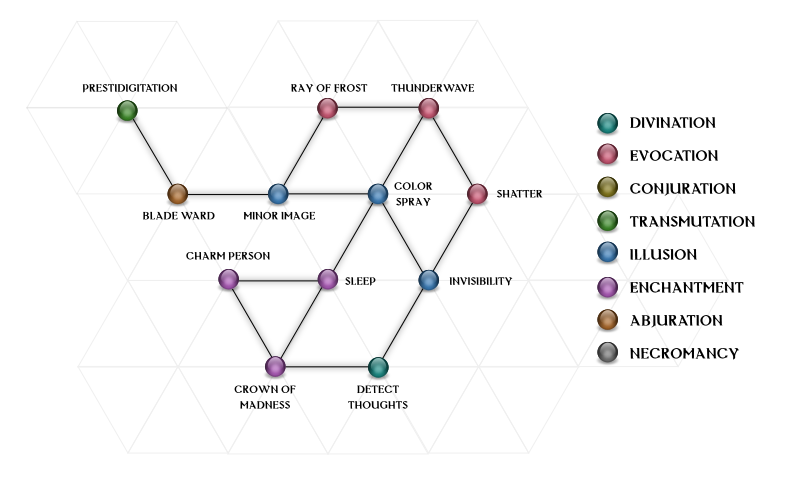
This spellmap contains the prepared spells and cantrips of a 20th level wizard with an Intelligence score of 20. It contains 6 closed loops and 6 terminals.

Advice for Geometer Players
Drawing a spell map can be time consuming, especially at high levels. A 20th level wizard with an Intelligence score of 20 has as many as 30 nodes to connect! In order to avoid leaving your fellow players waiting, consider coming to your game with a few spell maps already prepared. Adjusting a spell map is a significantly quicker process than drawing one from scratch if you only make a handful of a substitutions each day.
A useful tool for building spell maps has been developed by /u/calpin99, available here.
Arcane Topography
2nd-level School of Geometry feature
Starting at 2nd level, the layout of your spell map grants you insight into the fabric of reality. Its reservoirs reflect a well of power ready to spring forth at a moment's notice, and its rivers guide power to your fingertips.
You gain a +1 bonus to your Initiative rolls for each closed loop in your spell map, and your wizard cantrips deal 1 extra point of damage for each terminal in your spell map. The maximum for each of these bonuses is equal to 2 + half your wizard level.
Spell Link (Level 6)
6th-level School of Geometry feature
Starting at 6th level, the spells you link within the same resevoir can bleed into one another in a spectacular or subtle fashion. Whenever you cast a spell which is part of a closed loop in your spell map, you may choose one of the following effects to apply to that spell:
If the spell deals damage, you may change the damage type to any other type dealt by a spell within the same closed loop.
If the spell grants its target at saving throw, you may choose to change the type of saving throw to one required by another spell within the same closed loop.
For example, if you cast a fireball spell linked to the same closed loop as phantasmal killer, you may choose to deal psychic damage instead of fire damage. Alternatively, you may switch the Dexterity saving throw required by fireball for a Wisdom saving throw instead, as required by phantasmal killer.
Off the Grid (Level 10)
10th-level School of Geometry feature
Starting at 10th level, the spells at the edges of your spell map bleed into the world around you. When you cast a spell of 1st level or higher positioned at a terminal in your spell map, you and all allies within 30 feet gain temporary hit points equal to the spell's level.
Geometer's Journey (Level 14)
14th-level School of Geometry feature
Beginning at 14th level, the contours of your spell map can draw power from the aether. When you cast a wizard spell of 1st level or higher, place a token over that spell's position on your spell map. If this spell is not connected to the last spell you covered with a token, remove any tokens you have previously placed. If the number of tokens on your spell map is then equal to that spell's level plus one, you may choose not to expend a spell slot when you cast the spell. If you do, remove all the tokens from your spell map.
You remove all tokens from your spell map when you finish a short rest or a long rest.
School of Golemancy
School of Golemancy (Level 2)
Wizards of the school of golemancy strive to create artificial life and intelligence through purely arcane means. Though such golemancers see necromancy spells that bring the dead back to life or create undead as useful tools, they are unsatisfied with just restoring consciousness or creating a facsimile of life. They spend years studying consciousness, and weave enchantments that allow them to create a personality and persona.
As a golemancer, you have built a custom golem, carefully choosing its materials and components, installing specialized augments, and finally applying the persona you so precisely crafted. A golem is often a reflection of its creator, telling you much about their intentions and sensibilities; clay is used to denote protection of people, flesh used in a creator's attempt to create humanoid life, iron used for guardians of its creator's person and belongings, and stone used for stewards of particular locations. No matter what materials and features your golem possesses, you have created a companion that will safeguard and fight alongside you for the remainder of your days.
Golem Companion
When you select this school at 2nd level, you construct a golem and imbue it with artificial life. It is friendly to you and your companions, and it obeys your commands. See this creature's game statistics in the golem companion stat block, which uses your proficiency bonus (PB) in several places. You determine the golem's appearance and the materials from which it is constructed, neither of which have an effect on its game statistics.
In combat, the golem companion shares your initiative, but it takes its turn immediately after yours. It can move and use its reaction on its own, but the only action it takes on its turn is the Dodge action, unless you otherwise command it. You can use your action to have it take one of the actions in its stat block or to have it take the Help action, or you can use your bonus action to have it take any other action. You can't use your action and bonus action to command your golem on the same turn.
If the mending spell is cast on the golem, it regains 2d6 hit points. If it has died within the last hour, you can use an action to revive it, provided you are within 5 feet of it and expend a spell slot of 1st level or higher. The golem companion returns to life after 1 minute with all its hit points restored.
At the end of a long rest'24, you can create a new golem companion if you have the materials to do so. If you already have a golem companion from this feature, the first one immediately perishes. The golem also perishes if you die.
Arcane Augmentation
Also starting at 2nd level, you cannot help yourself but to try to improve your golem, seeking absolute perfection. Your golem companion gains two of the following augmentations of your choice. If an augmentation has prerequisites, you must meet them to choose it. You can choose the augmentation at the same time that you meet its prerequisites.
Your golem companion gains two additional augmentations of your choice at 6th level, and one additional augmentation of your choice at 10th and 14th level. Whenever you create a new golem, you can reselect its augmentations. When you do, you can't choose more than one augmentation that has a 10th-level prerequisite or more than one augmentation that has a 14th-level prerequisite.
Additional Arcane Augmentations
Your golem companion gains two additional augmentations of your choice at 6th level. Whenever you create a new golem, you can reselect its augmentations.
Additional Arcane Augmentation
Your golem companion gains one additional augmentation of your choice at 10th level. Whenever you create a new golem, you can reselect its augmentations. When you do, you can't choose more than one augmentation that has a 10th-level prerequisite.
Additional Arcane Augmentation
Your golem companion gains one additional augmentation of your choice at 14th level. Whenever you create a new golem, you can reselect its augmentations. When you do, you can't choose more than one augmentation that has a 10th-level prerequisite or more than one augmentation that has a 14th-level prerequisite.
Additional Arcane Augmentations (Level 6)
Your golem companion gains two additional augmentations of your choice at 6th level. Whenever you create a new golem, you can reselect its augmentations.
Additional Arcane Augmentation (Level 10)
Your golem companion gains one additional augmentation of your choice at 10th level. Whenever you create a new golem, you can reselect its augmentations. When you do, you can't choose more than one augmentation that has a 10th-level prerequisite.
Additional Arcane Augmentation (Level 14)
Your golem companion gains one additional augmentation of your choice at 14th level. Whenever you create a new golem, you can reselect its augmentations. When you do, you can't choose more than one augmentation that has a 10th-level prerequisite or more than one augmentation that has a 14th-level prerequisite.
School of Gravity
School of Gravity (Level 2)
These wizards are dedicated to the study of gravitational magic. This magic is focused on battlefield control and manipulation of the movement of others. Though it doesn't come through ritual or meditation as it does to most, they wield gravitational magic with as much force as any other. To them, it is a unique force of the universe to tap into and understand.
Gravity Savant
When you choose this arcane tradition at 2nd level, spells that appear on the gravitational spell list that don't appear on the wizard spell list are added to the wizard spell list for you, and you learn one cantrip of your choice from the gravitational spell list. This cantrip doesn't count against your number of cantrips known.
In addition, the gold and time you must spend to copy a spell that appears on the gravitational spell list into your spellbook is halved.
Control
Beginning at 2nd level, you have learned to control objects internal gravity. As an action, you can touch an object and either double its weight, or halve its weight. The object's weight remains altered for 8 hours. You can have a number of objects altered this way up to your Intelligence modifier (minimum of 1). If you try alter an object while you already have your maximum number altered, one of the object's of your choice returns to its normal weight.
You can also alter the weight of creatures. As an action, you can touch a creature and either double its speed, or halve its speed until the end of its next turn. Once you affect a creature this way, you can't do so again until you finish a short or long rest.
Unrestricted Weight (Level 6)
Boost of Gravity (Level 10)
Beginning at 10th level, when you cast a spell that appears on the gravitational spell list using a spell slot, you can cast it one level higher than the spell slot expended. You can do so a number of times equal to your Intelligence modifier (minimum of once), and regain all uses when you finish a long rest.
Double Target (Level 14)
Starting at 14th level you have mastered the local manipulation of gravity. When you cast a spell that appears on the gravitational spell list that targets at least 1 creature, you can target 1 additional valid creature within range. Once you use this ability, you can't do so again until you finish a long rest.
School of Hemomancy
School of Hemomancy (Level 2)
Though considered barbaric by most wizards, Hemomancy, also known as blood magic, is one of the most powerful and ancient Arcane Traditions. Discovered in ages long forgotten by priests of dark gods, Hemomancers use the power of their own lifeblood to work sinister spells of overwhelming power.
Hemomancy Savant
When you adopt this Arcane Tradition at 2nd level, you learn to copy spells into your spellbook in your blood. When you do so, both your current and maximum hit points are reduced by 1 per level of the spell you copy in place of expending the gold and ink. Any reduction to your maximum hit points from this feature cannot be reduced in any way.
You are also able to learn dark magic unknown to most wizards. You can copy any spell you find in a spell scroll or spellbook into your own spellbook, so long as it deals only poison or necrotic damage. Any spell you gain through this feature must be copied into your spellbook in your blood. It then counts as a wizard spell for you if it wasn't already.
Blood Magic
At 2nd level, you learn to use the ancient and sinister magic of Hemomancy to sacrifice your lifeblood to fuel your arcane abilities. As a bonus action, you can regain one expended wizard spell slot by reducing both your current hit points, and maximum hit points by an amount equal to twice the level of the spell slot you wish to regain. This reduction to your hit points cannot be lessened in any way. You cannot use this feature to regain a spell slot higher then 5th-level.
At the end of each long rest, if your maximum hit points have been reduced by one of your Hemomancy features, that reduction is reduced by 1. You can also choose to expend Hit Dice at the end of a long rest, reducing any reduction to your hit point maximum by a number of hit points equal to your Constitution modifier (minimum of 1 hit point).
Warning: The Dangers of Blood Magic
School of Hemomancy has the potential for great power, but at great risk. Any reduction to the already low maximum hit points of a wizard is dangerous, and reducing a player's maximum hit points to 0 causes instant death. This Arcane Tradition is not recommended for beginner players.
Hemomancy in Practice
Vlad the Hemomancer wizard finds a spell scroll of shadow of moil, a spell not normally available to wizards. That night, he copies the spell, using his blood, into his spellbook. Since shadow of moil is a 4th-level spell, his maximum hit points are reduced by 4, from 34 to 30. At the end of his next long rest, the reduction to Vlad's maximum hit points is lessened by 1. His hit point maximum is now 31.
Vampiric Restoration (Level 6)
You can use Hemomancy magic to drain life from your foes. Beginning at 6th level, whenever you deal poison or necrotic damage to a creature with a wizard spell, you can choose to gain temporary hit points equal to half the damage dealt.
You can use this ability a number of times equal to your Intelligence modifier (minimum of once), and you regain all expended uses when you finish a long rest.
Sanguine Vigor (Level 10)
Your use of blood magic fortifies your body. At 10th level you gain resistance to necrotic and poison damage, and you have advantage on saving throws against poison and disease.
Your magic also allows you to regenerate more quickly. At the end of each long rest, you regain additional expended Hit Dice equal to your Constitution modifier (minimum of 1).
Sinister Empowerment (Level 14)
Beginning at 14th level, you can increase the power of spells that sap the life from others. When you cast a wizard spell of 1st-level or higher that deals poison or necrotic damage you can choose to deal maximum damage in place of rolling.
The first time you do so each day, you suffer no adverse effects. However, each subsequent time you use this ability before you finish a long rest, your current and maximum hit points are reduced by an amount equal to twice the level at which you cast the spell you maximized with this feature.
School of Hemomancy
School of Hemomancy (Level 2)
The School of Hemomancy studies the ancient arcane art of blood magic. As you select this tradition, you learn to manipulate your own life force so that you may manipulate the life force of others. As you progress through this school, you learn how to transform that vital energy into a force of immeasurable power, capable of defeating even the greatest of foes.
Hemomancy Savant
Beginning when you select this school at 2nd level, the gold and time you must spend to copy a spell with the hemomancy tag into your spellbook is halved.
Arcane Endurance
At 2nd level, your hit point maximum increases by 2, and increases by 1 whenever you gain another level in this class.
Additionally, you only need to sacrifice a fraction of your life force to cast Hemomancy spells. When you spend hit points to cast a spell with the hemomancy tag, you gain a number of temporary hit points equal to half the amount spent on the spell. These temporary hit points last for up to 1 hour.
Deepen Wound (Level 6)
Starting at 6th level, when you damage a creature that is below half their hit point maximum with a spell, that creature takes additional necrotic damage equal to your Intelligence modifier if they haven't already taken damage from this feature this turn.
Improved Endurance (Level 10)
At 10th level, your ability to cast Hemomancy spells is greatly augmented. When you spend hitpoints to cast a spell with the hemomancy tag, you now gain temporary hit points equal to the total amount spent on the spell.
Dance with Dead (Level 14)
At 14th level, your body learns to repair itself when it is near death. At the start of each of your turns, you regain a number of hit points equal to your Intelligence modifier (minimum 1) if you have no more than half of your maximum hit points remaining. You don't gain this benefit if you start your turn with 0 hit points.
School of Hexcraft
School of Hexcraft (Level 2)
Some who study the arcane aren't satisfied with traditional schools of wizardry and turn to the dark arts in their hunger for power. Striking out into the wild, they seek out beings from the lower planes, creatures from the Shadowfell, or vile covens of hags in order to learn otherworldly eldritch magic.
Many who follow this path are willing to sacrifice anything, even their eternal soul, in order to learn sinister magics often reserved for those who enter pacts with eldritch entities.
Eldritch Savant
When you adopt this Arcane Tradition at 2nd level, you gain access to magic that is shunned by all by the most unhinged. You can copy warlock spells that you find in other spellbooks or spell scrolls into your spellbook. Warlock spells gained through this feature count as wizard spells for you.
Also, when you gain a level in this class, one of the spells you add to your spellbook must be from the warlock spell list.
Forbidden Arcana
In your study of dark magics you have gained for yourself strange and sinister abilities. At 2nd level, you learn of two Eldritch Invocations of your choice from the list below.
When you gain a level in this class, you can switch your Invocation for another of your choice from the list below.
You learn an additional Eldritch Invocation from this list when you reach 6th, 10th, and 14th level in this class.
Beast Speech
You can cast speak with animals at will, without expending a spell slot or material components.
Beguiling Influence
You gain proficiency in both the Deception and Persuasion skills.
Devil's Sight
You can see normally in darkness, both magical and nonmagical, to a distance of 120 feet.
Eldritch Sight
You can cast detect magic, at will, without expending a spell slot or material components.
Eyes of the Rune Keeper
You can read and understand all written symbols and writing.
Misty Visions
You can cast silent image at will, without expending a spell slot or material components.
One with Shadows
When you are in an area of dim light or darkness, you can use your action to become invisible until you move or take an action or a reaction.
Forbidden Arcana
School of Hexcraft grants wizards access to specific Eldritch Invocations from the warlock class. Consider granting a Hexcraft wizard access to more powerful Invocations in addition to their normal treasure, magic items, and other rewards.
Profane Ritual (Level 6)
You can use your knowledge of dark magic to enhance your life force at the cost of your surroundings. Beginning at 6th level, when you finish casting a ritual spell, you can grant yourself temporary hit points equal to the level at which you cast the ritual spell + your wizard level. When you complete a ritual in this way, the flora and fauna around you becomes noticeably withered and sickly, and delicate life dies.
Inscrutable (Level 10)
You familiarity with forbidden things allows you to hide yourself from the prying eyes of spellcasters and other powerful creatures. Starting at 10th level, you are immune to any effect that would sense your emotions, read your thoughts, or detect your alignment, as well as any divination spell that you refuse. Additionally, when a creature makes a Wisdom (Insight) check to ascertain your true intentions or sincerity they do so at disadvantage.
Heart of Darkness (Level 14)
You have learned the sinister magic of drawing power from death. Beginning at 14th level, when you kill a creature with a spell of 1st-level or higher, you can use your reaction to regain one of your expended spell slots. The recovered spell slot must be of a level lower then the spell cast to kill the creature, and you cannot be higher than 5th-level.
You can use this ability a number of times equal to your Intelligence modifier (minimum of once), and you regain all expended uses when you complete a long rest.
School of Hydromancy
School of Hydromancy (Level 2)
As a member of the School of Hydromancy, you focus your study on magic that conjures and manipulates water. Though detractors of this school believe it to be an overly specialized area of study, hydromancy spells actually cover a wide selection of the eight traditional schools of magic. Hydromancers can use their spells to protect themselves and their allies, disperse and destroy their foes, or do many other tasks. Though members of this school are most often sought out by shipmasters or the lords of coastal settlements, they can be found working in an array of diverse occupations and in varied environments.
Hydromancy Savant
Beginning when you select this school at 2nd level, the gold and time you must spend to copy a spell that has the hydromancy tag into your spellbook is halved.
Aqueous Magic
Beginning at 2nd level, you can use magic leftover from your spells to conjure shallow pools of water. When you cast a spell of 1st level or higher using a spell slot, you can create one of these pools centered on a point on the ground that you can see within 30 feet of you. The pool manifests as a 1-inch-deep layer of water on the ground. It covers a 10-foot-radius for a 1st-level spell slot, and the radius increases by 5 feet for each slot level higher than 1st. The pool lasts for 1 minute, and stays in the location it was created for its entire duration, even on inclines or if subjected to strong winds.
If you start your turn standing in one of these pools of water, your speed is increased by 10 feet until the end of the turn. Also, while standing in one of these pools you are aware of any hidden or invisible creatures within 10 feet of you that are also standing within a pool conjured by this feature.
These pools count as bodies of water for your hydromancy spells, and pools that intersect count as the same body of water.
Watery Transposition (Level 6)
Starting at 6th level, when you cast a hydromancy spell of 1st level or higher and utilize the spell's hydromancy radius, you can choose to teleport to the point that you chose to cast the spell from. You teleport after the spell is cast.
You can use this feature twice. You regain all expended uses of it when you finish a short or long rest.
Elemental Command (Level 10)
At 10th level, you add the conjure elemental spell to your spellbook if it is not there already. If the spell is already in your spellbook, you add a wizard spell of your choice with the hydromancy tag instead. You can cast conjure elemental without expending a spell slot. When you do so, you summon a water weird rather than one of the spell's normal options (the DM has the creature's game statistics). The water weird can be bound to one of the pools you create with your Aqueous Magic feature, or bound to a regular body of water.
Once you cast conjure elemental in this way, you can't do so again until you finish a long rest, though you can still cast it normally using an available spell slot.
If you use conjure elemental to summon a water elemental or water weird, the spell has a casting time of 1 action, and the summoned creature disappears if your concentration is broken rather than becoming hostile to you.
One with the Waves (Level 14)
Starting at 14th level, the pools created with your Aqueous Magic feature become imbued with stronger magic. While you stand within one of these pools, you gain the following benefits:
You gain a +2 bonus to your AC.
You gain advantage on Constitution saving throws.
You are aware of any hidden or invisible creatures that are also standing within a pool, regardless of distance.
School of Hydromancy
School of Hydromancy (Level 2)
As a member of the School of Hydromancy, you focus your study on magic that conjures and manipulates water. Though detractors of this school believe it to be an overly specialized area of study, hydromancy spells actually cover a wide selection of the eight traditional schools of magic. Hydromancers can use their spells to protect themselves and their allies, disperse and destroy their foes, or do many other tasks. Though members of this school are most often sought out by shipmasters or the lords of coastal settlements, they can be found working in an array of diverse occupations and in varied environments.
Hydromancy Savant
Beginning when you select this school at 2nd level, the gold and time you must spend to copy a spell that has the hydromancy tag into your spellbook is halved.
Aqueous Magic
Beginning at 2nd level, you can use magic leftover from your spells to conjure shallow pools of water. When you cast a spell of 1st level or higher using a spell slot, you can create one of these pools centered on a point on the ground that you can see within 30 feet of you. The pool manifests as a 1-inch-deep layer of water on the ground. It covers a 10-foot-radius for a 1st-level spell slot, and the radius increases by 5 feet for each slot level higher than 1st. The pool lasts for 1 minute, and stays in the location it was created for its entire duration, even on inclines or if subjected to strong winds.
If you start your turn standing in one of these pools of water, your speed is increased by 10 feet until the end of the turn. Also, while standing in one of these pools you are aware of any hidden or invisible creatures within 10 feet of you that are also standing within a pool conjured by this feature.
These pools count as bodies of water for your hydromancy spells, and pools that intersect count as the same body of water.
Watery Transposition (Level 6)
Starting at 6th level, when you cast a hydromancy spell of 1st level or higher and utilize the spell's hydromancy radius, you can choose to teleport to the point that you chose to cast the spell from. You teleport after the spell is cast.
You can use this feature twice. You regain all expended uses of it when you finish a short or long rest.
Elemental Command (Level 10)
At 10th level, you add the conjure elemental spell to your spellbook if it is not there already. If the spell is already in your spellbook, you add a wizard spell of your choice with the hydromancy tag instead. You can cast conjure elemental without expending a spell slot. When you do so, you summon a water weird rather than one of the spell's normal options (the DM has the creature's game statistics). The water weird can be bound to one of the pools you create with your Aqueous Magic feature, or bound to a regular body of water.
Once you cast conjure elemental in this way, you can't do so again until you finish a long rest, though you can still cast it normally using an available spell slot.
If you use conjure elemental to summon a water elemental or water weird, the spell has a casting time of 1 action, and the summoned creature disappears if your concentration is broken rather than becoming hostile to you.
One with the Waves (Level 14)
Starting at 14th level, the pools created with your Aqueous Magic feature become imbued with stronger magic. While you stand within one of these pools, you gain the following benefits:
You gain a +2 bonus to your AC.
You gain advantage on Constitution saving throws.
You are aware of any hidden or invisible creatures that are also standing within a pool, regardless of distance.
School of Illumination
School of Astronomy (Level 2)
First created by the shadow fey, the school of illumination blends observations of the heavens with the manipulation of light and shadow into an arcane tradition that's closely tied with the shadow plane. Many of its spells have much in common with divination, illusion, and necromancy. Unlike those schools, illumination magic is obscure and rarely practiced outside the shadow plane. Its practitioners have been likened to elementalists who manipulate shadow instead of fire, earth, air, or water.
This school is not simply about controlling shadow, however; its focus is simultaneously light and the absence of light. Starlight, in particular, holds special meaning within this school. Illumination mages study the ever-shifting alignment of the stars in their effort to read the road map of fate—a study that inevitably leads them out of the starless shadow plane and into contact with the mortal world.
Members of the School of Illumination, called illuminators, use the stars to predict when danger is near, and draw on the power of darkness to attack their foes. This school is popular with delvers into the underworld, because its spells work best where light is dim or absent.
Illumination Savant
Beginning when you select this school at 2nd level, the gold and time needed to copy illumination spells into your spellbook is halved.
Omen of Warning
Starting at 2nd level, you can forecast danger for the next 24 hours by studying the stars for one hour. The stars must be visible to you for you to use this ability. Studying the stars this way gives you advantage on up to two initiative checks. The bonus remains available for 24 hours or until the end of your next long rest. Instead of using an omen yourself, you can grant advantage on an initiative check to one other creature you can see when initiative checks are being made, but this prevents you from using the benefit yourself in that combat. You can choose whether to use an omen at the moment when initiative is rolled, but you must make the decision before rolling the die.
Master of the Endless Night (Level 6)
At 6th level, the spell attack modifier and spell save DC for cantrips you cast in dim light or darkness increases by 1.
Illusions of Permanence (Level 10)
Beginning at 10th level, illusions cast by you that require concentration last for 1 round after you lose concentration or stop concentrating, provided the spell hasn't exceeded its maximum duration.
Comprehension of the Starry Sky (Level 14)
Starting at 14th level, during a long rest you can consult the stars and comprehend some meaning in a cosmic event. The stars must be visible to you for you to use this ability. The insight you gather is stored as a small reserve of magic inside an item that has meaning to you; a star chart or astrolabe is commonly used, but any item that can be held in your hand will suffice. When the item is in your hand, you can consume that stored magic as a bonus action to invoke one of the following effects. The insight is expended by one use, and it's lost if it hasn't been used within 24 hours or by the start of your next long rest.
- Comet:
- Conjunction:
- Eclipse:
- Nova:
School of Illusion
School of Illusion (Level 2)
You focus your studies on magic that dazzles the senses, befuddles the mind, and tricks even the wisest folk. Your magic is subtle, but the illusions crafted by your keen mind make the impossible seem real. Some illusionists—including many gnome wizards—are benign tricksters who use their spells to entertain. Others are more sinister masters of deception, using their illusions to frighten and fool others for their personal gain.
Illusion Savant
Beginning when you select this school at 2nd level, the gold and time you must spend to copy an illusion spell into your spellbook is halved.
Improved Minor Illusion
When you choose this school at 2nd level, you learn the minor illusion cantrip. If you already know this cantrip, you learn a different wizard cantrip of your choice. The cantrip doesn't count against your number of cantrips known.
When you cast minor illusion, you can create both a sound and an image with a single casting of the spell.
Malleable Illusions (Level 6)
Starting at 6th level, when you cast an illusion spell that has a duration of 1 minute or longer, you can use your action to change the nature of that illusion (using the spell's normal parameters for the illusion), provided that you can see the illusion.
Illusory Self (Level 10)
Beginning at 10th level, you can create an illusory duplicate of yourself as an instant, almost instinctual reaction to danger. When a creature makes an attack roll against you, you can use your reaction to interpose the illusory duplicate between the attacker and yourself. The attack automatically misses you, then the illusion dissipates.
Once you use this feature, you can't use it again until you finish a short or long rest.
Illusory Reality (Level 14)
By 14th level, you have learned the secret of weaving shadow magic into your illusions to give them a semi-reality. When you cast an illusion spell of 1st level or higher, you can choose one inanimate, nonmagical object that is part of the illusion and make that object real. You can do this on your turn as a bonus action while the spell is ongoing. The object remains real for 1 minute. For example, you can create an illusion of a bridge over a chasm and then make it real long enough for your allies to cross.
The object can't deal damage or otherwise directly harm anyone.
School of Illusion
School of Illusion (Level 2)
You focus your studies on magic that dazzles the senses, befuddles the mind, and tricks even the wisest folk. Your magic is subtle, but the illusions crafted by your keen mind make the impossible seem real. Some illusionists—including many gnome wizards—are benign tricksters who use their spells to entertain. Others are more sinister masters of deception, using their illusions to frighten and fool others for their personal gain.
Illusion Tradition Spells
Illusion Tradition Spells
Dual Illusions
Beginning at 2nd level, when you cast an illusion spell that can create a sensory effect, you can create an additional effect for a different sense. For example, if you create a visual effect, you can also create a sound or smell to accompany it. The additional sensory effect cannot be harmful and must follow any rules and restrictions of the spell cast whenever possible.
Malleable Illusions (Level 6)
Starting at 6th level, the range and duration of all of your illusion spells doubles, and during the duration of an illusion spell you cast, you can use your action to change the nature of that illusion (using the spell's normal parameters for the illusion), provided that you can see the illusion.
Illusory Self (Level 10)
Beginning at 10th level, you can create an illusory duplicate of yourself as an instant, almost instinctual reaction to danger. When a creature makes an attack roll against you, you can use your reaction to interpose the illusory duplicate between the attackers and yourself. All attacks against you are at disadvantage until the end of your next turn, then the illusion dissipates.
You can use this feature a number of times equal to your Intelligence modifier (minimum of one), and you regain all uses on a long rest.
Illusory Reality (Level 14)
By 14th level, you have learned the secret of weaving shadow magic into your illusions to give them a semi-reality. When you cast an illusion spell, you can choose one inanimate, nonmagical object that is part of the illusion and make that object real. You can do this on your turn as a bonus action while the spell is ongoing. The object remains real for a number of minutes equal to your Intelligence modifier + your proficiency bonus (minimum of one), and at any time during the duration, you can use your bonus action to end it early. For example, you can create an illusion of a bridge over a chasm and then make it real long enough for your allies to cross.
The object can't deal damage or otherwise directly harm anyone.
School of Liminality
School of Liminality (Level 2)
Liminal spaces are spaces on the boundary, at the edge between what's real and what's unreal. A liminal space can be neither here nor there, and yet be both here and there at the same time. Stories of liminal spaces are common across cultures, though their true nature often isn't recognized by the uninitiated: the stranger who appears suddenly at a lonely crossroads, the troll that snatches at unwary travelers from a hiding spot beneath a bridge where no such hiding spot exists, the strangely familiar yet unsettlingly different scene that's sometimes glimpsed in a looking glass.
These are only the most obvious encounters with liminal spaces! Most liminalities are more easily overlooked, being as unconscious as the heartbeat between waking and sleeping, as fleeting as drawing in breath as an apprentice and exhaling it as a master, or as unassumingly familiar—and as fraught with potential—as a doorway that's crossed a hundred times without incident.
Those who specialize in liminal magic are known as liminists. They've learned to tap into the mysticism at the heart of spaces between spaces and to bend the possibilities inherent in transitional moments to their own ends. Like filaments of a dream, strands of liminality can be woven into forms new and wondrous—or strange and terrifying.
Liminal Savant
Beginning when you select this school at 2nd level, the gold and time you must spend to copy a liminal spell (see the Magic and Spells chapter) into your spellbook is halved.
Mulligan
At 2nd level, you can control the moment between an attempt at something and the result of that attempt to shift the flow of battle in your favor. When a creature you can see within 30 feet of you misses with an attack, you can use your reaction to allow that creature to reroll the attack. Similarly, when a creature within 30 feet of you that you can see hits with an attack but hasn't yet rolled damage, you can use your reaction to force that creature to reroll the attack and use the lower result. You can use this feature a number of times equal to your proficiency bonus. You regain all expended uses when you finish a long rest.
When you reach 10th level in this class, you can use this feature when a creature you can see within 30 feet of you makes an ability check or saving throw.
Otherworldly Sense (Level 6)
At 6th level, if you spend 1 minute meditating and expanding your senses outward, you can sense those not of this world — those who slip through the cracks of the in-between to wreak havoc on the unsuspecting. For 10 minutes, you can sense whether the following types of creatures are present within 1 mile of you: aberrations, celestials, dragons, elementals, fey, fiends, and undead. As long as you maintain your concentration, you can use an action to change the type of creature you sense. You know the direction to each lone creature or group, but not the distance or the exact number in a group. You can use this feature a number of times equal to your proficiency bonus. You regain all expended uses when you finish a long rest.
Liminal Adept (Level 10)
At 10th level, you add the threshold slip spell (see the Magic and Spells chapter) to your spellbook, if it isn't there already. You can cast threshold slip without expending a spell slot. When you do so, you can bring up to two willing creatures of your size or smaller that you're touching with you. The target junction must have unoccupied spaces for all of you to enter when you reappear, or the spell fails.
You can use this feature twice. You regain all expended uses when you finish a short or long rest. When you reach 14th level in this class, you can use this feature three times between rests.
Forced Transition (Level 14)
At 14th level, your mastery over moments of change is unequivocal. You can use an action to touch a willing creature or make a melee spell attack against an unwilling creature, choosing one of the following effects. The effect lasts for 1 minute. Once you use this feature, you can't use it again until you finish a long rest.
Rapid Advancement
The target's ability scores are each increased by 2. An ability score can exceed 20 but can't exceed 24.
Regression
The target's ability scores are each reduced by 2. This effect can't reduce an ability score below 1.
True Self
The target can't change its shape through any means, including spells, such as polymorph, and traits, such as the werewolf's Shapechanger trait. The target immediately reverts to its true form if it is currently in a different form. This option has no effect on illusion spells, such as disguise self, or a creature that appears changed from the effects of an illusion, such as a hag's Illusory Appearance.
School of Living Spells
School of Living Spells (Level 2)
The Mourning horrifies and fascinates the people of Khorvaire. Numerous studies have been attempted in the short years since the Mourning in hopes of studying its effects, discovering its cause, and determining if it's reversible... or possible to tame.
The School of Living Spells makes a special study of how magic has gone awry in the Mournland. These wizards' expertise is on how the Day of Mourning affected magic cast on that day, turning spells into constructs of trapped magical energy. These wizards have discovered how to create a living spell of their own, small enough to tame, yet holding enormous potential within.
Lucia ir'Brenith, a Cyran refugee living in New Cyre, is the mother of this movement, and her lab has become a haven for anyone wishing to study the Mournland and living spells in particular. Her research stays well-financed by Prince Oargev, who holds out hope that her work can lead to something that would explain the Mourning.
Living Spell Familiar
When you dedicate yourself to this school at 2nd level, you add the find familiar spell to your spellbook and have the option to create a living cantrip as a variant familiar. This familiar is a semi-sentient spell formed from your own arcane power. When you cast the find familiar spell to create a living cantrip, you can do so without material components.
When you cast any spell, regardless of its range, your living cantrip familiar can deliver the spell as if it had cast the spell. Your familiar must be within 100 feet of you, you must be able to see it, and it must use its reaction to deliver the spell when you cast it. If the spell requires an attack roll, you use your attack modifier for the roll. For example, while your familiar is 60 feet away from you, you could cast thunderwave, which has a range of self, but count your familiar as the origin point of the spell's blast wave.
When you reach certain levels in this class, you learn to imbue more powerful spells into your living cantrip familiar. Starting at 5th level, when you finish a short or long rest, you can expend a spell slot of a level indicated on the Imbued Living Spell Familiar table to imbue your living cantrip familiar with a damage dealing spell of that level that has a casting time of 1 action and requires no costly material component. When you do so, your familiar transforms into a more powerful living spell with full hit points, as indicated on the Imbued Living Spell Familiar table. While in this form, it gains the ability to take the Attack action on its turn, unlike other familiars. You can use your reaction on the familiar's turn to command it to cast the spell you imbued in it at its lowest level, using your wizard spell save DC and attack bonus instead of its own. (Instructions for customizing stat blocks for each type of familiar are provided in the section on "Customizing Living Spell Familiars". Unlike living spells found in the wild, your living spell familiar does not have the recharging Spell Mimicry feature, and can only cast the spell it is created from one time before it reverts to its living cantrip form).
When imbued with a spell, your familiar keeps this form until it casts the spell imbued in it, takes a long rest, or drops to 0 hit points, then it reverts to its normal living cantrip form, returning to the number of hit points it had before it transformed. However, if it reverts as a result of dropping to 0 hit points, any excess damage carries over to its normal form. If the spell it cast with Unleash Spell requires concentration, your familiar must maintain concentration on the spell once in living cantrip form.
| Wizard Level | Spell Level | Familiar Type |
|---|---|---|
5th | 1-2 | Least living spell |
9th | 3-4 | Lesser living spell |
13th | 5-6 | Greater living spell |
Customizing Living Spell Familiars
In the Living Spell Familiar feature for the School of Living Spells, you gain access to three more powerful forms of your living cantrip familiar: the least living spell, lesser living spell, and greater living spell familiar. Instructions for customizing the stat blocks for these living spell familiars are provided here.
When you imbue your living cantrip familiar with a spell, consult the Living Spell Familiar Customization table to see which example stat block to customize, based on the chosen spell's level.
| Spell Level | Familiar Type | Stat Block to Customize |
|---|---|---|
1-2 | Least living spell familiar | |
3-4 | Lesser living spell familiar | |
5-6 | greater living spell familiar |
Now make the following changes to that stat block:
Damage Immunity
Replace the living spell familiar's damage immunity with immunity to the type (or types) of damage dealt by the chosen spell.
Magical Psuedopod
Replace the damage that Magical Pseudopod deals with one type of damage dealt by the chosen spell.
Unleash Spell
Replace the effect of Unleash Spell with the effect of the chosen spell. If that spell requires a saving throw or attack roll, use your wizard spell save DC and attack bonus instead of the familiar's own. After the living spell familiar uses its Unleash Spell ability, it ceases to be a living spell familiar and reverts to its living cantrip familiar form, as described in your Living Spell Familiar feature.
For example, if you turn fireball (a 3rd-level spell) into a living spell familiar, you are creating a lesser living spell and should customize the living lightning bolt familiar. The resulting living fireball familiar has immunity to fire damage instead of lightning damage; deals fire damage with its Magical Pseudopod; and can replicate fireball once with Unleash Spell, after which it reverts to a living cantrip familiar.
Devour Magic
Also at 2nd level, your living cantrip familiar develops a taste for your spells. As a bonus action, you can expend a spell slot while you are within 30 feet of your living cantrip familiar to restore a number of hit points to it equal to 1d10 per level of the spell slot expended + your Intelligence modifier. If the familiar is currently imbued with a spell, these hit points are restored to the familiar's current form, not to its living cantrip form.
Awaken Living Spell (Level 6)
Starting at 6th level, your living cantrip familiar begins to show signs of sentience. Its Intelligence, Wisdom and Charisma scores all increase by an amount equal to your Intelligence modifier (minimum of 1). This increase carries over to its living spell familiar forms. If your Intelligence modifier changes in the future, the living cantrip's Intelligence, Wisdom, and Charisma scores change as well.
In addition, your living cantrip familiar acquires the following trait in all of its forms:
Limited Telepathy
Your familiar can magically communicate simple ideas, emotions, and images telepathically to any creature within 100 feet of it that can understand a language.
Absorb Magic (Level 6)
Beginning at 6th level, you learn how to harness your familiar's hunger for magic. When you or your familiar would be targeted by a spell cast by a creature within 60 feet of you, you can use your reaction to intercept the spell and try to break it down into raw magic. Make a spellcasting ability check with a DC equaling 10 + the spell's level. If your familiar is currently imbued with a spell, you gain a + 1d4 bonus on this check. On a success, the spell fails and has no effect, and both you and your familiar receive temporary hit points equal to three times the level of the spell absorbed. On a failure, the spell succeeds.
Once you use this feature, you can't use it again until you finish a short or long rest.
Remarkable Living Spell (Level 10)
At 10th level, you've learned to manipulate the raw arcane forces that constitute your living cantrip familiar. You can now imbue your familiar with a spell that does not deal damage. When you do so, the resulting living spell familiar is immune to force damage and its Magical Pseudopod action deals force damage.
Additionally, when you imbue your familiar with a spell, it can cast the spell twice, instead of once, before the spell is lost and it returns to its normal base form.
Imprison Living Spell (Level 14)
At 14th level, you learn the secrets of creating an unstable living spell and capturing it in a Khyber dragonshard, preserving its magical energy and allowing you to cast the spell that it's composed from.
When you complete a long rest, you can touch a Khyber dragonshard worth at least 250 gp that does not already have another creature bound inside it, choosing one spell of up to 5th level from your spellbook that has a casting time of 1 action and that requires no costly material components. When you do so, you capture that spell in the form of a living spell in the dragonshard without expending a spell slot or requiring material components.
When you are holding the dragonshard, you can use an action to expend a charge from it and cast the spell at its lowest level, requiring no verbal or material components. The spell level of the living spell you capture determines the number of charges the dragonshard has, as shown on the Captured Living Spell table. These charges last until expended or until you finish a long rest, after which time the magic of the living spell dissipates.
Additionally, if you encounter a living spell in the wild that is within 30 feet of you, and you have a Khyber dragonshard worth at least 250 gp that does not already have another creature bound inside it, you can use an action to cause the wild living spell to make a Charisma saving throw against your wizard spell save DC. On a failed save, the wild living spell is imprisoned within the dragonshard, and the dragonshard gains a number of charges as shown on the Captured Living Spell table. Once you have imprisoned a wild living spell, you can expend charges to cast the spell that it is made of, following the same rules for a living spell you captured in a dragonshard using this feature.
| Spell Level | Charges |
|---|---|
1 | 5 |
2 | 4 |
3 | 3 |
4 | 2 |
5 | 1 |
School of Material Magic
School of Material Magic (Level 2)
Some wizards abandon the limitations set by magic schools and instead focus on the binding force that holds everything together. These mages spend their efforts weaving and recreating matter from thin air to create art as well as utility. They value the craftsmanship taught by artisans around the world and consider their skills and creations to be a form of magic all its own.
Some arcanists focus on altering the living, whereas wizards of material magic focus on creating and enhancing the inanimate. These mages see beauty in the possibility presented by raw materials, and are found as readily studying ancient lore as they are in the center of a bustling forge. Many followers of this tradition take great care and pride in their component pouches, and find great kinship among bards, artists, and other craftsmen.
Arcane Artisan
Beginning at 2nd level, you have dedicated your studies to creation and the magic surrounding it. You gain proficiency with three artisan's tools of your choice and you learn the mending cantrip. If you already know this cantrip, you learn a different wizard cantrip of your choice. The cantrip doesn't count against your number of cantrips known.
In addition, your exceptional wit and aptitude allow you to do more with less time. When you use a set of artisan's tools with which you are proficient to craft an item or piece of art, you complete a full work day in a number of hours equal to 8–your Intelligence modifier (minimum of 1).
Minor Creation
Also at 2nd level, you can temporarily bend some of the laws of reality in your favor. When you cast a spell of 1st level or higher, you can create a cube of material measuring up to 5 feet large on a side on the ground in an unoccupied space you can see within 10 feet of you. You choose the material it's made out of. A cube weighs a number of pounds equal to 5 times its size on a side, regardless of its material, and can support up to 10 times its weight.
You can have a total number of these cubes in existence at any time equal to your Intelligence modifier (minimum of 1). You can dismiss any number of these cubes as a bonus action. Otherwise, a cube disappears after 1 hour or if it takes any damage.
Material Enhancement (Level 6)
At 6th level, your attention to both magic and mundane detail gives you a heightened understanding and control over them. As an action, you can touch an object, weapon, or piece of armor. Until the end of your next short or long rest, the item becomes magical if it isn't already, and gains your choice of up to two of the following benefits:
It emits bright light in a 10-foot radius and dim light for an additional 10 feet.
Its weight is halved.
When you throw it, immediately after it hits a creature or a solid object, it flies back to your hand.
You change any of its colors, smells, and textures.
(Weapon only) The wielder of it gains a +1 bonus to attack and damage rolls made with this weapon. If the weapon already granted a bonus to attack and damage rolls, this property has no effect.
(Armor only) The wearer gains a +1 bonus to AC. If the armor already granted a bonus to AC, this property has no effect.
(Armor only) If the armor would normally impose disadvantage on Dexterity (Stealth) checks, it does not.
You have 2 uses of this feature, and you expend 1 of its uses for each benefit you give an object. You regain all expended uses of this feature when you finish a short or long rest.
Dematerialize (Level 10)
Starting at 10th level, your spells deal double damage to objects and structures, and when you deal damage to a construct with an attack or a spell, it takes an extra 1d8 force damage.
Rematerialize (Level 14)
At 14th level, when you destroy a Large or smaller nonmagical object or structure with a spell, you can recreate it as an action once within the next 8 hours. When you do, the object or structure reappears intact in an unoccupied space you choose within 60 feet of you. If the object or structure is recreated in the air, it immediately falls. Any creature below the item must make a Dexterity saving throw against your wizard spell save DC. If the object is Small or smaller, a creature that fails the saving throw takes 1d8 bludgeoning damage from the impact for every 10 feet that it fell. If the object is Medium or Large, the bludgeoning damage increases to 1d10 or 1d12 for every 10 feet it fell, respectively. On a successful save, a creature takes half as much bludgeoning damage. If an object is the same size or larger than a creature it falls on, that creature is pushed to the nearest unoccupied space.
Once you use this feature, you can't use it again until you finish a long rest.
School of Metallurgy
School of Metallurgy (Level 2)
Originally developed by dwarves, School of Metallurgy emphasizes order, organization, and community. Known as Metallurgists, wizards who belong to this Arcane Tradition use their magic to impose order on a disordered world.
Masters of powerful abjuration and transmutation magic, Metallurgists wield an arcane alloy known as Arcanometal to great effect. Mages of this School are almost always Lawful in their outlook. Some seek to do the most good for the most people, while others use force to impose order on the world.
Arcanometal Adept
When you adopt this Arcane Tradition at 2nd level, you are taught the secret ritual that Metallurgists use to synthesize Arcanometal, the signature alloy of School of Metallurgy.
You can synthesize gold into liquid Arcanometal that you use to copy spells into your spellbook. For each level of the spell, you must expend 70 gold to create liquid Arcanometal to copy it. Spells added to your spellbook in this way become Arcanometal Spells for you, and gain the following benefits:
When you cast an Arcanometal spell that deals damage you can choose for the spell to deal force or magical bludgeoning damage in place of its normal damage.
When you cast an Arcanometal spell that targets one or more friendly creatures, one target of the spell gains temporary hit points equal to your wizard level.
Metallurgist
At 2nd level, you learn to create simple Arcanometal items. You conduct a 1-hour ritual that crafts a Small or Tiny item made only of metal. The creation is completed at the end of the ritual, and the item appears in an unoccupied space of your choice within 5 feet of you. Any Arcanometal object that you create with this feature is visibly magical in appearance.
The object you create must be worth less than 100 gold. As part of this ritual, you must lay out metal raw material, which can include coins, with a value equal to the object you wish to create. The metal irretrievably coalesces and transforms into the creation at the ritual's end. In place of providing metal, you can instead expend a spell slot of 1st-level or higher.
Once you use this feature, you must finish a short or long rest before you can use it again.
Arcanometal Shield (Level 6)
Beginning at 6th level, when you cast an Arcanometal Spell, you can siphon some of its power to create a shimmering shield of Arcanometal around yourself, granting yourself temporary hit points equal to twice the level of the spell slot you expended to cast the spell. While you have temporary hit points from this feature, you are resistant to all non-magical bludgeoning, piercing, and slashing damage.
Master Metallurgist (Level 10)
You wield your Arcanometal as an extension of your very self. Starting at 10th level, you can use your Metallurgist feature to create metal objects with a value of up to 1000 gold.
In addition, when you use your Metallurgist feature you can create larger metal objects, by spending higher level spell slots depending on the size as indicated in the table below:
| Spell Slot | Object Size | Spell Slot | Object Size |
|---|---|---|---|
3rd-Level | Medium | 7th-Level | Huge |
5th-Level | Large | 9th-Level | Gargantuan |
Metallum Arcanus (Level 14)
Your Arcanometal is a conduit for your overwhelming arcane power. Beginning at 14th level, when you have temporary hit points from your Arcanometal Shield, you gain resistance to all bludgeoning, force, piercing, and slashing damage.
School of Mimic Magic
School of Mimic Magic (Level 2)
Few monsters are as emblematic to dungeon delving as the mimic. As fluid shapeshifters, capable of replicating any object or fixture, these curious predators have made themselves a bane to adventurers everywhere. Innumerable histories trace the origin of this age-old monstrosity to a lesser-known wizard, mad tyrant, or sorcerer-king, who constructed the creature from vile magics long ago.
Such tales have led many spellcasters throughout the realms to cultivate a morbid fascination for mimics and their ecology, attempting to emulate the original witchcraft through mad experimentation with shapechanging beings.
After fully delving into occult magic, wizards of this deranged tradition have developed rituals to transform their own spellbooks into unprecedented hybrids, which are able to feed off the surrounding mana. The holder of such a macabre creation means to harness the power of mimics in its purest form, by tuning the species' anatomy to suit their own crazy blend of sorcery.
Monster Tongue
When you adopt this tradition at 2nd level, you gain proficiency in the Animal Handling skill; and you learn to speak, read, and write either Abyssal or Undercommon.
Mimic Grimoire
Starting at 2nd level, you learn a corrupted ritual that summons and infuses abyssal living matter into your spellbook, transforming it into a Mimic Grimoire.
You perform the ritual over the course of 1 hour, which can be done during a short rest. Your spellbook must be within your reach throughout the ritual, and once completed, it cannot be changed back to its original state.
The grimoire is a tiny monstrosity, with an AC of 12 and a number of hit points equal to five times your wizard level.
It has immunity to acid and poison damage, but is vulnerable to fire damage. It counts as a carried object when held by you. If it is forced to make an ability check or saving throw, treat all its ability scores as 6 (-2). The grimoire can use its body as a conduit for magic, enabling you to use it as an arcane focus for your wizard spells. Whenever you cast a cantrip through your grimoire, it briefly stores some of that energy within itself, allowing you to cast the same cantrip as a bonus action until the end of your next turn. This can be done a number of times per short or long rest equal to half your Intelligence modifier (rounded up), and the damage dice of a cantrip cast in this way become one size smaller.
Because of this unique anatomy, however, the grimoire needs to consume magic in order to survive; primarily feeding on its holder's mana. It must be fed once per day with one or more spell slots of a combined level equal to the highest one you currently have, otherwise it'll enter a starved state. When starved, the grimoire will drain your life force instead of your mana, dealing 2d8 necrotic damage for each of the days it has gone without being satiated at the end of a long rest. If it is fed with spell slots of a combined level equal to that same number of days, it returns to its normal state.
The grimoire dies if it is reduced to 0 hit points. While it is dead, you lose your ability to change prepared spells or learn any new ones. You can perform a ritual to revive it over the course of 8 hours, which can be done during a long rest.
Mana Devouring (Level 6)
At 6th level, you're able to use your grimoire's hunger to your advantage, having it feed on your target's essence in order to replenish your own.
Once per turn, whenever you hit a creature with a single-target spell attack, you can steal from it one spell slot of the same level as the spell you cast, or a lower one if the creature doesn't have slots of that level. If the targeted creature cannot cast spells or doesn't have any spell slots left, you instead steal 1d6 hit points per level of the spell you cast.
You may use this feature a number of times equal to your Intelligence modifier, and regain any expended uses when you finish a long rest.
Spell Mimicry (Level 10)
At 10th level, whenever a creature within 20 feet of you casts a spell of a level for which you have spell slots, you can use your reaction to have your mimic grimoire absorb that spell's essence, temporarily adding it to your list of prepared spells.
It remains on the list for up to 4 hours, and you can only cast it through your grimoire. Intelligence is your spellcasting ability for this spell, but it does not count as a wizard spell for you. You may only have one absorbed spell at a time.
Additionally, while it remains in the grimoire, you can choose to permanently exchange one of your spells known for the absorbed spell. If you do, the replaced spell is removed from your list of spells known. This can be done only once per long rest.
Two Mouths are Better than One (Level 14)
At 14th level, you wholly ingratiate yourself into your mimic magic, surpassing the limits of a wizard's mind through it. You learn a ritual to summon a second mimic grimoire, performing it over the course of 8 hours, which can be done during a long rest. Once the ritual is completed, you gain the following benefits:
Your mimic grimoires gain a flying speed of 15 feet (hover), and they now float around your hands when held by you. Additionally, they have hearing and darkvision out to a range of 30 feet, understand Abyssal and Undercommon, and can communicate telepathically with you as long as you are within 100 feet of them. They always obey your commands, even on a starved state.
While holding both grimoires, when using Mana Devouring, you always steal a spell slot of the highest level that your target possesses, and your life force draining increases to 1d8 hit points per level of the spell you cast. Spell slots with a higher level than your highest spell known can be stolen once per target, fade after 1 hour, and may be maintained only one at a time.
While holding both grimoires, you can absorb spells of any level with Spell Mimicry. Additionally, if you have the required slots for it, you can now permanently add the absorbed spell to your second grimoire's list of spells known. This can be done only once per long rest.
School of Mnemomancy
School of Mnemomancy (Level 2)
Wizards of the School of Mnemomancy wield the magic of memory, capable of being both bastions of knowledge and infiltrators of minds. As a mnemomancer, you augment your own ability to recall knowledge and experiences, while sealing the memories of your foes. As your mastery grows, you gain the ability to vividly experience others' memories and borrow their capabilities, as well as alter memories as you see fit.
Mind Palace
Beginning when you select this school at 2nd level, your memories are magically organized and stored within your mind for near perfect recall. When you make an Intelligence check to recall information or other memories, you can add your proficiency bonus to the check if you wouldn't normally add your proficiency bonus.
Recollection Snag
Also starting at 2nd level, you can magically search a creature's memories and seal a facet of its knowledge. As an action, you can expend a spell slot and force a creature you can see within 30 feet of you to make an Intelligence saving throw against your spell save DC. On a failure, you learn if the creature knows any spells or has any prepared and what those spells are, what languages it knows, and what skill and weapon proficiencies it has. You choose a combined number of spells, languages, and proficiencies up to the level of the expended spell slot for the creature to lose for 1 hour. The creature can't cast any lost spell, benefit from any lost proficiency, or understand, speak, or write any lost language for the duration. As an action on its turn, an affected creature can repeat the saving throw, ending this feature's effects on itself on a success.
Shared Reminiscence (Level 6)
Starting at 6th level, you can borrow memories from others to augment your own abilities. You can perform a 10 minute ritual with a willing creature, remaining within 5 feet of it for the duration. At the end of the ritual, the creature can share any number of the spells it knows or has prepared, any number of languages it knows, and any number of skill and tool proficiencies it has. You choose one of the shared spells, languages, or proficiencies to gain for yourself. The creature can also choose to share a memory that lasted no longer than 10 minutes, which you experience with perfect clarity through the creature's eyes.
If you choose to gain a cantrip, language, or proficiency, you have it until you use this feature to gain a different one of the same category.
If you choose to gain a spell of 1st level or higher, it counts as being prepared for you, but it doesn't count against the number of spells you can prepare each day. The combined level of spells you have through this feature can't exceed half your wizard level (rounded up). If you use this feature to gain a spell that would cause your total to exceed the maximum, you must choose a number of spells gained through this feature to lose until the total is within your maximum.
Each spell you gain using this feature counts as a wizard spell for you until you lose it.
Mental Block (Level 10)
Starting at 10th level, you ward your mind against intrusion. You are immune to any effect that would magically sense your emotions, read your thoughts, or cause you to become charmed or frightened.
Memory Manipulation (Level 14)
At 14th level, you become able to alter fine details of memories, not just read them. You always have the modify memory spell prepared, and it doesn't count against the number of spells you can prepare each day. When you cast the spell, you don't need to provide its verbal components, the target doesn't have advantage on its saving throw against the spell due to you fighting it, you can telepathically speak to the target to describe how its memories are affected, and the target doesn't need to understand the language you are speaking for the modified memories to take root.
Additionally, you can cast modify memory without expending a spell slot, as if you had expended the highest level spell slot you have. Once you do, you can't cast the spell without expending a spell slot again until you finish a long rest'24.
School of Necromancy
School of Necromancy (Level 2)
The School of Necromancy explores the cosmic forces of life, death, and undeath. As you focus your studies in this tradition, you learn to manipulate the energy that animates all living things. As you progress, you learn to sap the life force from a creature as your magic destroys its body, transforming that vital energy into magical power you can manipulate.
Most people see necromancers as menacing, or even villainous, due to the close association with death. Not all necromancers are evil, but the forces they manipulate are considered taboo by many societies.
Necromancy Savant
Beginning when you select this school at 2nd level, the gold and time you must spend to copy a necromancy spell into your spellbook is halved.
Grim Harvest
At 2nd level, you gain the ability to reap life energy from creatures you kill with your spells. Once per turn when you kill one or more creatures with a spell of 1st level or higher, you regain hit points equal to twice the spell's level, or three times its level if the spell belongs to the School of Necromancy. You don't gain this benefit for killing constructs or undead.
Undead Thralls (Level 6)
At 6th level, you add the animate dead spell to your spellbook if it is not there already. When you cast animate dead, you can target one additional corpse or pile of bones, creating another zombie or skeleton, as appropriate.
Whenever you create an undead using a necromancy spell, it has additional benefits:
The creature's hit point maximum is increased by an amount equal to your wizard level.
The creature adds your proficiency bonus to its weapon damage rolls.
Inured to Undeath (Level 10)
Beginning at 10th level, you have resistance to necrotic damage, and your hit point maximum can't be reduced. You have spent so much time dealing with undead and the forces that animate them that you have become inured to some of their worst effects.
Command Undead (Level 14)
Starting at 14th level, you can use magic to bring undead under your control, even those created by other wizards. As an action, you can choose one undead that you can see within 60 feet of you. That creature must make a Charisma saving throw against your wizard spell save DC. If it succeeds, you can't use this feature on it again. If it fails, it becomes friendly to you and obeys your commands until you use this feature again.
Intelligent undead are harder to control in this way. If the target has an Intelligence of 8 or higher, it has advantage on the saving throw. If it fails the saving throw and has an Intelligence of 12 or higher, it can repeat the saving throw at the end of every hour until it succeeds and breaks free.
School of Necromancy
School of Necromancy (Level 2)
The School of Necromancy explores the cosmic forces of life, death, and undeath. As you focus your studies in this tradition, you learn to manipulate the energy that animates all living things. As you progress, you learn to sap the life force from a creature as your magic destroys its body, transforming that vital energy into magical power you can manipulate.
Most people see necromancers as menacing, or even villainous, due to the close association with death. Not all necromancers are evil, but the forces they manipulate are considered taboo by many societies.
Necromancy Tradition Spells
Necromancy Tradition Spells
Grim Harvest
At 2nd level, you gain the ability to reap life energy from creatures you damage with your spells. Once per turn when you damage a creature with a spell, you gain temporary hit points equal to the spell level, and half the damage dealt if it is a necromancy spell or the spell deals necrotic damage. The minimum of the temporary hit points gained is one, so long as the spell is not a cantrip. The temporary hit points gained from this feature last until you take a long rest.
This feature improves at higher levels. At 6th level, any creatures summoned or created by a necromancy spell you cast gain temporary hit points equal to half the damage dealt by them. At 10th level, you gain temporary hit points equal to twice the spell level, and the damage dealt if it is a necromancy spell or the spell deals necrotic damage, and any creatures summoned or created by a necromancy spell you cast gain temporary hit points equal to the damage dealt by them. The minimum of the temporary hit points gained is two, so long as the spell is not a cantrip. At 14th level, anytime this feature triggers, both you and any creatures summoned or created by a necromancy spell you cast gain the temporary hit points, if you are both within 60 feet of each other.
Undead Thralls (Level 6)
At 6th level, the range and duration of all of your necromancy spells doubles, and when you cast a necromancy spell that creates or summons an undead creature, you can create or summon an additional undead creature, following the effects and restrictions of the spell.
Any undead creatures under your direct control gains these benefits:
The creature's hit point maximum is increased by an amount equal to your wizard level + your Intelligence modifier + your proficiency bonus + the spell's level (minimum of one).
The creature adds your Intelligence modifier (minimum of one) to its damage. If you would already add your Intelligence modifier to its damage, then you add it again.
Damage dealt by the creature is considered magical for the purpose of overcoming resistances and immunities.
Grim Harvest Improvement (Level 6)
At 6th level, any creatures summoned or created by a necromancy spell you cast gain temporary hit points equal to half the damage dealt by them.
Inured to Undeath (Level 10)
Beginning at 10th level, you have resistance to necrotic and poison damage, and your hit point maximum can't be reduced. Additionally, you gain advantage on death saving throws and saving throws against poison, and the death save DC of all death saving throws decreases by one.
Grim Harvest Improvement (Level 10)
At 10th level, you gain temporary hit points equal to twice the spell level, and the damage dealt if it is a necromancy spell or the spell deals necrotic damage, and any creatures summoned or created by a necromancy spell you cast gain temporary hit points equal to the damage dealt by them. The minimum of the temporary hit points gained is two, so long as the spell is not a cantrip.
Command Undead (Level 14)
Starting at 14th level, you can use magic to bring undead under your control, even those created by other necromancers. As an action, you can choose one undead that you can see within 60 feet of you. That creature must make a Charisma saving throw against your wizard spell save DC. If it succeeds, you can't use this feature on it again. If it fails, it becomes friendly to you and obeys your commands until you use this feature again, and it is treated as if it was created or summoned by you.
Intelligent undead are harder to control in this way. If the target has an Intelligence of 8 or higher, it has advantage on the saving throw. If it fails the saving throw and has an Intelligence of 12 or higher, it can repeat the saving throw at the end of every hour until it succeeds and breaks free.
Additionally, if it would normally require an action or bonus action to command undead under your control, you can do so mentally without using your action or bonus action.
Grim Harvest Improvement (Level 14)
At 14th level, anytime this feature triggers, both you and any creatures summoned or created by a necromancy spell you cast gain the temporary hit points, if you are both within 60 feet of each other.
School of Necromancy Dracolich
School of Necromancy Dracolich (Level 2)
The School of Dracolich explores the cosmic forces of life, death, and undeath. As you focus your studies in this tradition, you learn to manipulate the energy that animates all living things. As you progress, you learn to sap the life force from a creature as your magic destroys its body, transforming that vital energy into magical power you can manipulate.
Most people see necromancers as menacing, or even villainous, due to the close association with death. Not all necromancers are evil, but the forces they manipulate are considered taboo by many societies.
Necromancy Savant
Beginning when you select this school at 2nd level, the gold and time you must spend to copy a necromancy spell into your spellbook is halved. The inflict wounds, speak with dead and harm spells count as wizard spells for you.
Grim Harvest
At 2nd level, you reap life energy from creatures with your spells. Once per turn, when one or more creatures fail a saving throw against or are hit by one of your 1st level or higher spells, or you kill one or more creatures with such a spell, you regain hit points equal to twice the spell's level, or three times its level if the spell belongs to the School of Necromancy Dracolich. This feature can't target constructs or undead.
Undead Thralls (Level 6)
At 6th level, you can mentally command undead creatures you control and can see without spending any actions. In addition, you add the animate dead and summon undead spells to your spellbook if they are not there already. When you cast animate dead, you can target one additional corpse or pile of bones, creating another undead, as appropriate. You can also cast this spell on one non-humanoid corpse, provided its number of hit dice are equal to or lower than your level. It retains its statistics, and gains the zombie NPC feature (Dungeon Master's Guide page 282). You can only control one corpse animated this way at a time. The zombie mentioned in this subclass references the standard zombie, and not this animated corpse. The grave bolt ranged spell attack of your summon undead spirit counts as a weapon.
When you create an undead using a necromancy spell, it has additional benefits (except for the mob of zombies):
The creature's hit point maximum is increased by an amount equal to your wizard level.
The creature adds your proficiency bonus to its weapon damage rolls.
Dreadful summoner (Level 6)
Also at 6th level, you can create a pocket dimension where you can store your undead minions. As an action, you can send any number of undead you control and can see into this dimension, or summon any number that are already there into unoccupied spaces within 60 feet of you. If you lose control over an undead while it is in this pocket dimension, it will appear into an unoccupied space closest to the space where they were before being sent to this dimension. You can choose to destroy an undead you created when you lose control over it while it is in this dimension. You can also use your action this way to store (or summon back) any number of corpses or piles of bones that you can see within 60 feet of you within this dimension. Undead you control can take their turn on your initiative instead of their own.
Inured to Undeath (Level 10)
At 10th level, you have resistance to necrotic damage, and your hit point maximum can't be reduced. You have spent so much time dealing with undead and those that create them that you've become inured to some of their worst effects.
In addition, whenever you create an undead using a necromancy spell, it has additional benefits:
If the creature is not a mob of zombies, it gains the Undead Fortitude trait. If it already has this trait, then the DC of its Undead Fortitude is reduced by 5 instead.
It can calculate its AC as 10 + your proficiency bonus, provided it is not a zombie or mob of zombies. This amount can not be increased by any armor or shield.
As an action, you can combine four zombies you control and can see into a mob of zombies that you control (if each zombie is within 5 feet of another of those zombies), or separate the mob if you can see it and it has its maximum hit points. Any wounds the zombies have are transferred to the mob. When the mob is killed, all zombies that were combined in it are destroyed. If you lose control over a zombie in the mob, you lose control over the mob of zombies.
Command Undead (Level 14)
Starting at 14th level, you can use magic to bring undead under your control, even those created by other wizards. As an action, you can choose one undead that you can see within 60 feet of you. That creature must make a Charisma saving throw against your wizard spell save DC. If it succeeds, you can't use this feature on it again for the next 24 hours. If it fails, it becomes friendly to you and obeys your commands until you use this feature again.
Intelligent undead are harder to control in this way. If the target has an Intelligence of 8 or higher, it has advantage on the saving throw. If it fails the saving throw and has an Intelligence of 12 or higher, it can repeat the saving throw at the end of every day until it succeeds and breaks free.
School of Philosophy
School of Philosophy (Level 2)
As a member of the School of Philosophy you are as much a theorist as you are a practitioner of arcane arts. A student of magic, you do not focus on a single school but seek to use logic and methodology to explore all mystical secrets. Other schools denounce the rhetoric of these so-called philosophers, often faulting them for sharing the esoteric teachings that most seek to keep to themselves.
Master's Teachings
When you choose this school at 2nd level, you replace your spellbook with a magical scroll. The scroll acts as an arcane focus.
When you prepare your spells each day, you can prepare an additional number of spells equal to your Intelligence modifier (minimum 1).
Philosopher's Rebuke (Level 6)
Starting at 6th level, your mastery of magical discourse allows you to efficiently counter hostile magic. Whenever you use dispel magic or counterspell to successfully end a spell, you regain one expended spell slot. The slot you regain must be of a lower level than the spell you cast and can't be higher than 5th level.
Arcane Symposium (Level 10)
Beginning at 10th level you gain the ability to share your arcane teachings with others. When you prepare a 1st level wizard spell during a long rest you may choose a number of willing creatures who can hear and understand you, up to your Intelligence modifier (minimum 1). These creatures gain the ability to cast this spell once at its lowest level without expending a spell slot and requiring no material components. Intelligence is the spellcasting ability for spells cast in this way. Creatures lose the ability to cast the spell in this way 8 hours after the spell is prepared.
Magnum Opus (Level 14)
By 14th level your scroll has become a masterwork of arcane philosophy. You gain the ability to cast a spell of 3rd level or lower with a casting time of one action as if it were your highest level spell slot. Casting a spell in this way does not expend a spell slot. You must complete a long rest before you can use this feature again.
School of Reawakening
School of Reawakening (Level 2)
As a member of the school of reawakening, you combine the forces of necromancy with the power of conjuration. By transforming the necromantic energies of the creatures you kill into completely new conjurations, you bridge the gap between these two school of magic, creating a hybrid school that combines elements of both Conjuration and Necromancy. As you progress, you learn to shape together ever more powerful conjurations.
Dual Savant
Beginning when you select this school at 2nd level, the time you must spend to copy a necromancy or conjuration spell into your spellbook is halved.
Reawaken Soul
At 2nd level, you gain the ability to store a creature's soul for later use. You gain a Soul Vial, which can be used to store the soul of a creature with a challenge rating as high as 1/2. By using a 10 minute ritual on a creature that has died within the last hour, you can store that creature's soul in the vial. If there is already a soul within the vial, then the new soul replaces it.
Once you have a soul contained within your Soul Vial, you can release it to reform that creature. The creature has the same statistics as the creature you gathered the soul from, but it appears slightly translucent and visibly magical. Once formed, the creature lasts for up to 1 hour, and requires your concentration to maintain. The creature is friendly to you and your companions, and obeys your spoken commands (no action required by you). If you don't issue any commands to it, it defends itself from hostile creatures, but otherwise takes no actions. Once the duration ends, the creature's soul is freed and the vial is emptied.
Once you form a creature, you can't do so again until you finish a long rest.
Starting at 6th level, you can capture the soul of a creature with a CR as high as your wizard level divided by 3, rounded down.
Volatile Soul (Level 6)
Beginning at 6th level, the creatures you create through your Reawaken Soul feature can be used as arcane explosives. When one of the creatures is reduced to zero hit points, it explodes in a burst of necrotic essence.
Each creature of your choice within a 10 ft radius of the exploding creature must make a Dexterity saving throw against your spell save DC. On a failed save, a creature takes 2d6 necrotic damage for every point of that creature's CR. Creatures below CR 1 deal 1d6 necrotic damage. On a successful save, a creature takes half damage.
Consume (Level 10)
Starting at 10th level, you can consume the soul within your Soul Vial to restore hitpoints to yourself. As an action, you may drink the contents of the vial, regaining 2d4 hit points for every point of that creature's CR. This feature cannot restore hitpoints to a creature other than yourself.
Once you use this feature, you can't use it again until you complete a short or long rest.
Lasting Creation (Level 14)
Starting at 14th level, the creature created through your Reawaken Soul feature lasts for up to 8 hours, and no longer requires concentration to maintain.
School of Reconstruction
School of Reconstruction (Level 2)
You focus your study on manipulating magic in a way that turns the destructive power of arcane evocation into rejuvenating magic. For others, this gift manifests from faith, a pledge to a patron, or a deity's behest. Many arcane colleges have unlocked these regenerative powers from tireless hours poring over holy texts and alchemical manuals. While most wizards find outlets as talented enchanters, military artillery, or ward-makers, the students of this school could apply their versatility to any employment in nearly every setting, even that of an adventurer.
Creation Savant
Beginning when you select this school at 2nd level, the gold and time you must spend to copy an evocation spell into your spellbook is halved.
Additionally, you learn two cantrips and add one 1st-level spell to your spellbook from the cleric spell list. These spells are wizard spells for you, but other wizards can't copy cleric spells from your spellbook into their own spellbooks.
Applied Reconstruction
Starting at 2nd level, you can reverse the destructive force of your evocation spells, transforming their power into healing energy. When you cast an evocation spell of 1st level or higher that targets only one creature with an instantaneous duration that doesn't require concentration, the target creature takes no damage and instead regains a number of hit points equal to half of the total.
If the spell requires you to make an attack roll or requires a creature to make a saving throw, the creature can choose to be hit or fail the saving throw. The spell doesn't impose any status conditions.
Undead and constructs can't regain hit points in this way.
Prolonged Regeneration (Level 6)
Beginning at 6th level, when you cast a wizard spell that restores hit points, a living creature affected by the spell continues to regenerate over the next 1d4 rounds. The creature regains hit points equal to your Intelligence modifier at the start of its turn, provided it has at least 1 hit point remaining.
Additionally, while a creature is regenerates in this way, it's immune to disease and poison. If the creature is currently diseased or poisoned, any effects are suspended for the duration of its regeneration.
Blossom of Life (Level 10)
Starting at 10th level, you can focus the healing energies around certain pockets within the effects of your evocation spells. When you cast an evocation spells that affects other creatures that you can see, you can choose a number of them equal to 1 + the spell's level to impose an effect that uses your wizard's spell save DC. The chosen creatures automatically succeed on their saving throws and take no damage from the spell. They also regain hit points equal to half the damage the spell would have dealt. Undead and constructs can't regain hit points in this way.
Overheal (Level 14)
Starting at 14th level, you can increase the power of your simpler spells. When you cast a wizard spell of 5th level or lower that restores hit points, you can maximize the healing power of that spell.
The first time you do so, you suffer no adverse effect. If you use this feature again before you finish a long rest, you take 1d12 necrotic damage for each level of the spell, immediately after the healing affect occurs. Each time you use this feature again before finishing a long rest, the necrotic damage per spell level increases by 1d12. This damage ignores resistance and immunity.
Additionally, you choose four spells from the cleric spell list to add to your spellbook, one from each of the following levels: 2nd, 3rd, 4th, 5th. These spells are wizard spells for you, but other wizards can't copy cleric spells from your spellbook into their own spellbooks.
School of Sangromancy
School of Sangromancy (Level 2)
You study an uncommon subschool of magic known as sangromancy or blood magic. Despite its dark reputation, there's nothing inherently evil about the practice of sangromancy, though its demands on its practitioners are gruesome. As a sangromancer, your chosen magic demands more than knowledge—it demands sacrifice as well. Other wizards may view you with skepticism or even outright hostility, but none can deny the potency of your art.
Sangromancy Savant
Beginning when you select this arcane tradition at 2nd level, all sangromancy spells are added to the wizard spell list for you. In addition, the gold and time you must spend to copy a sangromancy spell into your spellbook is halved.
Full-Blooded
Starting at 2nd level, you gain a pool of d12s that you can expend instead of a hit die when you cast sangromancy spells. The number of dice in the pool equals 1 + your wizard level.
Your pool regains all expended dice when you finish a long rest.
Sanguine Vigor (Level 6)
Starting at 6th level, your hit point maximum increases by 6 and increases by 1 again whenever you gain a level in this class.
In addition, when you cast a sangromancy spell, you regain a number of hit points equal to the level of the spell.
Blood for Blood (Level 10)
At 10th level, when you deal damage to a creature with a spell you cast, you can expend and roll a hit die, or a d12 from your Full-Blooded feature, to add its result to the damage dealt to that creature.
Red Renewal (Level 14)
Starting at 14th level, when you finish a short rest, you can choose expended hit dice to recover. When you do, choose a number of expended hit dice equal to half your wizard level and regain them. You regain an equivalent number of dice from your Full Blooded feature. Once you use this feature, you can't use it again until you finish a long rest.
School of Shadow
School of Shadow Tradition (Level 2)
The arcane studies of the school of illusions led some specialist mages to discover ways to infuse their spells with shadow material drawn directly from the Shadowrealm. These illusions are tangible, almost real manifestations of their creator's creativity that can physically interact with their surroundings. Most shadow wizards in Aglarion treat their knowledge as a highly kept secret that they rarely teach to others. Many of them have succumbed to the negative influence of the umbral powers they have learned to manifest, turning into bitter, emotionless versions of their former selves.
Darksight
Starting at 2nd level, your eyes have adapted to darkness. You gain darkvision with a 60- foot radius, or your darkvision's radius improves by 60 feet if you already have darkvision.
Shadow Shield
Starting at 2nd level, you can instantly create a tangled mass of shadows that make you harder to hit. You can use your reaction to conjure a shadowy aura that negates one hit by an attack that targets you. Once you use this feature, you can't do so again until you finish a short or long rest.
Pseudo Reality (Level 6)
Starting at 6th level, you can empower your illusions with quasi-real shadows that deal damage. When you cast a 1st or higher level spell to create the image of an object, creature, or visible phenomenon, you can choose to cast your spell to deal 1d6 psychic damage per spell level at the beginning of every turn of each affected creature. Affected creatures can make an Intelligence saving throw to halve the damage. Physical interaction with the image does not reveal it to be an illusion. A creature that successfully disbelieves the image by taking an action to make a successful Intelligence (Investigation) skill check becomes immune to the damage dealt by the spell.
Shadow Evocation (Level 10)
Starting at 10th level, you can create a barrage of illusory damaging spells formed out of semi-real shadowstuff. As an action, you can choose an evocation spell that deals damage. You cast this spell as an illusion spell using a spell slot equal to the spell level of the chosen spell. Otherwise, the spell works exactly like the original spell. The affected creature must make the saving throws as described in the spell's description. However, a creature affected by a shadow evocation spell must first make an Intelligence saving throw. On a failed save, the creature believes the spell to be real and takes damage from the spell as normal. On a successful save, the creature takes only half damage.
Shadow Conjuration (Level 14)
Starting at 14th level, you can create a quasi-real creature made out of shadows. As an action, you can cast the conjure elemental spell without expending a spell slot or material components, but instead of conjuring an elemental, you can create an illusory creature of challenge rating 6 or lower of any type. A creature that uses its action to examine the illusory creature can determine that it is an illusion with a successful Intelligence (Investigation) skill check against your spell save DC. If a creature discerns the illusory creature for what it is, the creature can see through the image and takes only half damage from the illusory creature, and has advantage on saving throws and ability checks made against the illusory creature. Once you use this feature, you can't use it until you finish a long rest.
School Of Somnomancy
School Of Somnomancy (Level 2)
Somnomancers are an idiosyncratic bunch, given to fancies, daydreams, and odd sartorial choices, so it is no surprise that their subschool of magic is rarely accorded any respect by mages of other schools. Although their obsession with sleep is occasionally useful, such as when someone needs to be hypnotized or must have their dreams interpreted, it is more often a source of humor—much to the chagrin of so-called "pajama mages"!
Somnambulist
Beginning when you select this school at 2nd level, your mastery over sleep magic has rendered you a persistent sleep-walker. While you are asleep, you can move around freely; you don't fully perceive your environment while asleep, so you must navigate from memory. Additionally, you can copy spells to your spellbook while asleep.
Deep Sleep
Also at 2nd level, you add the sleep spell to your spellbook if it is not there already. Whenever you cast this spell, it is improved in the following ways:
The total number of hit points that can be affected is equal to double the number rolled on the dice.
The radius of the spell is increased to 30 feet.
You can freely choose the order in which creatures are affected by a sleep spell you cast.
Mesmerize (Level 6)
Beginning at 6th level, by performing a repetitive action for 1 minute, you can hypnotize a willing creature within 60 feet that can see and hear you.
While hypnotized by you, it is semi-conscious and charmed by you. Other spells and effects that charm the creature or influence its mind have no effect while the creature is hypnotized. If you choose, you can cause a creature to repeat its saving throw against these effects, ending an effect on itself on a success.
The creature has the ability to perfectly recall its memories while hypnotized, including memories that have been magically altered or suppressed. While hypnotized, the creature will truthfully answer any question you pose to it.
Lastly, you can specify a single command word to be embedded in the creature's subconscious for up to 24 hours. The first time the creature hears the command word while it is not hypnotized, it immediately performs the single action or repeats a certain phrase that you specified while the creature was hypnotized. The creature performs this action or speaks this phrase even if the effects of a spell would compel them to act otherwise.
The creature remains hypnotized by you for up to 1 hour, or until it takes damage or you end it early by saying a special command word.
Dreamspeaker (Level 10)
At 10th level, you add the spell dream to your spellbook if it is not there already. When you cast this spell, the messenger may jump between up to 12 creatures (each makes their saving throw against the spell separately), conversing with any or all of them. They can only appear monstrous to one of the targets, however, and the spell ends immediately after that option is utilized.
Fitful Slumber (Level 14)
When you reach 14th level, you can give creatures that you put to sleep terrible nightmares. At the start of their turn, you can choose to make any creature that is under the influence of a sleep spell that you cast take 3d6 psychic damage. This damage can't wake a creature up, nor can it reduce a creature below 1 hit point.
School of Sonomancy
School of Sonomancy (Level 2)
While bards use enchanting melodies to cast their tantalizing spells, the wizards from the school of sonomancy view sound differently. While the songs of bard flow with emotion, the sounds of sonomancy vibrate with logic. They use their arcane abilities to creating vibrating Sound Weapons, stop projectiles in mid air, or to cast their spells without the need for vocal components.
Wizards of this school are often found in battle, and many of them are battle-hardened veterans. Many foes of such wizards only hear a faint hum before they realise that a vibrating dagger plunged into their hearts.
Channeling Sound
When you select this school at 2nd level, you gain proficiency with one instrument of your choice and you can use that instrument as a spellcasting focus.
Furthermore, as you learn to shield yourself against forceful sounds preemptively, you gain resistance to thunder damage.
Sound Weapons
Also at 2nd level, you learn how to control weapons with the vibrations of your magic. Whenever you finish a long rest, you can touch one weapon that you are proficient with, which has the light property. The weapon becomes your Sound Weapon. You can also transform a magic weapon into your Sound Weapon.
Using a bonus action, you can make your Sound Weapon vibrate, letting it float in an unoccupied space within 5 feet of you for 1 minute. When you animate your Sound Weapon in this way, you can immediately make a melee spell attack against a creature within 5 feet of the sound weapon.
When attacking with your Sound Weapon in this way, it deals thunder damage instead of bludgeoning, piercing, or slashing damage. Should the weapon have any additional effects, they apply as if you would be wielding or attacking with it normally.
As a bonus action on your turn, you can move the weapon up to 20 feet and repeat the attack against a creature within 5 feet of it.
You can catch your sound weapon when it is within 5 feet of you and stop the vibrations as a free action. If you fall unconscious, your Sound Weapon drops on the ground in the space it is floating in.
You can use this feature to let your Sound Weapon float twice. You regain all expended uses when you finish a short or long rest.
Protective Vibration (Level 6)
Starting at 6th level, you can protect yourself from attacks by letting the air around you vibrate.
When a creature hits you with a ranged weapon attack or ranged spell attack, you can use your reaction to block the attack from truly reaching you. When you do so, the damage you take from the attack is reduced by 1d10 + your wizard level.
Perfect Pitch (Level 10)
Starting at 10th level, you gain the ability to distinguish sounds perfectly and your mastery of vibrations reaches new heights. You can cast all your spells without requiring vocal components.
Additionally, you gain advantage on all Wisdom (Perception) checks that rely on hearing and you gain blindsight within 10 feet.
Additional Sound Weapon (Level 14)
Starting at 14th level, you can create an additional Sound Weapon.
Using your bonus action you can make both Sound Weapons vibrate and
School of Tattooism
School of Tattooism (Level 2)
Mastering the geometry of arcane diagrams is essential to studying any school of wizardry, for it is in this manner that spellbooks are written. However, one school of exceptionally specialized study strives to achieve the complete perfection over these diagrams, and to transcend spellbooks entirely. Tattoo Mages are their own canvases for arcane diagrams, turning their bodies into a beautiful, yet functional, murals of arcane spells.
Tattooist
Beginning when you select this tradition at 2nd level, you do not learn or prepare spells as a normal wizard does. Rather than inscribing arcane diagrams in your spellbook and preparing spells from these each morning, you tattoo your skin with the arcane figures and require no study to prepare them. This replaces your normal means of learning and preparing spells, and you create and maintain no spellbook. Tattooed spells count as spells copied in your spellbook for the purposes of other class features.
There is, however, limited space with which to tattoo your spells, though you can create them smaller and overlap these diagrams as you become more skilled. You have space for a number of spells of 1st level or higher equal to your wizard level + twice your Intelligence modifier (minimum 5). You need not prepare tattooed spells to cast them.
When you find a wizard spell of 1st level or higher, you can craft it into a magical tattoo. For each level of the spell, the process takes 1 hours and costs 50 gp. The cost represents the material cost of magical inks required. Once learned, you can remove a spell through a painful process that takes 1 hour per level of the spell and deals you 1 point of slashing damage per spell level. You learn and can freely tattoo only 1 additional spell when you gain a level in the wizard class.
The use of cantrips is unchanged. You know a number of wizard cantrips of your choice as shown in the Cantrips Known column of the Wizard table.
Rune Scars
At 2nd level, in addition to your spell tattoos, you permanently mark yourself with powerful symbols called Rune Scars. Gain two Rune Scars of your choice. Your selection cannot be changed. Unless otherwise noted, Rune Scars can be selected only once.
Additionally, you can select an additional Rune Scar at 6th, 10th, and 14th level.
Disappearing Ink (Level 6)
By 6th level, as a bonus action you can hide your tattoos, causing them to be invisible so long as you concentrate on the change.
Scar Ally (Level 10)
Beginning at 10th level, you can inscribe 1 willing creature with a temporary version of a Rune Scar that you know which last for 1 hour. This process requires 1 minute. Only 1 creature may gain the effects from a temporary Rune Scar at a time.
Spellglyph (Level 14)
By 14th level, you can inscribe the spell glyph of warding upon your body and are immune to its effects. You can have 1 such glyph of warding active at a time. Additionally, the glyph does not break if you move 10 feet from where you cast it.
School of Technomancy
School of Technomancy (Level 2)
A new world brings new opportunities as the magical and the mundane fuse into novel patterns. The technomage combines the rising power of magic with a deep understanding of technology. The technomage has a roster of spells that he or she may cast, and in addition gains new powers that meld magic and machinery.
Technomancy Savant
Beginning when you select this school at 2nd level, you change your spellbook into a E-book device infused with magic, allowing you to save spells on it in a special format called "spellfiles". The cost or the time you must spend to copy a spell in your E-book device is halved (your choice).
Machine Empathy
Also at 2nd level, you gain proficiency with one of the following tools: engineering kit, hacking tools or mechanic tools, and whenever you make an ability check using the chosen tool, you add twice your proficiency bonus to that roll.
Program Spell (Level 6)
At 6th level, you can cast a 5th-level spell or lower with a casting time of 1 action while you're touching an electronic device. When you do so, you spend the spell slot and the material components (if any), but none of the spell effects occur. Instead, the spell is uploaded into the device for later use. You determine the method of activating the spell, such as typing a specific word, flicking a switch or similar. If the device already have a spell programmed, you cannot use this feature in that device until the previous spell is used or dismissed.
After that, a creature that has an Intelligence score of at least 6 can use an action to activate the spell and cast the programmed spell in the device. The creature must know the method of activation to cast the spell (for example, you can program the haste spell to be casted in a creature when it hits Control-Alt-H in the keyboard). A concentration spell placed in a device cannot be activated if you are concentrating on another spell.
When you program a spell in this way, it must be used within 8 hours. After that time, the magic fades and is wasted. The programmed spell is also lost if the device is destroyed or after you finish a long rest.
Once you use this feature, you can't use it again until you finish a short or long rest.
Online Casting (Level 10)
At 10th level, you can cast certain spells through electronic devices, including cameras, smartphones, tablets, computers, and so on by following this rules.
You can only use this feature to cast spells that target a specific creature or objective.
The range is determined from you to the device and then from the device to your target.
If the spell requires you to see your target, you must be able to see it directly in order to cast it. This also applies if the spell requires the target to see or hear you. If the device has a camera, a screen or speakers, you can try to hack and gain access to these parts for casting your spells.
You can use this feature a number of times equal to your Intelligence modifier (minimum of once), and you regain your expended uses when you finish a long rest.
Download Spell (Level 14)
At 14th level, you can download temporary spellfiles into your E-book device to cast them once.
When you prepare your spells, you can choose two spells of 4th level or lower you know. These spells don't count against the total number of spells you can prepare and you can cast each of them once without expending a spell slot until you finish a long rest.
School of the Elements
School of the Elements (Level 2)
The School of the Elements is actually a rework of the previous version of the School of Pyromancy, which was too reliant on fire damage. However, fixing the mechanics required a change in flavor, which made the new version not fit the theme of a "School of Pyromancy."
As a member of the School of the Elements, you have honed your ability to harness the destructive power of the natural energies of the world. Though this school is often considered a sub-branch of the School of Evocation, its magic also connects to both the School of Transmutation and the School of Conjuration.
Called elementalists, members of this school are often in high demand in times of war, where their offensive power can be used to redefine the battlefield and turn the tides of war. While many of the most famous elementalists are those employed in a state's military, many others are self-employed, working as adventurers, mercenaries, or even simple bandits.
Elemental Savant
Beginning when you select this school at 2nd level, the gold you must spend to copy a spell that deals acid, cold, fire, lightning, or thunder damage into your spellbook is halved.
Energy Wisps
At 2nd level, you can weave a wreath of elemental energy around yourself to punish attackers. When you cast a spell of 1st level or higher that deals acid, cold, fire, lightning, or thunder damage, you can simultaneously conjure wisps of energy that flit around you until they are expended or until you finish a long rest. The number of wisps you conjure is equal to your Intelligence modifier + half your Wizard level.
Whenever a creature makes an attack against you while you have these wisps, one of the wisps hurls at your attacker, dealing it 1d4 acid, cold, fire, lightning, or thunder damage (your choice) and expending the wisp. The attacker is dealt this damage after the attack completes.
Until you finish a long rest, subsequent spell casts conjure fewer wisps. When you cast a spell of 1st level or higher that deals acid, cold, fire, lightning, or thunder damage, you conjure a number of wisps equal to half the spell's level (rounded up). The total number of wisps you can have at once can never exceed your Intelligence modifier + half your Wizard level.
Controlled Wisps (Level 6)
Starting at 6th level, you can use your bonus action to send some of the wisps conjured by your Energy Wisps feature to flit around another creature you can see within 30 feet of you, or return back to you. The maximum number of wisps you can send or return at once equals your Intelligence modifier (minimum 1). While the wisps flit around another creature, they hurl at that creature's attackers just as they would for you.
Also, whenever you hurl a wisp at a creature attacking you (not another creature), you can use your reaction to hurl more wisps at your attacker. The maximum number of additional wisps you can hurl equals your Intelligence modifier (minimum 1), and those wisps deal damage and are expended as normal.
Elemental Servants (Level 10)
At 10th level, you add the conjure minor elementals and the conjure elemental spells to your spellbook, if they are not there already. For you, these spells have a casting time of 1 action. Additionally, whenever you cast a spell that deals acid, cold, fire, lightning, or thunder damage, you can cast the spell as though you were in the space of an elemental you've conjured, but you must use your own senses.
You can cast conjure minor elementals without expending a spell slot. When you do so, you can only conjure one elemental of challenge rating 1/2 or lower, or two elementals of challenge rating 1/4 or lower.
Once you cast conjure minor elementals in this way, you can't do so again until you finish a long rest, though you can still cast it normally using an available spell slot.
Master of the Elements (Level 14)
Starting at 14th level, the damage die of your Energy Wisps feature becomes a d6, rather than a d4.
Also, whenever creatures within 30 feet of you would take acid, cold, fire, lightning, or thunder damage from a single source, you use your reaction to grant up to 3 of those creatures resistance to that instance of damage. If you were the source of that instance of damage, you instead grant those creatures immunity to it.
School of Theurgy
School of Theurgy (Level 2)
Not all who serve deities of the upper planes do so as clerics, priests, and paladins. Some wizards focus their great intellect on studies of the divine, and in turn learn to produce divine magic. Wizards who join this school often reside in temples rather then towers, and tend to be more benevolent then their arcane counterparts. In their studies of the upper planes and their magic, these sages often find themselves sympathizing with the causes of the deities they spend their lives studying.
Arcane Theologian
When you adopt this Arcane Tradition at 2nd level, you gain access to divine magics unavailable to most wizards. You can copy any cleric spell that you find in other spellbooks or spell scrolls into your spellbook, so long as it does not restore hit points to its target. Any cleric spell you add to your spellbook through this feature counts as wizard spells for you.
Moreover, when you gain a wizard level, one of the spells you add to your spellbook can be from the cleric spell list, so long as the spell does not restore hit points to its target.
Channel Divinity
Also at 2nd level, you learn to channel divine energy directly from the upper planes, and use it to fuel magical effects. You start with one such Channel Divinity effect: Turn Undead.
Channel Divinity: Turn Undead
As an action, you present a holy symbol and speak a prayer censuring undead creatures. Undead within 30 feet that can see or hear you must succeed on a Wisdom saving throw or be turned for 1 minute, or until they take any damage.
A turned creature must use its turn to move as far away from you as it can. It cannot willingly move to a space within 30 feet of you, or take reactions. For its action, it can use only the Dash action or try to escape from an effect that prevents it from moving. If it can't move, it can use the Dodge action.
Once you use your Channel Divinity to produce one of the divine effects you know, you must finish a short or long rest before you can use any of your Channel Divinities again.
If one of your Channel Divinity effects requires a creature to make a saving throw, it uses your wizard spell save DC.
Should you find a scroll, tome, or a willing teacher, you can copy additional Channel Divinities into your spellbook. To do so, you must spend 100 gold on blessed inks and parchment and spend 8 hours copying the prayers into your spellbook.
Channel Divinity: Harness Divine Power (Level 6)
Upon reaching 6th level you gain the Channel Divinity option here. As a bonus action, you can grasp a holy symbol, utter a prayer, and regain one expended 1st-level spell slot.
At certain wizard levels, you can use this Channel Divinity to regain expended spell slots of higher levels: at 10th level (2nd-level spell slots) and 14th level (3rd-level spell slots).
Divine Protection (Level 10)
Your knowledge of the upper planes grants you a measure of protection against evil. Beginning at 10th level, When a fiend or undead attacks you, it must make a Wisdom saving throw. On a failed save, the creature must choose a different target, or the attack automatically misses. On a successful save, the creature is immune to this effect for 24 hours.
Any creature with an Intelligence of 4 or higher is aware of this effect before it makes its attack against you.
Blessed Intervention (Level 14)
Beginning at 14th level, you can use your knowledge of the divine to implore a being of the upper planes for direct aid.
As an action, you can grasp a holy symbol and beseech that deity for aid, naming a cleric or wizard spell of your choice, of a level for which you have a spell slots. Roll percentile dice. If the result is equal to, or higher, then the number on the table below for the level of spell you wish the deity to cast, you are successful. On a success, the spell is instantly cast as if you had cast it without expending a spell slot or components.
Once you use this feature to successfully cast a spell, you must complete 1d6+1 long rests before you can use it again.
| Level | d100 | Level | d100 | Level | d100 |
|---|---|---|---|---|---|
1st | 10+ | 4th | 40+ | 7th | 70+ |
2nd | 20+ | 5th | 50+ | 8th | 80+ |
3rd | 30+ | 6th | 60+ | 9th | 90+ |
School of Thought
School of Thought (Level 2)
Proponents of this approach to the arcane avoid adhering to one specific field of study, and aim to keep an open mind. Such wizards are even willing to share knowledge with casters from very different traditions; all the better to build a holistic picture of magic. Keeping the formulae of so much spellcraft straight requires a highly organized mind: even more than other wizards, these scholars train their brains with an intensive rigor. Their mental architecture is, figuratively, awesome to behold. Information is carefully compartmentalized and filed away - even from the wizard's own conscious mind - in order to minimize distraction.
Scholars of thought are well aware that a single life's experience is inadequate to unlock the mysteries of the Weave. Through simple magic, they telepathically study the knowledge of others to help expand their own. Although they have garnered a reputation as ponderous thinkers, they make for reliable advisors and allies in any magical undertaking.
Memory Palace
Your mind holds the form of a well-structured building, through which you can move to browse or store memories. You have a number of rooms inside your memory palace equal to 1 + your Intelligence modifier (a minimum of one). Unless otherwise stated, you can empty a room of your memory palace at any time (no action required). You can utilize the rooms in one of the following ways:
At the end of a long rest, you can store the details of a spell from your spellbook in an empty room. You always have this spell prepared while it is stored inside the room, and it does not count against the total number of wizard spells you prepare.
When you cast a spell using the Ready action, you can use an empty room to hold the energy of the spell so that you do not need to maintain concentration to do so yourself. While the spell is stored in the room, you can continue to hold it ready until the specified trigger is met, you empty the room, or you use the Ready action again.
You do not need to maintain concentration on casting a spell with a casting time longer than a single action or reaction while you have an empty room available.
At the end of a short or long rest, you can create and store a false memory inside an empty room. The memory must be able to be expressed in twenty-five words or less. Part of you remains aware that the memory is false, but any creature that is able to access it will believe it to be legitimate. When you store a false memory within your memory palace, you can choose to leave the door to its room unlocked, allowing it to be seen as a surface thought by the detect thoughts spell and similar magic.
At the end of a short or long rest, you can hide a true memory behind a locked door in an empty room. The memory must be able to be expressed in twenty-five words or less. While the memory is locked in the room, you have no knowledge of it whatsoever. Your mind fills in or dismisses any resulting gaps in logic. You can retrieve a memory locked in a room by browsing the rooms of your memory palace again at the end of a short or long rest.
Open Book
You have learned to skim a well-read mind like any other tome. As a bonus action, you can focus your thoughts on a creature that you can see within 30 feet of you and attempt to peruse its magical knowledge. Make an Intelligence (Investigation) check. The DC equals 11 + the level of spells you are hoping to peruse. On a success, you learn the name and effect of each spell of the chosen level or lower that the target can cast. If a spell you find appears on the wizard spell list, you can make a mental note of the spell's formula by storing it within an empty room of your memory palace.
You can add a spell you have stored in your memory palace in this way to your spellbook as normal if it is of a spell level you can prepare. The gold and time you must spend to copy a spell found in this way into your spellbook is halved.
Hold Thought (Level 6)
By opening the doors to your own spacious mind, you can ease the mental load of spellcasting for another. As a bonus action, you can choose a creature within 30 feet of you that is concentrating on a spell. If the target is unwilling, it can make an Intelligence saving throw against your spell save DC. On a success, this feature has no effect.
You maintain concentration on the target's spell in its stead by storing it inside an empty room of your memory palace. You can continue to concentrate on one other spell of your own while you have a spell stored in this way. If you lose concentration on either spell for any reason other than willingly choosing to end it, both spells end.
Once you concentrate on two spells at once, you must complete a short or long rest before you can do so again.
Enduring Ego (Level 10)
When you are reduced to 0 hit points, you can temporarily transfer your consciousness into the mind of another creature within 60 feet of you. When you do so, your body is unconscious but stable as your mind divorces from it. You can maintain concentration on spells, making a Constitution saving throw as normal against the triggering damage to do so when you use this feature.
In this state you are intangible and cannot be targeted by any means. You cannot take any actions, bonus actions, or reactions, other than to use your Hold Thought or Open Book features. You perceive through your host creature's senses, and you gain the benefits of any special senses that it has. You can communicate telepathically with any other creature within 60 feet of it. Your telepathic utterances are in a language you know, and a creature understands you only if it knows that language. It can respond in kind. Your host is not aware of your presence unless you choose to communicate with it. If you choose to allow it to do so, the host can use your Intelligence saving throw modifier in place of its own whenever it is forced to make an Intelligence saving throw.
Your consciousness can persist in this state for up to 1 hour. If your body regains hit points, you immediately return to it if it is on the same plane of existence. When the effect ends, you die if you have not returned to your body.
Sympathetic Revelation (Level 14)
You can attempt to cast spells beyond your understanding by using the knowledge of another. As an action taken when you find a spell with a casting time of 1 action in a creature's mind using your Open Book feature, you can cast it at its lowest level. The spell chosen must be 5th-level or lower, but does not need to be on the wizard spell list.
The spell is cast as if by you, using your spell save DC, spell attack bonus, and spellcasting ability. If your target has a spell slot of the required level for the chosen spell, that spell slot is used instead of your own to cast the spell.
If the spell is a wizard spell and of a spell level you can prepare, you can immediately replace one of your prepared wizard spells with it.
Once you use this action, you must complete a long rest before you can do so again.
School of Transmutation
School of Transmutation (Level 2)
You are a student of spells that modify energy and matter. To you, the world is not a fixed thing, but eminently mutable, and you delight in being an agent of change. You wield the raw stuff of creation and learn to alter both physical forms and mental qualities. Your magic gives you the tools to become a smith on reality's forge.
Some transmuters are tinkerers and pranksters, turning people into toads and transforming copper into silver for fun and occasional profit. Others pursue their magical studies with deadly seriousness, seeking the power of the gods to make and destroy worlds.
Transmutation Savant
Beginning when you select this school at 2nd level, the gold and time you must spend to copy a transmutation spell into your spellbook is halved.
Minor Alchemy
Starting at 2nd level when you select this school, you can temporarily alter the physical properties of one nonmagical object, changing it from one substance into another. You perform a special alchemical procedure on one object composed entirely of wood, stone (but not a gemstone), iron, copper, or silver, transforming it into a different one of those materials. For each 10 minutes you spend performing the procedure, you can transform up to 1 cubic foot of material. After 1 hour, or until you lose your concentration (as if you were concentrating on a spell), the material reverts to its original substance.
Transmuter's Stone (Level 6)
Starting at 6th level, you can spend 8 hours creating a transmuter's stone that stores transmutation magic. You can benefit from the stone yourself or give it to another creature. A creature gains a benefit of your choice as long as the stone is in the creature's possession. When you create the stone, choose the benefit from the following options:
Darkvision out to a range of 60 feet, as described in chapter 8.
An increase to speed of 10 feet while the creature is unencumbered.
Proficiency in Constitution saving throws.
Resistance to acid, cold, fire, lightning, or thunder damage (your choice whenever you choose this benefit).
Each time you cast a transmutation spell of 1st level or higher, you can change the effect of your stone if the stone is on your person.
If you create a new transmuter's stone, the previous one ceases to function.
Shapechanger (Level 10)
At 10th level, you add the polymorph spell to your spellbook, if it is not there already. You can cast polymorph without expending a spell slot. When you do so, you can target only yourself and transform into a beast whose challenge rating is 1 or lower.
Once you cast polymorph in this way, you can't do so again until you finish a short or long rest, though you can still cast it normally using an available spell slot.
Master Transmuter (Level 14)
Starting at 14th level, you can use your action to consume the reserve of transmutation magic stored within your transmuter's stone in a single burst. When you do so, choose one of the following effects. Your transmuter's stone is destroyed and can't be remade until you finish a long rest.
School of Transmutation
School of Transmutation (Level 2)
You are a student of spells that modify energy and matter. To you, the world is not a fixed thing, but eminently mutable, and you delight in being an agent of change. You wield the raw stuff of creation and learn to alter both physical forms and mental qualities. Your magic gives you the tools to become a smith on reality's forge.
Some transmuters are tinkerers and pranksters, turning people into toads and transforming copper into silver for fun and occasional profit. Others pursue their magical studies with deadly seriousness, seeking the power of the gods to make and destroy worlds.
Transmutation Tradition Spells
Transmutation Tradition Spells
Minor Alchemy
Starting at 2nd level, you can transform materials into simple items. You conduct an hour-long ritual that crafts a nonmagical item: a simple or martial weapon, a suit of armor, ten pieces of ammunition, a set of tools, or another object. The creation is completed at the end of the hour, coalescing in an unoccupied space of your choice on a surface within 5 feet of you. The thing you create can be something that is worth no more than 100 gp and you must have seen it before. As part of this ritual, you must lay out the same type of materials that the item is made of, which can include coins if the item is made out of metal, with a value equal to the creation. The material irretrievably coalesces and transforms into the creation at the ritual's end, magically forming even parts of the creation that does not include the type of material the rest of the item is made out of. The ritual can create a duplicate of a nonmagical item, such as a key, if you possess the original during the ritual.
After using this feature once, you cannot use it again until you take a long rest.
Transmuter's Stone (Level 6)
Starting at 6th level, the range and duration of all of your transmutation spells doubles, and you can spend 8 hours creating a transmuter's stone that stores transmutation magic. You can benefit from the stone yourself or give it to another creature. A creature gains the benefits of the stone as long as the stone is in the possession of the wearer. The stone grants the wearer two of the following benefits:
Darkvision out to a range of 60 feet. If the wearer already has darkvision, then this extends it by 60 feet. They can also see through magical darkness that is within their darkvision.
An increase to their speed by 10 feet.
Proficiency in Strength, Dexterity, Constitution, Intelligence, Wisdom, or Charisma saving throws (your choice whenever you create the transmuter's stone). If the creature is already proficient in the chosen saving throw, they gain advantage when making the chosen saving throw instead.
Resistance to acid, cold, fire, lightning, poison, or thunder damage (your choice whenever you create the transmuter's stone).
You can pick a benefit multiple times. Each time you cast a transmutation spell of 1st level or higher, you can change the effects of the stone if it is within 30 feet, or the range of the spell (whichever is higher). If you create a new transmuter's stone, the previous one ceases to function. At 10th level, you can choose three benefits, and at 14th level, you can choose four benefits.
Master Transmuter (Level 10)
At 10th level, you can cast one of your Tradition Spells without expending a spell slot once per long rest. If you want to upcast the spell, you must expend a spell slot as normal.
Additionally, during a long rest, you can replace one of your Tradition Spells with a transmutation spell from any spell list, but the spell chosen must be the same level as the Tradition Spell you replaced it with.
Transmuter's Stone Improvement (Level 10)
At 10th level, you can choose three benefits.
Magnum opus (Level 14)
Starting at 14th level, you can use your action to consume the reserve of transmutation magic stored within your transmuter's stone in a single burst. When you do so, choose one of the following effects. Your transmuter's stone is destroyed and can't be remade until you finish a long rest.
- Major Transformation
You create one nonmagical item of your choice in an unoccupied space within 20 feet of you. The item must appear on a surface or in a liquid that can support it. The gp value of the item can't be more than 40 times your wizard level, and the item must be a nonmagical object that you have seen that is Huge or smaller. You can have only one item created by this feature at a time; if you use this action and already have an item from this feature, the first one immediately vanishes.
- Panacea
You remove all curses, diseases, and poisons affecting a creature that you touch with the transmuter's stone. The creature also regains all its hit points.
- Restore Life
You cast the Raise Dead spell as an action on a creature you touch with the transmuter's stone, without expending a spell slot, material components, or needing to have the spell in your spellbook.
- Restore Youth
You touch the transmuter's stone to a willing creature, and that creature's apparent age is reduced by 3d10 years, to a minimum of 18 years, or the equivalent for the creature's race. This effect extends the creature's lifespan by the same amount of time its age is reduced.
Transmuter's Stone Improvement (Level 14)
At 14th level, you can choose four benefits.
Shadow Arcane Tradition
Shadow Arcane Tradition (Level 2)
The powers of shadow are an obsession for wizards who follow the Shadow Arcane tradition. Because they understand shadow's tantalizing powers—and seek to learn more—these practitioners infuse their very beings with it to discover its secrets firsthand.
Shadow Symbiote
At 2nd level, you bond a living shadow to your body, wearing it like a second skin. While you are bonded in this way, you gain the following:
You gain darkvision out to a range of 60 feet. If you already have darkvision, its range is extended by 60 feet.
You can see in magical darkness out to a range of 30 feet.
You have sunlight sensitivity, and while in sunlight, you have disadvantage on attack rolls as well as on Wisdom (Perception) checks that rely on sight.
Dark Transfusion
Starting at 2nd level, you can feed energy to your symbiote to transform it. As a bonus action, you can expend two spell slots to recover one spell slot equal to or less than the total combined value of the expended spell slots. For example, you could expend a 1st-level spell slot and a 2nd-level spell slot to recover one 3rd-level spell slot.
Orb of Night (Level 6)
At 6th level, your shadow symbiote can expand to hide you from foes. When a creature makes an attack roll against you, you can use your reaction to encase yourself in a 10-foot-radius sphere of magical darkness (imposing disadvantage on attacks against you if a creature cannot see through magical darkness). If the triggering target hits you with the attack, you can't use this feature on the attacker again until you finish a long rest. The darkness persists until the beginning of your next turn.
You must choose to use this feature before knowing whether the attack hits or misses. Creatures that don't rely on eyesight are immune to this effect.
From the Shadows (Level 10)
Starting at 10th level, your shadow symbiote camouflages you, allowing you to get the drop on your enemies. Whenever you roll initiative while in dim light or darkness, you are automatically hidden from all creatures at least 10 feet away from you. You are no longer hidden if you move, attack, or cast a spell.
Second Skin (Level 14)
Starting at 14th level, your shadow symbiote shares your pain. While in dim light or darkness, you have a +2 to AC and resistance to all bludgeoning, piercing, and slashing damage.
Sharn Skymage
Manifest Flight (Level 2)
2nd-level Skymage Feature
Beginning at 2nd level, you learn how to redirect magic into brief 2ight. As a bonus action, you can expend a spell slot and gain a fly speed equal to 10 feet + 10 feet per level of the spell slot expended. This fly speed lasts until the end of your next turn.
Stay Aloft (Level 6)
2nd-level Skymage Feature
At 2nd level you gain pro&ciency in the Deception skill and learn the Infernal and Abyssal languages
Superior Flight (Level 10)
We All Float Up Here (Level 10)
10th-level Skymage Feature
Also at 10th level, you have strengthened your connection to the sky enough that the ground has lost its hold over you. You are immune to bludgeoning damage from falls and you can substitute your Intelligence for your Strength when determining your jumping distance or making Athletics checks related to jumping.
Aerial Perfection (Level 14)
14th-level Skymage Feature
At 14th level, when you use your Manifest Flight feature, you can choose to wrap yourself in the essence of Syrania itself. This effect lasts for one minute. During that time, you retain your flight speed from your Manifest Flight feature and, while flying, you can hover and you never provoke opportunity attacks. In addition, while you are airborne, the area in a 5 foot radius around you is always clear, calm, and pleasant—unaffected by wind, weather, and temperature extremes including magical effects that cause these. While flying, you are resistant to cold, fire, lightning, and thunder damage. You can use this feature once. You must then &nish a short or long rest to use this feature again.
Shinobi
Shinobi (Level 2)
Masters of illusion, guerilla warfare, and martial combat, Shinobi wizards are elusive tricksters and deadly warriors, striking in a furious onslaught of magic, weaponry, and acrobatics. They adopt a philosophy which unifies martial skill with spellcasting, empowering their blows with devastating magical enhancements before vanishing into darkness. A Shinobi's unique abilities make them the ultimate artisans of espionage and infiltration, wielding deception, secrecy, and explosive aggression as lethal tools in their arsenal.
Shinobi Training
2nd-level Shinobi feature
You gain proficiency with light armour, hand crossbows, Thrown weapons, and Finesse weapons; you gain proficiency with the Stealth skill; and you can use a weapon you are proficient with as your spellcasting focus. Finally, you gain darkvision out to 60 feet, or if you already have darkvision, its range is increased by 30 feet.
Shadow Striker
2nd-level Shinobi feature
You have learned the art of synchronising spellcasting and weaponry. Immediately after you hit a creature with a weapon attack on your turn, you can use a bonus action and expend one spell slot to deal extra damage to that target, equal to 1d8 damage per level of the spell slot expended. You can then perform one of the following techniques as a part of that bonus action:
- Cloud of Shadow.
- Enervating Touch.
- Shadow Vanishing.
- Shadow Ward.
Extra Attack (Level 6)
6th-level Shinobi feature
You can attack twice rather than once when you take the Attack action on your turn. In addition, magical darkness doesn't impede your vision.
Umbral Striker (Level 10)
10th-level Shinobi feature
Your command of shadow magic further enhances your lethal capabilities. You can now also choose from the following options when you use your Shadow Striker feature, but only if you empower your attack with a spell slot of 3rd level or higher.
- Duplicitous Strike.
- Rapid Strikes.
- Vanish.
Shadow Savant (Level 14)
14th-level Shinobi feature
The shadows are your eager servants. When another creature you can see moves into an area that is heavily obscured from an effect you have magically created or starts its turn there, you can force it to make a Strength saving throw against your wizard spell save DC (no action required). On a failure, the creature is restrained until the start of its next turn. A creature can be forced to make this saving throw no more than once per turn.
Sigilsmithing
Sigilsmithing (Level 2)
Sigilsmiths master a tradition of wizardry focused on the forging and enchanting of magic weapons and armor. Though there is debate as to whether this tradition was first practiced by giants or dwarves, it has been adopted by cultures throughout the multiverse, who have each incorporated their own magical specialties into the art.
In battle, a sigilsmith inscribes weapons and armor with temporary sigils that imbue magical abilities. Thus, wizards of this tradition are beloved by adventuring parties if they can be convinced to journey away from their workshops and arcane forges.
Craftmage
When you select this tradition at 2nd level, you study the theories behind the creation of magic armor and weapons, as well as spells that infuse objects with power. You gain proficiency with smith's tools'24 if you don't already have it. If you craft a magic weapon, a set of magic armor, or a magic shield, it takes you half of the normal time and costs you half as much of the usual gold.
Additionally, the chaos weapon, elemental weapon, guiding weapon, holy weapon, and primordial weapon spells are each added to the wizard spell list for you. The gold and time you must spend to copy one of those spells or one of the invisible weapon, magic weapon, or vampiric weapon spells into your spellbook is halved.
Sigil Inscription
At 2nd level, you learn arcane sigils that you can apply to weapons and armor to imbue them with magical effects. You add three sigils of your choice to your spellbook, which are detailed under "Sigils" below. You add two additional sigils of your choice to your spellbook at 6th, 10th, and 14th level. When you find a sigil, you can add it to your spellbook by spending 1 hour and 25 gp worth of ink and gems.
As an action, you can expend a spell slot to magically inscribe a sigil from your spellbook onto a weapon, suit of armor, or shield you touch. For the sigil's duration, the item gains the properties granted by the sigil, and if it isn't already a magic item, it becomes one for the duration. The sigil's duration depends on the level of the expended spell slot, as shown in the Sigil Duration table. The sigil is dispelled if you attempt to inscribe another sigil onto the same object, or if the object becomes the target of dispel magic or enters an antimagic field.
While each sigil can be applied to suits of armor, weapons, and shields, many have special effects when inscribed onto a particular type of equipment. Some sigils refer to your Sigil Die, which is a d4. Your Sigil Die changes when you reach certain levels in this class: to a d6 at 6th level, to a d8 at 10th level, and to a d10 at 14th level.
| Spell Slot Level | Sigil Duration |
|---|---|
1st | 1 minute |
2nd | 10 minutes |
3rd | 30 minutes |
4th | 1 hour |
5th | 4 hours |
6th-9th | 8 hours |
Reverse Engineer (Level 6)
Starting at 6th level, you can unravel the enchantments on magic weapons and armor to learn the secrets of their arcane workings, making it easier for you to recreate them. With 1 hour of light activity and 100 gp worth of ink and gems, you can perform a special ritual to magically remove all of the magical properties of a magic weapon, a suit of magic armor, or a magic shield, given that it doesn't have the Sentience property or a class prerequisite for attunement, and that it has a rarity of common or uncommon. You must remain within 5 feet of the object for the duration of the ritual.
When you complete the ritual, the magic item becomes a mundane object of its type with no magical properties, and you record the magic item's name and properties in a special section of your spellbook. If you craft a magic item that is recorded in your spellbook, it takes you a quarter of the normal time and the usual gold, instead of half.
You can use this feature to unravel and learn the properties of magic items of higher rarities when you reach certain levels in this class: up to rare at 10th level, up to very rare at 14th level, and up to legendary at 20th level.
Ranged Inscription (Level 10)
Starting at 10th level, the range of your Sigil Inscription feature and of the spells mentioned in the Craftmage feature all become 30 feet for you, instead of touch.
Dual Inscription (Level 14)
At 14th level, your mastery of your sigils has become such that you can inscribe a weapon, suit of armor, or a shield with two sigils simultaneously. When you use your Sigil Inscription, you can expend two spell slots of the same level to inscribe the weapon or armor with two different sigils. It gains the properties of both sigils for the duration.
Silver Pyromancer
Divine Wizardry (Level 2)
2nd-level Silver Pyromancer Feature
Beginning at 2nd level, when you add two spells to your spellbook upon gaining a level, one of those spells can be from the paladin spell list. You must otherwise obey all the restrictions for selecting the spell, and it becomes a wizard spell for you. You also learn sacred flame as a cantrip. It is a wizard spell for you, but it does not count against your number of cantrips known.
Radiant Fire (Level 2)
2nd-level Silver Pyromancer Feature
Also at 2nd level, when you cast a spell that normally deals fire damage, you can choose for half of the damage you deal to be radiant damage instead of &re damage. When you reach 10th level, you can choose to have all the damage dealt by such a spell be radiant damage instead.
Burning Smite (Level 6)
6th-level Silver Pyromancer Feature
At 6th-level your cantrips become more potent against fiends and undead. When any fiend or undead would take fire damage or radiant damage from one of your cantrips, it takes an additional amount of radiant damage equal to your Intelligence modi&er (minimum of +1).
Pyromantics (Level 6)
6th-level Silver Pyromancer Feature
Also at 6th level, you learn how to imbue your burning spells with additional power. When you cast a spell that deals fire damage or radiant damage, you can impose disadvantage on saving throws against that spell. Once you use this feature, you cannot do so again until you complete a short rest or a long rest.
Silver Flame Aura (Level 10)
10th-level Silver Pyromancer Feature
At 10th level, you can spend a bonus action to surround yourself with an aura of silver flame with a 10-foot radius. The aura sheds bright light in a 30-foot radius and dim light for an additional 30 feet. When another creature enters the aura for the first time or begins its turn there, it must succeed on a Constitution saving throw against your spell save DC or take 2d6 fire damage and be blinded until the beginning of its next turn. A creature that succeeds on this saving throw takes half damage and is not blinded. This aura lasts for one minute and it remains active even if you are incapacitated or die. You can use this feature a number of times equal to your Intelligence bonus (minimum 1). You regain all expended uses when you finish a long rest.
Flame Incarnate (Level 14)
14th-level Silver Pyromancer Feature
At 14th level, when your Silver Flame Aura is active, you can use a bonus action to end its effect and become filled with the power of living silver flame. Your eyes become pits of silver fire and waves of heat radiate from your body. When you use this feature, you gain the following bene&ts:
You shed bright light in a 20-foot radius and dim light for an additional 20 feet.
You are immune to fire damage and radiant damage.
If you are hit with an attack, you can use your reaction to cast sacred flame targeting your attacker, provided that the target is within range.
Fiends and undead have disadvantage on attack rolls against you and you have advantage on any saving throws made against their abilities.
You do not require verbal, somatic, or material components that lack a gold cost when you cast a spell that deals fire or radiant damage.
This feature lasts 10 minutes or until you use a bonus action to end it, are incapacitated, or die. Once you use this feature, you cannot do so again until you &nish a long rest.
Soul Sage
Soul Sage (Level 2)
You focus your studies on magic that comes from the soul, bringing forth abilities that revolves around drawing out the strength of souls to aid you and to speak with the souls of the departed. A rare tradition to see practiced, most soul sages are often mistaken as necromancers, but that is far from the truth; soul sages rarely focus on bringing a body back to life, but instead choose to speak with souls and spirits, and are often found as shamans, spiritual counselors, or are simply seekers of understanding the afterlife or immortality.
Spectral Familiarity
Starting at 2nd level, the time you have spent with the souls of the departed and other spirits has increased both your familiarity to their presence and communicating with them. Whenever you make a Charisma check when interacting with undead, your Proficiency bonus is doubled if it applies to the check. You also have advantage on saving throws against being charmed or frightened by undead. You also gain proficiency in the Religion skill.
Additionally, when you cast either the find familiar or Yune's find greater familiar spell, your familiar can appear to have a spectral or ghostly appearance.
Soul Siphon
Beginning at 2nd level, you have learned how to drain the souls of the deceased to rejuvenate you and your allies. You have a pool of healing energy that replenishes whenever you acquire souls, and this pool resets to 0 on a long rest. With this pool, you can hold an amount of soul energy equal to your wizard level x 2. This pool of soul energy lasts until you finish a long rest.
Whenever you or an ally within 60 feet of you reduces a creature to 0 hit points, you can use your bonus action or reaction to absorb the soul of the creature, adding an amount of energy to the pool equal to your wizard level.
As a bonus action, you can expend an amount of energy up to the maximum amount remaining in your pool to restore an equal amount of hit points to you or an ally that you touch.
This feature has no effect on constructs or creatures that lack a soul.
Séance (Level 6)
By 6th level, you have learned how to better consult with the souls of the departed. You add the speak with dead spell to your spellbook, and it is considered a wizard spell for you. You may cast this spell as a ritual spell. When you cast speak with dead, any corpse you speak with views you as an ally, and tries to offer truthful answers to you, though the corpse will consider you and your allies as hostile if either you or one of your allies was the one who killed it.
Eldritch Attunement (Level 10)
At 10th level, the time you have spent with spirits and souls has changed your body. You have resistance to necrotic damage, and you can see out into the Ethereal Plane within 30 feet of you.
Additionally, your time spent with those beyond the grave has made you become accustomed to where they may be. You cannot be surprised by undead.
Harvester of Souls (Level 14)
At 14th level, you have mastered the study of souls. You add the soul cage spell to your spellbook, if it is not there already. Whenever you cast soul cage, you can capture the soul of a celestial, dragon, fey, or fiend in addition to humanoid, and you can use the trapped soul an additional number of times equal to your Intelligence modifier.
In addition, your soul has become strengthened. You have advantage on saving throws against spells that would remove or imprison your soul.
Spellgunner
Spellgunner (Level 2)
Spellgunners are a unique breed of wizard that divide their skills between traditional magic and its fusion with firearms. They infuse their gun of choice with the arcane, both increasing its effectiveness in battle and using it as a conduit for their spells. Most spellgunners begin as wizards who wish to improve their power in battle, but other paths exist. Whatever their inspiration or background, spellgunners are a rare sight in most lands.
Proficiency
Starting when you choose this arcane tradition at 2nd level, you gain proficiency with advanced firearms.
Gunsmith
Upon choosing this arcane tradition at 2nd level, you gain proficiency with Tinker's Tools. You may use them to craft ammunition, repair damaged firearms, or even draft and create new ones (DM's discretion). Some extremely intricate and experimental firearms are only available through crafting.
Spellgunner's Firearm
Wizards who choose this arcane tradition at 2nd level gain the ability to bond with one particular firearm. Over the course of one hour, you attune your firearm to your arcane powers, imbuing it with a portion of your magical essence. You can use this firearm as a spellcasting focus for your wizard spells. The weapon ceases being your spellcasting focus if you die, if you perform the 1-hour ritual on a different firearm, or if you use a one-hour ritual to break your bond to it.
Spellgunner's Litany
Starting at 2nd level, you can invoke a secret arcane mantra called the Spellgunner's Litany, provided you aren't wearing medium or heavy armor or using a shield. A blend of elemental magic, focusing power, and tiny telekinetic tweaks that help a firearm function smoothly, the Litany is the foundation of a Spellgunner's power. Some practitioners may recite it quietly to themselves even when not using it to channel magic.
You can use a bonus action to start the Spellgunner's Litany, which lasts for one minute. It ends early if you are incapacitated, if you don medium or heavy armor or a shield, or if you make an attack with a weapon other than a firearm. You can dismiss the Litany at any time you choose (no action required).
While your Spellgunner's Litany is active, you gain the following benefits:
You have advantage on Wisdom (Perception) checks.
Bullets fired from your weapon are considered magical.
You gain a bonus to any Constitution saving throw you make to maintain your concentration on a spell. The bonus equals your Intelligence modifier (minimum of +1).
The Misfire score of your Spellgunner's Firearm is reduced by 1, to a minimum of 1.
You can use this feature twice, and regain all expended uses of it when you finish a short or long rest.
Extra Attack (Level 6)
Starting at 6th level, you can attack twice, instead of once, whenever you take the Attack action on your turn.
Arcane Rounds (Level 10)
Beginning at 10th level, you can imbue your weapon's ammunition with elemental magic. As a bonus action, you can expend a spell slot to choose one of the following types of damage: acid, cold, fire, lightning, or thunder. The first attack made with your Spellgunner's Firearm before the end of your next turn is enhanced with this elemental energy. On a hit, the attack deals 2d4 additional damage per level of the spell slot expended.
If the attack misses, or if you do not make a firearm attack before the end of your next turn, the energy dissipates and is wasted.
Gunner's Insight (Level 14)
Starting at 14th level, you add your Intelligence modifier to the damage of your firearm attacks while your Spellgunner's Litany is active (minimum of 1).
Spellsmith
Spellsmith (Level 2)
Some wizards pride themselves on being spell artisans, carefully sculpting the magical energy of spells like smiths sculpt iron. Focusing on the artistry inherent in spellcasting, these wizards learn to tap the magical energy of spells and manipulate that energy to amplify or modify spells like no other arcane practitioners.
Arcane Emendation
Beginning when you choose this tradition at 2nd level, you can manipulate the magical energy in scrolls to change the spells written on them. While holding a scroll, you can spend 1 hour for each level of the spell focusing on the magic within the scroll to change the spell on the scroll to another spell. The new spell must be of the same school, must be on the wizard spell list, and must be of the same or lower level than the original spell. If the new spell has any material components with a cost, you must provide those when changing the scroll's original spell to the new spell, and the components are consumed as the new spell's magic overwrites the original spell on the scroll.
Spell Transformation
At 2nd level, you learn to mold the latent magical energy of your spells to cast new spells. While concentrating on a wizard spell that you cast using a spell slot, you can use an action to end your concentration on that spell and use the energy to cast another wizard spell you have prepared without expending a spell slot. The new spell must be half the level (minimum of 1st) of the spell on which you were concentrating, and the new spell's casting time must be 1 action.
You can use this feature a number of times equal to your proficiency bonus. You regain all expended uses when you finish a long rest.
Spell Honing (Level 6)
At 6th level, you can hold onto the magic of lasting spells or siphon off some of their magic to amplify spells you cast. If your concentration is broken (willingly or unwillingly), the spell's magic lingers, causing the spell's effects to remain until the end of your next turn.
In addition, while concentrating on a spell with a duration of concentration up to 1 minute or concentration up to 10 minutes, you can amplify a wizard spell you cast of 1st level or higher. When you amplify a spell in this way, the duration of the spell on which you are concentrating is reduced by a number of rounds (if the duration is concentration up to 1 minute) or minutes (if the duration is concentration up to 10 minutes) equal to the amplified spell's level. You can choose only one of the following options when amplifying a spell:
Increase the saving throw DC by 2
Increase the spell attack bonus by 2
Add your Intelligence modifier to one damage roll of the spell.
You can amplify a spell this way a number of times equal to your proficiency bonus. You regain all expended uses when you finish a long rest.
Spell Reversion (Level 10)
At 10th level, you learn to manipulate the magical energy of spells cast against you. When you must make a saving throw to end an ongoing effect, such as the frightened condition of the fear spell or the slowing effect of a copper dragon's slowing breath, you have advantage on the saving throw.
In addition, when an ongoing condition you successfully end on yourself was from a spell cast by a creature you can see, you can use your reaction to force that creature to make the same saving throw against your spell save DC. On a failed save, the creature suffers the effect or condition you just ended on yourself until the end of its next turn. For example, if you succeed on the saving throw to end the paralyzed condition on yourself from the hold person spell cast by a spellcaster you can see, you can force that spellcaster to make a Wisdom saving throw against your spell save DC, and that spellcaster becomes paralyzed until the end of its next turn on a failed save.
Spell Duality (Level 14)
At 14th level, you become a master at manipulating and extending the magical energy of your long-lasting spells. You can concentrate on two spells simultaneously. If you cast a third spell that requires concentration, you lose concentration on the oldest spell. When you take damage while concentrating on a spell and must make a Constitution saving throw to maintain concentration, you make one saving throw for each source of damage, as normal. You don't have to make one saving throw for each spell you are maintaining. If you are concentrating on two spells and fail a Constitution saving throw to maintain concentration because of taking damage, you lose concentration on the oldest spell.
If you are concentrating on two spells and lose concentration on both spells in 1 round, you suffer one level of exhaustion.
Stormsinger
Stormsinger (Level 2)
There are some wizards who understand that, after enough studying and practice, magical power can be harnessed from the raw power of storms. These wizards, known as 'Stormsingers', develop a unique form of magic known as the 'Stormsong', which grants them strength against lightning and thunder, as well as increased speed. Followers of this tradition often find peace and solitude in the presence of mighty tempests and gales, living in areas with where they occur frequently as they continue studying their behavior and perfecting the art of the Stormsong.
Thunderous Savant
Beginning when you choose this tradition at 2nd level, you have begun your studies of storms and stormy magic. You gain proficiency in the Nature skill.
In addition, the gold and time you must spend to copy a spell that can deal lightning or thunder damage is halved.
Stormsong
Starting at 2nd level, you can channel the might of storms through a magical art called a Stormsong, provided you aren't wearing medium or heavy armor or using a shield. The Stormsong creates rain and streaks of lightning that swirl around you and occupy your space, and it grants you enhanced defenses, movement, and strength.
You can use a bonus action to start the Stormsong, which lasts for 1 minute. It ends early if you are incapacitated, or if you don medium or heavy armor or a shield. You can also dismiss the Stormsong at any time you choose (no action required).
While your Stormsong is active, you gain the following benefits:
You can use this feature twice. You regain all expended uses of it when you finish a short or long rest.
Lightning Flash (Level 6)
By 6th level, you have learned how to move as fast as lightning. Whenever you roll for initiative, you can add your Intelligence modifier to the result of the roll. You also add the thunder step spell to your spellbook, if it is not there already. When you cast thunder step, you can cast it as a bonus action, and you can choose for thunder step to deal lightning damage instead of thunder.
Blitzkrieg (Level 10)
At 10th level, you can summon a storm wherever you are. You add the call lightning spell to your spellbook, and it counts as a wizard spell for you. Whenever you cast call lightning while your Stormsong is active, the rain and lightning surrounding you from the Stormsong counts as an existing storm for the purposes of the spell's increased damage.
Additionally, you can no longer be blinded by lightning or deafened by thunder, and when using your Stormsong, your movement speed is doubled instead of being increased by 10 feet.
Master of the Tempest (Level 14)
At 14th level, you have become as mighty as a storm. While your Stormsong is active, the rain and lightning surrounding you extends out to a 10-foot radius sphere around you. Whenever a hostile creature enters the area for the first time on a turn or starts its turn there, it takes lightning or thunder damage (your choice) equal to half your wizard level.
Subtlety Magic
Subtlety Magic (Level 2)
Most wizards of the world like to be known for their achievements and marvelous powers. You, however, like to be known for your nice smiles and good people skills. In the meantime you grow your arcane abilities and knowledge hidden from the rest of the world.
Throw a fireball at your enemies and they'll try to jump and dodge it, surprise your victim with a vampiric touch from your hiding position and they'll have no time to scream.
Always hidden, but instead of relying on the shadows, you prefer to use your magic as a veil to obscure your actions.
Spell Puncture
You have learned to utilize your allies as a distraction, or as the element of surprise to empower your spells for a deadlier strike. Once per turn, if you cast a spell of 1st-level or higher that requires an attack roll and can target only one creature, you can choose to deal an extra 1d6 damage to the creature you hit if you have advantage on the attack roll. You don't need advantage on the attack roll if another enemy is within 5 feet of the target, that enemy isn't incapacitated, and you don't have disadvantage on the spell attack roll.
The amount of extra damage increases when you reach certain levels in this class: 2d6 at 6th level, 3d6 at 10th level, and 4d6 at 14th level.
Master of Silence
Your mastery over subtlety is unparalleled. You can choose to cast a spell that has no material cost without any verbal components. You can use this feature a number of times equal to your intelligence modifier, and you regain all spent uses after completing a short or a long rest.
Unseen (Level 6)
Invisibility is one of the greatest tools of a good assassin, and you have mastered it. You learn the spell Invisibility if you don't know it already, and you always have it prepared without counting against your number of prepared spells.
Additionally, you can cast Invisibility as a bonus action, but when casted that way the spell duration becomes 1 minute and you can only cast it on yourself. You can cast Invisibility it this way once per short rest.
Motionless (Level 6)
Additionally, whenever you cast a spell without verbal components with Master of Silence, the spell also loses its somatic components.
Untouchable (Level 10)
You are always alert, and adept at avoiding threats. Whenever a creature attempts to attack you, you can spend your reaction to teleport a number of feet equal to your movement speed. If this teleport puts you out of the attempted attack range, the attack automatically misses. You can do this twice, and you regain all spent uses at the end of a long rest.
Additionally, you can't be tracked by nonmagical means, and you gain proficiency in stealth if you don't have it already.
Silent Menace (Level 14)
You have studied a way to render your enemies unable to call for help or defend themselves. You learn the spell Silence if you don't know it already, and you always have it prepared without counting against your number of prepared spells.
Additionally, whenever you can cast Silence, you can choose to modify it, and target one creature. The area of the spell will be centered around that creature, and it will move with them. When you cast the spell this way, it doesn't require concentration. You can use this feature a number of times equal to your intelligence modifier, and you regain all spent uses after completing a long rest.
Technomancer
Technomancer (Level 2)
The internet is a vast sea of data, a digital world, a plane of electricity and information complete with its own rules... and magic. With a bit of training, study, and immersion within the ceaseless data stream, a practitioner of technomancy can reach out and manipulate the stream.
Technomancers make incredible hackers, their bodies becoming naturally compatible with machines and networks. In a civilization that has come to rely heavily on technology, gadgets, and constant connection, it's difficult to comprehend the potential power that a technomancer can wield.
Datamind
At 2nd level, your mind can interface with machines. You gain proficiency with hacking tools and immediately gain the benefits of having the hacking tools augment installed without requiring surgery or counting against your total number of augments installed. You can open a magical port on your body to accept connections from universal cables.
Arcane Storage
Starting at 2nd level, your spellbook can be a data drive, a smartphone, or another similar machine with data storage. The cost of material components required for copying a spell into your spellbook represents magical software and licensing fees.
Technomancy
Also at 2nd level, you learn programs that can command machines and affect the world around you.
- Programs.
- Program Usage.
- Recovering Programs.
- Visibility.
- Saving Throws.
Ghost in the Shell (Level 6)
At 6th level, you learn the find familiar spell if you don't already know it. When you cast find familiar, you can choose to have it appear as a Tiny machine and replace its statistics with those of a tiny object animated by the animate objects spell.
Active Countermeasures (Level 10)
At 10th level, you can cast the contingency spell with a casting time of 1 action and without expending a spell slot or material components. The contingent spell still requires you to expend its spell slot. When you cast contingency in this manner, it has a duration of 24 hours, and you can use up to two contingency spells at a time. Once you use this feature, you must finish a long rest before you can use it again.
At 14th level, you can use up to three contingency spells at a time and you can use this feature twice between long rests.
Ex Machina (Level 14)
Starting at 14th level, your power can mimic the effects of powerful cybernetics in your body. Choose one cyberware of tier 3 or lower. You gain the effects of that cyberware as if it were installed, but it does not count against your total number of attunements. When you finish a long rest, you can change your chosen cyberware to a different one of tier 3 or lower.
Additionally, you can spend 10 minutes refocusing your power to change your chosen cyberware to a different one of tier 2 or lower. Once this feature is used, you must finish a long rest before you can use it again.
Telthor Companion
Telthor Companion (Level 2)
Rashemen is a land filled with nature spirits. Some, known as telthors, are sacred guardian spirits protecting locations, berserker lodges, and in some cases, individuals. A few rare witches can form a connection with these spirits who become the caster's bonded protector.
Interestingly, many durthans who worked secretly against wychlaran rule followed this tradition, binding darker spirits of the country to their will.
Spiritual Companion (Level 2)
When you adopt this tradition at 2nd level, you gain a spiritual companion called a telthor. Your telthor can take the form of any beast (not including swarms) with a CR of 1/2 or less. The companion uses the stats of your chosen beast with the following changes:
Your telthor's type is fey, instead of beast.
Your telthor has a number of hit dice equal to your own, and gains an additional hit die whenever you gain a level in this class.
You and your telthor can communicate telepathically, as long as you are within 100 feet.
After choosing the form your telthor takes, you cannot change it. Your telthor acts independently of you, but it always obeys your commands. In combat, it makes its own initiative checks and acts on its own turn. As long as you and your telthor are within 30 feet of each other, you can make any spell you cast that targets only you also target your telthor. If it is of a suitable size, your telthor can also serve you as a mount both in and out of combat.
As an action, as long as you are within 100 feet of your telthor, you can see and hear through its eyes and ears until the start of your next turn. During this time, you are deaf and blind with regard to your own senses, but gain the benefits of any special senses your telthor has.
When your telthor drops to 0 hit points, it disappears, leaving behind no physical form. You can also dismiss it at any time as an action, causing it to disappear. In either case, it can be resummoned by performing a ritual during a long rest, at the end of which your telthor reappears, restored to its hit point maximum.
At 6th level, you gain a second telthor companion, which can take the form of any beast (not including swarms) with a CR of 1 or less.
Heart of Ice (Level 6)
By the time you reach 6th level, your connection to the magic you wield grants you and your telthor resistance to cold damage. Additionally, spells you cast that deal cold damage ignore resistances.
Irresistible (Level 10)
As your knowledge of the arcane grows, your magic becomes harder for others to resist. Starting at 10th level, whenever you cast a wizard spell that requires targets to make a saving throw, you can choose to force all targets to make the saving throw with disadvantage. Once you've used this feature, you can't do so again until you finish a long rest.
Telthor Coordination (Level 14)
By 14th level, your telthor have become an irreplaceable part of your combat tactics. Whenever you cast a spell or make a weapon attack, one of your telthor can use their reaction to move up to 10 feet and make an attack against a creature within range.
The Chronomancer
School of Chronomancy (Level 2)
The focus of the School of Chronomancy is harnessing the energies of flowing time, and manipulating them to suit your gain. It is a most dangerous tradition, as the practice of slowing, reversing, or diverting the flow of time can accidently tear novices to pieces, spreading them thinly across millennia, or sometimes even drop them wholesale into a new or old era, with no way of returning home. Masters, however, walk the generations as planeswalkers walk the cosmos. Experienced chronomancers can reliably (and literally) end most conflicts before they even begin.
Temporal Savant
Beginning when you select this school at 2nd level, the time you must spend to copy a spell into your spellbook is halved.
Chronoshift
At 2nd level, when you cast a spell that has a casting time of 1 action, you can change the casting time to 1 bonus action for this casting. After you use this ability, you must finish a short or long rest before using it again.
Alter Causality (Level 6)
At 6th level, you add the spells slow and haste to your spellbook, if it they are not there already. You can cast one of these spells without expending a spell slot. If you cast haste, you can target only yourself. Once you cast one of these spells in this way, you can't do so again until you finish a long rest, though you can still cast it normally.
Quantum Lag (Level 10)
At 10th level, when you cast a spell, you can delay its effect one to three turns. Before the spell is cast, you select the duration, the target, and roll any relevant attack rolls. Any effects on the spell's targets, including saving throws, are resolved when the spell triggers. If any conditions change between casting and effect of the spell that would make the spell impossible–such as the target leaving the spell's maximum range before the spell goes off–the spell fails. After you use this ability, you must finish a short rest before using it again.
Timewalker (Level 14)
Beginning at 14th level, you can borrow time from the present as an action, and use it in the future. Select a duration, either one round or two rounds. Time stops for you for this duration and you may take no actions. When this duration ends, no time passes for other creatures and you may move and act normally for the chosen duration. Time restores to normal if one of the actions you use during this period, or any effects that you create during this period, affects a creature other than you or an object being worn or carried by someone other than you. In addition, the effect ends if you move to a place more than 100 feet from the location where you cast it. After you use this ability, you must finish a long rest before using it again.
The Grey Guild
The Grey Guild (Level 2)
Wizards of the Grey Guild arcane tradition eschew a focus on one specific school of magic in favor of an arcane specialty in duplicity and espionage. In some worlds, all wizards of this tradition belong to one organization with its own overarching goals and schemes while in others, the Grey Guild is a methodology used by individual wizards and arcane organizations in competition with one another. Regardless of which is the case in your world, wizards of the Grey Guild have a bad reputation amongst wizards of other traditions given their proclivity for hoarding magical secrets from other spellcasters.
Grimoire Codex
Beginning when you select this school at 2nd level, you translate your spellbook into a code only you can understand. When you add additional spells to your spellbook, they are encoded as well. Other wizards cannot copy spells from your spellbook unless you assist them by translating your writing out of this coded language.
Bonus Proficiencies
At 2nd level, you gain proficiency in two of the following skills of your choice: Deception, Insight, Investigation, Perception, Sleight of Hand, or Stealth.
Encoded Speech
Also starting at 2nd level, you can use a bonus action on your turn to magically encode your speech for 10 minutes. When you do, choose a number of creatures you can see up to your Intelligence modifier + your wizard level. Chosen creatures understand the encoded messages within your speech.
All other creatures hear you speaking about a subject of your choice and can make a Wisdom saving throw against your spell save DC. On a success, a creature suspects you are speaking code but doesn't understand the message. On a failure, it is clueless to your subterfuge.
Once you use this feature, you must finish a short or long rest to use it again.
Arcane Occultation (Level 6)
Starting at 6th level, the Weave intervenes in the minds of others to obscure your comings and goings. When you interact with a humanoid for 10 minutes or less, you can choose to force the creature to make an Intelligence saving throw against your spell save DC. Creatures who already know you personally have advantage on this saving throw. On a failure, the creature forgets all the details of the interaction as soon as it is over, including your identity and any of your identifying characteristics.
Conspiracy of One (Level 10)
By 10th level, you have learned to trust no one but yourself. That would pose a problem for the agents of the Grey Guild except that they learn to form a conspiracy of one. As an action, you can expend a spell slot to create a number of conspirators equal to the level of the spell slot expended. Each conspirator appears in its own unoccupied space within 30 feet of you.
Conspirators are indistinguishable from one another and from you. Each conspirator has your Armor Class, saving throw proficiencies, and other attributes but evaporates into shadows and spiderwebs when it takes any damage. It is immune to all conditions. When you take an action, you can choose to take it as if you occupied the same space as any one of your conspirators.
While you have one or more conspirators, you can use a bonus action to swap places via teleportation with a conspirator of your choice who is on the same plane as you. As an action, you can sense through a chosen conspirator's senses indefinitely until you choose to end the ability or the conspirator is destroyed. Your conspirators have the same senses as you. While you are sensing through a conspirator, you are blind and deaf in regard to your own senses.
After an hour, or 8 hours if you expended a spell slot of 6th level or higher to create your conspirators, all remaining conspirators are destroyed. Whenever a conspirator is destroyed or evaporates into shadows and spiderwebs, you can use a reaction immediately after to teleport to the nearest unoccupied space closest to where the conspirator was.
Once you use this feature, you must finish a long rest'24 before you can do so again.
Ethereal Infiltrator (Level 14)
Starting at 14th level, while you are in dim light'24 or darkness'24, you can move through creatures and objects. If you end your turn inside a creature or object, you take 1d10 force damage for each 5 feet between you and the nearest unoccupied space, then you teleport to that space.
The Maleficar
The Maleficar (Level 2)
The study of magic is a field that many devoted scholars and wizards strive to master and understand. Many schools of magic are broadly accepted and admired all across the Forgotten Realms, while others are rejected and taboo. Mages who study the forbidden art of extracting magical power from blood are known as Maleficars. Practitioners of these arts usually do so in secret, as their magical abilities, rituals and spells tend to terrify anyone who witnesses, excluding most wizards and other magic users.
The purposes of studying blood magic depends on each wizard. Many Maleficars study the magical source of blood for the pursuit of incredible power, willing to sacrifice anything if needed be. Some might practice these arts because, as magic researchers, it is their right to do so if not given an unethical use. Others might feel the duty of mastering these abilities so they can use them for others benefit, even if that leads to being exposed.
Maleficars are pursued due to them being perceived as cruel and malevolent. Nonetheless, those assumptions are not unjustified, as many of these wizards are manipulated by fiends attracted to this type of magic power. Those who bend their will to these evil beings travel through the realms looking for life to usurp in benefit of their masters. The constant pressure caused by confronting these fiends is an evil that any practitioner of this art must face, even those with the best intentions are vulnerable to giving in to temptation or surrender to madness.
Maleficar Research
Beginning when you select this school at 2nd level, the gold and time you must spend to copy a necromancy spell into your spellbook is halved. Although the purpose of blood magic does not necessarily have necrotic means, experimenting with the magical power of blood made you proficient in the understanding of the necromancy school of magic.
The Magical Secret of Blood
When casting a spell of 5th level or lower, you may forgo spending a spell slot by sequentially rolling any number of your wizard hit dies until the rolled values add twice the level of the spell. No modifiers are added to these rolls. The spell must be one that you know and are able to cast.
In case of running out of hit dies or not being willing to spend more, you may spend health points equal to 5 times the difference between your roll's result and your goal. The number of health points spent count as damage to maintain concentration effects. You are still able to use this feature if no hit dies are available, taking your roll's result as 0.
If the goal is not reached on any way, the result of all hit dies is lost, the spell is not cast, and you lose your action, bonus action or reaction used to cast the spell. In case of spending more health points than your current health, the spell casts, but you die immediately right after.
You may use this feature up to a number of times equal to half your intelligence modifier rounded up (minimum of 1), regaining all expended uses when finishing a short or long rest.
Starting at 14th level, you may cast a spell of 6th and 7th level using this feature. Doing so requires adding four times the spell level when rolling hit dies instead of just two. You cannot attempt to cast a 6th or 7th level spell using this feature again until you finish a long rest.
Life Drainer (Level 6)
You get proficient at managing your own blood, as well as reaping others'. At 6th level, you add the vampiric touch spell to your spellbook. If you already know this spell, you can instead choose a necromancy spell of any spell list for which you have spell slots. This spell counts as a wizard spell for you. The attack range of your vampiric touch spell increases to 30ft and counts as a ranged spell attack when your target is outside melee range.
Maleficar Resilience (Level 10)
At 10th level, you get resilient to physical wounding and discomfort as a consequence of your studies in blood magic. You may roll any constitution saving throw with advantage.
Additionally, the rate at which your body regenerates has improved. When you spend hit dies to heal yourself at the end of a short rest, you may add your intelligence modifier to every hit die rolled.
Blood Regeneration Mastery (Level 14)
You unveiled a secret to exceed your body's regeneration limits. Starting at 14th level, after completing a short rest but before spending any hit dies to heal yourself, you can recover a number of hit dies equal to you intelligence modifier (minimum of 1). When you do so, you cannot use this feature again until you finish a long rest.
Additionally, if you roll initiative and have no uses of The Magical Secret of Blood remaining, you regain one use of it.
The Magical Secret of Blood Improvement (Level 14)
You can now cast 6th and 7th level spells as specified in The Magical Secret of Blood feature.
Theurgy
Theurgy (Level 2)
You have a deep faith in the transcendent nature of the multiverse. Although you may honor a particular god or goddess, you recognize them as manifestations of a divinity that suffuses all reality. You feel most in touch with this divinity when working magic, which you view as a sacred act between the fabric of existence and all living beings. Theurgists are often at odds with their more orthodox colleagues from other traditions who prefer studying the laws of reality to meditating on its inscrutable nature.
Arcane Apostle
Beginning when you select this tradition at 2nd level, you can use a holy symbol (found in Chapter 5 of the Player's Handbook) as a spellcasting focus for your wizard spells. In addition, cleric cantrips count as wizard spells for you and when you prepare spells you can choose any combination of wizard spells in your spellbook and spells from the cleric spell list. Your wizard level determines the maximum spell level of cleric spells you can prepare in this way. These cleric spells count as wizard spells while you have them prepared, but you cannot copy them into your spellbook.
Channel Divinity
At 2nd level, you gain the ability to channel divine energy directly from the multiverse. You start with two such effects: Divine Arcana and Supernal Sight.
When you use your Channel Divinity, you choose which effect to create. You must then finish a short or long rest to use your Channel Divinity again.
Some Channel Divinity effects require saving throws. When you use such an effect, the save DC equals your spell save DC.
When you reach 10th level in this class, you can use your Channel Divinity twice between rests. When you finish a short or long rest, you regain your expended uses.
Channel Divinity: Divine Arcana
As a bonus action, you speak a prayer to control the flow of magic around you. The next spell you cast gains a +2 bonus to its attack roll or saving throw DC, as appropriate.
Channel Divinity: Supernal Sight
As an action, you open your senses to the divine and arcane elements in the world, allowing you to detect their influence within 30 feet of you for the next minute. Within this range, you can sense the presence of magic and know if there is an aberration, celestial, elemental, fey, fiend, or undead (as well as where the creature is located). If you sense magic in this way, you can use your action to see a faint aura around any visible creature or object in the area that bears magic, and you learn its school of magic, if any. In addition, you know if there is a place or object within 30 feet of you that has been magically consecrated or desecrated.
This ability can penetrate most barriers, but it is blocked by 1 foot of stone, 1 inch of common metal, a thin sheet of lead, or 3 feet of wood or dirt.
Daily Devotion (Level 6)
At 6th level, choose three divine domains. As part of completing a long rest'24 you can contemplate these facets of the divine, selecting one of the three chosen divine domains. Until you use this feature again, add the selected domain's 2nd level Channel Divinity effect to the options you can choose when using your Channel Divinity.
Empyreal Resilience (Level 10)
Starting at 10th level, you have resistance to radiant damage.
Radiant Countenance (Level 14)
Starting at 14th level, you can use an action to shed your mundane form for a radiant countenance for the next minute. While you have a radiant countenance, you gain the following benefits:
You shed bright light'24 out to 150 feet and dim light'24 out 150 feet beyond that.
Attacks made against you by creatures without blindsight have disadvantage.
When you cast a spell that deals damage, you can choose for the damage to be radiant instead of its normal damage type.
Once you use this feature, you can't use it again until you finish a long rest'24.
Tidecaller
Tidecaller (Level 2)
Tidecallers are a rare kind of wizard, bravely exploring the vast seas of the world to learn about the magical wonders that lie beneath the waves. They are wizards who master techniques of sailing and maneuvering in water, wielding weapons of the sea, and draw strength from the cold depths of the oceans. Followers of this tradition are usually, found out near or on the seas, aiding ships in smooth sailing and helping to explore uncharted territories, often singing. It is not uncommon to see these wizards befriend some druids or storm sorcerers, or even see Tidecallers commanding ships or fleets themselves.
Oceanic Explorer
Beginning at 2nd level, you have spent enough time at the sea to know how to navigate through both water and on ships. You gain proficiency in water vehicles and navigator's tools, and you gain a swimming speed equal to your movement speed, if you do not already have it. You also gain proficiency in either the Investigation or Perception skill.
Sea Savant
By 2nd level, you have become adept at wielding magic related to water and maelstroms. The gold and time you must spend to copy a spell that includes the words water, wave, tidal, and anchor in its name into your spellbook is halved.
Star Charts (Level 6)
By 6th level, you have learned how to use navigational star charts to aid you in your journeys. Over the course of a long rest, you can obtain one of the following benefits. You can only be attuned to one of these constellations at a time. As a bonus action, you can swap out your Star Chart for another. You can use this swap feature a number of times equal to your Intelligence modifier per long rest.
The Northern Star: You cannot become lost, both magically and non magically, and you have advantage on Wisdom (Survival) checks. Additionally, you always know which direction is north.
The Great Turtle: You are always under the effects of the spell mage armor while not wearing armor or wielding a shield. Additionally, your swim speed increases by 30 feet, and you can breathe both air and water.
The Lighthouse: You gain darkvision out to 60, if you already have darkvision it increases by 30 feet, and fog or mist do not impose disadvantage on Wisdom (Perception) checks. Additionally, choose a number of friendly creatures up to your Intelligence modifier. These creature always know your exact location so long as you are both on the same plane of existence.
The Sea Dragon: Whenever you cast a spell that deals cold or lightning damage, you can add your Intelligence modifier to one damage roll.
The Lovely Siren: You have immunity to being charmed and can add your Intelligence modifier to Charisma (Persuasion) checks.
Seaworthy (Level 10)
By 10th level, you have learned how adapt to the weather on the seas. You gain resistance to either cold or lightning damage.
Additionally, years of studying magic out at sea has taught you how to anchor yourself against being moved. When you are subject to either a spell or other effect that would move you or knock you prone, you have advantage on the saving throw to resist the effects.
Nautical Mastery (Level 14)
At 14th level, you have become a true navigator and oceanic sage. Choose one constellation from your Star Charts feature. You gain its benefits permanently. When you gain a level in this class, you can replace your chosen constellation with another one.
Additionally, you can call upon the true might of the sea. You add the tidal wave spell to your spellbook, if it is not there already. You can cast the tidal wave spell without expending a spell slot. When you cast tidal wave in this way, the area can be up to 90 feet long, up to 30 feet wide, and up to 30 feet tall, and creatures who fail their saving throw against this spell take additional bludgeoning damage equal to your wizard level.
Once you cast tidal wave in this way, you can't do so again until you finish a short or long rest, though you can still cast it normally using an available spell slot.
Timekeeper
Timekeeper (Level 2)
For those who understand its Secrets, the flow of time itself is a powerful source of magical power.
Wizard Specialty
Wizards who strive to Master Temporal Magic view seconds and minutes not merely as a way to measure Life Span, but as a way of manifesting great and mysterious power.
How to Start: If you're a wizard who wants to become a timekeeper, you make that decision upon reaching 2nd level, when you are also entitled to choose an arcane tradition. If you decide to follow the path of the timekeeper exclusively, you can forego the selection of an arcane tradition and gain the features of the timekeeper specialty instead.
You can also pursue the timekeeper specialty in conjunction with one of the standard arcane traditions. If you choose to do this, you gain the Savant feature of your chosen school in addition to Temporal Magic Savant. Also at 2nd level, you choose whether to gain the Temporal Points feature or the 2nd-level feature of your chosen school. Thereafter, at 6th, 10th, and 14th level, you choose between the lowest-level features still available. For instance, an abjurer might select Arcane Ward at 2nd level and Temporal Points at 6th level, followed by either Projected Ward or Extended Magic at 10th level.
Temporal Magic Savant
Beginning when you select this school at 2nd level, the gold and time you must spend to copy a temporal spell into your spellbook is halved.
Temporal Points
Starting at 2nd level, you gain access to temporal points, which you can spend to acquire benefits. You receive 2 temporal points at 2nd level, and you gain 1 additional point every time you gain a level, to a maximum of 20 points at 20th level. You regain all spent temporal points when you finish a long rest.
You can spend 1 temporal point as a reaction or a bonus action on your turn to gain one of the following effects for 1 round:
You can use a bonus action on your next turn to take the Dash, Disengage, Hide, or Use an Object action.
Your Armor Class increases by 2.
You have advantage on the next Dexterity check you make.
Optionally, you can spend 2 temporal points as a bonus action on your turn to grant a creature you touch one of the listed effects for 1 round.
Extended Magic (Level 6)
Beginning at 6th level, when you cast a spell whose duration is 1 minute or longer, you can spend 1 temporal point to double the spell's duration, to a maximum of 24 hours.
Hastened (Level 10)
At 10th level, you add the haste spell to your spellbook, if you don't have it already. From now on, you never suffer the negative aftereffects of the haste spell and can act normally when the spell ends.
Also, you can cast haste on yourself without expending a spell slot. Once you cast haste in this way, you can't do so again until you finish a short or long rest. You can still cast it normally using an available spell slot.
Time Mastery (Level 14)
Starting at 14th level, you can choose to ignore the effect of a temporal spell that would otherwise affect you. For instance, you can exempt yourself from the effect of a slow spell cast in the area you occupy. Or, if you would be affected by a quick time spell, you can choose to automatically succeed on the saving throw.
Also, you can spend temporal points in the following ways.
When you cast a spell with a casting time of 1 action, you can spend 2 temporal points to change the casting time for this casting to 1 bonus action.
When you must make a saving throw against a temporal spell, you can spend 2 temporal points to succeed on the saving throw automatically. You can make the decision to spend the points after rolling the d20 and seeing the result.
As a reaction when another creature casts time stop, you can spend 5 temporal points to gain the ability to act during the spell's duration. You and the spell's caster alternate taking turns, with the caster acting first. You have the same restrictions as the caster. If the caster ends the spell, it ends for everyone; if you take an action that ends the spell, it ends only for you, not for the caster.
Tri-Caster
Tri-Caster (Level 2)
How does magic work ? Rule of 3, clearly.
-Balthibab, Grand Tricaster Wizard
These wizards are empowered by ancient magic, allowing them to use the rule of 3 to improve their casting, and shatter the battlefield The only reason this school of magic exists in the first place is thanks to deep dives under the earth where ncient knowledge was recovered and studied.
Arcane of the Triad
At 2nd level, every third spell that you cast, using a spell slot of 1st level or higher, within the same hour, is considered as casted with a spell slot of one level higher (to a maximum of a 9th level spell slot).
Tertiary Knowledge
Also at 2nd level, your knowledge is magically enhanced You can add a +3 bonus to your arcana, history and religion checks.
Third Instinct (Level 6)
Beginning at 6th level, you can empower your reflexes magically. When initiative is being rolled after your roll but before knowing the initiative order, you can, as a reaction, consume a third level spell slot to put yourself third in the initiative order.
Magic Absorption (Level 10)
At level 10, when you take damage from a spell or magical effect, you can absorb the energy from the magic to refuel your own reserve. As a reaction you ignore a third of the damage you received (rounded up), and regain some of your expended spell slots. The spell slots can have a combined level that is equal to or less than a third of your wizard level (rounded up).
Once you used this ability you can't use it again until you complete a short or long rest.
Unleashed Arcane (Level 14)
At 14th level: You gain the ability to unleash your powers. You consume your action, reaction, bonus action to cast 3 spells at the same time with the same action. Each of these spells must use a maximum of a 3rd level spell slot, and only one of those spells can require concentration. After using this ability, you can only cast cantrips on your next turn.
You can use this ability once every 3 days.
Universalist
Universalist (Level 2)
Out of all wizards, those most studious and dedicated to understanding the Art are called universalists. The path many accomplished archmages chose to walk even as young practitioners, universalists have no care for perfection of a single school of magic or casting style, since they believe in the one True Magic. In pursuing it, they attain incredible mastery of the arcane, being able to reshape magic in ways even their colleagues find extraordinary.
To be a universalist, however, is not only about producing grandiose displays of magical crafting. Universalists, in their core, understand the Weave, the mana, and some say are those closest to peering through the veil of magic itself. While all wizards seek revelations hidden behind the arcane mystery, universalists see magic as the means of perfecting themselves and the world around them.
Arcana Savant
2nd-level Universalist feature
Enamored by the beauty of knowledge, you have delved further into the intricate secrets of magic. You gain proficiency in the Arcana skill. If you are already proficient in the Arcana skill, you double your proficiency bonus for any ability check that uses that skill.
In addition, the time you must spend to copy any wizard spell into your spellbook is halved.
Advanced Learning
2nd-level Universalist feature
Your advanced pace of learning brings forward knowledge untouched by other practitioners of the art. When you gain this feature, choose one spell from any class. A spell you choose must be of a level you can cast, as shown in the Wizard Table.
You add the chosen spell to your spellbook, and it counts as a wizard spell for you. You add one additional spell from any class to your spellbook at when you reach 3rd, 5th, 7th, 9th, 11th, 13th and 17th level in this class.
You can't choose any spells you gain from this feature with your Spell Mastery and Signature Spells features, which you gain when you reach higher levels in this class.
Modify Magic (Level 6)
6th-level Universalist feature
Your extensive study over the arcane arts allows you to modify spells. When you add or copy a wizard spell in your spellbook, you can choose to modify the spell's formula that you write in your spellbook in the following ways:
Alter Energy
If the original spell deals acid, cold, fire, lightning or thunder damage, you can replace the damage type with one other type from that list. If the original spell deals multiple damage type from that list, the new damage type replaces all types from the original spell.
Alter Manifestation
If the original spell requires saving throws, you can change a phsyical saving throw (Strength, Dexterity, Constitution) to another physical saving throw of your choice, and you can change a mental saving throw (Intelligence, Wisdom, Charisma) to another mental saving throw of your choice.
A spell modified by this feature counts as a different spell from the original and therefore counts against the number of wizard spells you can prepare. For example, a 1st-level wizard universalist that has a scroll containing the 1st-level spell burning hands and wishes to copy the spell to their spellbook can choose to modify the copied spell to deal cold instead of fire damage. If the wizard later decides to also copy the original burning hands spell to their spellbook, they can choose to prepare burning hands, the modified spell, or both when preparing their wizard spells.
Rapid Preparation (Level 10)
10th-level Universalist feature
Your studies have taught you the importance of preparation. As a bonus action, you can replace one spell you have prepared with another spell from your spellbook.
Once you use this feature, you can't use it again until you finish a short or long rest.
High Arcanum (Level 14)
14th-level Universalist feature
Unearthing the deepest parts of the wizard's craft, you gain access to High Arcana. When you finish a long rest, you can choose to gain one of the following benefits:
Arcane Fire
When you deal damage to a creature with a spell, you can expend a spell slot to deal extra force damage to that creature. The extra damage is equal to 2d10 for a 1st-level spell slot, plus 1d10 for each spell level higher than 1st.
Arcane Reach
When you cast a spell that has a range of 5 feet or greater, you can expend a spell slot to increase the range of the spell by 60 feet per level of the spell slot.
Archmage's Sight
You are under the effects of a detect magic spell.
Sage's Knowledge
If your total for an Intelligence check is less than your Intelligence score, you can use that score in place of the total.
Spell Power
The spell save DC for your wizard spells increases by 1. The chosen benefit lasts until you finish a long rest. As an action, you expend a 5th-level or higher spell slot to change the chosen benefit to another one.
Universalist
School of Universalism (Level 2)
Though most wizards specialize in a single school of magic, the rare and exceptionally gifted can advance their studies without losing focus on any arcane school. These wizards are known as Universalists, and can wield the forces of any arcane school with equal measure.
Arcane Savant
Beginning when you select this tradition at 2nd level, the amount of gold required to copy a spell into your spellbook is halved.
Arcane Memorization
At 2nd level, choose 1 spell that you know to memorize. This spell is always prepared and does not count against your total number of spells known. You can select an additional spell to memorize at 6th, 10th, and 14th level.
Arcane Condensation (Level 6)
By 6th level, you can expend two spell slots of the same level to cast a spell of 1 level higher.
Arcane recitation (Level 10)
At 10th level, the time required to cast a spell as a ritual is reduced to 1 minute, unless casting time of the spell is longer.
Arcane Concentration (Level 14)
By 14th level, your focus is legendary. Whenever you would lose your concentration on a spell, you can instead choose to maintain your focus by expending a spell slot of a level greater level or equal to the spell you are concentrating on.
Void Caster
Void Caster (Level 2)
Given the Nature of Void Magic, it comes as no Surprise that a specialty of arcane spellcasting sprang up from the study of Void Speech.
Wizard Specialty
Void casters are a standoffish and secretive lot, prone to delving into monster-prowled ruins and the dark corners of moldering libraries with equal caution; carelessly reading a text that might be sprinkled with Void glyphs can be just as deadly as stumbling into a den of trolls. As Void casters continue to study Void Speech, they learn to properly invoke the words and glyphs to empower a special type of magic that taps the vast potential of the Void.
Some Void casters risk the darkness for the sake of gaining knowledge or strengthening one's defenses against that which lies beyond. Others succumb to the madness and corruption that Void magic causes and become living conduits for the horrors seeking entry into the world.
Void Affinity
A Void caster can accumulate twice the normal amount of Void Taint before being affected by exposure to the Void—and has advantage on saving throws made to resist gaining Void Taint.
Whispers of the Void
Starting at 2nd level, as a bonus action immediately before casting a spell of 1st level or higher, a Void caster can utter a few words of Void Speech and weave its Dark Magic into the spell. The tainted spell disorients one creature the caster can see that the spell affects when it is cast. The creature has disadvantage on the next attack roll or ability check it makes before the start of the Void caster's next turn. The caster must be able to speak in order to use this feature.
Rebuke from Beyond (Level 6)
Beginning at 6th level, when damaged by a creature within 60 feet, a Void caster can use a reaction to bark a destructive word of Void Speech. If the creature can hear the caster, it takes necrotic damage equal to half the caster's wizard level + his or her Intelligence modifier. A caster can use this ability a number of times equal to his or her Intelligence modifier (minimum of one), and regains all expended uses after finishing a long rest. The caster can't use this feature if he or she is unable to speak.
Powerful Echo (Level 10)
Starting at 10th level, when casting a Void magic spell that targets only one creature, a Void caster can also target a second creature. Additionally, he or she has advantage on Constitution saving throws made to maintain concentration on Void spells.
Manifestation (Level 14)
At 14th level, a Void caster can choose a point he or she can see within 60 feet and use an action to utter a complicated phrase in Void Speech. The area within 20 feet of the point is shrouded in dim light for 1 minute. Any creature in the area that is hostile to the caster gains vulnerability to necrotic damage and has disadvantage on Wisdom checks. An affected creature that starts its turn in the area or that enters the area for the first time on its turn takes 3d6 necrotic damage, or half that damage with a successful Constitution saving throw (using the Void caster's spell save DC). Once a caster uses this ability, it can't be used again until after finishing a short or long rest. The caster can't use this feature if he or she is unable to speak.
Void Speaker
Void Speaker (Level 2)
Given the nature of void magic, it comes as no surprise that a tradition of wizards sprang up from the study of void speech. Void speakers are a standoffish and secretive lot, prone to delving into crumbling, monster-prowled ruins and the dark corners of moldering libraries with equal caution; carelessly reading a text that may be sprinkled with void glyphs can be just as deadly as stumbling into a den of trolls. As you focus your study on void speech, you learn to properly invoke the words and glyphs to empower your magic and to tap the vast potential of the void.
Some void speakers risk the darkness for the sake of knowledge or defense against that which lies beyond. Others succumb to the madness and corruption that void magic touches and become living conduits for the horror seeking entry into the mortal world.
Void Savant
Beginning when you select this tradition at 2nd level, the gold and time you must spend to copy a void spell into your spellbook is halved.
When you gain a level, one of the two spells you learn for gaining a level can be a void magic spell, even if you've never encountered the spell before. Similarly, when you learn a new cantrip, it can be a void magic cantrip, even if you've never previously encountered it.
Whispers of the Void
Starting at 2nd level, as a bonus action immediately before you cast a spell of 1st level or higher, you can utter a few words of void speech and weave its dark magic into your spell. The tainted spell disorients one creature you can see that the spell affects when you cast it. The creature has disadvantage on the next attack roll or ability check it makes before the start of your next turn. You can't use this feature if you are unable to speak.
Rebuke from Beyond (Level 6)
Beginning at 6th level, when you are damaged by a creature within 60 feet, you can use your reaction to bark a destructive word of void speech. If the creature can hear you, it takes necrotic damage equal to half your wizard level plus your Intelligence modifier. You can use this ability a number of times equal to your Intelligence modifier (minimum of 1), and you regain all expended uses when you finish a long rest. You can't use this ability if you are unable to speak.
Powerful Echo (Level 10)
Starting at 10th level, when you cast a void magic spell that targets only one creature, you can have it target a second creature. Additionally, you have advantage on Constitution saving throws made to maintain concentration on void spells.
Manifestation (Level 14)
At 14th level, you can use your action to pronounce a complicated phrase in void speech. Choose a point you can see within 60 feet. The area within 20 feet of that point is shrouded in dim light for one minute. Any creature hostile to you within the area is vulnerable to necrotic damage and has disadvantage on Wisdom checks. An affected creature that starts its turn in the area or that enters the area for the first time on its turn takes 3d6 necrotic damage, or half damage with a successful Constitution saving throw (using your spell save DC). Once you use this ability, you can't use it again until you finish a short or long rest. You can't use this feature if you're unable to speak.
Wand Lore
Wand Lore (Level 2)
Some children grow up sword-fighting with sticks and become soldiers, but you've learned how to turn a simple stick into something more powerful than a blade. The study of wand lore delves deeper into old magic, beyond the normal lists of components and incantations, and into the rich history and tradition of wandcraft. As a wizard of wand lore, you know that a mage's true power can be amplified with the right tool: for you, that tool is a wand of your own creation.
Core Wand
When you choose this tradition at 2nd level, you create a special wand called a core wand, which you can use as a spellcasting focus for your wizard spells. You determine the wand's appearance, and only you are capable of using it. You can use a bonus action to summon the wand to your hand, regardless of physical or planar distances. If this wand is destroyed, you can create a new one over the course of 8 hours of work.
Your core wand gains power each time you use it to cast a spell. This power is represented by core charges. The wand can have up to 7 core charges at a time, and whenever you finish a long rest, the number of core charges in the wand resets to 1. Whenever you expend a spell slot to cast a spell of 1st level or higher while holding your wand, it gains up to a number of core charges equal to half the spell's level (minimum of 1). You can expend these core charges in the following ways:
Whenever you make an attack roll or saving throw, you can expend any number of core charges to gain a bonus to the roll equal to the number of core charges spent. You can wait until after you roll the d20, but must decide before the GM says whether the roll succeeds or fails.
Whenever you are hit by an attack, you can expend any number of core charges from your wand as a reaction to gain a bonus to AC against that attack equal to the number of core charges spent.
Wand Savant
Starting at 2nd level, you can interpret staves and wands the way other wizards read scrolls and spellbooks. If a staff or wand in your possession can cast a spell that's on the wizard spell list, you can copy the spell into your spellbook as if you were copying a spell from a scroll. In addition, when you cast a wizard spell with a range of touch while holding your core wand, you can choose a target that you can see and isn't behind cover up to 10 feet away from you instead. At 14th level, this range increases to 30 feet.
Arcane Battery (Level 6)
Beginning at 6th level, when you use your Arcane Recovery feature, your core wand regains 3 expended core charges.
In addition, you gain a new option to use your wand's core charges. When you cast a spell that targets only one creature and forces it to make a saving throw while you're holding your core wand, you can expend up to 3 core charges to gain a bonus to that spell's save DC equal to the number of core charges spent.
Imbue Minor Wand (Level 10)
Starting at 10th level, whenever you finish a long rest, you can imbue a number of wizard spells from your spellbook up to your Intelligence modifier (minimum of one) into a nonmagical stick, dowel, or similar Tiny object, transforming the object into a magic wand. Each spell must be a cantrip or a 1st- or 2nd-level spell and have a casting time of 1 action or bonus action. In addition, the spells can't require concentration or require any material components that indicate a cost or are consumed as part of casting the spell, and if the spell is a cantrip, it mustn't be able to damage a target.
The wand has a number of charges equal to your Intelligence modifier (minimum of 1) with which to cast the imbued cantrips (0 charges), 1st-level spells (1 charge), or 2nd-level spells (2 charges). A creature holding the wand can use an action to cast one of the spells from it using your spell save DC, spell attack bonus, and spellcasting ability. The wand ceases to be magical the next time you finish a long rest.
Manifest Charges (Level 14)
When you reach 14th level, you can convert the core charges within your wand into raw, arcane energy. By manipulating this energy, you can use the wand's core charges in the following new ways:
As a bonus action, you can expend 1 or more of the wand's core charges to create a number of motes of magical force equal to the core charges spent. Each mote streaks toward a different target that you can see within 60 feet of you, dealing force damage to each target equal to 1d4 + your Intelligence modifier.
When you or another creature that you can see within 30 feet of you takes damage, you can use your reaction to expend 1 or more of the wand's core charges to create a magical barrier, reducing the damage taken by an amount equal to three times the number of core charges spent.
In addition, you have gained a supreme mastery and understanding of wands. If you expend the last charge of a staff or wand, you needn't roll a d20, even if it says to. Further, the gold and time you must spend to craft a magic wand is halved.
War Magic
War Magic (Level 2)
A variety of arcane colleges specialize in training wizards for war. The tradition of War Magic blends principles of evocation and abjuration, rather than specializing in either of those schools. It teaches techniques that empower a caster's spells, while also providing methods for wizards to bolster their own defenses.
Followers of this tradition are known as war mages. They see their magic as both a weapon and armor, a resource superior to any piece of steel. War mages act fast in battle, using their spells to seize tactical control of a situation. Their spells strike hard, while their defensive skills foil their opponents' attempts to counterattack. War mages are also adept at turning other spellcasters' magical energy against them.
In great battles, a war mage often works with evokers, abjurers, and other types of wizards. Evokers, in particular, sometimes tease war mages for splitting their attention between offense and defense. A war mage's typical response: "What good is being able to throw a mighty fireball if I die before I can cast it?"
Arcane Deflection
At 2nd level, you have learned to weave your magic to fortify yourself against harm. When you are hit by an attack or you fail a saving throw, you can use your reaction to gain a +2 bonus to your AC against that attack or a +4 bonus to that saving throw.
When you use this feature, you can't cast spells other than cantrips until the end of your next turn.
Tactical Wit
Starting at 2nd level, your keen ability to assess tactical situations allows you to act quickly in battle. You can give yourself a bonus to your initiative rolls equal to your Intelligence modifier.
Power Surge (Level 6)
Starting at 6th level, you can store magical energy within yourself to later empower your damaging spells. In its stored form, this energy is called a power surge.
You can store a maximum number of power surges equal to your Intelligence modifier (minimum of one). Whenever you finish a long rest, your number of power surges resets to one. Whenever you successfully end a spell with dispel magic or counterspell, you gain one power surge, as you steal magic from the spell you foiled. If you end a short rest with no power surges, you gain one power surge.
Once per turn when you deal damage to a creature or object with a wizard spell, you can spend one power surge to deal extra force damage to that target. The extra damage equals half your wizard level.
Durable Magic (Level 10)
Beginning at 10th level, the magic you channel helps ward off harm. While you maintain concentration on a spell, you have a +2 bonus to AC and all saving throws.
Deflecting Shroud (Level 14)
At 14th level, your Arcane Deflection becomes infused with deadly magic. When you use your Arcane Deflection feature, you can cause magical energy to arc from you. Up to three creatures of your choice that you can see within 60 feet of you each take force damage equal to half your wizard level.
White Necromancer
White Necromancer (Level 2)
An enlightened few wizards know that true mastery of life and death requires understanding of the uneasy balance between life, death, and undeath—the necromantic triad.
Wizard Specialty
You don't walk the same path as traditional users of necromantic magic, which your order refers to as "dark necromancers." You have profound respect for life's eternal cycle and use the power you have accumulated to honor the dead and aid the living.
Restriction: Non-Evil
You can choose this wizard specialty only if you have an alignment that isn't evil.
Necromancy Savant
Beginning when you select this specialty at 2nd level, the gold and time you must spend to copy a necromancy spell into your spellbook is halved.
Lore of Life and Death
At 2nd level, you gain proficiency in Medicine and Religion if you don't already have it, your proficiency bonus is doubled for Wisdom (Medicine) checks, and you have advantage on Intelligence (Religion) checks to recall lore about deities of death, burial practices, and the afterlife. In addition, you learn the spare the dying cantrip, which is a wizard cantrip for you and doesn't count against the number of wizard cantrips you know.
Rebuke Death
Also starting at 2nd level, you can use an action to heal a creature you can touch. The creature regains hit points equal to your Intelligence modifier + your wizard level (minimum of 1). This feature can restore a creature to no more than half its hit point maximum. Once a creature has regained hit points from this feature, it can't do so again until it finishes a long rest.
White Necromancy (Level 6)
At 6th level, you add the animate dead spell to your spellbook if it is not there already. When you cast this spell, it has additional effects:
If the undead creature has an Intelligence score of 5 or lower, its Intelligence becomes 6, and it gains the ability to understand and speak one language of your choice that you speak.
The undead creature's alignment is the same as yours.
At the end of the undead creature's first 24 hours of serving you, it might continue to serve you for another 24 hours or else return to its eternal rest. You can convince the undead creature to continue serving you with a successful Charisma (Persuasion) check against a DC equal to 8 + the creature's challenge rating. On a successful check, the creature remains under your control, and the DC of the next check you make to maintain control 24 hours later increases by 1. You have disadvantage on this check if you were disrespectful to the creature in the previous 24 hours. On a failed check, or if you choose not to maintain control, the undead creature immediately crumbles to dust.
When you reach 11th level, you add the create undead spell to your spellbook. All of the above effects also apply whenever you cast that spell.
Life Bond (Level 10)
At 10th level, you add the warding bond spell to your spellbook, and it is a wizard spell for you. You can cast warding bond without expending a spell slot or requiring the material component, and the spell's duration increases to 4 hours.
Once you cast warding bond in this way, you can't do so again until you finish a long rest. You can still cast warding bond normally using an available spell slot.
Protect Life (Level 14)
Once you reach 14th level, you can use an action to cause life-preserving magic to emit from you. When you do so, you and friendly creatures within 20 feet of you have resistance to necrotic damage for 1 minute. In addition, each creature affected by your use of Protect Life has advantage on saving throws against spells and effects that reduce its hit point maximum, such as a specter's Life Drain or the harm spell.
Once you use this feature, you can't use it again until you finish a short or long rest.
Wild Mage
Wild Magic (Level 2)
Whether this unofficial school of magic was created through a desire to understand distortions of the weave or out of sheer madness, wild magic is perhaps the most misunderstood and confusing arcane school of magic. Wild Magic is understanding the raw powers of arcane energy itself, trying to harness it to the fullest, and seeing where the energy takes you as a result. For obvious reasons, this school of magic faces more persecution than the necromancy school.
While there are no restrictions to the alignment of a Wild Mage. Once taken the character's alignment shifts to the nearest chaotic alignment.
When you gain access tot he Wild Magic arcane tradition, you gain an extra cantrip Nahal's Reckless Dweomer, and have access to a number of Wild Mage only spells.
Choatic Studies
Beginning when you select this school at, the gold and time you must spend to copy all future spells into your spellbook is determined randomly.
| d20 | Copying Effect |
|---|---|
1 | After spending Twice the Cost and Time, the spell is lost. |
2-4 | Twice the Cost and Time |
5-9 | Twice the Time; normal price |
10-14 | Half the cost; normal time |
15-19 | Half the cost and time |
20+ | The Spell is immediately transcribed into the spell book, no cost or time spent |
Choatic Studies
Beginning when you select this school at, the gold and time you must spend to copy all future spells into your spellbook is determined randomly.
| d20 | Copying Effect |
|---|---|
1 | After spending Twice the Cost and Time, the spell is lost. |
2-4 | Twice the Cost and Time |
5-9 | Twice the Time; normal price |
10-14 | Half the cost; normal time |
15-19 | Half the cost and time |
20+ | The Spell is immediately transcribed into the spell book, no cost or time spent |
Controlled cHAoS
Starting at 2nd level, whenever you encounter any random effect, as a reaction you may take advantage on the roll to determine what that effect is. You may do this once per short or long rest.
Controlled Chaos
Example items that work on randomness: Amulet of the Planes, Bag of Beans, Bag of Tricks, Deck of Illusions, Deck of Many Things, Rod of Wonder and the Well of Many Worlds; for such you roll twice to determine its effects. If you are targeted by Prismatic Spray, roll twice to determine which color you are hit by. If you are walking down the street and find a random object or have a random encounter you may roll twice to determine what it is or how many there are. Dm's may wish to do this by themselves. In situations such as treasure or Encounters, the reaction can only be used to determine one of the rolls. In other words, you affect the type of encounter or the number of creatures encountered, but not both. You could effect the results of treasure found, or the number coins, jewels or the like.
Servant of ChAoS (Level 6)
Starting at 6th level, when a wild surge is activated, you may now add or subtract your level to wild surge results choosing between the two results. (Results that are less than 01 counts as a 1). You may additionally use Controlled Chaos to perform the following:
You may elect to trade a prepared spell for a spell you did not prepare, but as a result all your other prepared spells are randomly determined.
You may choose to change the damage type of offensive/defensive spells you cast for 1 minute. (when you cast such a spell, you become vulnerable to that type of damage until the start of your next turn, and resistant to its opposite.)
| Damage Type | Opposite Damage Type |
|---|---|
Acid | Electric/Thunder |
Bludgeoning | Piercing/Slashing |
Cold | Fire |
Force | Psychic |
Necrotic | Radiant |
Student of cHaOS (Level 10)
At level 10, your understanding of chaos increases. You gain an additional use of Controlled Chaos and you may additionally use Controlled Chaos to perform the following:
You can use Controlled Chaos to prevent a surge from happening entirely (only once per turn).
Impose disadvantage on saving throw for a spell you cast - (but the first attack against you before your next turn is at advantage.)
Master of ChaoS (Level 14)
At 14th level, whenever you roll a critical failure or critical success, you gain an additional use of Controlled Chaos, until your next short or long rest.
You may also use Controlled Chaos to perform the following:
Choose to gain advantage on die rolls for spell effects (hp for determining sleep, die rolls for damage dealt, etc) for 1 minute. (your saves are at disadvantage during this time).
When you attack with a modified damage type, you may choose up to your spell ability modifier in damage types, the resulting total damage is a proportionate distribution of each damage type.
Windbringer
Windbringer (Level 2)
Your studies focus on the primordial might of the winds, harnessing the strength of the sky to aid you. Known as Windbringers, wizards who follow this tradition of sky magic feel most at home near or in the open air, and often study weather patterns, creatures of the air, or the Elemental Plane of Air. Windbringers prefer spells that aid their maneuverability and bring the winds down upon their foes.
Sky Speaker
Starting at 2nd level, you have begun your studies of the sky and air. You learn how to read, write, and speak Auran, and you learn the gust cantrip. When you cast gust, you can cast it as a bonus action, and can affect creatures of size Large or smaller.
Shielding Air
Beginning when you select this tradition at 2nd level, you can use mighty winds to protect you. Whenever you cast a spell of 1st level or higher, you can surround yourself with whirling winds as part of the same action used to cast the spell. Until the beginning of your next turn, ranged weapon attacks made against you have disadvantage on the attack roll.
Gale Mage (Level 6)
At 6th level, you have learned how to infuse your spells with mighty air. Whenever you cast a spell of 1st level or higher, you can use a bonus action to channel wind through the spell, choosing one of the following effects:
Airborne Prodigy (Level 10)
By 10th level, you have become attuned to the strength of the winds. You can cast the levitate spell on yourself or a willing creature at will, without expending a spell slot. When you cast levitate in this way, you can move the target in any direction of your choice when you use an action to move it.
Wind Mastery (Level 14)
At 14th level, you have gained mastery over wind. As an action, you can cast the investiture of wind spell on yourself without expending a spell slot. When you cast investiture of wind in this way, while the spell is active, creatures of your choice up to your Intelligence modifier within a 20-foot radius of you also gain a flying speed of 60 feet as long as you maintain concentration on the spell. If you or an ally land before the spell ends, you or your ally take no falling damage and can land on their feet.
Once you cast investiture of wind in this way, you can't do so again until you finish a long rest, though you can still cast it normally using an available spell slot.
Witchcraft
Witchcraft (Level 2)
Before the times of prestigious magical institutions and universities, there were those who first discovered the arts of the arcane, in its raw and primal form. These wizards were the herald for a magical tradition known as Witchcraft. The wizards and witches who follow this tradition hone their magical skills through the acquisition of unique magics called Crafts, and later Grand Crafts, as well as learning spells the usual wizard would not be able to. Many who study the tradition of Witchcraft can be seen as either guides and village elders, or as sinister and dark practitioners of the arcane. However, while some places may be more accepting to students of witchcraft, other established universities or regions may have a much more demeaning view of these magical practitioners, even going so far as to hunt them down.
Witchtongue
Beginning when you select this tradition at 2nd level, you learn Witchtongue, the secret language of witches. You can speak the language and use it to leave hidden messages. You and others who know this language automatically spot such a message. Others spot the message's presence with a successful DC 15 Wisdom (Perception) check, but can't decipher it without magic.
Coven Magic
Beginning at 2nd level, you enter into a Coven, which helps to define what special field of witchcraft you adhere to. Your Coven grants you special abilities, one of which is the acquisition of many spells normally not known to the wizards who follow other magical traditions. Choose one of the following Covens:
Black Magic (focuses on curses, toying with the minds of others, and the dead). Bard & Warlock - enchantment, evocation, necromancy
Green Magic (focuses on aspects of nature, such as the elements, animals, and plantlife). Druid - conjuration, divination, transmutation
White Magic (focuses on healing, medicine, and divine or heavenly qualities of both life and the world). Cleric - abjuration, divination, transmutation
You learn one cantrip of your choice from a Class associated with your Coven. Whenever you gain a wizard level, you can replace one of the wizard spells you add to your spellbook with a spell from your Coven's associated class, so long as it belongs to the schools associated with that coven. These spells are known as your Coven spells. The spell must be of a level for which you have spell slots. Any Coven spell you gain from this feature is considered a wizard spell for you, and you can cast them using a wizard spell slot, but other wizards can't copy Coven spells from your Grimoire into their own spellbooks, and any wizard feature that utilizes a spellbook does not utilize an Arcane Grimoire.
Arcane Grimoire
Beginning when you choose this tradition at 2nd level, you gain an Arcane Grimoire, within which are your Coven Spells as well as magical abilities, called Crafts. This grimoire is separate from your spellbook, and any spell acquired through a Craft is treated as not being written in your spellbook, but in your grimoire, as you would with your Coven Spells. If your Arcane Grimoire becomes lost or destroyed, you can make another one using the same rules as you would for replacing a spellbook.
Crafts
You learn two Crafts of your choice at 2nd level, which are listed in the Crafts List at the end of this subclass. You learn one additional Craft of your choice at 6th, 10th, and 14th level. Each time you gain a wizard level, you can also replace one Craft you know with a different one.
Crafts List
The following is the list of Crafts that are available for the Witchcraft Arcane Tradition.
Ancient Longevity
You suffer none of the frailty of old age, and you can't be aged magically. Additionally, for every 5 years that pass, your body ages only 1 year.
Arcane Attunement
Choose one of the following damage types: acid, cold, fire, lightning, necrotic, poison, radiant, or thunder. You gain resistance to that damage type. You can choose this craft one additional time. When you do so, you must choose a different damage type.
Beguiler
You gain proficiency in the Insight skill, and you gain proficiency in your choice of either the Deception or Persuasion skill.
Cauldron
You gain proficiency in the Herbalism Kit and Poisoner's Kit. Additionally, as an action, you can conjure forth a cauldron with which to create potions and poisons in. This cauldron is summoned for 1 hour. Whenever you use your Herbalism Kit or Poisoner's Kit to create a potion or poison, you can create one additional potion or poison of the same type. You can use this Craft once per short or long rest.
Faithful Mount
Once per short or long rest, you can cast the spell find steed without expending a spell slot. When you do so, if your mount has an Intelligence of 6 or higher, it gains the ability to speak one language of your choice that you speak.
Hag's Movement
Your movement speed increases by 5 feet, and you can move along vertical surfaces or upside down on your turn without falling during the move.
Hag's Stomach|
You are immune to the poisoned condition, and you can eat rotten food and tainted water without suffering any penalty.
Nature's Explorer
You gain proficiency in the Nature skill. Additionally, moving through nonmagical difficult terrain costs you no extra movement, and you can also move through nonmagical plants without being slowed by them and without taking damage from them if they have thorns, spines, or a similar hazard.
Night Witch
You gain proficiency in the Stealth skill, and you can see in dim lighting within 60 feet of you as it if we're bright light, and in darkness as if it were dim light. You can't discern colors in darkness, only shades of grey.
Pureblood
You gain immunity to disease, and one per short or long rest, you can use your action to touch another creature suffering from a disease, expending a spell slot of your choice to remove the disease from them.
Trusted Companion
You add the find familiar spell into your Arcane Grimoire. When you cast find familiar, your familiar gains additional hit points equal to half your wizard level, and your familiar can read and speak every language that you speak.
Witch's Sight
You can see through fog, mists, smoke, and similar obscurants without any penalties, and you can see into the Ethereal Plane up to 30 feet.
Channeling Purity (Level 6)
At 6th level, you have learned how to cleanse yourself of ill effects. Whenever you expend a spell slot of 1st level or higher to cast a Coven spell, you can use your bonus action to end one effect on yourself that is causing you to be charmed or frightened.
Coven Familiarity (Level 10)
By 10th level, your time spent studying the ways of witchcraft has granted you increased resilience and willpower. You have advantage on Wisdom and Charisma saving throws.
Additionally, your Coven grants you additional benefits when interacting with certain creatures. You can add your Intelligence modifier to the result of any Charisma based skill check you make when interacting with a creature associated with your Coven.
Black Magic. fiends, undead
Green Magic. beasts, fey
White Magic. celestials, good aligned humanoids
Grand Witch (Level 14)
By 14th level, you have mastered the magic of witchcraft. You learn one Grand Craft of your choice, which are listed in the Grand Crafts List at the end of this subclass, and it is added into your Arcane Grimoire.
Grand Crafts List
The following is the list of Grand Crafts that are available for the Witchcraft Arcane Tradition.
Animal Shape
As an action, you can cast the polymorph spell on yourself without expending a spell slot, though you can only transform into a beast of CR ¼ or lower. When you do so, you are still retain the ability to speak.
Covenous Duality
When you cast a Coven spell from your Arcane Grimoire which targets one creature, you can target two creatures instead.
Craft Knowledge
Choose two Crafts from the Crafts List. You are considered to always know those Crafts, even if your Arcane Grimoire is destroyed or lost.
Hag Ally
By spending one hour in ritual, you can summon either a sea hag, a green hag, or a night hag. In combat, and hag acts and moves as she chooses. The hag is friendly to you and your allies. At the end of one hour, or when the hag is reduced to zero hit points, it vanishes either in a burst of water (sea hag), by melting (green hag), or in a plume of dark smoke (night hag).
Once you have used this feature, you cannot do so again until you finish a long rest.
Sacred Knowledge
You gain resistance to your choice of either necrotic or radiant damage. You also add the dispel evil and good, greater regeneration, and hallow spells into your Arcane Grimoire.
Shielded Mind
You gain resistance to psychic damage, and you are immune to magic that allows other creatures to read your thoughts, determine whether you are lying, know your alignment, or know your creature type. You can communicate telepathically with creatures within 30 feet of you, provided that you both share at least one language. Creatures can telepathically communicate with you only if you allow it.
Witch's Flight
You gain a flying speed equal to your base movement speed.
Witch Speech
You are considered to be permanently under the effects of the tongues spell.
Wizard of the Citadel
Wizard of the Citadel (Level 2)
Hedge mages must make do with what meager spellcraft they can eke out in the world, but Citadel Wizards can draw on the arcane advancements of their colleagues living and dead, stretching back across the centuries. Scholars and archmagi unraveled many of the world's mysteries and—most importantly—wrote down what they learned, accumulating greater knowledge with each generation of wizardly preeminence. This is the legacy you inherit upon your initiation: the discoveries of history's greatest and most privileged magicians.
Name Cloaks
When Wizards who study magic at the Citadel graduate from their base studies and choose a subclass—whether or not they adopt the Wizard of the Citadel subclass or some other one—they undergo a magical ceremony to protect their name and shield them from divination or influence that hinges on a name. This protection is the Name Cloak. The Wizard chooses a word to become their name, and by tradition almost all graduating Wizards choose a word that begins with the letter S. Prominent examples are Sky, Steel, Stone, and Soft. The exceptions to this tradition are Wizards who don't continue their studies at the Citadel—voluntarily or otherwise—and Citadel Abjurer Wizards. Abjurers create a deeper layer of protection by choosing an S name, then translating the word into a dead language and adopting that word as their Name Cloak.
Anyone who hasn't received the Wizard's name in writing from the Wizard themself, or from someone else who was gifted the name in that manner, forgets it entirely. Even those who hear the name spoken aloud after the cloaking hear the Name Cloak instead—only those who have been gifted or discovered the name hear it for what it is. For spells and effects that hinge on knowing or speaking a target's name, the Name Cloak offers no benefit—only the name itself confers power.
Once a creature has been gifted a Wizard's name, whether before or after the Name Cloak was created, that knowledge cannot be rescinded except by Modify Memory, Wish, or similar magic. A carefully worded Wish spell can also determine a Wizard's name.
Spellcraft Secrets (Level 2)
Through diligent study, you've learned esoteric tricks, twists, and shortcuts of spellcasting methodology, and can modulate your spells as you cast them. You gain two spellcraft secrets of your choice from among those described in the "Spellcraft Secrets Options" section later in this subclass's description. Whenever you gain a Wizard level after 2, you gain one additional secret of your choice. You can use only one secret on a spell when you cast it.
If a secret calls for a saving throw, use your spell save DC if no other DC is specified. You can modify a Wizard spell with a secret a number of times equal to your Proficiency Bonus, and you regain all expended uses when you finish a Short or Long Rest.
Additionally, whenever you gain a Wizard level, you can choose one of the secrets you know and replace it with another secret.
Spellcraft Secret Options (Level 2)
Spellcraft Secrets options appear in alphabetical order.
Ritual Diagrams (Level 2)
You learn to map out your spells to speed your ritual spellcasting. When you cast a spell as a ritual, you can draw a 15-foot-radius arcane diagram on a flat, level surface, using chalk, salt, blood, or another material suitable to the spell in question. Once the first ritual casting is complete, you can cast the same spell as a ritual without spending the additional 10 minutes so long as you are within the boundaries of the diagram.
A creature within 5 feet of the diagram can use an action to scuff it, ending this effect. Likewise, running water, strong winds, and other such forces can destroy the diagram.
You can maintain a number of diagrams equal to your Proficiency Bonus. If you exceed your maximum number of diagrams, your oldest diagram immediately loses its magical properties.
Applied Arcana (Level 6)
The Citadel reminds its scholars to step out of the ivory tower and undertake creative labors. Choose one of the following fields of applied arcana and gain the associated feature.
Cryptic Rider (Level 10)
You have learned to hide one spell within the umbra of another. When you cast a level 5+ Wizard spell that forces one or more creatures to make a saving throw, you can choose to give affected creatures Advantage on their saving throw. When you do so, you can simultaneously cast a second spell with a casting time of 1 action that targets only one creature. Choose one target who succeeded on its save against the first spell. It has no effect on that creature, and the creature is targeted by the second spell instead. (The second spell uses its own range or that of the first spell, whichever is longer.)
If the first spell is countered, the creature that countered it is automatically targeted by the second spell, if the creature is within range.
Master of the Citadel (Level 14)
You are an expert at modifying spells at the moment of casting. When you cast a Wizard spell, you can choose up to two of the following:
Geometric Substitution
If the spell has an area of effect that isn't an Emanation, change its area of effect to one of the following: a 30-foot Cone, a 25-foot Cube, a Cylinder with a radius of 15 feet and a height of 60 feet, a Line that's 60 feet long and 5 feet wide, or a 20-foot-radius Sphere.
Range Substitution
Change a spell with a range of Touch to a range of 60 feet. Alternatively, change a ranged spell attack to a melee spell attack.
Elemental Substitution
If the spell deals damage, you can change one damage type dealt by the spell to a different damage type other than Force damage.
Statistical Substitution
After you roll damage, you can choose for the spell to deal its average damage instead.
You can use this feature once, and regain the use of it after you finish a Short or Long Rest, or when you expend a level 4+ spell slot to use it again.
Wizard School of Nethermancy
Wizard School of Nethermancy (Level 2)
Nethermancy was created when wizards fled to Shadowfell hundreds of years ago and searched through the plane's many secrets. The original nethermancers found shadow magic as the reason for the Shadowfell's creation. The strength of shadow magic derives from the dark energy that the primordials rejected when they first gave form to substance. Nethermancers focus on pulling raw shadow from their environment and then forcing it into arcane forces to create magical effects.
Nethermancy Savant
Beginning at 2nd level, the gold and time you must spend to copy a nethermancy spell into your spellbook is halved.
Being of the Shadow
Starting at 2nd level, at nightime, you have advantage on all attack rolls and saving throws that rely on Strength, Dexterity, or Intelligence.
Shadowsight (Level 6)
Starting at 6th level, you add the darkness spell to your spellbook if it is not there already. You can see in magical darkness as if it were dim light.
Protection From the Shadows (Level 10)
Beginning at 10th level, your shadow can become a physical being and guard you as an instant, almost instinctual reaction to danger. When a creature makes an attack roll against you, you can use your reaction to interpose your shadow between the attacker and yourself. The attack automatically misses you, then the shadow returns to its normal state. Once you use this feature, you can't use it again until you finish a short or long rest.
Being of Darkness (Level 14)
Beginning at 14th level, you have learned to become one with the shadows. When you are in an area of dim light or darkness, you can use your action to become invisible. You remain invisible until you make an attack, cast a spell, or are in an area of bright light.
Wyrm Wizard Magic
Wyrm Wizard (Level 2)
Each true dragon is like a library full of books so old their titles have been forgotten. Most would pay dearly for a chance to plunder such a resource, but only few have the key to the library doors.
Wyrm wizards are spellcasters who learn new spells by tapping into the vast wealth of arcane knowledge possessed by dragons. Like many other wizards, wyrm wizards spend a great deal of time perfecting their spellcasting techniques, though most of their spells are based on the teachings of friendly dragons. A wyrm wizard and their dragon mentor might spend weeks or months in seclusion, discussing the finer points of spell manipulation or exploring new concepts. Unlike many others who interact with dragons, wyrm wizards also act as comrades to spellcasting dragons, providing insight into magic that the creature might not otherwise possess. Furthermore, thanks to your advanced understanding of magic gleaned from many hours with dragon mentors, you have an uncanny knack for unraveling spells cast by others. Walking this path means that you will have to endure slander by other wizards, as there are some that question your methods of turning to dragons for aid in your arcane studies, or even call you a slave to dragon kind. But you know better, as your ability to make amazing discoveries in conjunction with your dragon allies has given you great confidence to see beyond the accepted rules of magic. Above all, you believe that dragons hold the key to new knowledge and advancement of magical abilities, and that your best course of action is to befriend these majestic creatures and learn new ways to practice magic from them.
Knowledge of the Wyrm
You spend a great deal of time exploring the depths of a dragon's magical knowledge, giving you a distinct advantage over spellcasters who do not have the benefit of draconic tutelage.
Starting at 2nd level, you gain proficiency in the Arcana skill. If you have proficiency in this skill from another source, then your proficiency bonus is doubled for any ability check you make that uses Arcana.
Additionally, you can now speak, read and write Draconic.
Whenever you make a Charisma check when interacting with dragons, your proficiency bonus is doubled if it applies to the check.
You learn one 1st-level spell of your choice from any spell list, which becomes a wizard spell for you and which you always have prepared without having to add it to your spellbook. You must otherwise obey all the restrictions for selecting the spell. You learn an additional spell from any spell list this way when you reach 4th, 6th, 8th and 10th level in this class. Each of these spells must be of a level for which you have spell slots. For instance, when you reach 4th level in this class, you can learn one new spell of 1st or 2nd level from any spell list. From 10th level on, when you gain a level in this class, you can choose one of the spells you gained through this feature, and replace it with another spell from any spell list. It must be a 5th level or lower spell. You cannot add these spells to your spellbook or other spellbooks, and as such you cannot use these spells for the Spell Mastery and Signature Spells features.
Draconic Discovery
At 2nd level, you make startling discoveries into the nature of magic thanks to the unique insight of your dragon mentors. Once per turn, when you cast a 1st level or higher spell, you can empower it and cast it at a spell level that is one level higher, provided the spell grants additional benefits when you cast it at a higher spell level. You can do so a number of times equal to your proficiency bonus, and you regain all expended uses when you finish a long rest. You can only empower spells of 8th level or lower with this feature. Empowered spells can't exceed 9th level. For example; a 5th level wizard casting the magic missile spell with a 3rd level spell slot can empower the spell with this feature to upcast it as though they had cast a 4th level magic missile instead (even though they don't have 4th level spell slots), creating six magic darts of force instead of five.
Convert Counterspell (Level 6)
At 6th level, you become a master at countering the spells of enemy spellcasters. You add the counterspell and dispel magic spells to your spellbook if they are not there already. In addition, you can cast both of these spells once at their lowest level without expending a spell slot, and you regain the ability to do so after finishing a long rest.
Whenever you successfully end a spell with counterspell or dispel magic, or you reduce a creature (of challenge rating 1/4th or higher if it is a non-player creature) to 0 hit points with a 3rd level or higher spell, you regain one use of your Draconic Discovery feature. You can regain a use of your Draconic Discovery feature this way a number of times equal to half your proficiency bonus (rounded up), which resets after you finish a long rest.
BreaK Spell Resistance (Level 10)
At 10th level, you gain great insight into the way creatures naturally resist magic by studying the magical defenses of dragons. When you force a creature to make a saving throw against one of your spells, it cannot have advantage on that saving throw. Creatures that attempt to counter, dispel, or otherwise end, any spell cast by you have disadvantage on ability checks to do so (if any).
In addition, you can expend one use of your Draconic Discovery feature to cast a spell from your spellbook that you do not have prepared. You must still expend the necessary spell slot(s) and provide any necessary materials required to cast the spell normally. Starting at 14th level, you can expend two uses of Draconic Discovery to cast a 5th level or lower spell you do not know from any list. It is cast at its lowest level, can't be upcast in any way, and you must expend the appropriate spell slot(s) and provide any necessary materials required to cast the spell normally. Additionally, at 14th level, you can instead expend three uses of Draconic Discovery to cast a 6th, 7th, or 8th level spell this way with the same restrictions, but afterwards you can't do so again until you finish a long rest.
Wyrm Sage (Level 14)
At 14th level, you have completed your training under your dragon mentors. You have defied the slander that you were a dragon slave, and instead have formed a strong bond with dragon kind. With their tutelage you have learned new ways to utilize your magical talent, walking in the footsteps of legendary figures like Lina Inverse the Slayer. When you cast a cantrip that has a casting time of 1 action, you can cast it with 1 bonus action instead. If you do, you can still cast non-cantrip spells with your action during the current turn. Any cantrip cast in this way, or attack made while casting that cantrip or as part of that cantrip's effects, deals half damage and cannot grant you resistance to damage.