Pasti a nebezpečí
Pasti a environmentální nebezpečí
Abnormal Gravity
BEGGraviturgy magic and other powerful forces can cause the local gravitational field to change significantly. The options below detail some of the possible changes that could occur.
Directional Gravity
The strength of gravity in the area is normal, but the direction it pulls in is not. In the area, gravity pulls creatures and objects upwards, to the side, or in some other direction that isn't traditionally "down".
Strong Gravity
The strength of gravity in the area is doubled. In the area, each creature's jump distance and carrying capacity is halved, their walking speed decreases by 10 feet, and the fall damage they take is doubled.
Subjective Gravity
The area has no normal gravity, so creatures and objects within it float in place. Instead, a creature can move up to its walking speed in any direction by merely thinking of the desired direction of travel, and can choose the effective direction of gravity for the purpose of walking on and interacting with objects.
Weak Gravity
The strength of gravity in the area is halved. In the area, each creature's jump distance and carrying capacity is doubled, their walking speed increases by 10 feet, and the fall damage they take is halved.
Abnormal Sizes
BEGSome regions have oversized plants and creatures compared to normal. Others cause humanoids, and perhaps other intelligent creatures, to shrink down to a fraction of their normal size. Relative to the party, the effects of both of these are the same.
In a region with abnormal sizes, all creatures and objects that are oversized (from the party's perspective) are tripled in size. All distances are tripled, all oversized objects have double their normal hit points, and all oversized creatures receive the following statistical changes:
The creature's size increases by two categories (e.g. from Medium to Huge).
The creature's speed and melee reach are tripled.
The size and range of the creature's spells are tripled in all dimensions.
The creature deals two extra dice of damage whenever it hits with an attack.
The creature's Strength score is increased by 8, to a maximum of 30.
Abyssal Gate
bookofchallengesThis trap requires a spellcaster to carve a specific sequence of Abyssal runes into a doorframe using demon blood and diamond dust. The person who carves the runes chooses a passphrase in Abyssal. When the passphrase is spoken aloud (whispering counts) within 15 feet of the door, the trap is rendered inert for 1 minute.
When the final rune is carved, the sequence fades into the doorframe. The runes can be spotted with a DC 15 Wisdom (Perception) check, but a character can feel the runes if it runs its hand along the frame and succeeds on a DC 10 Intelligence (Investigation) check. A character who knows Abyssal can determine the passphrase with a DC 15 Intelligence check, though sometimes the passphrase is more difficult to discover and a clever carver may hide it in a riddle within the runes. Dealing 50 damage to the door's frame renders the trap inert until it is repaired. The AC for the doorframe depends on the material of which it is made (wood AC 15, stone AC 17, metal AC 19).
Any non-fiend creature who walks through the door triggers the trap. The creature is transported into a random area of the Abyss and witnesses unspeakable horror. That creature must make a DC 15 Wisdom saving throw. On a failed save it takes 55 (10d10) psychic damage. On a success it takes half damage. The creature returns on the side of the doorframe from which it entered at the end of its next turn.
Abyssal Gate
20NewTrapsThis trap requires a spellcaster to carve a specific sequence of Abyssal runes into a doorframe using demon blood and diamond dust. The person who carves the runes chooses a passphrase in Abyssal. When the passphrase is spoken aloud (whispering counts) within 15 feet of the door, the trap is rendered inert for 1 minute.
When the final rune is carved, the sequence fades into the doorframe. The runes can be spotted with a DC 15 Wisdom (Perception) check, but a character can feel the runes if it runs its hand along the frame and succeeds on a DC 10 Intelligence (Investigation) check. A character who knows Abyssal can determine the passphrase with a DC 15 Intelligence check, though sometimes the passphrase is more difficult to discover and a clever carver may hide it in a riddle within the runes. Dealing 50 damage to the door's frame renders the trap inert until it is repaired. The AC for the doorframe depends on the material of which it is made (wood AC 15, stone AC 17, metal AC 19).
Any non-fiend creature who walks through the door triggers the trap. The creature is transported into a random area of the Abyss and witnesses unspeakable horror. That creature must make a DC 15 Wisdom saving throw. On a failed save it takes 55 (10d10) psychic damage. On a success it takes half damage. The creature returns on the side of the doorframe from which it entered at the end of its next turn.
Acidic Fall
20NewTrapsSuspended above a 10-foot-square of thin stone ceiling is an acid-filled container. Any weight of more than 20 pounds placed on a hidden pressure plate in the floor beneath this area triggers the trap. The pressure plate can be spotted with a DC 15 Wisdom (Perception) check. A character studying the area can determine the pressure plate is a slightly different color than the rest of the floor with a DC 15 Intelligence (Investigation) check. Wedging an iron spike or other object under the pressure plate prevents the trap from activating.
When the trap is triggered the container holding the acid opens, pouring it onto the ceiling. Immediately stone and acid fall upon any creatures standing beneath. Creatures in the area must make a DC 15 Dexterity saving throw. Creatures who fail take 11 (2d10) acid and 11 (2d10) bludgeoning damage. Creatures who succeed take half damage.
Aging Offerings
TreTra- Purpose:
Atop a shrine rests a copper bowl filled with gemstones.
Trigger (Offering)
A creature that removes the offerings from the bowl triggers the trap.
Effect (Aging)
A pulse of necromantic energy emanates from the bowl, aging the thief. The triggering creature must succeed on a DC 10 Constitution saving throw or be magically aged 1d10 years. If the roll is even, the creature is made younger; if odd, it becomes older. This forced aging can be undone with remove curse or more powerful magic.
Countermeasures
A creature can infer the importance of the offerings with a successful DC 10 Intelligence (Religion) check, and detect magic reveals an aura of necromancy on the bowl. Casting dispel magic on the bowl disables the trap.
Arcane Effluence
NFSpoiled potions, broken magic items, or runoff from magical workshops can pollute waterways, creating a sludge called arcane effluence. While many Low Netherese individuals recognize the effluence's peculiar violet sheen, careless High Netherese mages usually don't even know such pollution exists.
One patch of arcane effluence covers a 5-foot square, and creatures within 30 feet of it can smell its acrid, unnatural scent. A creature that comes into contact with arcane effluence takes 3 (1d6) Acid damage. The creature takes the damage again at the start of each of its turns until the effluence is scraped off (requiring an action) or destroyed.
The Dispel Magic spell or a similar effect destroys arcane effluence.
Avalanche
IDRotFThe following rules can be used for rockslides as well as avalanches.
An avalanche is a mass of snow and debris falling rapidly down a mountainside. A typical avalanche is 300 feet wide, 150 feet long, and 30 feet thick. Creatures in the path of an avalanche can avoid it or escape it if they're close to its edge, but outrunning one is almost impossible.
When an avalanche occurs, all nearby creatures must roll initiative. Twice each round, on initiative counts 10 and 0, the avalanche travels 300 feet until it can travel no more. When an avalanche moves, any creature in its space moves along with it and falls prone, and the creature must make a DC 15 Strength saving throw, taking 1d10 bludgeoning damage on a failed save, or half as much damage on a successful one.
When an avalanche stops, the snow settles and buries creatures in it. A creature buried in this way is blinded and restrained and has total cover. The creature gains one level of exhaustion for every 5 minutes it spends buried in the snow. It can try to dig itself free as an action, breaking the surface and ending the blinded and restrained conditions on itself with a successful DC 15 Strength (Athletics) check. A creature that fails this check three times can't attempt to dig itself out again.
A creature that is not restrained or incapacitated can spend 1 minute freeing another creature buried in the snow. Once free, that creature is no longer blinded or restrained by the avalanche.
Avalanche
TCEA typical avalanche (or rockslide) is 300 feet wide, 150 feet long, and 30 feet thick. Creatures in the path of an avalanche can avoid it or escape it if they're close to its edge, but outrunning one is almost impossible.
When an avalanche occurs, all nearby creatures must roll initiative. Twice each round, on initiative counts 10 and 0, the avalanche travels 300 feet until it can travel no more. When an avalanche moves, any creature in its space moves along with it and falls prone, and the creature must make a DC 15 Strength saving throw, taking 1d10 bludgeoning damage on a failed save, or half as much damage on a successful one.
When an avalanche stops, the snow and other debris settle and bury creatures. A creature buried in this way is blinded and restrained, and it has total cover. The creature gains 1 level of exhaustion for every 5 minutes it spends buried. It can try to dig itself free as an action, breaking the surface and ending the blinded and restrained conditions on itself with a successful DC 15 Strength (Athletics) check. A creature that fails this check three times can't attempt to dig itself out again.
A creature that is not restrained or incapacitated can spend 1 minute freeing a buried creature. Once free, that creature is no longer blinded or restrained by the avalanche.
Azure Lilies
PKBThese blue-tinted lilies expel a burst of toxic pollen whenever the lily patch is disturbed. The lilies have AC 17, 120 hit points, vulnerability to fire damage, and immunity to poison damage.
When disturbed, the lilies erupt in a 30-foot radius of pollen. Any creatures caught in this area must succeed on a DC 17 Wisdom saving throw or take 42 (12d6) psychic damage as the pollen causes wracking headaches and jolts of pain. Furthermore, any creature failing its Wisdom saving throw is confused as per the confusion spell for 1 minute. The creature can attempt a new saving throw at the end of each of its turns to end this effect. A creature that succeeds on its saving throw takes half damage and is not confused.
A DC 17 Intelligence (Nature) or Wisdom (Survival) ability check is necessary to spot the danger the azure lilies pose as well as to successfully harvest the pollen without triggering the hazard. Regardless of whether or not the hazard is triggered or the pollen is harvested, the pollen regrows and is ready to use again given 1 month. The only way to stop this from happening is to destroy the azure lilies by reducing them to 0 hit points.
Balance and Ruin
BMTA narrow wooden beam spans the length of this hundred-foot-long, fifty-foot-wide chamber. The beam crosses a twenty-five-foot-deep pit filled with slowly turning, bloodstained gears. The chamber's side walls, each 25 feet from the balance beam, are made of smooth metal sheeting.
The most obvious way to cross the room is to walk along the beam. But there's a hidden danger: a pressure plate beneath the beam's closest end causes the metal walls to emit a strong magnetic field.
Fulcrum
Stone pillars set at regular intervals appear to hold up the beam. But the pillar beneath the beam's center is a fulcrum (like the center of a seesaw), which gives the beam a nearly indiscernible tilt. A creature that examines the beam and succeeds on a DC 15 Intelligence (Investigation) check notices the tilt. When the characters enter the room, the beam's weight rests on the far end. When any amount of weight is placed on the stretch of beam between the characters and the fulcrum, unless a counterweight is placed on the opposite side, the end of the beam sinks a few inches and presses on a hidden pressure plate. If all the weight is removed from the beam at once, the beam remains in whatever position it was last in.
Balance Beam
The balance beam is difficult terrain. A creature that ends its turn on the beam or that is on the beam when it tilts must make a DC 12 Dexterity saving throw to keep its balance. If the walls are magnetized (see below) and the creature is wearing metal armor or holding metal equipment, the creature has disadvantage on this save. A creature that fails the save by 4 or less slips, landing on the beam, and has the prone condition. A creature that fails this save by 5 or more falls into the gear pit (see "Gear Pit" below).
Magnetic Walls
When the balance beam's weight is on the pressure plate, the metal walls emit a magnetic field. Any creature wearing metal armor or holding metal equipment who isn't on the beam is pulled to the nearest metal wall and sticks to it, taking 11 (2d10) bludgeoning damage. Any creature stuck to the wall has the restrained condition until the magnetic field deactivates. Removing pressure from the plate—such as by putting more weight on the opposite end of the beam—deactivates the magnetic field. If the whole party has access to flight, you can make the trap suitably challenging by removing the pressure plate and having the magnetic field toggle on or off in 1-minute intervals or whenever a creature ends its turn on a different side of the pit from where it started. A character wearing metal armor or holding metal equipment who flies across the hall while the walls are magnetized is pulled to the wall and stuck to it.
Gear Pit
Whenever a creature falls into the pit or ends its turn there, that creature must succeed on a DC 17 Dexterity saving throw or take 55 (10d10) bludgeoning damage and have the prone condition. A creature that is prone on the gears can't use movement to stand up without first using an action and a Tiny object to jam the gears below it. Those gears remain jammed until the end of the character's turn, whereupon the Tiny object tumbles loose, falls through the gears, and is lost.
Ballista Defense
PKBThis is one of several ballistae that augment the defenses of King Irovetti's Palace in Pitax. If the alarm is raised while the PCs approach the palace, guards ready and load the ballista firing on any targets within range on their initiative. With a team of at least three guards attending the ballista, the weapon can be reloaded and fired each round.
Ballista
Ranged Weapon Attack: +6 to hit, range 120/480 ft., one target. Hit: 16 (3d10) piercing damage.
The ballista has AC 15 and 50 hit points. However, it fires through an arrow slit in the castle wall and has three-quarters cover from attacks originating from outside the wall. Attempting to sabotage the ballista's firing mechanism through the arrow slit from outside the wall requires a successful DC 25 Dexterity (thieves' tools) check. If the same check is attempted from inside the room with the ballista, the DC is 15.
There are four guards stationed at the ballista. If two or more of the guards are made to leave their post or are incapacitated or killed, the efficiency of the ballista is compromised. At least three guards are needed to maintain its optimal firing rate. If only two guards attend the ballista, they must spend an action to reload and aim, allowing the weapon to fire only every other round. If only a single guard attends the weapon, they must spend an action to reload, another to aim, and one to fire, allowing a shot only once every 3 rounds.
Ballista Trap
MADMTMechanical Trap (level 5-10, dangerous threat)
The big sister of the Crossbow Trap. Typically, ballistae are used to attack or defend castles, so anyone placing one indoors is either expecting serious trouble, or is wildly eccentric. Since a ballista is much harder to conceal than a crossbow, this trap is usually hidden behind a door, and can often shoot straight through it.
Trigger. A creature that opens a trapped door triggers the trap.
Effect. The trap makes an attack against the triggering creature. The attack has a +8 attack bonus and deals 16 (3d10) piercing damage on a hit. This attack can't gain advantage or disadvantage.
Countermeasures. A successful DC 15 Wisdom (Perception) check reveals a mechanism attached to the door. A successful DC 15 Desxterity check using thieves tools disables the trip wire, and a check with a total of 5 or lower triggers the trap.
Barbed Javelin Trap
BookofLairsThis trap hurls several javelins to a range of 50 feet.
Bear Trap
XGEA bear trap resembles a set of iron jaws that springs shut when stepped on, clamping down on a creature's leg. The trap is spiked in the ground, leaving the victim immobilized.
Bile Lichen
FRAiFBile lichen is a toxic, green-yellow substance resembling vomit. It flourishes where extreme heat and cold mingle, such as at the steam-vent openings to Icewind Dale's Underdark. One patch of bile lichen covers a 5-foot square.
If a patch of bile lichen is touched, it releases a cloud of spores that fills a 10-foot Cube and dissipates after 1d4 hours. When a creature enters the cloud for the first time on a turn or starts its turn there, the creature makes a DC 14 Constitution saving throw, taking 11 (2d10) Poison damage and contracting Lichen Plague on a failed save (see "Magical Contagions" later in this chapter). On a successful save, the creature takes half as much damage only.
Bioenergy Cyst
EdEHard, mineral-laced mounds jut from the surface, thrumming with energy.
On activation, a cyst generates a 5 foot wide line of lightning between itself and another cyst within 100 feet of it. Each creature in the line must make a DC 16 Dexterity saving throw, taking 28 (8d6) lightning damage on a failed save, or half as much damage on a successful one.
Alternatively, the cyst explodes with fire on activation. Each creature within 20 feet of the cyst must make a DC 16 Dexterity saving throw, taking 28 (8d6) fire damage on a failed save, or half as much damage on a successful one.
A bioenergy cyst is Medium, has 40 hit points, and has an AC of 13. Once activated, a bioenergy cyst cannot be activated again until it is regenerated and is not missing any hit points. Regenerating a bioenergy cyst causes it to regain 10 hit points.
All worldskin features are immune to poison, psychic, and radiant damage. They each have a Constitution score equal to their AC, they automatically fail Strength and Dexterity saving throws, and they are immune to effects that require Intelligence, Wisdom, or Charisma saves.
Blackdamp
WDMMCStill air with a lethal absence of oxygen and an abundance of harmful gases, blackdamp has claimed many a miner. Creatures that pass through an extended area must hold their breath or begin to suffocate. Additionally, those that breathe in this foul air must make a DC 12 Constitution saving throw at the start of their turn or take 2d6 poison damage. After three failures, a creature is poisoned for 1 hour.
Blizzard
IDRotFThe blizzards that ravage Icewind Dale and harry travelers on the mountain pass are reflections of Auril's self-imposed isolation. A blizzard in Icewind Dale typically lasts 2d4 hours, and whenever the characters are caught in one, the following rules apply until it ends.
A blizzard's howling wind limits hearing to a range of 100 feet and imposes disadvantage on ranged weapon attack rolls. It also imposes disadvantage on Wisdom (Perception) checks that rely on hearing. The wind extinguishes open flames, disperses fog, erases tracks in the snow, and makes flying by nonmagical means nearly impossible. A creature falls at the end of its turn if it is flying by nonmagical means and can't hover.
Visibility in a blizzard is reduced to 30 feet. Creatures without goggles or other eye protection have disadvantage on Wisdom (Perception) checks that rely on sight due to blowing snow.
Any creature that is concentrating on a spell in a blizzard must succeed on a DC 10 Constitution saving throw at the end of its turn or lose its concentration on the spell unless the creature is sheltered against the elements (for example, in an igloo).
Veering Off Course
It's easy to veer off course while traveling through a blizzard, and it's also easy for party members to become separated from one another, which is why the wisest course of action is to stay put and wait for the blizzard to pass.
If the characters travel during a blizzard, have the players designate one party member as the navigator. At the end of each hour of travel through the blizzard, the DM makes a DC 15 Wisdom (Survival) check on behalf of the navigator. On a successful check, the party stays on course. On a failed check, the party wanders off course, putting its members no closer to their destination than they were at the start of that hour. If the check fails by 5 or more and the party members aren't tied together, one randomly determined party member becomes lost in the blizzard and separated from the others. If the group tries to reunite with its missing member, have the party members (including the missing one) make a DC 15 Wisdom (Survival) group check at the end of each hour. If this group check succeeds, the missing party member is found, but no progress is made toward reaching the group's intended destination that hour. The group check can be repeated after each hour spent searching for the missing party member.
Bloomers
MADMTA peculiar mushroom capable of inflating itself to ward off predators. Its typical resting state resembles a cluster of dirty white spheres on a white stalk. Sprouting in all kinds of environments, Bloomers aren't especially dangerous by themselves, their sudden and startling inflation being more than enough to deter most ordinary threats, unless they happen to grow near cliffs where they can push people off.
Normally the mushroom occupies a 5ft cube. When a creature moves within 5ft of the Bloomer, it rapidly inflates to occupy a 15ft cube. Creatures are pushed into the nearest unoccupied space, unless there are no available spaces, in which case it remains where it is and is restrained under the bulk of fungal balloons. If the Bloomer dies it rapidly but harmlessly deflates, but if it takes slashing or piercing damage it bursts in a powerful blast or air. Creatures within 5ft of the Bloomer must make a DC 10 Strength saving throw or be pushed 5ft away from the Bloomer and be knocked prone. A Bloomer has an AC of 7, 5 hitpoints, is resistant to bludgeoning damage, and immune to psychic damage. Identifying a Bloomer requires a DC 10 Intelligence (Nature) or Wisdom (Survival) check.
Blowout
SandsOfDoom14A sudden change in wind direction has the power to shift the sands of a dune, sculpting a hollow cavity at its core, and covering it with a thin and weak layer of sand. This natural trap is known as a 'blowout,' a treacherous pitfall lurking beneath a fragile crust of sand. To the unsuspecting eye, the surface appears undisturbed. When a character places even the slightest weight upon the surface, the frail layer of sand gives way, causing the victim to plummet into the pit below. This sudden displacement acts as a catalyst, triggering all the sand to fall alongside the victim like an avalanche. Within moments, the creature finds themselves swallowed and entombed in a sandy grave.
To determine who in the party is affected by the blowout and the damage it causes, all creatures in the party must participate in a skill challenge. Each creature must make three checks: a Wisdom (Perception) check, either a Strength (Athletics) or Dexterity (Acrobatics) check, and a third skill check of their choice. Players must justify their choice for the third skill, which must be approved by the GM. The DC for these checks is 13. As an option, the GM may allow a relevant spell or class feature to substitute the third check, granting an automatic success on that check. For instance, a wizard could cast the spell Fly to automatically succeed in lieu of making the third skill check.
HaulersHaulers must also participate in the skill check challenge to avoid the blowout. However, Haulers can use the same skill for all three checks.
Creatures can sacrifice themselves to save their beasts of burden. A creature can turn one of their successes into a failure to turn one of the Hauler's failures into a success.
- 3 Successes
- 2 Successes
- 1 Success
- 0 Successes
The creature is buried from the hip down and considered Restrained. It automatically frees itself after 1 minute. Any creature within 5 feet (including the victim) can spend an action to make a DC 20 Strength (Athletics) check to free it. Not counting the victim itself, the DC is reduced by 5 for each assisting creature.
Fully BuriedA fully buried creature is Blinded, Restrained, Incapacitated, and unable to breathe. If conscious, they can hold their breath for a number of minutes equal to 1 + their Constitution modifier; otherwise, they immediately begin to suffocate. A fully buried creature is helpless and cannot dig themselves out unless they have special magic to do so.
To find a fully buried creature, others must succeed on a DC 15 Wisdom (Perception) or Intelligence (Investigation) check. Each check requires 1 minute of searching. Once located, the buried creature can be pulled out with another minute of effort or a single DC 20 Strength (Athletics) check to do so instantly. The DC to pull the creature out is reduced by 5 for each assisting creature. If no one is there to help a fully buried creature, the victim is doomed to die.
Wasteland EncountersWhenever a Blowout is rolled as part of a Wasteland Hazard for a random encounter, assume that all creatures traveling on foot are within the area of the blowout—the hazard's dimensions can be as big as needed. Roll a d100 to determine when the blowout activates in relation to the encounter. On a roll of 01-50, the blowout occurs first, and the encounter happens shortly after or is triggered by the hazard, if possible. On a roll of 51-100, the blowout occurs midway through the encounter, affecting both groups.
Blowout
SandsOfDoomA sudden change in wind direction has the power to shift the sands of a dune, sculpting a hollow cavity at its core, and covering it with a thin and weak layer of sand. This natural trap is known as a 'blowout,' a treacherous pitfall lurking beneath a fragile crust of sand. To the unsuspecting eye, the surface appears undisturbed. When a character places even the slightest weight upon the surface, the frail layer of sand gives way, causing the victim to plummet into the pit below. This sudden displacement acts as a catalyst, triggering all the sand to fall alongside the victim like an avalanche. Within moments, the creature finds themselves swallowed and entombed in a sandy grave.
To determine who in the party is affected by the blowout and the damage it causes, all creatures in the party must participate in a skill challenge. Each creature must make three checks: a Wisdom (Perception) check, either a Strength (Athletics) or Dexterity (Acrobatics) check, and a third skill check of their choice. Players must justify their choice for the third skill, which must be approved by the GM. The DC for these checks is 13. As an option, the GM may allow a relevant spell or class feature to substitute the third check, granting an automatic success on that check. For instance, a wizard could cast the spell Fly to automatically succeed in lieu of making the third skill check.
HaulersHaulers must also participate in the skill check challenge to avoid the blowout. However, Haulers can use the same skill for all three checks.
Creatures can sacrifice themselves to save their beasts of burden. A creature can turn one of their successes into a failure to turn one of the Hauler's failures into a success.
- 3 Successes
- 2 Successes
- 1 Success
- 0 Successes
The creature is buried from the hip down and considered Restrained. It automatically frees itself after 1 minute. Any creature within 5 feet (including the victim) can spend an action to make a DC 20 Strength (Athletics) check to free it. Not counting the victim itself, the DC is reduced by 5 for each assisting creature.
Fully BuriedA fully buried creature is Blinded, Restrained, Incapacitated, and unable to breathe. If conscious, they can hold their breath for a number of minutes equal to 1 + their Constitution modifier; otherwise, they immediately begin to suffocate. A fully buried creature is helpless and cannot dig themselves out unless they have special magic to do so.
To find a fully buried creature, others must succeed on a DC 15 Wisdom (Perception) or Intelligence (Investigation) check. Each check requires 1 minute of searching. Once located, the buried creature can be pulled out with another minute of effort or a single DC 20 Strength (Athletics) check to do so instantly. The DC to pull the creature out is reduced by 5 for each assisting creature. If no one is there to help a fully buried creature, the victim is doomed to die.
Wasteland EncountersWhenever a Blowout is rolled as part of a Wasteland Hazard for a random encounter, assume that all creatures traveling on foot are within the area of the blowout—the hazard's dimensions can be as big as needed. Roll a d100 to determine when the blowout activates in relation to the encounter. On a roll of 01-50, the blowout occurs first, and the encounter happens shortly after or is triggered by the hazard, if possible. On a roll of 51-100, the blowout occurs midway through the encounter, affecting both groups.
Breath of Despair
PKBComplex Trap
The faces carved into the wall exhale slithering tendrils of darkness that writhe and coil in the air. When a non-flying creature moves more than 10 feet into the area, the trap triggers, causing the stone faces to inhale and sap energy from those in the area. All creatures in the affected area must make a DC 14 Constitution saving throw, taking 11 (2d10) necrotic damage and becoming enfeebled on a failed save. While enfeebled, a creature deals half damage with weapon attacks that use Strength, and has disadvantage on Strength checks. The enfeeblement lasts until a creature finished a short or long rest, or until removed by greater restoration. On a successful saving throw, a creature takes half the amount of damage and is not enfeebled.
At the start of the next round, the stone faces exhale a despair-inducing breath. All creatures in the affected area must make a DC 14 Wisdom saving throw, taking 11 (2d10) psychic damage and becoming frightened until the end of their next turn on a failed save. A frightened creature must take the Dash action to move out of the area by the safest route it can see, unless there is nowhere for it to move. On a successful saving throw, a creature takes half the amount of damage and is not frightened.
The trap continues this cycle of inhaling and exhaling as long as a non-flying creature remains in the area, ceasing if there are no creatures in the area for 1 round. Then the trap resets itself after 1 minute.
The trap can be detected with a successful DC 15 Intelligence (Arcana) check and disarmed with a second successful check. A failed check triggers the trap. Detect magic reveals an aura of necromantic magic around the faces in the wall. A successful dispel magic (DC 15) cast on the faces destroys the trap. A single face has AC 17, 10 hit points, and is immune to poison and psychic damage. Completely blocking the mouths of all four faces or destroying all four faces disables the trap.
Breath of Zevira
baThis stone carving is a trap shaped in honor of Zevira, a minor goddess of air and weather. According to legend, this goddess created the winds and embodied them with her voice, losing it in the process. Sometimes her voice can be heard in the howling of the winds. Others say that Zevira had her voice stolen by a storm deity. Talking in front of the trap will cause it to trigger.
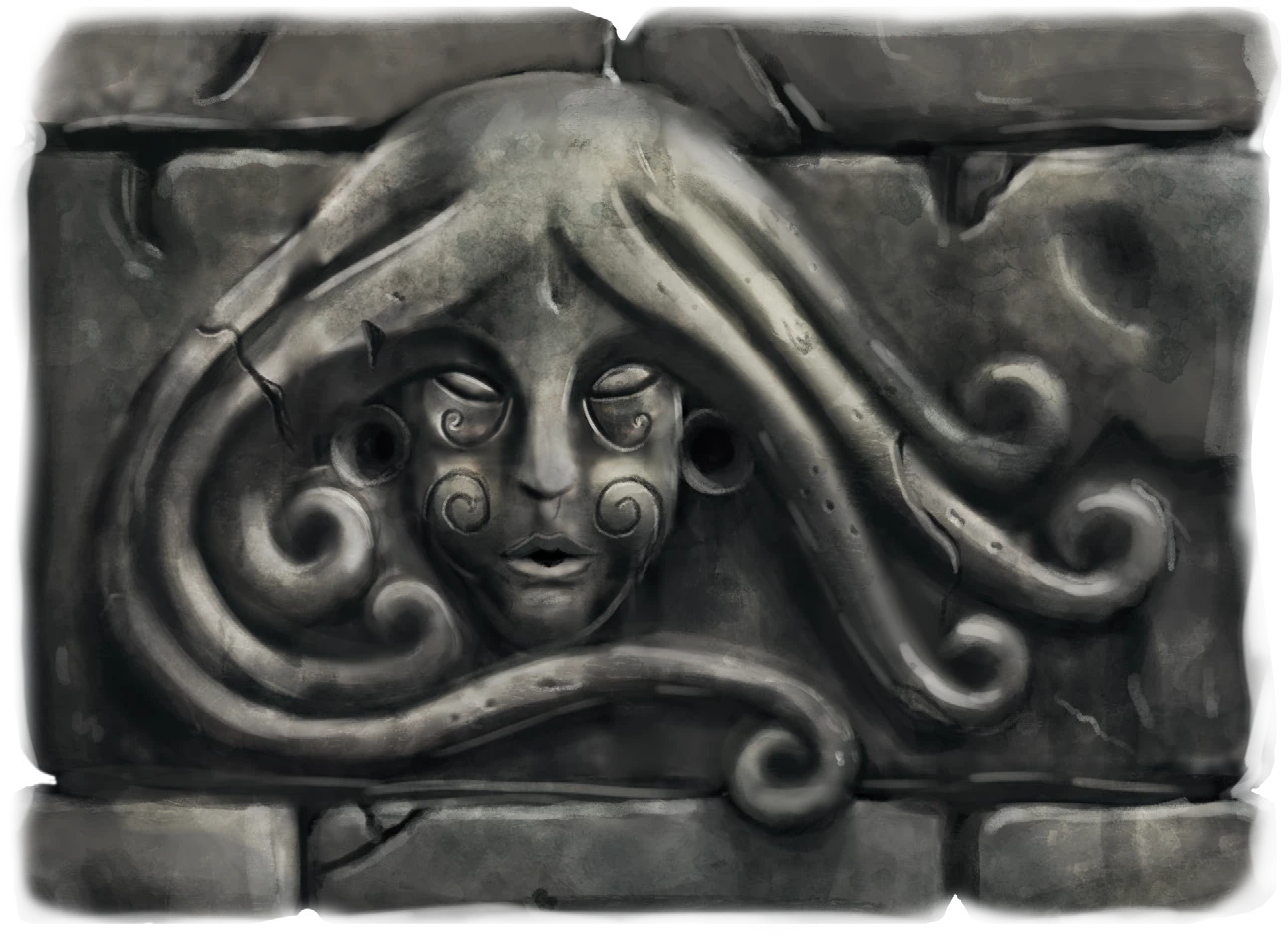
Trap Summary
| Detail | Description |
|---|---|
Trigger | Sound |
Area | 20-foot cone |
Duration | Instantaneous |
Save | Strength (DC 15) |
Effects | 13 (2d10 + 2) bludgeoning damage, pushed 5 feet away |
Trap Details
Trigger
When a creature within 40 feet of the face uses their voice (including talking, using verbal spell components, etc.)
Effect
A burst of air blows outward in a 20-foot cone centered on the target. All creatures in the area must succeed on a DC 15 Strength saving throw or take 13 (2d10 + 2) bludgeoning damage and be pushed 5 feet directly away from the trap. On a successful save, they take half damage and are not pushed.
Spotting and Disarming Summary
| Phase | Solution |
|---|---|
Detection | Wisdom (Perception) (DC 14) or detect magic (strong evocation) |
Analysis | Intelligence (Investigation) (DC 15) or Intelligence (Arcana or Religion) (DC 12) |
Solution |
Spotting and Disarming Details
A particularly intelligent creature may recognize the image of Zevira and notice the holes that enable its effects.
Disarming
Read the following text aloud when a character disarms the trap by casting dispel magic.
As you finish casting the spell, a soft warm breeze blows around you and you hear a soft sigh from the wall. Its stony lips close and the wind ceases. You've soothed Zevira's sorrow... for now.
If the magic of the trap is dispelled this way, it regains its magic after 1d6 days.
Other Countermeasures
There are other methods of disabling the trap. Use the Analysis and Solution DCs above (if applicable) to determine whether a creature can use these methods.
Intelligence
Casting the spell silence on the face in the wall also stops it from working for the duration. The face is also a valid target for blindness/deafness (deafen only) and automatically fails the saving throw.
Strength
Destroying the face (for example with a bludgeoning weapon or with mason's tools) can temporarily or permanently disable it. The wall has an AC of 17 and 12 hit points.
Wisdom
Plugging the 3 holes with cloth or some other substance prevents the face from detecting sound.